

Diversification is not a strategy for crisis. It's a baseline for calm markets. When a true crash arrives, correlations often converge and traditional portfolios fail. You've likely felt the stress of watching market volatility erase years of progress while financial news headlines amplify the chaos. It's a rational fear. A single catastrophic drawdown can ruin a retirement plan. To survive, you need disciplined bear market protection strategies that replace emotional reacting with systematic execution.
This guide moves beyond generic advice to provide a clear framework for identifying high-risk periods. We'll show you how to reduce portfolio drawdown during market crashes by following a logical, emotion-free investment routine. You'll learn to move past the noise and focus on objective market health signals. Protection isn't about guessing the bottom. It's about having a systematic "kill switch" based on data. By the end of this article, you'll understand how to prioritize capital preservation above speculative excitement.
Key Takeaways
- Learn why the traditional 20% drawdown threshold is an inadequate metric for capital preservation and how to identify structural risks earlier.
- Master the use of volatility metrics, such as the VIX Term Structure, to decode market health and anticipate high-risk regimes.
- Implement disciplined bear market protection strategies that rely on objective, non-discretionary signals instead of emotional reactions to financial news.
- Understand the strategic role of cash as a protective asset and how systematic market timing shields your retirement plans from catastrophic losses.
- Transition to a rule-based investment routine that replaces the "fear-greed" cycle with a professional, data-driven framework for long-term security.
Defining Bear Market Protection Strategies for the Modern Investor
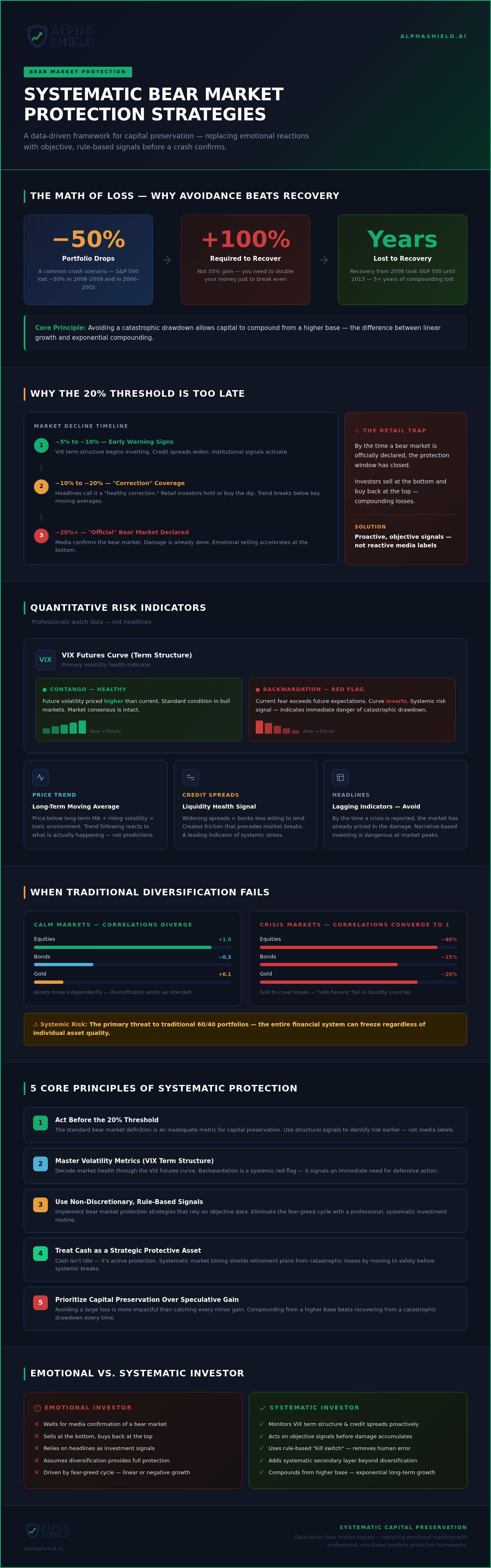
A 20% decline is the standard definition of a bear market. For the disciplined investor, waiting for this threshold is a mistake. By the time the media confirms a bear market, your portfolio has already suffered significant damage. True bear market protection strategies must be proactive. They rely on objective data rather than reactive labels. If you wait for the "official" announcement, you've missed the window for effective capital preservation.
The psychological cost of a major drawdown is often underestimated. Watching a retirement plan evaporate leads to emotional decision-making. Investors often sell at the bottom and buy back at the top. Systematic investing removes this human error. It replaces the "fear-greed" cycle with a rule-based routine. Math favors the defensive investor. Avoiding a large loss is more impactful than catching every minor gain. This is the logic of institutional risk management.
The Limits of Traditional Diversification
Diversification is a baseline, not a complete solution. In calm markets, different asset classes move independently. During high-stress regimes, these correlations often converge to one. This means everything falls at the same time. The "Safe Haven" illusion suggests that bonds or gold will always protect you. History shows this isn't always true. During liquidity crunches, even "safe" assets are sold to cover losses elsewhere. Systemic risk is the primary threat to traditional 60/40 portfolios because it represents the potential for an entire financial system to freeze regardless of asset quality.
Capital Preservation as a Growth Strategy
Defensive investing is the engine of long-term wealth. Consider the "Math of Loss." If your portfolio drops 50%, you don't need a 50% gain to recover. You need a 100% gain just to return to your starting point. This recovery can take years. Avoiding these catastrophic drawdowns allows your capital to compound from a higher base. It's the difference between linear growth and exponential compounding.
Institutional wealth managers use quantitative market risk signals to identify high-danger zones. These signals provide an objective "kill switch" for risk. A passive "Buy and Hold" strategy works during secular bull markets but leaves you exposed to systemic shocks. Adding a systematic secondary layer ensures you aren't just hoping for the best. You're calibrating your exposure based on real-time market health. This tactical approach distinguishes the professional strategist from the retail speculator.
Quantitative Indicators: Identifying High-Risk Market Regimes
Volatility is often misunderstood as a synonym for fear. In institutional finance, it's a measurable variable of market health. High volatility indicates a lack of consensus and rising systemic risk. Low volatility suggests stability. Monitoring these shifts is a core component of effective bear market protection strategies. While retail investors watch the news, professionals watch the VIX. It's a calculation of probability, not an emotional reaction.
The VIX Futures Curve: A Professional Warning Sign
The VIX Term Structure measures the price of volatility over time. In a healthy market, the curve is in contango. This means future volatility is priced higher than current volatility. It's the standard weather for a bull market. When the curve flips into backwardation, current fear exceeds future expectations. This inversion is a systemic red flag. It indicates an immediate need for market crash defense strategies. Alpha Shield monitors these complexities continuously so the investor doesn't have to. If the curve breaks, the risk of a catastrophic drawdown increases exponentially.
Price action confirms what volatility suggests. Trend following doesn't predict. It reacts to what is actually happening. If the price remains below a long-term moving average and volatility is rising, the environment is toxic. Institutional players also filter for macro risks like credit spreads and liquidity. Widening spreads mean banks are less willing to lend. This creates a friction that precedes market breaks. You can monitor these shifts through the Alpha Shield Dashboard to stay ahead of the curve.
Removing the Noise of Financial Headlines
Headlines are lagging indicators. By the time a crisis is reported, the market has often already priced in the damage. Narrative-based investing is dangerous at market peaks. It encourages investors to stay in risky positions because the story still sounds good. Data-driven objectivity is the only hedge against this bias. Price and volatility are leading indicators. They tell you what capital is doing, not what pundits are saying.
Logic dictates that we follow the flow of money rather than the volume of news. This detachment is essential for professional discipline. If the data signals a high-risk regime, the narrative is irrelevant. We prioritize capital preservation over the need to be right about a specific news event. This systematic approach strips away the noise and provides a clear, unobstructed path to understanding market health.
A Roundup of Proven Bear Market Protection Strategies
Effective capital preservation requires a transition from passive holding to active risk management. Many retail strategies focus on defensive sector rotation, such as tilting toward utilities or healthcare. While these sectors may decline less than technology or consumer discretionary, they still carry significant equity risk. During a systemic liquidity event, these "defensive" assets often sell off as investors liquidate whatever they can. Professional bear market protection strategies prioritize the safety of principal over the hope of relative outperformance. These strategies replace guesswork with a mechanical routine.
Tactical Cash Management
Cash is an active asset class. In high-volatility regimes, moving to the sidelines is a deliberate professional choice. It provides the "dry powder" necessary to navigate a crisis without the stress of mounting losses. Many investors fall into the opportunity cost fallacy. They fear missing a minor rally while ignoring the threat of a major crash. This is a mathematical error. The benefit of reducing portfolio drawdown far outweighs the risk of being out of the market during a period of structural instability. If the risk-to-reward ratio is skewed, "doing nothing" becomes the most productive action you can take. It allows you to maintain emotional detachment while others succumb to panic.
Rules-Based Exit Strategies
Discipline is maintained through an "If-Then" framework. This approach pre-determines your actions before the market becomes chaotic. If a specific signal triggers, then the exit is executed with zero hesitation. This removes the need for prediction or news analysis. Alpha Shield focuses on these systematic exits rather than complex shorting strategies. Shorting involves unlimited risk and high borrowing costs. Capital preservation is achieved more efficiently by simply removing exposure when the market health deteriorates.
Protecting retirement accounts like 401ks is a primary objective. These accounts often suffer the most during catastrophic late-cycle reversals. Implementing systematic bear market protection strategies ensures that you aren't caught in a "hope-based" strategy. You don't need to guess where the bottom is. You only need to know when the environment is no longer safe for your capital. Drawdown management requires setting hard rules for capital preservation before the crisis hits. You must decide your maximum pain threshold in advance. If you wait until you're down 15%, your judgment is already compromised by stress. This logical approach provides a rational anchor in a volatile world.
Removing Human Emotion: The Logic of Systematic Investing
The human brain is biologically wired to fail at investing. Survival instincts like fear and greed, while useful in nature, are destructive variables in a portfolio. These impulses cause you to buy at market peaks and sell during troughs. To achieve long-term security, you must bypass these instincts. Disciplined bear market protection strategies work because they replace human impulse with mechanical logic. If the system signals a retreat, the decision is already made.
Confirmation bias is a silent portfolio killer. You naturally seek out headlines that validate your risky positions while ignoring red flags. This creates a dangerous feedback loop that keeps you invested long after the risk has become unacceptable. A rules based investing system breaks this loop. It doesn't care about your opinion or the latest news cycle. It only cares about objective market health metrics. This 'set and forget' mentality is the ultimate hedge against your own emotions.
The Power of Non-Discretionary Signals
Non-discretionary signals take the guesswork out of the equation. They remove the burden of choice during high-stress periods. When a crash arrives, most investors are frozen by fear or indecision. Systematic signals provide the clear permission to act when others are paralyzed. Alpha Shield simplifies complex institutional data into a single, actionable instruction. This structural simplicity strips away the noise, providing a clear path to capital preservation.
Establishing an Investment Routine
Professionalism requires a steady, predictable routine. An hourly obsession with price action leads to mental fatigue and tactical errors. A simple daily check-in is far more effective for long-term wealth. Use the Alpha Shield Dashboard to visualize risk instead of reading subjective opinion pieces. This shifts your focus from 'narrative' to 'data' and maintains a sober perspective regardless of market headlines. Consistency is the foundation of institutional-grade protection.
Bear market protection strategies are only as effective as your willingness to follow them. By treating market volatility as a data point to be managed rather than an experience to be shared, you maintain the detachment necessary for success. You don't need to be a market guru to protect your wealth. You only need the discipline to follow a battle-tested philosophy.
Implementing the Alpha Shield Market Signal for 2026
Implementing the Alpha Shield Market Signal is the final step in moving from reactive fear to proactive discipline. This tool isn't designed for speculators or those seeking day-trading tools. It's built for investors who prioritize capital preservation above all else. By integrating a systematic signal into your existing strategy, you gain a professional "kill switch" for high-risk regimes. You don't need to change your long-term investment philosophy. You only need to know when to move your capital to safety. This is the logical evolution of modern bear market protection strategies. It provides the clarity needed to navigate a 2026 market that may be defined by rising systemic volatility.
Clarity Over Chaos: The Dashboard Experience
The Alpha Shield Dashboard serves as a professional filter for the financial world's noise. It visualizes market health at a glance, significantly reducing the mental load of complex decision-making. Instead of deciphering conflicting news reports, you monitor a single, data-driven status. We decode complex volatility metrics and credit spreads into a clear visual indicator. If the environment is healthy, the system remains in a growth posture. If the data signals a structural break, the system instructs a move to safety. This "simplicity as a luxury" approach allows you to act with certainty while others are paralyzed by uncertainty.
Discover how the Alpha Shield Market Signal protects your portfolio.
Long-Term Security Through Systematic Rigor
Alpha Shield leverages over 50 years of institutional banking expertise to protect individual wealth. We explicitly avoid individual stock recommendations and shorting strategies. These activities introduce unnecessary complexity and speculative risk. We focus exclusively on the primary variable that determines long-term success: avoiding catastrophic drawdowns. This specialization creates a sense of integrity and reliability. We don't try to be everything to everyone. We are a methodical strategist for those who value consistency and the avoidance of catastrophic errors.
The best bear market strategy is the one you can follow when the world feels chaotic. Systematic rigor provides the emotional detachment necessary to survive a crash. Alpha Shield acts as your rational anchor in a volatile environment. It stands in opposition to market madness, providing a steady pulse of objective data. True professional achievement is the reduction of complex data into a single, actionable instruction. With this clarity, you can navigate 2026 with confidence and preserve the wealth you've worked decades to build. capital preservation isn't just a goal; it's a disciplined routine.
Securing Your Portfolio Against Systemic Risk
Successful investing in 2026 requires a shift from passive hope to systematic execution. You've learned that waiting for a formal 20% decline is a failure of capital preservation. Instead, professional bear market protection strategies rely on leading indicators like the VIX Term Structure and credit spreads to identify toxic regimes before the damage is done. By establishing a non-discretionary routine, you strip away the emotional noise that ruins retirement plans. Capital preservation is not a one-time event. It's a continuous process of calibration and discipline.
Alpha Shield provides the institutional-grade dashboard and data-driven rigor needed to act with confidence. Founded by former investment bankers with over 50 years of experience, our system acts as your rational anchor in a volatile world. We explicitly avoid the chaos of stock picks and day-trading to focus on what matters: the safety of your principal. You now have the framework to replace guesswork with a mechanical routine that prioritizes long-term security over short-term speculative excitement.
Secure your capital with the Alpha Shield Market Signal
Take the next step toward a more resilient investment future. With the right tools and a rule-based philosophy, you can navigate any market cycle with clarity and peace of mind.
Frequently Asked Questions
What is a bear market and how long do they typically last?
A bear market is defined by a 20% decline from recent highs. Historically, they last about 9.6 months on average. However, waiting for the 20% mark is often too late for capital preservation. Professionals focus on the structural health of the market rather than the duration of the decline. Identifying high-risk regimes early is the key to minimizing damage to your wealth. Logic dictates that you protect your capital before the panic begins.
Can I really protect my portfolio without being a professional trader?
Yes, you don't need to be a professional trader to implement systematic protection. Alpha Shield simplifies institutional data into a single, actionable instruction. This allows you to follow a rule-based routine without the need for complex day-trading or shorting strategies. By using a dedicated dashboard, you can monitor market health and execute defensive moves with the same discipline as global markets professionals. It's about following a signal, not predicting the news.
Why is diversification sometimes not enough for bear market protection?
Diversification fails when asset correlations converge to one during a systemic crisis. In healthy markets, stocks and bonds move independently. During a crash, everything often falls at the same time as liquidity dries up. True bear market protection strategies require a tactical layer that can move capital to safety. Relying solely on a 60/40 split leaves you exposed to the total market breaks seen in historic drawdowns. Systematic exits provide the security diversification cannot.
How does a market signal help me avoid drawdowns?
A market signal identifies high-risk regimes by analyzing volatility metrics and credit spreads. It acts as an objective "kill switch" for your portfolio. When the data indicates a structural weakness, the signal instructs a move to cash. This prevents you from remaining invested during the most aggressive phases of a decline. By following a mechanical signal, you remove the indecision and emotional stress that lead to catastrophic losses. It's a rational anchor in chaos.
What are the most common mistakes investors make during a market crash?
The most common mistake is emotional reacting based on financial news headlines. Investors often sell at the bottom due to fear and buy back at the top due to greed. Another error is "averaging down" into a systemic break without a clear exit plan. These behaviors stem from a lack of a disciplined routine. Using systematic bear market protection strategies ensures that your actions are dictated by data rather than panic. Consistency prevents catastrophic errors.
Is it better to stay in cash or buy defensive stocks during a bear market?
Cash is often the superior defensive asset during a high-volatility regime. While defensive stocks like utilities may decline less than the broader market, they still carry equity risk and can lose significant value. Cash provides absolute capital preservation and the "dry powder" needed to reinvest when the environment stabilizes. Moving to the sidelines is a deliberate professional choice that eliminates the risk of correlated asset crashes. It's a tactical move for long-term security.
How does the VIX impact bear market protection strategies?
The VIX measures expected volatility and serves as a primary indicator of market stress. Professionals monitor the VIX Term Structure to identify inversions, where current fear exceeds future expectations. This backwardation is a reliable warning sign of an impending break. By decoding these volatility metrics, you can calibrate your exposure to risk. High VIX levels suggest a toxic environment where capital preservation must become the primary objective. It's a calculation of probability, not emotion.
Can I use bear market protection strategies in my 401k or IRA?
Yes, these strategies are highly effective for retirement accounts like 401ks and IRAs. Most providers allow you to move your balance into a stable value fund or a money market account. This allows you to execute a systematic exit when a high-risk signal triggers. Protecting these accounts from late-cycle reversals is essential for maintaining your retirement timeline. Systematic rigor ensures your long-term security remains intact regardless of market volatility. It's about protecting your principal during high-risk regimes.


