

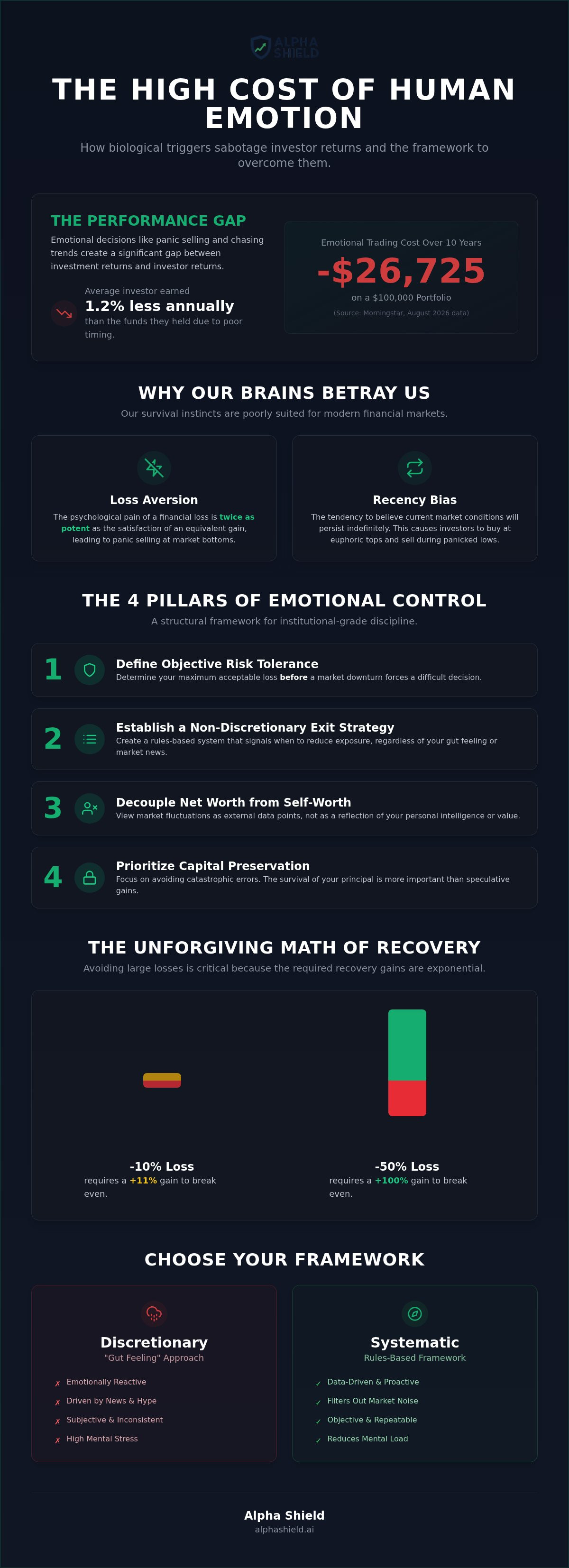
Did you know that emotional buying and selling cost the average investor $26,725 on a $100,000 portfolio over the last decade? According to August 2026 data from Morningstar, this performance gap isn't a result of poor intelligence, but a lack of structural discipline. Most market participants understand they should buy low and sell high, yet 43% of investors believe their own feelings will sabotage their returns this year. Learning how to control investment emotions isn't about developing stronger willpower. It's about implementing a better ruleset.
You've likely experienced the sleepless nights that accompany a market correction or the regret of selling at a local bottom. The constant noise of conflicting financial news creates a chaotic environment where rational thought is often sidelined by fear. This article provides a path to replace reactive impulses with a disciplined, data-driven framework designed to preserve your capital. You'll learn a repeatable process for managing risk and reducing the mental load of market fluctuations. If the market shifts, your ruleset dictates the response. We'll outline how to filter out the noise and maintain absolute clarity during major drawdowns.
Key Takeaways
- Understand how biological survival triggers like loss aversion lead to catastrophic errors in modern financial environments.
- Discover how to control investment emotions by replacing subjective intuition with a non-discretionary exit strategy.
- Define your objective risk tolerance and establish clear thresholds before market volatility forces a reactive response.
- Transition from discretionary trading to a systematic framework that uses objective indicators to filter out market noise.
- Leverage the Alpha Shield Dashboard to visualize risk through an institutional lens that prioritizes capital preservation.
The Biology of Market Panic: Why Our Brains Betray Us
The human brain was not designed for the stock market. The amygdala, our primitive alarm system, triggers a fight or flight response during rapid price drops. This biological reflex prioritizes immediate survival over long-term capital preservation. In the field of Behavioral economics, this is known as loss aversion. Research suggests the psychological pain of a financial loss is twice as potent as the satisfaction of an equivalent gain. While this kept our ancestors safe from predators, it causes modern investors to liquidate positions at the exact moment they should hold or accumulate.
Recency bias further complicates the decision-making process. It's the tendency to believe that current market conditions, whether bullish or bearish, will persist indefinitely. This bias leads to buying at the top due to fear of missing out and selling at the bottom due to panic. Financial news cycles exacerbate these tendencies. Media outlets engineer headlines to trigger emotional volatility. Fear generates higher engagement than calm, data-driven analysis. Understanding these biological triggers is the first step in learning how to control investment emotions.
Identifying Your Emotional Triggers
Successful investing requires a clear distinction between calculated risk and emotional gambling. Calculated risk involves a data-driven assessment of probabilities. Emotional gambling is a reaction to price movement without a plan. Common symptoms include checking portfolio balances multiple times per hour or feeling physical distress during a minor correction. Market psychology is the aggregate of human biases. If you don't identify your triggers, you can't manage your risk. Awareness allows you to categorize a feeling as a variable to be filtered rather than an instruction to be followed.
The Cost of Emotional Reactivity
Emotional exits during market drawdowns cause permanent impairment to capital. When an investor sells in a panic, they lock in losses and often miss the subsequent recovery. Data from Morningstar in August 2026 confirms that the average investor earned 1.2% less annually than the funds they held due to poor timing. Missing just the ten best trading days in a decade can reduce total returns by nearly half. Learning how to control investment emotions is a financial necessity. A systematic approach ensures that your long-term compounding remains uninterrupted by short-term biological impulses. If the system doesn't signal an exit, the trade stays open. Discipline is the only hedge against biological betrayal.
The Four Pillars of Emotional Control in Investing
Discipline is not an inherent personality trait; it is a structural byproduct of a well-defined system. To understand how to control investment emotions, you must move beyond the myth of willpower and adopt a framework that governs your behavior. These four pillars provide the foundation for institutional-grade emotional detachment.
- Pillar 1: Define objective risk tolerance. Determine your maximum drawdown limit during a period of market calm. If you don't know your breaking point, the market will find it for you.
- Pillar 2: Establish a non-discretionary exit strategy. Create a rule that triggers an exit regardless of your gut feeling. If the data signals a high-risk environment, you reduce exposure.
- Pillar 3: Decouple net worth from self-worth. Market fluctuations are external variables, not reflections of your intelligence or value. Detachment is the only way to maintain objectivity.
- Pillar 4: Prioritize capital preservation. Focus on the avoidance of catastrophic errors. Speculative gains are secondary to the survival of your principal.
Pre-defining Your Risk Parameters
Setting a maximum drawdown limit is a prerequisite for stability. If you cannot psychologically withstand a 20% decline, your asset allocation must reflect that reality before the storm hits. A written Investment Policy Statement (IPS) acts as a rational anchor. It serves as a contract with your future self, signed during a period of clarity to prevent a period of panic. While asset allocation dampens the swings, the IPS ensures you don't deviate from the plan when the news cycle turns aggressive.
The Discipline of Capital Preservation
The mathematics of recovery are unforgiving. A 10% loss requires an 11% gain to recover; however, a 50% loss requires a 100% gain just to reach break-even. Avoiding the big loss is more important than catching the big win. When you prioritize not losing, the mental load of investing decreases. You no longer need to predict the future. You only need to react to the present using a systematic market signal for capital preservation. This shift in perspective transforms the market from a source of anxiety into a series of data points to be managed. If you value consistency, you can use the Alpha Shield Market Signal to remove the burden of subjective decision-making.
Systematic vs. Discretionary Investing: Removing the Human Element
Discretionary investing relies on human judgment. It involves making decisions based on intuition, breaking news, or a "gut feeling" about where the market is headed. While this approach feels natural, it's inherently flawed because it's vulnerable to the biological biases discussed earlier. Systematic investing, by contrast, follows a predetermined, data-driven ruleset. It operates regardless of personal feelings or external noise. This binary contrast is essential for anyone seeking how to control investment emotions. If the rules are met, the action is taken. If the criteria are not met, the portfolio remains unchanged. The system doesn't care about the news cycle; it only cares about the data.
Even seasoned professionals struggle with discretion during extreme market volatility. Institutional experience doesn't eliminate emotion; it only provides better tools to manage it. During a sharp drawdown, the pressure to "do something" is immense. Discretionary managers often succumb to this pressure, making reactive trades that impair long-term compounding. Systematic frameworks remove this burden by using "if-then" logic. For example: if market volatility exceeds a specific technical threshold, then the system triggers a reduction in exposure. This mechanical response ensures consistency when human resolve is at its weakest. It replaces the "what if" with a definitive "since-then."
The Flaw of Human Intuition in Markets
Gut feelings are usually lagging indicators of market sentiment. By the time an investor feels enough fear to sell, the majority of the price decline has often already occurred. Conversely, the greed felt during a market peak usually signals the exhaustion of a trend. Systematic signals filter out the noise of financial headlines and social media sentiment. They focus on objective price action and volatility metrics rather than speculative narratives. A rules-based system provides transparency. You know exactly why a decision was made because the criteria were documented and tested before the market opened. This clarity is the only way to understand how to control investment emotions and avoid the traps of market psychology.
Market Regime Identification
The goal of a systematic approach is not to predict the future, but to identify the current risk regime. Predicting is a speculative gamble. Identifying is a technical calculation. Volatility metrics signal when the market has shifted from a stable environment to a high-risk regime. When these metrics cross a defined threshold, the system moves to a protective stance. This reduction of complex macro data into a single, actionable instruction is the ultimate professional achievement. Simplicity is a luxury that provides the clarity needed to preserve capital. It allows you to stay liquid during periods of chaos and remain invested during periods of growth. This methodical identification process is the core of institutional risk management.
How to Build a Rules-Based Investment Framework
Building a framework is the transition from a passive observer to a methodical strategist. It requires the removal of subjective interpretation. To understand how to control investment emotions, you must view the market as a series of technical conditions rather than a narrative of news events. A rules-based system provides the structural integrity needed to remain objective when volatility spikes. The following four steps outline the construction of an institutional-grade framework.
- Step 1: Select objective indicators. Choose data points that are not influenced by sentiment. Price action and volatility metrics are neutral. Expert forecasts are not.
- Step 2: Establish thresholds. Define clear "risk-on" and "risk-off" levels. These binary triggers eliminate the need for mid-market deliberation.
- Step 3: Automate the monitoring process. Use tools like the Alpha Shield Dashboard to track signals. This reduces the urge for constant price-checking and lowers the mental load.
- Step 4: Execute without hesitation. When a signal is triggered, the action must be immediate. Second-guessing the data introduces the very bias the system was built to avoid.
Selecting Objective Data Points
Price action and volatility are more reliable than expert forecasts. Forecasts are opinions. Price is reality. When you use too many indicators, you risk analysis paralysis. This state of indecision often leads to inaction during critical market shifts. A simplified system focuses on high-probability signals. Systematic tools identify high-risk periods before they become catastrophes. By filtering out the noise of financial headlines, you maintain a clear view of the underlying market regime. Simplicity is the ultimate professional achievement in risk management.
The Execution Phase: Avoiding the 'Just This Once' Trap
The first time you ignore your rules is the most dangerous. It sets a precedent for discretionary interference. If you bypass a signal because "this time is different," you no longer have a system. You have a suggestion. This often happens during relief rallies when FOMO tempts investors to re-enter a high-risk market prematurely. A systematic framework keeps you liquid until the data confirms a safe environment. Disciplined execution is the core of professional investing. The signal is final. It requires no debate and no emotional input. Consistency is the only path to long-term capital preservation.
Leveraging Institutional Signals for Personal Clarity
Professional discipline is the hallmark of institutional finance. Retail investors often drown in sentiment, but institutional bankers rely on mechanical systems to manage risk. Alpha Shield delivers this same systematic rigor to individual portfolios. By using the Alpha Shield Market Signal, you remove the burden of subjective decision-making. This is how to control investment emotions at an institutional level. The system doesn't guess; it calibrates. It provides a rational anchor when the broader market environment becomes unpredictable.
The Alpha Shield Dashboard represents the concept of simplicity as a luxury. It distills complex market mechanics into a clear, actionable representation of risk. You see the data without the emotional noise of social media or sensationalist news. This transition from anxiety to sober transparency is critical for long-term success. If the system indicates a high-risk regime, the signal is binary. There is no room for debate or hesitation. This clarity reduces the mental load, allowing you to focus on capital preservation rather than speculative excitement.
The Alpha Shield Approach to Risk
The Market Signal identifies regime shifts without human bias. It functions as a protective filter, decoding volatility metrics to determine the current market state. While retail traders often chase rallies into overextended territory, our focus remains on the avoidance of significant drawdowns. Systematic signals developed since 2017 provide a battle-tested foundation for wealth protection. Avoiding a single catastrophic loss is more impactful than catching multiple minor gains. In this framework, protection is not an option; it's the primary objective.
Starting Your Journey Toward Disciplined Investing
Integrating a systematic signal into your existing portfolio is a straightforward process. It doesn't require a total overhaul of your investment strategy. Instead, it provides a protective overlay that dictates when to increase or decrease exposure. You gain the mental freedom that comes from a clear, actionable instruction. If the data suggests a defensive posture, you act according to the ruleset. This removes the analysis paralysis often associated with volatile markets. Learning how to control investment emotions becomes a mechanical process rather than a psychological struggle. Consistency is built on the avoidance of errors, not the pursuit of perfection.
Transitioning to a Data-Driven Investment Future
Understanding that our brains are wired for survival rather than market success is the fundamental first step toward objectivity. You've seen how biological survival triggers often lead to catastrophic financial errors during periods of high volatility. By replacing discretionary "gut feelings" with a systematic ruleset, you can preserve your capital while significantly reducing the mental load of daily market fluctuations. This approach prioritizes long-term stability and capital preservation over the speculative noise of the news cycle.
Mastering how to control investment emotions is not a matter of willpower; it is a matter of process. Alpha Shield provides the institutional-grade risk management and data-driven crash protection required to navigate modern markets with confidence. Our no-nonsense, anti-hype philosophy ensures you receive clear, actionable instructions without the clutter of conflicting expert forecasts. You can now move from a state of reactive anxiety to one of sober transparency.
Disciplined investing is the only path to sustainable wealth. You now have the tools to build a rational anchor in a volatile world and protect your financial future with absolute clarity.
Frequently Asked Questions
Is it possible to completely remove emotions from investing?
It is not possible to eliminate human emotion entirely, but you can neutralize its impact on your portfolio. You achieve this by treating fear and greed as variables to be managed rather than instructions to be followed. A systematic approach replaces subjective intuition with a data-driven framework. When you follow a ruleset, your biological impulses are sidelined. This structural discipline allows you to maintain a protective stance even when market sentiment is volatile.
What is the most common emotional mistake investors make during a crash?
The most frequent error is panic-selling during a sharp market drawdown. This reactive behavior permanently impairs capital by locking in losses at local price bottoms. Investors often succumb to the fight or flight response triggered by the amygdala. By the time the news cycle turns negative enough to cause panic, the majority of the price decline has typically occurred. Learning how to control investment emotions involves recognizing these biological traps before they dictate your actions.
How do I know if I am making an emotional investment decision?
You are likely making an emotional decision if your primary motivation is a reaction to a news headline or a sudden price swing. Symptoms include checking your portfolio balance multiple times per hour or feeling physical anxiety during market hours. Rational decisions are planned in advance during periods of calm. If you find yourself deviating from your written investment policy because of a gut feeling, you have moved from calculated risk into emotional gambling.
Can a rules-based system actually outperform my gut feeling?
A rules-based system provides a level of consistency that human intuition cannot match. Gut feelings are usually lagging indicators of market sentiment, whereas systematic frameworks rely on objective volatility metrics and price action. Data-driven systems remove the noise of speculative excitement. By following a predetermined ruleset, you ensure that your responses to market shifts are calibrated and repeatable. This institutional rigor is designed to preserve capital more effectively than discretionary trading.
What should I do when my rules tell me to sell but the news is positive?
You must prioritize the data over the narrative. Positive news is often a lagging indicator or a distraction from underlying technical risks. If your systematic signal indicates a high-risk regime, the rational response is to reduce exposure regardless of media sentiment. The Alpha Shield Market Signal is designed to identify these regime shifts without human bias. Sticking to your ruleset during these periods of conflict is what defines professional investment discipline and protects your principal.
How much data do I need to create a systematic investment plan?
You don't need an overwhelming volume of data; you need the correct data. Using too many indicators leads to analysis paralysis, which is a common form of emotional stagnation. A systematic plan should focus on a few objective, high-probability signals like volatility metrics and market regime indicators. Alpha Shield simplifies this by distilling complex institutional data into a single, actionable instruction. This reduction of complexity is a professional luxury that ensures clear decision-making.
Does systematic investing mean I will miss out on the biggest market gains?
Systematic investing focuses on capital preservation, which may involve exiting the market during high-risk periods. While you might miss the tail end of a speculative rally, you also avoid the catastrophic drawdowns that follow. Long-term wealth is built by avoiding the big loss rather than catching every big win. Compounding is most effective when it is uninterrupted. By staying liquid during chaos, you preserve the capital needed to participate in the next sustainable growth phase.
How can a market signal dashboard reduce my daily investment stress?
A dashboard provides a rational anchor in a volatile environment. It reduces stress by replacing uncertainty with sober transparency. Instead of interpreting conflicting financial news, you look at a single, data-driven visualization of market risk. The Alpha Shield Dashboard offers this clarity by providing a binary signal. If the signal is green, the environment is stable. If it is red, the risk is elevated. This simplicity removes the mental load of constant deliberation and helps you understand how to control investment emotions.


