
Emotional resilience is a poor substitute for a systematic exit strategy. While many investors rely on willpower to manage the fear of stock market crash, true discipline is found in data rather than the human psyche. You've likely experienced the paralyzing anxiety of a red market day or the confusion caused by conflicting financial headlines. This mental friction is a direct result of operating without a clear, objective framework for risk. It's the byproduct of a strategy that prioritizes hope over calculation.
We believe that capital preservation should be mechanical. If the system identifies a significant shift in market risk, then the necessary action must be immediate and emotionless. This article provides a disciplined framework to replace your anxiety with a data driven approach to protecting your wealth. You'll learn to filter out the noise of historical volatility and the "September effect" that often clouds judgment. We'll preview how a professional grade signal acts as a rational anchor during periods of high stress. By adopting this systematic rigor, you can achieve emotional detachment from market fluctuations and gain the confidence of a clear, actionable plan.
Key Takeaways
- Identify the biological triggers of investment anxiety and learn to filter sensationalist media noise.
- Evaluate the limitations of passive strategies and transition to a systematic approach that prioritizes capital preservation.
- Replace the fear of stock market crash with objective leading indicators that signal exactly when to reduce exposure.
- Construct a rule-based defense strategy that removes emotional discretion from your drawdown management.
- Leverage the Alpha Shield Dashboard to access a simplified, institutional-grade signal for immediate risk calibration.
The Psychology of Fear in Investing: Why We React to Volatility
Survival instincts are useful in the wild but destructive in a portfolio. The fear of stock market crash is a hard-wired biological response to perceived scarcity. When markets turn red, your brain prioritizes immediate safety over long-term compounding. This reaction is a variable that must be managed, not an emotion to be explored. Professional risk management begins with the realization that your instincts are often your greatest liability.
The High Cost of Emotional Decision-Making
Emotional exits carry a hidden tax. When an investor liquidates a position during a panic, they lock in a drawdown. They then face the "re-entry problem." Most wait for "certainty" before buying back. By the time they feel safe, prices have already recovered. Missing just a few of the market's best days can decimate a retirement fund. This cycle is driven by loss aversion. It's the tendency to fear losses more than we value equivalent gains. While retail investors succumb to this bias, institutional frameworks utilize non-discretionary rules. Studying the psychology of stock market crashes shows that the largest price drops are fueled by this collective loss of logic. A systematic approach prevents you from becoming part of that statistic.
Filtering Signal from Noise in Financial Media
Financial news is often a distraction disguised as information. Media outlets prioritize engagement metrics over investor success. This creates a constant stream of "noise" that amplifies anxiety. If you're reacting to a breaking news alert, you're competing with high-frequency algorithms that have already priced in the information. You must shift your focus from qualitative stories to quantitative facts.
- Qualitative news creates a narrative of chaos.
- Quantitative data provides a map for navigation.
- Sensationalism feeds the fear of stock market crash.
- Systematic signals provide the "rational anchor" needed to stay the course.
Replacing the habit of "doom-scrolling" with a reliance on objective metrics is a prerequisite for capital preservation. You don't need more news. You need better filters. Emotional detachment isn't about having no feelings; it's about having a system that makes those feelings irrelevant to the outcome. When the system dictates the move, the burden of choice is removed. This clarity is the ultimate luxury in a volatile market.
Buy and Hold vs. Systematic Risk Management
Passive "Buy and Hold" is a strategy built for a frictionless world. It ignores the reality of secular bear markets that can last a decade or more. During these periods, the fear of stock market crash isn't a temporary hurdle; it's a persistent threat to your retirement timeline. Systematic risk management provides a disciplined alternative. It's a rule-based philosophy that prioritizes the avoidance of catastrophic errors over the pursuit of marginal gains. Transitioning to a professional framework like Alpha Shield: The Systematic Market Signal for Capital Preservation allows you to step outside the retail mindset of "Buy and Hope."
The Math of Drawdowns: Why Protection Matters
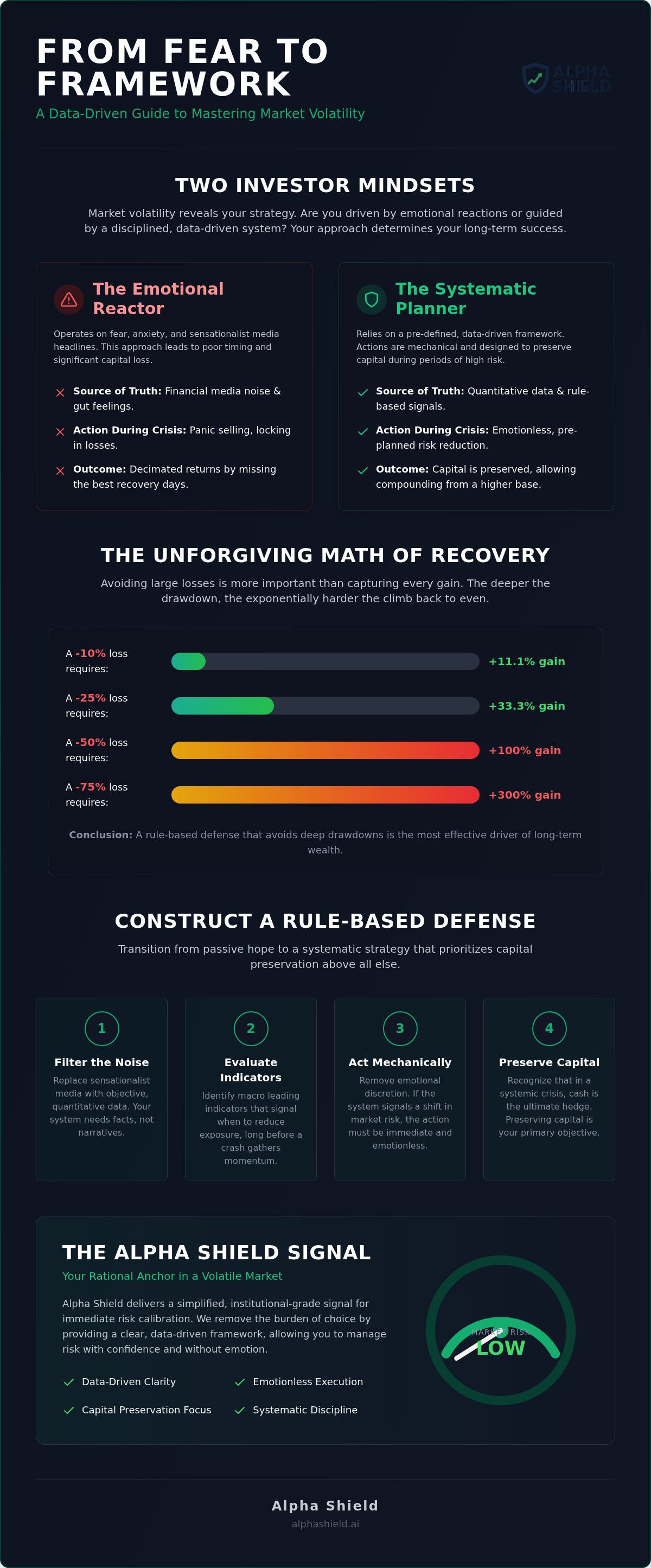
Math is indifferent to optimism. A 50% drawdown requires a 100% gain just to return to the starting point. This asymmetry is the greatest threat to long-term wealth. If you avoid the worst 10 days of a market cycle, your terminal value is significantly higher than if you stayed invested throughout. Protecting against the downside isn't just about safety; it's about compounding from a higher base. Avoiding deep drawdowns preserves your most valuable asset: time. Capital preservation is the primary driver of long-term wealth.
When Diversification Is Not Enough
Many investors believe a broad portfolio of stocks and bonds provides a safety net. This is an illusion of safety during systemic crises. When a major crash occurs, correlations across asset classes often converge toward 1.0. Everything sells off simultaneously as investors scramble for liquidity. Diversification fails exactly when you need it most. Cash is the only true hedge in a systemic drawdown. It provides the stability that a basket of correlated assets cannot offer when the market breaks down.
To manage the fear of stock market crash, you need a timing-based risk signal that identifies when to move to safety. This isn't about day-trading or speculative timing. It's about macro risk management and recognizing when the structural integrity of the market is failing. You can monitor these shifts through the Alpha Shield Market Signal to ensure your capital remains protected when the math of diversification fails. If the system identifies a high-risk environment, then the priority shifts from growth to defense. This mechanical response ensures you aren't left holding a declining portfolio while waiting for a recovery that may take years to materialize.
Identifying Macro Market Risk Indicators
Macro market risk indicators are the objective metrics used to measure the structural health of the financial system. Unlike sensationalist headlines, these data points provide a sober assessment of probability. Institutional investors do not rely on lagging indicators like GDP growth, which describes the past. They focus on leading indicators that signal shifts in future volatility. By calibrating exposure based on these signals, professionals manage the fear of stock market crash through calculation rather than intuition. This is an anti-hype approach. It treats the market as a mathematical engine to be decoded. If the data suggests a high probability of a drawdown, the system dictates a reduction in risk. There is no room for debate.
The VIX and Volatility Structure as a Warning Sign
The VIX is often called the "fear gauge," but it's more accurately a measure of the market's expected 30-day volatility. Professionals monitor the VIX term structure to identify systemic stress. In a healthy market, the structure typically slopes upward. This means future protection is more expensive than immediate protection. If this structure flattens or inverts, it indicates that the institutional demand for immediate insurance has spiked. This is a primary warning sign of a potential drawdown. Volatility is a measurable variable, not a mystery. Decoding the shape of this curve allows you to see what the largest players in the market are doing to protect their capital.
Trend Following and Market Breadth
Price trends serve as a natural filter for market sentiment. If the price of a major index is below its long-term moving average, the probability of a significant decline increases. Market breadth adds a layer of confirmation. It measures how many individual stocks are participating in a move. A rising index supported by only a few large companies is structurally weak. Conversely, broad participation signals underlying strength. Momentum helps identify high-risk regimes where price action becomes overextended. By monitoring these metrics, you can replace the fear of stock market crash with a clear signal for when to reduce risk. This systematic rigor ensures that your defense strategy is grounded in current market mechanics rather than historical anecdotes. Simplicity is a luxury. Reducing complex breadth data into a single instruction is the ultimate professional achievement.
Building a Rule-Based Defense Strategy for 2026
A systematic defense requires a transition from abstract worry to concrete protocols. The fear of stock market crash is often rooted in the absence of a defined exit plan. To eliminate this anxiety, you must construct a framework that functions independently of your daily mood. This process involves four distinct steps designed to replace emotional reactions with institutional rigor. By defining these rules in advance, you ensure that your capital preservation plan is ready before the market breaks down.
- Step 1: Define your maximum acceptable drawdown. Determine the exact percentage of capital loss that would compromise your long-term goals. This isn't a guess; it's a mathematical limit.
- Step 2: Select a non-discretionary signal. Use an objective trigger based on market mechanics rather than news headlines.
- Step 3: Establish clear "If-Then" logic. If the signal identifies a high-risk regime, then the move to cash or defensive assets is immediate.
- Step 4: Systematize the monitoring. Reduce the frequency of portfolio checks to a scheduled routine to prevent "doom-scrolling" and daily bias.
Creating Your Personal Risk Policy
A written risk management protocol is a requirement for long-term survival. Your policy must align your defense strategy with your specific time horizon. If you're approaching retirement in 2026, your tolerance for a significant drawdown is likely lower than a younger investor's. Establishing these boundaries in advance allows you to act with decisiveness when the fear of stock market crash is pervasive. The policy acts as a contract with your future self. It ensures that your response to volatility is pre-calculated rather than impulsive. When the plan is written, the burden of decision-making is removed.
Removing Human Emotion from the Equation
Discretion is the primary source of human error in investing. When you allow your judgment to override a signal, you're gambling on your ability to remain rational during a crisis. Non-discretionary tools eliminate this variable. You don't need to predict the future or interpret the latest Federal Reserve meeting. You only need to follow the calibrated output of your system. Ignoring the noise of "experts" is a professional discipline. By trusting a systematic signal, you maintain a level of emotional detachment that retail investors cannot achieve. This clarity is the ultimate luxury in a chaotic market environment. It turns market chaos into a series of predictable, manageable events.
Alpha Shield: The Professional Signal for Capital Preservation
Alpha Shield is the rational anchor in a volatile environment. It's a specialized market signal designed to navigate volatility through professional discipline and institutional authority. While retail investors often succumb to the fear of stock market crash, our system provides the sobriety required for long-term security. We prioritize capital preservation and emotional detachment over speculative excitement. This isn't a "guru" service or a tool for speculative gambling. It's a high-tech analytical engine that works behind the scenes to decode global market mechanics. By focusing on macro risk management, we provide a steady pulse for your investment strategy.
Data-Driven Objectivity via the Alpha Shield Dashboard
The Alpha Shield Dashboard represents simplicity as a luxury. It reduces thousands of complex institutional data points into a single, actionable instruction. This tool visualizes global market risk for the individual investor, providing a clarity that's usually reserved for professional desks. We don't offer individual stock recommendations or day-trading signals. Instead, we provide a systematic calculation that identifies high-risk periods before they become catastrophic. If the risk metrics exceed established thresholds, the system provides a clear signal to calibrate your exposure. This accessibility allows retail portfolios to utilize the same systematic rigor used by seasoned professionals with decades of experience. It filters out the noise of the financial world, providing a clear path to understanding market health.
Capital Preservation as the Logical Conclusion
Capital preservation is the logical conclusion of a data-driven strategy. By following a systematic signal, you achieve the emotional stability that willpower alone cannot provide. You don't need to predict a crash or interpret the latest sensationalist headline. You only need to respond to the calibrated risk levels identified by the system. This approach transforms the fear of stock market crash into a manageable variable. Avoiding catastrophic errors is the foundation of compounding wealth over time. When you eliminate the risk of a 50% drawdown, you remove the need for a 100% recovery gain. The long-term benefits of this discipline are mathematical and absolute. It's about consistency and the avoidance of the emotional errors that destroy retirement savings.
Secure Your Financial Future Through Systematic Discipline
Managing the fear of stock market crash requires a transition from emotional reaction to mathematical certainty. You've seen how passive strategies often fail during systemic crises and why leading indicators like volatility structure are superior to lagging economic data. Capital preservation isn't a matter of willpower. It's the result of a non-discretionary framework that prioritizes long-term security over short-term speculation.
Alpha Shield provides this framework through institutional-grade signals designed by former investment bankers. Our system has been in development since 2017 to ensure objective risk assessment without the noise of individual stock picks or market hype. By utilizing a rule-based defense, you can maintain emotional detachment even during periods of extreme volatility. Simplicity is the ultimate luxury in risk management. Reducing complex global data into a single, actionable instruction provides the clarity needed to protect your retirement savings.
The path to long-term wealth is built on the consistent avoidance of catastrophic errors. You don't have to navigate market chaos alone. Take control of your portfolio's defense by adopting a professional-grade strategy that values stability and systematic rigor above all else.
Frequently Asked Questions
Is it possible to predict a stock market crash?
Prediction is a speculative retail myth that often leads to significant losses. Professionals focus on risk regimes rather than exact dates. While you cannot predict the specific moment a market breaks, you can identify environments where the probability of a drawdown is high. By assessing objective data points, you can position your portfolio defensively before the structural health of the market deteriorates. This shift from prediction to probability is the foundation of capital preservation.
How do I protect my 401k from a market crash without selling everything?
Protecting a 401k involves adjusting your asset allocation based on risk signals. You don't need to liquidate your entire portfolio to find safety. Protection typically involves shifting a portion of your equity exposure into stable assets like money market funds or short-term treasuries when a signal triggers. This mechanical adjustment preserves your capital during a drawdown. It ensures you have the liquidity to re-enter the market once the risk environment has stabilized.
What is the most reliable indicator of an upcoming market crash?
The VIX term structure is widely regarded as a primary leading indicator. Specifically, when front-month VIX futures trade higher than back-month futures, it signals that institutions are paying a premium for immediate protection. This state, known as backwardation, suggests that the market's structural health is deteriorating. Monitoring these volatility metrics provides a data-driven warning sign that is far more reliable than following sensationalist financial headlines or subjective retail sentiment trends.
Should I move my investments to cash when I feel a crash is coming?
Decisions based on intuition often lead to the catastrophic error of selling low. If you move to cash because of a feeling, you lack a clear re-entry rule for when the market recovers. A systematic approach requires you to wait for a non-discretionary signal before making any allocation changes. This removes the psychological burden of second-guessing the market. It ensures that every move you make is grounded in calculation rather than anxiety.
What is the difference between market timing and systematic risk management?
Market timing is a speculative attempt to guess peaks and troughs for short-term profit. Systematic risk management is a defensive protocol designed to avoid significant drawdowns. It uses "if-then" logic to ensure that capital is protected when specific risk thresholds are breached. The goal is long-term survival and the avoidance of catastrophic errors. Unlike timing, systematic management is a rule-based philosophy that prioritizes the structural integrity of your portfolio over speculative gains.
How does Alpha Shield help with the fear of stock market crash?
Alpha Shield provides a rational anchor during periods of high volatility. It helps manage the fear of stock market crash by converting complex institutional data into a single, actionable instruction. By using the Alpha Shield Dashboard, you follow a non-discretionary signal that removes the need for emotional decision-making or interpreting conflicting news. This systematic approach ensures that you remain disciplined and focused on capital preservation when market noise is at its peak.
Is capital preservation more important than maximizing returns?
Capital preservation is the mathematical requirement for long-term wealth. A 50% loss requires a 100% gain just to return to your starting point. By prioritizing the avoidance of deep drawdowns, you ensure that your portfolio compounds from a higher base over time. Maximizing returns is a secondary objective that only matters if you can survive the market's worst days. Avoiding permanent capital loss is the most effective way to reach your retirement goals.
How often should I check my market risk signals?
Checking signals too frequently creates unnecessary mental noise and encourages impulsive behavior. A daily check of the Alpha Shield Dashboard is sufficient for most long-term investors. This routine maintains discipline without the stress associated with constant price monitoring. Consistency is more valuable than frequency in a systematic plan. By following a steady pulse, you reduce the mental load of complex decision-making and stay focused on your long-term capital preservation strategy.


