

Most investors believe that market stress is a psychological flaw they must overcome through sheer willpower. It isn't. It is a structural failure caused by using intuition instead of an objective market signal. When you lack a rule-based framework, every headline becomes a threat. You have likely experienced sleepless nights during corrections or the paralysis that comes from conflicting financial news. Regretting a panic-sell at the market bottom is a common symptom of this lack of structure. With inflation holding at 3.4% and the Federal Reserve weighing further rate hikes, the cost of an emotional error has never been higher.
Effective investment anxiety management doesn't require emotional suppression. It requires a systematic approach. You'll learn how to replace emotional volatility with institutional-grade discipline to protect your capital and your peace of mind. We will examine how a repeatable decision-making framework can decouple your emotions from daily market swings. This shift provides the clarity needed for a robust capital preservation strategy. We'll outline the steps to move from reactive guessing to mechanical execution. It's time to stop reacting to the noise and start following a rational process.
Key Takeaways
- Identify how loss aversion triggers emotional sabotage and learn to recognize biological biases before they impact your capital.
- Implement a systematic framework for investment anxiety management that prioritizes objective data over subjective intuition.
- Adopt the principle of "Execution Rigor" to decouple your decision-making process from the volatility of daily financial headlines.
- Build a defensive strategy using pre-defined risk parameters and "if-then" logic to ensure consistent capital preservation.
- Leverage the Alpha Shield Dashboard as a rational anchor to transform complex market noise into clear, actionable instructions.
The Psychology of Investment Anxiety: Why Your Brain Sabotages Your Wealth
Investment anxiety is not a personal failure. It is a biological response to the psychology of investment anxiety that drives global markets. This distress stems from a fear of capital loss and the inherent uncertainty of price movement. It is a survival mechanism applied to an abstract environment. When an investor lacks a rule-based framework, their brain treats a market correction like a physical threat. This reaction is predictable, but it is rarely profitable.
Consider the principle of loss aversion. Neurological studies suggest that the pain of losing $1,000 is twice as potent as the satisfaction of gaining $1,000. This asymmetry distorts objective analysis. It forces investors to prioritize the avoidance of short-term pain over long-term growth. When the market drops, the brain demands immediate action to stop the perceived "pain." This is where the discipline of investment anxiety management becomes essential. Without it, you are fighting your own biology.
The modern financial environment operates as a "Noise Trap." 24/7 news cycles and instant notifications trigger a state of hyper-vigilance. This constant stream of data forces the brain into a reactive mode. It treats every headline as a direct threat to survival. Intuition is reactive. Mathematical reality is objective. Markets move in cycles; emotions move in spikes. A professional approach requires a transition from emotional reaction to systematic execution.
Biological Mismatch: Instinct vs. The Modern Market
The human amygdala is designed to respond to physical danger. It is not equipped to process market volatility. During high-volatility periods, this part of the brain overrides rational decision-making. Gut feelings become the primary driver of catastrophic errors. If the amygdala dominates, the portfolio suffers. If the system dominates, the capital survives. Emotional reactivity often leads investors to sell at the trough, ensuring they miss the eventual recovery. Instinct is a liability in a data-driven environment.
Identifying the Symptoms of Market-Induced Stress
Effective investment anxiety management begins with recognizing behavioral symptoms. These are not merely habits; they are indicators of systemic stress. Recognizing these patterns is the first step toward decoupling feelings from financial execution.
- Checking portfolio balances multiple times per day as a form of compulsive monitoring.
- Feeling paralyzed by conflicting macro-economic data and contradictory headlines.
- Experiencing irritability or sleep loss during standard market corrections.
These symptoms indicate that intuition has replaced discipline. When you find yourself unable to ignore the noise, the system has failed. The goal is not to stop feeling the stress, but to prevent that stress from dictating your financial decisions.
Managing Market Stress by Decoupling Emotion from Execution
Execution rigor is the professional practice of separating a financial plan from a temporary feeling. If you only follow your strategy when the market is rising, you don't have a strategy; you have a mood. Professional investment anxiety management requires a transition from reactive intuition to mechanical execution. This shift ensures that your portfolio is managed by logic rather than the biological stress responses discussed in the previous section. When you decouple your emotions from your actions, you stop being a victim of market movement and start being its manager.
There is a fundamental difference between healthy volatility and catastrophic drawdown. Volatility is the noise of the market; it's the daily movement that creates headlines but doesn't destroy long-term wealth. Drawdown is a structural decline that threatens your core capital. Institutional investors don't fear volatility. They welcome it as a sign of a functioning market. They only act when the data suggests a drawdown is imminent. By focusing on risk-adjusted preservation, you prioritize what you keep over what you might gain. This mindset shift is the foundation of institutional-grade discipline.
Many investors believe "Buy and Hold" is the safest path, but it's often the most psychologically taxing. Watching a portfolio lose 30% of its value without a plan for protection creates immense mental strain. Managing Market Stress is often easier through systematic timing. This doesn't mean day-trading. It means having a rules-based exit and entry system. If the data is bearish, you reduce exposure. If the data is bullish, you participate. This clarity reduces the mental load of decision-making during a crisis.
Filtering the Signal from the Noise
Financial headlines are designed to capture attention, not to protect your capital. They thrive on the "Narrative Investing" trap, where portfolios are built on compelling stories rather than objective data. Stories are subjective and often wrong. Data is objective and impartial. To maintain discipline, you must use objective macro indicators to filter out the noise. If the signal doesn't change, your position doesn't change. This "wait-and-see" discipline prevents the impulsive errors that destroy wealth.
Defining Your Maximum Drawdown Tolerance
You must mathematically determine your breaking point before the market becomes volatile. Every investor has a threshold where they will likely panic. If you don't define this point, you'll find it in the middle of a crash, leading to a panic-sell at the bottom. Establishing pre-set exit rules removes the need for "heroic" decision-making when stress is high. Utilizing a market crash and drawdown tool can help you identify these boundaries with precision. If the market hits your pre-defined limit, the system executes the exit automatically. This is how you protect your peace of mind and your capital.
A Systematic Framework for Reducing Emotional Investing
Discretionary investing is a subjective process. It depends on an individual's interpretation of news and price action. Systematic investing is a rule-based process. It depends on objective data. This binary contrast is the foundation of institutional-grade investment anxiety management. A systematic framework replaces the "what if" of emotional investing with the "if-then" of professional risk management. If a specific data threshold is crossed, the system acts. There is no debate. There is no hesitation.
Logic-based systems utilize a subtraction technique. They filter out variables that don't contribute to predictive accuracy. Most investors add more information when they feel stressed. They check more news and watch more tickers. This increases the noise. A professional system does the opposite. It simplifies. It focuses on a primary Market Health indicator rather than individual stock fluctuations. If the broad market health is declining, individual stock picks are irrelevant. By reducing the number of variables you track, you reduce the mental load of managing your wealth.
The burden of choice is a primary source of stress. When markets crash, deciding what to do is mentally exhausting. A rules-based system removes this burden. It provides a single, actionable instruction based on pre-calculated risk parameters. This is why a non-discretionary approach is the ultimate solution for market-induced stress. It allows you to step back from the chaos and trust a mechanical process.
The Rules-Based Investing System
A non-discretionary system operates without human interference. It is a mechanical response to market conditions. This removes the hesitation that often leads to catastrophic errors, such as waiting too long to exit a declining market. Confidence in such a system is built through back-testing. When you see how a rule-based strategy performed during the 2008 or 2020 crashes, you gain the conviction to follow it today. You aren't guessing. You're executing a battle-tested plan that has already proven its value in high-stress environments.
Focusing on Capital Preservation
Rational investing prioritizes the avoidance of large losses over the pursuit of maximum gains. The mathematics of recovery are unforgiving. If your portfolio drops 50%, you need a 100% gain just to return to your starting point. This reality makes capital preservation the most important variable in long-term wealth building. You can explore this further in our analysis of Alpha Shield: The Systematic Market Signal for Capital Preservation. Protecting your downside is the only way to ensure your upside remains meaningful. When you stop chasing every rally and start protecting your core capital, your anxiety naturally dissipates.
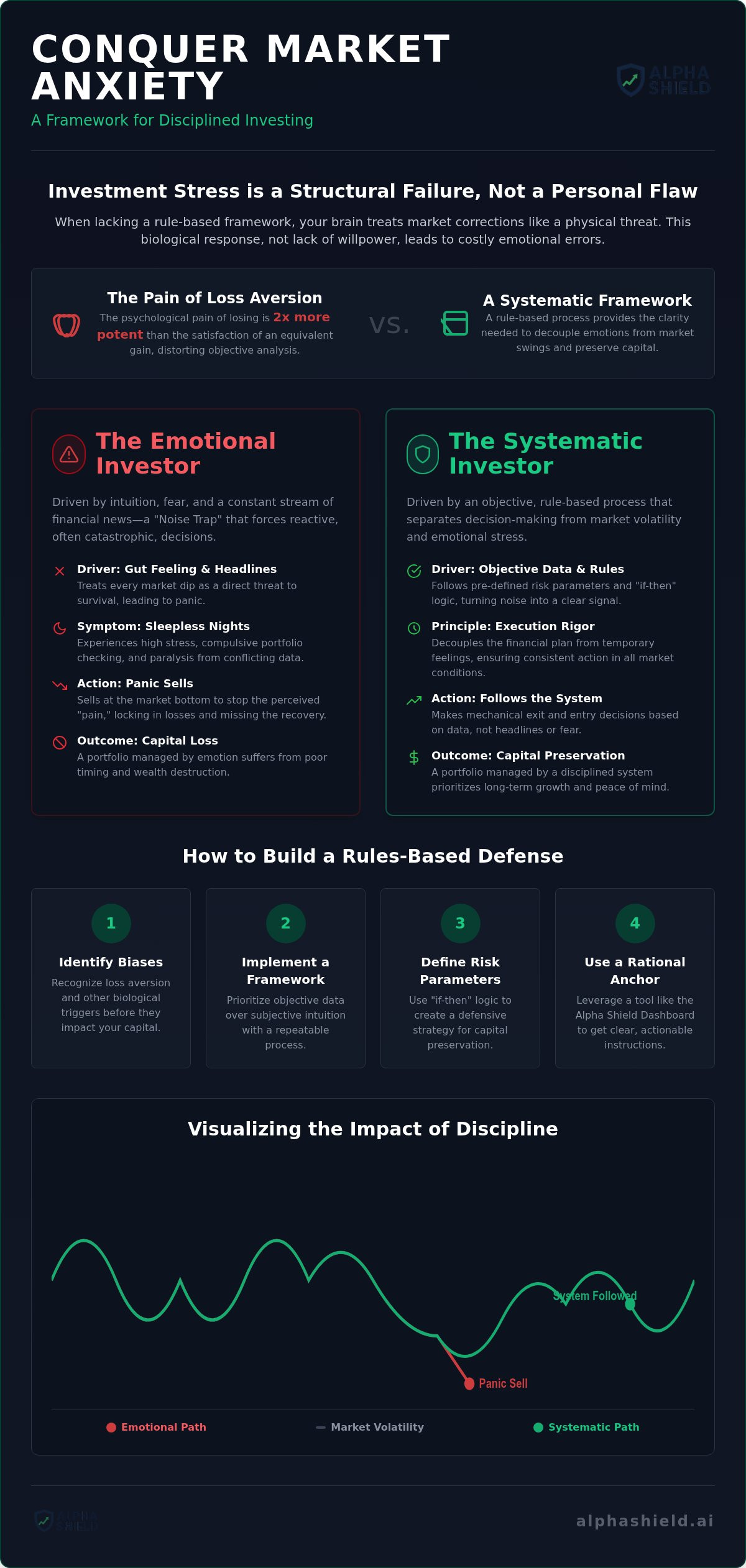
How to Build a Rules-Based Defense Against Market Volatility
Building a rules-based defense is the practical application of investment anxiety management. It moves beyond reframing thoughts to implementing structural safeguards. This process requires five distinct steps to ensure your capital remains protected during market regime shifts. Preparation must occur before the crisis, not during it.
- Step 1: Quantify your risk parameters before the market becomes volatile. If you haven't defined your exit point in advance, you'll likely find it during a panic.
- Step 2: Select a primary market signal that is data-driven and historically reliable. This signal should be the foundation of every decision you make.
- Step 3: Establish a mechanical exit strategy for high-risk periods. When the signal triggers a "Risk Off" instruction, the execution must be immediate and total.
- Step 4: Create a re-entry protocol. This ensures you participate in the recovery phase and avoid the long-term damage of staying in cash for too long.
- Step 5: Review the signal daily. You should ignore intraday price noise; it is a distraction that triggers emotional responses rather than rational actions.
Monitoring Macro Market Risk Indicators
Price charts are lagging indicators. They show where the market was, not where it's going. Professionals monitor market breadth and volatility structures, such as the VIX, to identify underlying health. These indicators reveal when the market regime has shifted from growth to defense. If breadth is narrowing while prices remain high, the risk of a crash is rising. Objective indicators identify these shifts before they become catastrophic drawdowns. This allows you to move to safety while others are still debating the news.
Implementing an Anti-Hype Routine
Financial media is designed for engagement, not for capital protection. To maintain discipline, you must limit your media consumption to once per week or less. Replace opinion-based newsletters with data-centric dashboards that provide objective facts. The signal is your only source of truth because it translates complex market mechanics into a single, actionable instruction for capital preservation. By removing the "experts" and focusing on the data, you eliminate the primary source of investment stress.
A systematic defense is not about predicting the future. It is about having a pre-calculated response to whatever the market does. When you have a plan, you don't need to worry about the headlines. You simply follow the process. This is the ultimate luxury in a volatile world: the ability to remain calm while the market is in chaos.
Achieving Clarity with the Alpha Shield Market Signal
The Alpha Shield Market Signal serves as the professional response to the structural failure of emotional investing. It is not a speculative tool. It is a systematic anchor designed for those who prioritize capital preservation over the excitement of the trade. By converting complex global risk metrics into a single, actionable instruction, the system provides the ultimate form of investment anxiety management. It replaces the exhausting "burden of choice" with a mechanical process rooted in institutional-grade discipline.
Our approach utilizes the subtraction technique to ensure absolute clarity. The system does not provide individual stock picks. It does not offer shorting strategies or day-trading signals. Instead, it filters out the noise of the financial world to identify the underlying health of the broad market. If the data indicates a regime shift toward high risk, the signal identifies it. If the market remains stable, the signal confirms it. This sober transparency allows investors to stand in opposition to market chaos with a rational, emotion-free partner.
The Alpha Shield Dashboard: Your Risk Command Center
The Alpha Shield Dashboard functions as a visual, rational anchor for risk assessment. It is designed to visualize market health without overwhelming the user with unnecessary data points. Simplicity is a luxury in wealth management. When you have access to a market crash and drawdown tool that monitors risk while you sleep, the need for hyper-vigilance disappears. The dashboard provides a clear narrative of cause and effect. It allows you to see the logic behind every signal, building a foundation of trust through data-driven objectivity rather than marketing hype.
Transitioning to a Systematic Future
Adopting a systematic approach changes your relationship with the market. Subscribers manage their portfolios with professional-grade detachment because they no longer rely on intuition. There is a profound peace of mind that comes from knowing you have a battle-tested exit plan. This isn't about predicting every minor fluctuation; it's about avoiding catastrophic errors that destroy decades of savings. When you follow a repeatable system for investment anxiety management, you protect both your capital and your mental health.
The transition from reactive guessing to mechanical execution is the final step in securing your financial future. It allows you to ignore the sensationalism of retail trading and adopt the steady pulse of institutional risk management. Clarity is not found in more information. It is found in a better filter.
Securing Your Capital Through Systematic Discipline
Transitioning from a state of hyper-vigilance to mechanical execution is a significant professional achievement. You've seen how biological biases like loss aversion can sabotage your wealth if left unmanaged. Effective investment anxiety management is not found in psychological reframing; it's found in a rule-based system that operates with institutional-grade discipline. By decoupling your feelings from your financial plan, you protect your capital from the volatility of global markets.
Alpha Shield provides the rational anchor needed in these volatile environments. This systematic market signal was designed by former investment bankers to focus on long-term capital preservation and crash protection. Through our professional dashboard, you gain a clear, data-driven method for monitoring market risk. You no longer need to rely on the noise of financial media or speculative intuition.
Secure your financial future by choosing clarity over chaos. When you follow a proven, data-driven process, peace of mind becomes a natural byproduct of your discipline. You have the tools to protect what you've built.
Frequently Asked Questions
What is the best way to manage investment anxiety during a market crash?
The most effective method for investment anxiety management during a crash is to follow a pre-determined, rules-based exit strategy. Relying on intuition during a crash triggers biological stress responses that lead to panic-selling. By using a systematic approach, you replace emotional guesswork with data-driven instructions. This ensures you act based on objective market mechanics rather than fear. Proper preparation before volatility begins is the foundation of institutional-grade discipline and long-term security.
How can I stop checking my stock portfolio every day?
You can reduce compulsive monitoring by shifting your focus from daily price fluctuations to a primary market health indicator. Checking balances frequently is a symptom of a lack of structural protection. When you have a reliable market crash and drawdown tool in place, you know you will be alerted if the risk regime changes. This allows you to ignore intraday noise and trust the system to work while you sleep. Clarity is found in better filters.
Is it better to stay the course or exit the market when volatility increases?
The decision depends on whether the volatility is healthy noise or a precursor to a catastrophic drawdown. "Staying the course" can be psychologically damaging if you lack a plan for capital preservation. A systematic approach uses objective data to identify when the risk of a major crash outweighs the potential for gain. If the signal indicates a high-risk environment, reducing exposure is often the more rational, protective choice for securing your long-term financial future.
What is the difference between emotional investing and systematic investing?
Emotional investing is discretionary and subjective; it relies on an individual's reaction to headlines and gut feelings. Systematic investing is rule-based and objective; it uses pre-calculated if-then logic to execute trades. This binary contrast is central to effective investment anxiety management. While emotional investors are often paralyzed by conflicting news, systematic investors follow a mechanical process. This removes the burden of choice during periods of high stress, ensuring capital preservation remains the priority.
Can a market signal really predict a crash before it happens?
While no tool can predict the future with absolute certainty, institutional-grade signals can identify high-probability risk regimes. By monitoring macro indicators like market breadth and volatility structures, systems can detect when the market's internal health is deteriorating. These signals act as an early warning system rather than a crystal ball. They allow you to shift to a defensive posture before a drawdown becomes catastrophic, prioritizing capital preservation over speculative excitement in the market.
How much drawdown should I realistically expect in a long-term portfolio?
Historical data shows that broad market indices can experience drawdowns of 30% to 50% during major crises. For instance, the S&P 500 dropped roughly 50% during the 2008 financial crisis. Understanding these mathematical realities helps you define your personal breaking point. A systematic framework allows you to set risk parameters that trigger an exit before these declines destroy your core capital. This makes recovery much faster and less mentally taxing for the long-term investor.
Why does financial news make my investment anxiety worse?
Financial news is designed for engagement and clicks, not for capital protection. It thrives on narrative investing, which builds stories around market movements to trigger emotional responses. This constant stream of conflicting data puts the brain in a state of hyper-vigilance. To maintain clarity, you must filter out this noise and rely on a single, actionable signal. Replacing opinion-based media with a data-centric dashboard reduces the mental load of decision-making during volatile periods.
How do professional investors remain calm during market volatility?
Professionals remain calm because they have decoupled their emotions from their execution. They don't rely on heroic decision-making during a crisis. Instead, they follow battle-tested systems developed from years of institutional experience. When you have a pre-calculated response to market movement, volatility becomes a variable to be managed rather than a threat to be feared. This mechanical approach provides the stability needed to navigate periods of extreme market stress without compromising your peace of mind.


