

Most investors treat a market crash like an unpredictable natural disaster. It isn't. It's a measurable shift in market mechanics that can be identified through systematic calculation. You've spent years compounding your wealth, and learning how to protect portfolio from crash events is more critical than chasing the next speculative gain. It's exhausting to watch your gains vanish because of a "buy and hold" philosophy that ignores real-time volatility. You need a rational anchor in this environment.
This guide provides the institutional-grade framework for identifying risk before it destroys your capital. We'll strip away the noise of conflicting 2026 headlines, from 3.4% inflation reports to the 3.63% federal funds rate, and focus on the Alpha Shield Market Signal. We'll move directly from problem identification to a mechanical solution. You'll discover how the Alpha Shield Dashboard replaces emotional guesswork with disciplined, data-driven clarity. This is about capital preservation and the avoidance of catastrophic errors. We value consistency over speculative excitement.
Key Takeaways
- Understand why traditional "buy and hold" advice fails during high-correlation events. You will learn to distinguish between a standard market correction and a structural crash.
- Shift your focus from subjective economic predictions to objective market health signals. This professional standard prioritizes data-driven indicators over the noise of financial news.
- Discover how to protect portfolio from crash scenarios by utilizing tactical cash as a primary defensive stance. This approach avoids the risks associated with complex shorting or speculative hedging strategies.
- Implement a 4-step framework to establish baseline market health and define maximum allowable drawdowns. A mechanical exit strategy removes emotional stress from your decision-making process.
- Utilize the Alpha Shield Market Signal to decode institutional-grade risk metrics. The Alpha Shield Dashboard acts as a rational anchor by visualizing macro risk with absolute clarity.
The Anatomy of a Market Crash: Why Traditional Advice Fails
A market correction is a functional adjustment. A stock market crash is a structural breakdown. While a correction is typically defined as a 10% decline, a crash involves a rapid, double-digit drop that often exceeds 20% and compromises market liquidity. Most retail investors struggle with how to protect portfolio from crash events because they rely on outdated assumptions. They expect traditional safe havens to remain stable. In a systemic event, these expectations are rarely met.
The primary driver of capital destruction during a crash is "Correlation 1." This phenomenon occurs when the historical relationships between asset classes dissolve. If market stress reaches a critical level, then stocks, bonds, and commodities often fall in unison. Diversification, the supposed "free lunch" of investing, disappears exactly when it's needed most. This isn't a matter of bad luck. It's a mechanical reality of forced deleveraging.
We categorize market environments into two distinct regimes: Calm and Fragile. A Calm regime allows for standard growth strategies. A Fragile regime requires immediate defensive action. Staying the course during a Fragile regime isn't discipline; it's a strategy for capital destruction. You can't recover years of gains if your principal is reduced by 30% or 50%.
The Failure of Static Diversification
Traditional models like the 60/40 portfolio rely on the inverse relationship between stocks and bonds. This model failed significantly during previous periods of high inflation and rising interest rates, such as 2022. Exiting risk is a professional decision; hiding in supposedly "safe" assets is a retail hope. Systemic risk is the breakdown of traditional asset relationships where diversification provides no safety.
Why Financial News is a Lagging Indicator
Financial headlines follow price action. They provide a narrative to explain what has already happened. Narrative-based investing is dangerous because it encourages emotional reactions to lagging data. Professional risk management ignores this noise. Instead, it focuses on internal market mechanics and quantitative signals. If the data indicates a regime shift, the reason behind the shift is irrelevant. The only priority is capital preservation. Learning how to protect portfolio from crash risks means filtering out the media's urgency and focusing on objective, rule-based signals.
Systematic Indicators: Moving Beyond Investor Sentiment
Professional risk management ignores the "why" behind market movement. Narrative-driven questions about inflation or interest rates are often distractions. We focus on whether the market engine is fundamentally sound. Quantitative signals provide an objective answer. This shift from sentiment to data is the first step in learning how to protect portfolio from crash events. It transforms a subjective guessing game into a mechanical process. If the data indicates fragility, then the narrative doesn't matter. You prioritize capital preservation over speculative theories.
Algorithmic tools are essential for this transition. They filter out daily price fluctuations to identify structural shifts in the market regime. High-frequency noise often triggers emotional responses in retail traders. A systematic approach ignores these ripples. It looks for the underlying tide. By using mathematical filters, you can distinguish between a temporary dip and a developing breakdown. This level of objectivity is a professional standard. It's the difference between reacting to a headline and responding to a data-driven signal.
The VIX Futures Curve: An Institutional Warning Sign
The CBOE Volatility Index (VIX) is frequently called a "fear gauge." This is a simplification. Institutional experts look at the VIX term structure to gauge market health. In a healthy environment, the curve is in "contango." This means future volatility is priced higher than current volatility. If the curve flips into "backwardation," it signals immediate structural stress. Backwardation indicates that the cost of protection today is higher than in the future. This is a binary warning sign. It suggests the market's defensive mechanics are failing. Monitoring this curve helps you identify when the market engine is overheating before the damage is visible in your account balance.
Identifying Market Drawdown Regimes
Structural shifts are different from daily price fluctuations. A noisy market involves volatility without a change in the underlying trend. A broken trend occurs when risk metrics cross specific thresholds. We define these as high-risk regimes. In these periods, the probability of a 10% or 20% drawdown increases significantly. Using a systematic long-term portfolio protection strategies framework allows you to identify these shifts before they accelerate. It's the most effective way to understand how to protect portfolio from crash scenarios without relying on luck. This binary approach eliminates the emotional burden of decision-making. You can monitor these structural shifts in real-time using the Alpha Shield Dashboard to maintain professional discipline.
Tactical Cash vs. Strategic Hedging: Choosing Your Defense
Selecting a defensive posture requires a choice between three primary methods: tactical cash, strategic hedging with options, or inverse ETFs. While institutional players often discuss advanced hedging strategies, these tools often introduce unnecessary complexity and cost for the individual investor. Hedging is essentially an insurance policy. Like any insurance, the premiums create a persistent drag on your long-term returns. If the market remains flat or rises slowly, the cost of your "protection" can erode your gains as effectively as a minor correction.
Inverse ETFs and shorting strategies present even greater risks. Shorting is a speculative tool with unlimited downside potential. It requires perfect execution and constant monitoring. We categorize shorting as a prohibited strategy for long-term capital preservation. It shifts your focus from protecting wealth to gambling on directionality. For those seeking how to protect portfolio from crash scenarios, simplicity is a luxury. Alpha Shield prioritizes "Cash as a Position." It is the most reliable method for absolute capital preservation during structural market breakdowns.
The Power of the Sidelines
Cash is a low-volatility, zero-drawdown asset. During a systemic crash, it is the only position that guarantees the safety of your principal. Retail investors often focus on the opportunity cost of being out of the market, but they ignore the mathematical reality of drawdowns. If your portfolio drops by 50%, you don't need a 50% gain to recover; you need a 100% gain just to break even. The "Breakeven Math" of large investment losses is the non-linear relationship where the percentage gain required to recover from a drawdown increases exponentially as the loss deepens. Staying in cash during a high-risk regime isn't "missing out." It is a calculated move to protect your ability to compound wealth in the future.
Rules-Based Exits vs. Panic Selling
The difference between a professional exit and a retail panic is the catalyst. Panic selling occurs when an investor is overwhelmed by fear after the damage is already visible. A rules-based exit occurs because a pre-defined signal was triggered. This distinction is critical for avoiding the "Sell Low" trap. If you react to news headlines, you're likely already too late. If you react to a mechanical signal, you're executing a plan. Knowing how to protect portfolio from crash events involves removing the burden of decision-making. A market timing signal dashboard provides the binary clarity required to act without hesitation. You move to the sidelines because the system requires it, not because you're scared. This detachment is the hallmark of institutional-grade risk management.
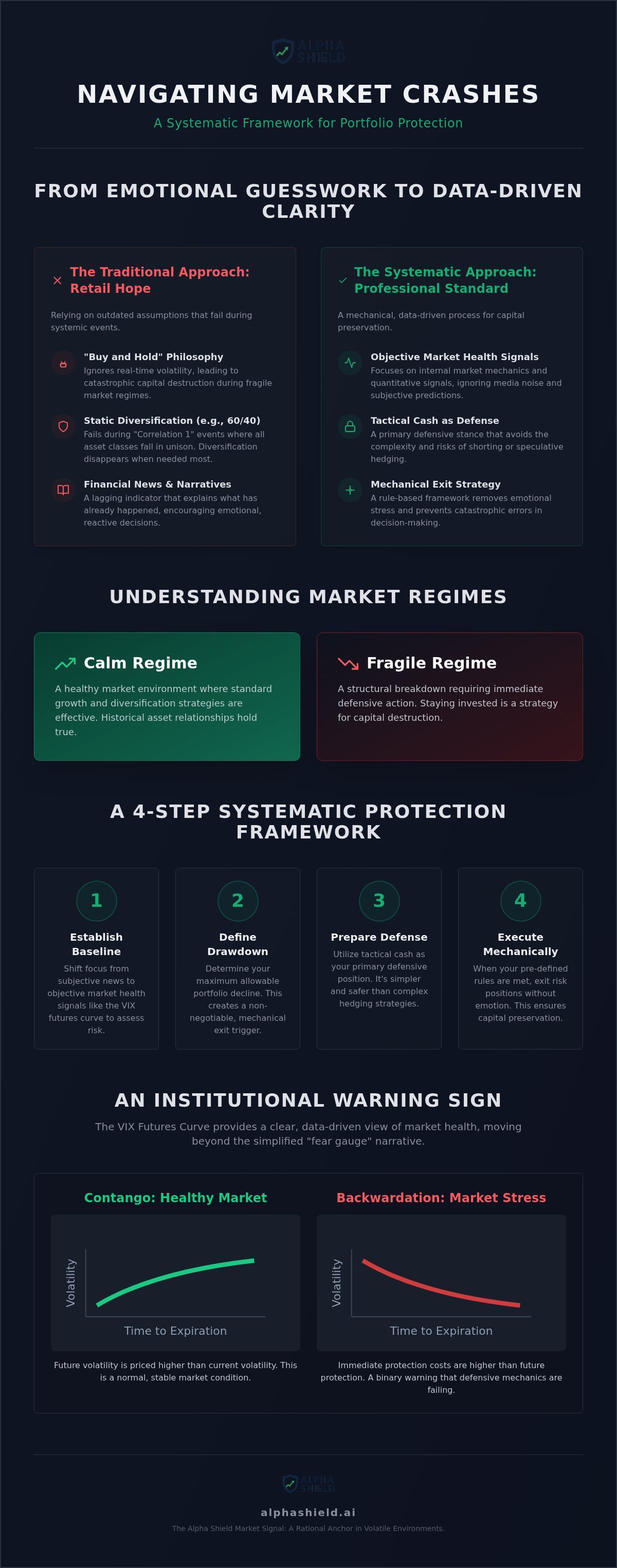
A 4-Step Systematic Portfolio Protection Framework
Understanding how to protect portfolio from crash events requires a shift from reactive fear to a pre-defined process. A framework provides the structure needed to remain objective when the market becomes irrational. We utilize a four-step sequence to manage risk and preserve capital. This process isn't a prediction; it's a reaction to internal market health. It removes the stress of uncertainty by replacing it with a rule-based philosophy.
- Step 1: Establish a baseline Market Health indicator. This filters out daily noise to determine whether the current regime is calm or fragile.
- Step 2: Define your Maximum Allowable Drawdown per asset. This is your structural risk floor that dictates when a position is no longer viable.
- Step 3: Execute a binary exit strategy. If risk thresholds are breached, then you move to cash immediately without hesitation.
- Step 4: Establish objective re-entry criteria. This ensures you capture the eventual recovery while avoiding the trap of a false bounce.
Setting Objective Risk Thresholds
Discretionary decisions are the primary cause of portfolio underperformance during high-volatility periods. Moving beyond gut feelings to hard data points is a professional requirement for serious investors. You must establish non-discretionary rules for wealth preservation before the drawdown begins. Consistency in your exit strategy is more important than attempting to sell at the absolute top. If you follow a mechanical rule, then you eliminate the emotional burden of uncertainty. This discipline prevents the hesitation that leads to catastrophic losses. In a systematic environment, a breach of a threshold is a direct instruction to act.
The Re-Entry Protocol: When is it Safe?
Returning to the market is often more difficult than exiting. Investors often fall into the trap of buying the dip too early in a structural bear market. This exposes capital to significant second-wave losses. An objective protocol waits for trend-following signals and volatility normalization before committing capital. This reduces the risk of a dead cat bounce destroying your remaining principal. Learning how to protect portfolio from crash scenarios includes knowing when the environment has shifted from fragile back to calm. You can automate this entire framework by monitoring the Alpha Shield Market Signal to identify these critical regime shifts in real-time.
Alpha Shield: Professional Risk Management for Individuals
Alpha Shield acts as a rational anchor in a market environment defined by volatility and noise. We've established that knowing how to protect portfolio from crash events requires more than just diversification; it requires a systematic signal. The Alpha Shield Market Signal provides this clarity. It is a specialized tool designed for capital preservation, not speculative excitement. We maintain a high degree of professional discipline by focusing on what works. Our system is built on institutional authority and sober transparency.
The Alpha Shield Dashboard visualizes macro risk without the distraction of financial news headlines. It operates as a high-tech analytical engine that filters out market chaos. This is simplicity as a luxury. Most retail investors are overwhelmed by data. We provide the reduction of that data into a binary decision. If the signal is green, the environment is calm. If the signal is red, the environment is fragile. This structural simplicity strips away the noise. It provides a clear, unobstructed path to understanding market health. Our personality is that of a disciplined expert, not a guru or a hustler.
Our "Anti-Hype" philosophy is defined by subtraction. We explicitly state what we do not provide to clarify our specific value proposition:
- We do not offer day-trading tools.
- We do not provide individual stock picks.
- We do not recommend shorting strategies.
Institutional Data, Simplified
The engine behind our system decodes institutional-grade metrics, including VIX term structures and macro volatility variables. We've built 50+ years of institutional experience into a framework that began development in 2017. Our approach treats emotional reactions as variables to be managed rather than experiences to be shared. This results in a single signal that tells you when to stay in and when to move to safety. It is a professional standard brought to the individual investor. We value consistency and the avoidance of catastrophic errors above all else.
Securing Your Long-Term Growth
Avoiding a single 30% or 50% drawdown has a massive cumulative effect on a 20-year horizon. You can't compound wealth if your principal is repeatedly destroyed. Integrating the Alpha Shield Market Signal into your 401k or brokerage routine is a methodical process. It doesn't require constant monitoring. It requires disciplined execution when the signal shifts. This reduces the mental load of complex decision-making and provides long-term security. It's the most effective way to understand how to protect portfolio from crash risks while maintaining emotional detachment. View the Alpha Shield Dashboard and Protect Your Portfolio.
Preserve Your Wealth Through Systematic Discipline
Capital preservation is a choice between emotional reaction and systematic execution. You now understand that traditional diversification often disappears when systemic risk peaks. By implementing a rule-based framework, you replace the noise of financial media with binary, data-driven signals. Learning how to protect portfolio from crash events is not about predicting the future; it's about responding to the present market regime with professional detachment. If the data indicates a fragile environment, then moving to cash is the only rational defensive posture.
Alpha Shield provides the rational anchor needed to navigate these structural shifts. Our system is battle-tested since 2019 and was developed by former investment bankers to bring institutional-grade risk management to individual investors. It's an emotion-free tool that prioritizes the safety of your principal above all else. You can secure your long-term growth by avoiding the catastrophic errors that destroy wealth. Access the Alpha Shield Market Signal & Dashboard to begin your transition from speculative hope to disciplined clarity. Your financial future depends on the steps you take before the next drawdown begins.
Frequently Asked Questions
How much cash should I hold if a market crash is predicted?
The amount of cash you hold should depend on objective signals rather than predictions. If the market regime is identified as fragile, moving 100% of your equity exposure to cash is the most effective way to protect portfolio from crash events. This isn't a guess; it's a mechanical response to data. If the signal is calm, you remain fully invested. We view cash as a tactical position that guarantees principal safety during structural breakdowns.
Can I protect my 401k from a market crash without selling everything?
You can protect your 401k by moving equity allocations into stable value funds or money market options within the plan. You aren't closing the account; you're shifting to a defensive posture. This allows you to avoid structural drawdowns while keeping your tax-advantaged status intact. Once the market regime returns to a calm state, you reallocate to growth assets. It's a systematic process that ignores the emotional urge to stay the course during capital destruction.
What is the most reliable indicator of a stock market crash?
Institutional professionals prioritize volatility mechanics over news headlines. The VIX futures curve is a primary health metric. When the curve shifts from contango to backwardation, it signals that the market engine is failing. This technical shift is far more reliable than investor sentiment or economic predictions. It provides a binary warning that the probability of a systemic crash has increased significantly, requiring an immediate transition to capital preservation and risk management.
Is market timing really impossible for individual investors?
Predictive market timing is difficult, but reactive regime identification is entirely possible. We don't predict when a crash will happen; we identify when the market environment has become fragile. This distinction is critical. Individual investors can succeed by following a mechanical, rule-based philosophy rather than chasing speculative excitement. Success comes from a disciplined framework that decodes internal market mechanics to provide a clear, data-driven signal to either exit or enter the market.
What happens if I miss the best days of the market recovery?
Missing a few high-growth days is a minor cost compared to avoiding a 30% or 50% drawdown. The math of compounding favors the avoidance of large losses. If you lose half your capital, you need a 100% gain just to break even. A systematic re-entry protocol ensures you return when volatility has normalized. This protects you from a dead cat bounce destroying your remaining principal while securing the majority of the subsequent bull market's gains.
How does Alpha Shield differ from a standard stock alert service?
Standard alert services often focus on individual stock picks or speculative day-trading setups. Alpha Shield is a specialized market crash and drawdown tool. We prioritize capital preservation through a single, actionable market signal. Our dashboard filters out the noise of financial news to visualize macro risk with absolute clarity. It's a rational anchor developed by former investment bankers with over 50 years of combined institutional experience to help you manage risk.
Do I need to short stocks to protect my portfolio?
No, we categorize shorting as a prohibited strategy for long-term investors. Shorting involves unlimited downside risk and requires perfect timing. It often turns into a speculative gamble rather than a defensive move. The most reliable way for individuals to understand how to protect portfolio from crash risks is to move to tactical cash. This guarantees principal safety without the complexity or persistent costs associated with advanced hedging strategies or inverse ETFs.
What is a drawdown and why does it matter for my retirement?
A drawdown is the peak-to-trough decline of your portfolio value. It matters because large drawdowns can permanently impair your retirement timeline. If a crash occurs shortly before or during retirement, you may be forced to sell assets at depressed prices to cover living expenses. This creates a sequence of returns risk that can exhaust your capital prematurely. A systematic approach focuses on minimizing these drawdowns to ensure your long-term financial security and peace of mind.
