

Traditional diversification is a failed insurance policy when you need it most. During high-correlation sell-offs, nearly every asset class drops simultaneously, leaving your capital exposed. If your strategy relies on the hope that bonds will always offset equity losses, you're operating without a professional safety net. Reducing portfolio drawdown requires more than just a mix of assets. It demands a disciplined, systematic understanding of market risk regimes and the removal of emotional guesswork.
It's frustrating to watch years of gains evaporate in a few weeks of volatility while headlines offer nothing but noise. You deserve a rational anchor in this environment. This guide provides the same rules-based framework for capital preservation used by institutional professionals to protect wealth. We'll analyze the specific data points that actually predict drawdowns, including the 4.98% yield on the 10-year Treasury and current VIX metrics. You'll gain a reliable exit signal that replaces human bias with data-driven objectivity, ensuring your portfolio remains a tool for long-term security rather than a source of stress. This approach transforms market volatility from a threat into a manageable variable.
Key Takeaways
- Understand why traditional diversification fails during high-correlation crashes and how to identify the structural limits of a standard balanced portfolio.
- Learn to establish a non-discretionary, rules-based checklist for reducing portfolio drawdown that removes emotional bias from your capital preservation strategy.
- Discover the critical difference between unreliable market sentiment and the systematic quantitative signals used by institutional risk managers.
- Master the "If-Then" logic of a disciplined exit strategy to protect your gains before market volatility turns into a catastrophic loss.
- See how professional-grade tools like the Alpha Shield Dashboard filter out macro noise to provide clear and actionable market risk indicators.
What is Portfolio Drawdown and Why Does Traditional Diversification Fail?
Professional risk management begins with a cold assessment of loss. What is a drawdown? In institutional finance, it's the specific peak-to-trough decline of an investment during a defined period. It isn't just a number on a screen; it's the measurement of temporary capital impairment. Most retail investors rely on gut-feel exits when markets turn volatile. This emotional response often leads to selling at the bottom or buying back too late. A systematic approach to reducing portfolio drawdown replaces this panic with data. It treats capital preservation as the primary objective because without capital, growth is impossible.
Traditional diversification suggests that different asset classes will move in opposite directions. This theory often fails during a true market crash. We call this the "Correlation 1.0" problem. In high-stress regimes, liquidity dries up and investors sell what they can, not what they want. Stocks, bonds, and commodities often fall together. If everything in your portfolio is correlated, you don't have a diversified strategy; you have a single, high-risk bet.
The Mathematics of Recovery
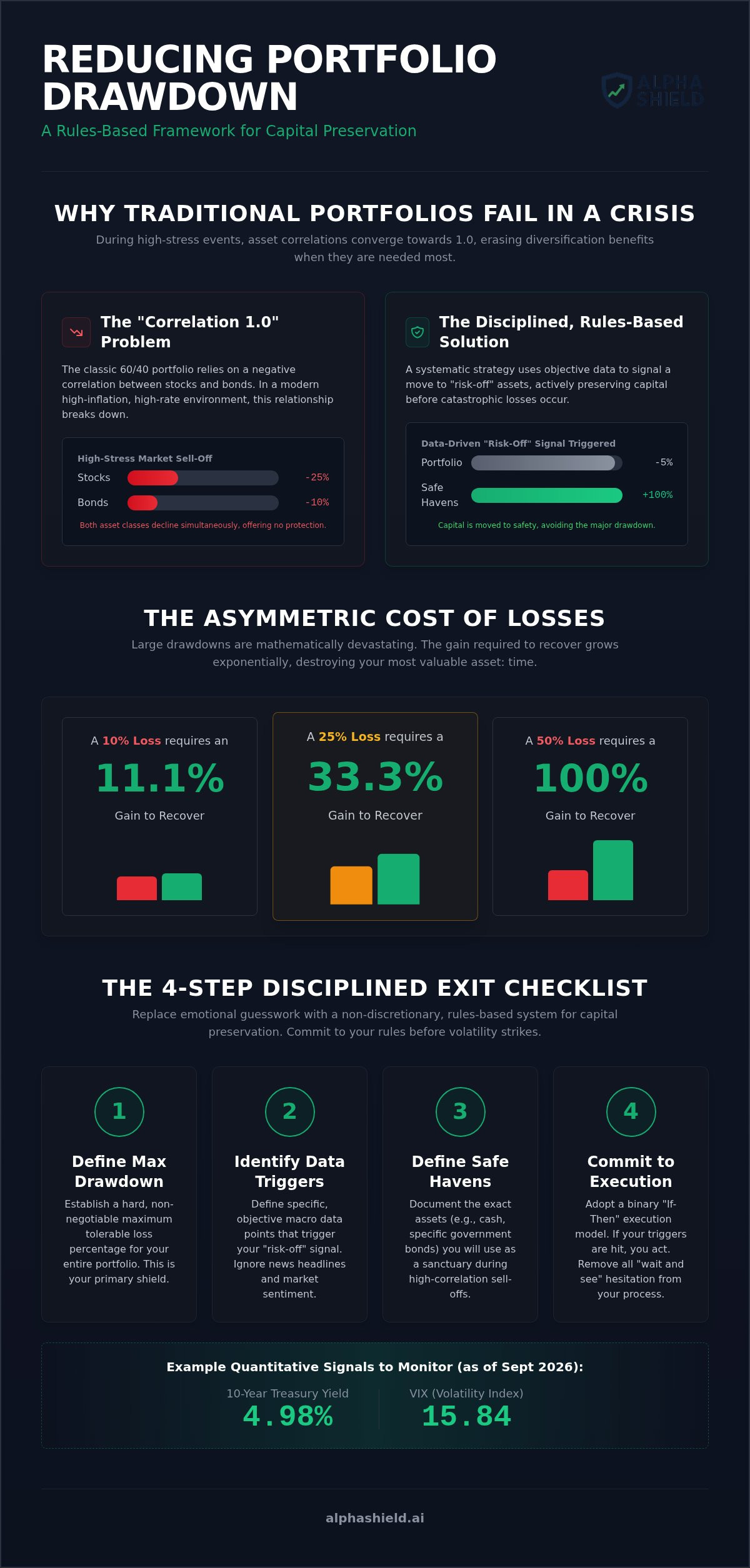
The impact of a drawdown is mathematically asymmetric. If your portfolio loses 10%, you need an 11.1% gain to recover. If you suffer a 50% loss, you must generate a 100% gain just to return to your starting point. Large losses don't just reduce your net worth; they destroy your most valuable asset: time. By reducing drawdown, you significantly shorten the duration required to reach new all-time highs. Large drawdowns create a mathematical hole that most investors never fully climb out of.
Why 60/40 Portfolios Are No Longer Enough
The classic 60/40 split relied on a negative correlation between stocks and bonds. This worked in the 1990s when interest rates were trending lower and inflation was stable. In 2026, the environment is different. With the 10-year Treasury yield at 4.98%, fixed income no longer provides a reliable shield against equity volatility. When inflation rises, both stocks and bonds can decline simultaneously. Relying on outdated models prevents you from effectively reducing portfolio drawdown in a high-rate environment. A static allocation is a passive vulnerability. You need a dynamic market signal to identify when the risk regime has shifted from growth to preservation.
The 2026 Checklist for Reducing Portfolio Drawdown
Discipline is the only defense against market chaos. A checklist ensures that your response to volatility is mechanical rather than emotional. Without a non-discretionary system, your capital is subject to the whims of sentiment. Reducing portfolio drawdown is a function of preparation, not prediction. You must establish your boundaries before the market forces them upon you. A rules-based philosophy strips away the noise, leaving only the data that matters for capital preservation.
- Establish a maximum tolerable loss percentage for the entire portfolio.
- Define the specific macro data points that trigger a risk-off signal.
- Document the exact assets used as "safe havens" during high-correlation sell-offs.
- Commit to a binary execution model that removes "wait and see" hesitation.
Step 1: Define Your Risk Parameters
Every investor has a breaking point. You must identify your maximum tolerable drawdown threshold before you deploy capital. This isn't a vague feeling; it's a hard percentage. Normal volatility is the price of admission for growth. Catastrophic drawdown is a threat to your financial survival. By writing down your exit rules now, you prevent the paralysis that occurs during a sudden 20% sell-off. If the market breaches your predefined risk level, the execution must be automatic. This "hard stop" is your primary shield against the asymmetric risk of large losses.
Step 2: Selecting Objective Data Sources
Financial news headlines are designed for engagement, not accuracy. They are lagging indicators that reflect what has already happened. To protect your wealth, you must monitor macro market risk indicators rather than individual stock fluctuations. As of September 2026, the 10-year U.S. Treasury Note yield sits at 4.98% and the VIX is at 15.84. These data points provide a clearer picture of the risk regime than a pundit's opinion. Decoding these metrics allows you to see the market's internal mechanics with professional clarity.
A professional approach involves filtering out the noise to find actionable signals. This requires a binary framework: Risk-On or Risk-Off. When the macro environment deteriorates, the system signals a move to cash or equivalents. This isn't about timing the market perfectly. It's about avoiding the "Correlation 1.0" events mentioned previously where all assets fall together. Utilizing a tool like the Alpha Shield Market Signal allows you to visualize these shifts through a professional dashboard. Reducing portfolio drawdown is simplified when you reduce complex data into a single, actionable instruction. Systematic calculation beats hope every time.
Quantitative Signals: Moving Beyond Market Sentiment
Market sentiment is a lagging byproduct of emotion. Relying on it for capital preservation is a mistake. Technical analysis often focuses on individual stock patterns or short-term trends. Systematic risk signals operate differently. They measure the structural health of the entire market. For those serious about reducing portfolio drawdown, the goal isn't to guess the next move of a single ticker. The goal is to identify the current market regime. Is the environment conducive to growth, or has it turned hostile? Recognizing this shift is the difference between a professional strategy and a retail gamble.
Algorithmic risk signals remove the variables of "hope" and human bias. When markets decline, the natural instinct is to wait for a rebound. This hesitation often leads to catastrophic losses. A rules-based signal ignores the noise of financial news and focuses on objective data. It treats capital preservation as a professional necessity. If the data indicates a high-risk regime, the system dictates a reduction in exposure. There's no room for negotiation or emotional attachment to a position. This detachment is what separates institutional-grade management from speculative trading.
Understanding the VIX Term Structure
The VIX term structure is one of the most reliable indicators of systemic risk. It measures the relationship between different VIX futures contracts. In a healthy market, the curve is in "contango." This means longer-term protection is more expensive than immediate protection. When the curve shifts into "backwardation," the spot price of the VIX exceeds futures prices. This indicates immediate panic and a high probability of a crash. As of September 11, 2026, the VIX sits at 15.84. Monitoring this structure allows for early detection of stress before it manifests as a full portfolio decline. Alpha Shield utilizes these specific metrics to calibrate its crash protection signals, providing a clear boundary between stability and chaos.
Signal vs. Noise: The Institutional Approach
Institutional risk management is built on the principle of simplicity. Former investment bankers don't over-trade on minor fluctuations. They wait for major regime shifts. Over-trading on small signals creates unnecessary costs and emotional fatigue. The institutional approach involves decoding complex macro cycles into a binary instruction. If the risk regime is healthy, you stay invested. If it breaks, you exit. This clarity is the ultimate sophistication. By filtering out the daily noise of the market, you can focus on the signals that actually impact your long-term wealth. Reducing portfolio drawdown isn't about being active; it's about being right when the regime changes.
Implementing a Disciplined Market Exit Strategy
Execution is the final barrier in risk management. A systematic approach to reducing portfolio drawdown is useless if you cannot pull the trigger. Most retail investors struggle because they view the market through a lens of hope rather than logic. A disciplined exit strategy relies on "If-Then" logic. If the signal turns red, you move to cash or equivalents. This removes the need for a perfect forecast. You're simply responding to a measured shift in the risk regime. By the time a crash is obvious to the public, the damage is already done.
Some investors prefer reducing exposure incrementally to find a comfort zone. Others utilize a total exit strategy to minimize correlation risk immediately. A total exit is a binary switch. It eliminates market exposure entirely when the risk regime shifts. This is the most effective way to preserve capital during a systemic shock. Incremental reduction involves scaling back exposure as risk levels rise. This approach may feel more manageable for some, but it requires even stricter rules to be effective. Both methods are valid if they're governed by data rather than intuition.
The hardest part of this strategy is exiting while the market is still near all-time highs. It feels counterintuitive to sell when returns look strong. However, professional logic dictates following the signal, not the price action. Re-entry rules are equally vital. They ensure you don't miss the subsequent recovery by waiting for "clear skies" that never feel certain. A rule-based re-entry allows you to participate in the next growth cycle without the emotional baggage of the previous decline.
The Mechanics of Capital Preservation
During "Risk-Off" periods, the objective shifts from growth to defense. This involves moving to high-yield cash equivalents or short-term treasuries. With the 3-month U.S. Treasury Bill yield at 4.01% as of September 2026, holding cash is a productive defensive move. You can use a stock market drawdown indicator to trigger these exits before the damage becomes permanent. This prevents the common trap of "buying the dip" too early. In a systemic crash, what looks like a discount is often just the first stage of a multi-month decline.
Removing Human Emotion from the Equation
The human brain is hardwired for the wrong decisions in a crisis. Loss aversion makes you hold onto losing positions in the hope of breaking even. Greed makes you ignore warning signs when returns are high. Using a systematic guide maintains the discipline that your biology lacks. You must treat your portfolio like a professional business. A business doesn't operate on feelings; it operates on data and execution. Reducing portfolio drawdown is the result of following a script when everyone else is improvising.
Alpha Shield: Professional Risk Management for Individuals
Professional risk management is often gated behind high fees and complex institutional structures. Alpha Shield removes these barriers. It provides individual investors with a systematic market signal designed for one purpose: capital preservation. The system doesn't rely on "guru" predictions or speculative gambles. It utilizes a battle-tested philosophy developed by investment bankers with over 50 years of collective experience. Reducing portfolio drawdown is not about being lucky during a crash. It's about having a mechanical process that identifies when the risk regime has shifted from stability to chaos. This approach provides a level of professional discipline that was previously only available to the ultra-wealthy.
Capital preservation is the foundation of long-term outperformance. If you lose 50% of your portfolio, you need a 100% gain just to break even. By avoiding these catastrophic drawdowns, your capital continues to compound from a higher base. Alpha Shield acts as a rational anchor in a volatile environment. It provides the emotional detachment necessary to make the right decision when the market is in a state of panic. While others are paralyzed by conflicting news headlines, our users rely on systematic calculation to protect their gains. This is the difference between a methodical strategist and a retail gambler.
The Alpha Shield Dashboard Advantage
The Alpha Shield Dashboard is designed to strip away the noise of the financial world. It simplifies complex macro metrics, such as the VIX term structure and Treasury yields, into clear, actionable signals. You don't need to spend hours decoding data. The platform provides a visual representation of market health at a glance. This clarity is a luxury in an era of conflicting headlines. It's built specifically for long-term investors who value consistency. We don't offer day-trading tools or individual stock picks. We offer a systematic filter that identifies high-risk periods before they destroy your wealth. This "simplicity as a luxury" approach allows you to focus on your long-term goals without the stress of constant market monitoring.
Getting Started with Systematic Protection
Integrating the Alpha Shield Market Signal into your existing strategy is straightforward. It complements your current 401k or brokerage holdings by providing the "exit signal" that traditional diversification lacks. In 2026, the global market environment remains choppy and unpredictable. Relying on hope is not a strategy. Data-driven objectivity is the only way to navigate high-correlation sell-offs with confidence. By following a rules-based framework, you remove the mental load of complex decision-making and ensure your portfolio remains a tool for security. Reducing portfolio drawdown is the result of applying institutional rigor to your personal wealth.
Securing Your Capital Through Systematic Discipline
Successful investing in 2026 requires more than a passive allocation. It demands a transition from emotional guesswork to systematic calculation. You've learned that traditional diversification often fails when correlations spike, leaving your capital exposed during systemic crashes. By adopting a non-discretionary checklist and monitoring institutional-grade signals, you can replace panic with professional execution.
Reducing portfolio drawdown is the only way to protect your most valuable asset: time. Our platform, developed by investment bankers with 50+ years of experience, has provided data-driven protection since 2017. The Alpha Shield Dashboard simplifies macro complexity into actionable clarity, ensuring you stay ahead of market regime shifts. You don't have to navigate volatility alone when you have a rational anchor to guide your decisions.
Take control of your financial future today. A disciplined approach ensures that your wealth remains a source of security for the long term.
Frequently Asked Questions
What is the most effective way to reduce portfolio drawdown?
The most effective way involves implementing a non-discretionary, rules-based system that identifies market risk regimes. Traditional diversification fails when correlations reach 1.0 during a crash. A systematic approach uses objective data points like the VIX term structure to trigger defensive actions. This shift from hope to calculation ensures you preserve capital before losses become catastrophic. Reducing portfolio drawdown is a function of following a proven script rather than reacting to headlines.
Can I reduce drawdown without selling all my stocks?
Risk reduction doesn't always require a total exit. You can reduce exposure incrementally by moving a portion of your portfolio to cash equivalents or short-term treasuries. The goal is to lower your market sensitivity when risk signals turn red. However, any reduction must be governed by strict rules. If you don't have a specific percentage for your reduction, you're still relying on guesswork. Consistency in execution is more important than the scale of the move.
How does the VIX term structure help in predicting market crashes?
The VIX term structure measures the difference between spot volatility and future expectations. In healthy markets, the curve is in contango. This means protection is cheaper now than in the future. When the curve flips into backwardation, it signals that professional traders are panicking about immediate risks. This structural shift often precedes major market declines. Alpha Shield monitors these institutional signals to provide an early warning before the retail market reacts.
Is market timing different from systematic risk management?
Market timing often relies on subjective predictions or gut feelings about price movements. Systematic risk management is a data-driven process that measures the current environment. It doesn't try to predict the top or bottom. Instead, it identifies when the probability of a crash has increased significantly. If the risk regime is hostile, the system dictates a defensive posture. This approach prioritizes capital preservation over the excitement of speculative trading.
What is a "Market Regime" and why does it matter for my portfolio?
A market regime is the prevailing set of conditions that dictate how assets behave. For example, a low-volatility regime favors growth and buy-and-hold strategies. A high-volatility regime characterized by rising inflation and interest rates makes traditional assets more correlated. Recognizing the shift between these regimes is essential for reducing portfolio drawdown. If you apply a growth-oriented strategy during a defensive regime, you're exposing your wealth to unnecessary and avoidable risks.
How often should I check my market risk signals?
Our system is designed for long-term capital preservation, not high-frequency trading. Checking your signals once a day is sufficient for most systematic strategies. The Alpha Shield Dashboard provides a steady pulse of market health, filtering out the intraday noise that causes emotional stress. You don't need to monitor every tick. Professional discipline involves following a daily routine that ensures your portfolio remains aligned with the current risk regime.
Does Alpha Shield work for retirement accounts like a 401k or IRA?
Alpha Shield is compatible with any account where you have the authority to move between equities and cash equivalents. This includes most 401k plans and IRAs. You simply monitor the market signal and adjust your allocation within your existing brokerage platform. Since we don't use shorting or complex derivatives, our systematic guide is a practical tool for long-term retirement savers who prioritize the avoidance of catastrophic errors.
What happens if I miss the market bottom after exiting?
Missing the absolute bottom is a standard part of a defensive strategy. Professional risk management focuses on avoiding the meat of a crash rather than catching the exact reversal. The mathematical benefit of avoiding a 40% decline far outweighs the cost of missing the first 5% of a recovery. A rule-based re-entry signal ensures you rejoin the market once the risk regime has stabilized, protecting your wealth from false dawns.

