

Most investors believe that mastering their psychology is a matter of willpower. It isn't. Discipline is not a feeling; it is a calculation. If you want to learn how to invest without emotion, you must stop trying to control your feelings and start controlling your process. Human intuition is a liability in the face of market volatility. It leads to panic selling during drawdowns and the exhaustion of constant news monitoring. You've likely felt the regret of buying at a peak because of noise or selling at a bottom because of fear. These reactions are biological, but in the markets, they are expensive.
We agree that the mental load of managing a portfolio is unsustainable without a mechanical anchor. This guide provides a clear, data-driven framework to replace psychological bias with institutional rigor. You'll learn how to protect your capital by following a rule-based system that prioritizes preservation over speculative excitement. We will outline the steps to reduce portfolio drawdowns and achieve a state of professional detachment. This transition from intuition to logic ensures you remain a rational actor in a volatile environment. We'll demonstrate how to filter noise and follow the data.
Key Takeaways
- Recognize that emotional bias is a biological reality that must be managed through systematic subtraction rather than mental effort.
- Learn how to invest without emotion by replacing intuition with a data-driven framework that eliminates discretionary errors.
- Contrast the noise of financial news with objective market signals to maintain clarity during periods of extreme volatility.
- Build a disciplined process using macro risk indicators like the VIX term structure to identify and avoid high-risk market conditions.
- Leverage professional tools like the Alpha Shield Dashboard to transform complex market data into simple, actionable instructions for capital protection.
The Psychology of Investing: Why Your Brain is Wired for Drawdowns
Emotional investing is the tendency to execute trades based on fear or greed. It is a biological response, not a lack of intelligence. When markets fluctuate, the human brain triggers a "fight or flight" mechanism. It perceives a declining portfolio as a physical threat. This reaction is central to behavioral economics, which identifies the cognitive errors that compromise capital. One primary error is loss aversion. Data suggests that the psychological pain of a 10% drawdown is twice as intense as the satisfaction of a 10% gain. This asymmetry often forces investors to sell at the bottom to stop the pain.
Recency bias further complicates the decision-making process. Investors frequently project the immediate past into the future. If the market has risen for several months, they assume it will continue indefinitely. This leads to buying at peaks due to speculative excitement. Understanding these biological triggers is the first step in learning how to invest without emotion. You cannot delete these instincts. You can only build a system that bypasses them. If the data remains objective, the investor remains protected.
The High Cost of Emotional Decisions
The "behavior gap" represents the difference between the returns of an investment fund and the actual returns realized by the investor. This gap is usually significant. One panic-sold drawdown can erase years of disciplined growth. Frequent decision-making during high-risk periods leads to mental fatigue. When you monitor news headlines constantly, your ability to remain rational degrades. Capital preservation requires a reduction in the number of emotional choices you make. A disciplined professional prioritizes the avoidance of catastrophic errors over the pursuit of short-term gains.
Why "Staying the Course" is Often Incomplete Advice
Retail advice often suggests that investors should simply "stay the course" during every dip. This is incomplete logic. There is a fundamental difference between healthy volatility and a catastrophic market crash. If your portfolio suffers a 50% drawdown, you require a 100% gain just to return to your starting point. Passive holding during a secular bear market is not a strategy; it is a hope. To protect your wealth, you need a data-driven signal that acts as a shield. Relying on blind endurance is a gamble that professional institutions avoid. Learning how to invest without emotion means knowing when the data indicates that risk is too high to remain exposed.
Identifying Emotional Landmines: Fear, Greed, and Financial News
Headline risk is an omnipresent variable in modern finance. Every "breaking news" alert is engineered to provoke an immediate psychological response. This creates a dangerous feedback loop where market sentiment, or how the crowd feels, is mistaken for a valid market signal. To understand how to invest without emotion, you must learn to distinguish between these two forces. Sentiment is volatile and reactive. A signal is objective and data-driven. Learning how to invest without emotion requires a deliberate subtraction of these external influences.
The "FOMO" cycle typically follows a predictable path. It begins with skepticism during the early stages of a rally. As prices rise, skepticism turns into participation. Eventually, participation accelerates into euphoria. At this peak, confirmation bias takes hold. Investors actively seek out news that supports their current positions while ignoring data that suggests an impending reversal. This cycle is a trap for the undisciplined. It replaces logic with hope, which is never a viable strategy for capital preservation.
The Noise Machine: Why Financial Media Sells Emotion
Financial media outlets operate on a revenue model fueled by attention. Clicks and views are the primary metrics of success. Sensationalism is the most effective tool for driving these metrics. Consequently, "breaking news" often prioritizes urgency over accuracy. A professional market signal does not react to headlines; it processes underlying mechanics. Many retail investors fall victim to "guru" syndrome, where they follow individual stock recommendations based on the perceived authority of a media personality. These picks are often emotional traps that lack a broader risk management framework. Adopting a model of systematic investing allows you to filter this noise through a logical lens.
Recognizing Your Personal Emotional Triggers
Discretionary trading relies on personal judgment and "gut feelings." In a professional context, a gut feeling is simply an unquantified risk variable. It is not a reliable basis for capital allocation. To refine your process, begin logging your emotional state during market drawdowns. If you feel an urgent need to sell during a 5% dip, your process is likely discretionary rather than rules-based. Transitioning to a systematic approach requires you to replace these feelings with pre-defined instructions. Using a tool like the Alpha Shield Dashboard can help you visualize the difference between emotional noise and actionable data. This shift ensures that your portfolio is managed by logic, not by your reaction to the latest headline.
Discretionary vs. Systematic Investing: Choosing Data Over Intuition
Discretionary investing relies on personal judgment, current news, and intuition. It is an inherently inconsistent process. Decisions are made in real-time, often under the influence of market volatility. In contrast, systematic investing follows a pre-defined set of rules based on objective data. This is the standard for institutional capital preservation. While retail traders often chase speculative excitement, professionals prioritize systematic rigor. They understand that the human mind is a flawed engine for processing risk. To learn how to invest without emotion, you must transition from being the decision-maker to being the system-follower.
The primary difference lies in the source of the instruction. In a discretionary model, the investor must interpret the "noise" of the market to find a path forward. This leads to mental fatigue and inconsistent results. In a systematic model, the path is already mapped. This shift replaces the stress of constant choice with the clarity of a binary signal. If the data indicates high risk, the system acts. If the data indicates stability, the system remains. Willpower is a finite resource; a data-driven framework is constant.
The Mechanics of a Rules-Based System
A rules-based system operates on "if-then" logic. This structure mirrors the mechanics of institutional risk management. If the market indicators meet specific risk thresholds, then the system triggers a defensive stance. If the indicators signal a healthy regime, then the system maintains exposure. This binary clarity removes the "Should I sell?" anxiety from every market dip. The signal provides the answer, regardless of how the investor feels about the day's headlines.
It's vital to recognize that a system does not need to be right 100% of the time. Its primary function is to prevent 100% of catastrophic drawdowns. By filtering out the noise and focusing on core volatility metrics, the system ensures that the portfolio survives to participate in the next uptrend. Survival is the first step toward growth.
Systematic Capital Preservation
The fastest way to build long-term wealth is to avoid the "big mistake." Significant drawdowns are mathematically destructive. A 20% loss requires a 25% gain to recover, but a 50% loss requires a 100% gain just to break even. Systematic investing focuses on market regime identification. It distinguishes between standard volatility and a high-risk environment where catastrophic loss is probable.
Knowing when to be aggressive and when to be defensive is the essence of professional detachment. This is how to invest without emotion at an institutional level. You subtract the need for intuition and replace it with a calibrated, protective shield. In a world of market chaos, simplicity and discipline are the ultimate luxuries.
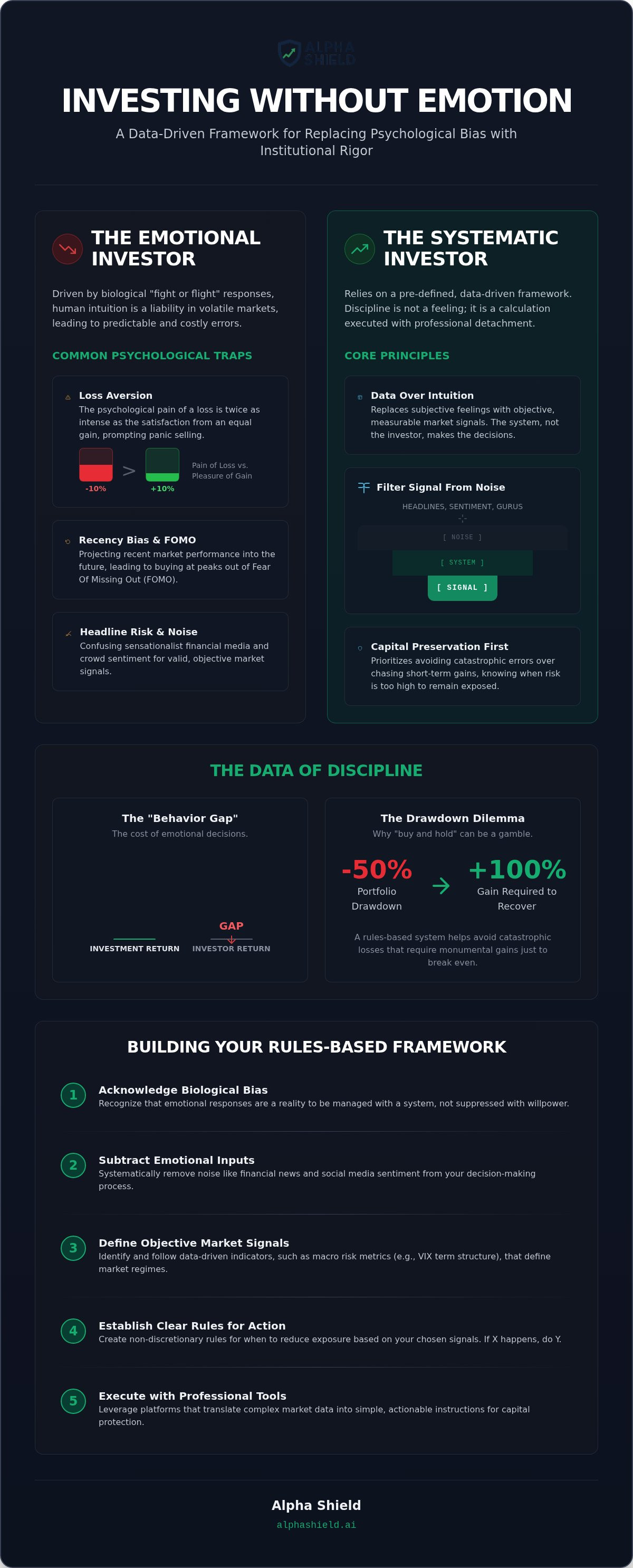
Building Your Rules-Based Framework: A 5-Step Process
Discipline is not a state of mind. It is a sequence of actions. To master how to invest without emotion, you must build a framework that functions independently of your current mood. This process replaces intuition with a mechanical sequence that prioritizes capital preservation. If the framework is robust, the investor's psychology becomes irrelevant. Follow these five steps to establish institutional-grade rigor in your portfolio management.
- Step 1: Define objective risk tolerance. This is not about how you feel during a dip. It is a mathematical calculation of the maximum drawdown your portfolio can sustain before the recovery time becomes unacceptable.
- Step 2: Select macro market risk indicators. Institutional professionals monitor the VIX term structure to gauge market stress. These metrics provide a sober view of volatility that headlines cannot offer.
- Step 3: Establish entry and exit triggers. Define your actions before the market moves. If the signal crosses a specific threshold, then you execute the trade. No debate. No hesitation.
- Step 4: Automate the monitoring. Manual checks invite emotional interference. Use a system that monitors data points daily and provides a clear output.
- Step 5: Review system performance. Do not judge your success by daily price fluctuations. Judge it by how accurately you followed your pre-defined rules.
Moving Beyond Simple Diversification
Diversification is often sold as a complete safety net. It is an incomplete solution. During a severe market crash, correlations often move toward 1. This means that different asset classes begin to fall in unison, rendering traditional diversification ineffective. Systematic market timing is the professional alternative. It is a tool for risk management, not a speculative gamble. By identifying high-risk regimes, a systematic signal can protect a 401k or retirement portfolio from the math of catastrophic loss. It ensures you are defensive when the data dictates, rather than when the news becomes unbearable.
The Importance of a Professional Dashboard
A spreadsheet is a passive record of the past. A professional dashboard is an active instruction for the future. Visual clarity is essential for maintaining discipline during periods of high volatility. When you see a "Red" signal on a dashboard, it provides the psychological permission to move to a defensive stance. It strips away the complexity of global markets and delivers a single, actionable truth. This is the luxury of simplicity. Anti-hype tools do not seek to entertain; they seek to protect. They filter the noise of the financial world into a clear path for capital preservation.
Learning how to invest without emotion is a transition from being a reactive observer to a disciplined operator. You don't need more news. You need a better filter.
Leveraging Alpha Shield for Emotion-Free Capital Preservation
Alpha Shield provides the mechanical anchor required to navigate market volatility. It is a battle-tested risk tool designed to identify high-risk periods before they result in catastrophic losses. While retail sentiment fluctuates based on headlines, the Alpha Shield Market Signal relies on the VIX term structure. This approach prioritizes data over narrative. It transforms complex market mechanics into actionable clarity through the Alpha Shield Dashboard. By focusing on VIX futures rather than financial news, the system identifies the underlying risk regime of the market. This is the ultimate method for those seeking how to invest without emotion.
The system's development began in 2017 with a focus on systematic market timing. Since its inception in January 2019, Alpha Shield has reported an annualized return of 27.71% compared to the SPY's 17.26% over the same period. These figures illustrate the power of avoiding significant drawdowns rather than chasing speculative peaks. The dashboard filters out the noise, allowing you to maintain a professional distance from market chaos. It is a protective engine built for long-term growth. It does not provide individual stock recommendations; it provides a macro shield for your entire portfolio.
Institutional Discipline for the Individual Investor
Alpha Shield is built on 50+ years of institutional banking experience. It is not a day-trading tool or a shorting strategy. It is a long-term capital preservation engine designed for those who value security. The dashboard offers sober transparency, defining exactly when the risk-to-reward ratio is unfavorable. If the signal is red, the priority is protection. If the signal is green, the priority is participation. This binary logic strips away the hype often found in retail environments. It provides the individual investor with the same signals used by professional institutions to manage massive capital pools.
Getting Started with Systematic Protection
Stop guessing and start following a systematic signal. Peace of mind is the result of a reliable process. When you have a professional market timing dashboard, you no longer need to monitor the news for direction. The data provides the instruction. You can finally learn how to invest without emotion by outsourcing the decision-making to a proven, data-driven system. This shift reduces mental load and ensures consistency across all market cycles. It is time to replace intuition with calculation. Use the tools that professionals use to protect their wealth.
Securing Your Portfolio Through Institutional Discipline
Mastering how to invest without emotion is a transition from reactive participation to systematic execution. You've learned that willpower is not a reliable defense against market volatility. A data-driven framework is. By replacing discretionary judgment with a rules-based process, you eliminate the "behavior gap" that erodes wealth. Capital preservation is not about timing every minor dip; it is about avoiding the catastrophic errors that require decades of recovery.
Alpha Shield provides this necessary detachment. Built by former investment bankers, the system has focused on capital preservation since its inception in 2019. Our anti-hype dashboard strips away the sensationalism of financial media, providing a sober, binary signal for your portfolio. This institutional-grade rigor ensures that your decisions are based on market mechanics rather than headlines. It is a rational anchor in an environment of constant noise.
Consistency is the ultimate competitive advantage in finance. Use a proven system to filter the noise and protect your future. You've established the framework; now it's time to execute with confidence.
Frequently Asked Questions
How do I stop panic selling when the market drops?
Panic selling is stopped by replacing human discretion with a pre-defined exit strategy. You must establish clear rules before volatility occurs. If your system triggers a defensive signal, you execute the trade without debate. This mechanical approach removes the burden of choice during high-stress periods. Following a systematic signal ensures that your capital is protected based on data rather than a reactive response to a declining portfolio.
Is it possible to completely remove emotion from investing?
You cannot eliminate biological instincts, but you can bypass them through systematic subtraction. Learning how to invest without emotion involves outsourcing your decision-making process to a data-driven framework. When a signal provides a binary instruction, your personal feelings become irrelevant variables. You aren't suppressing fear; you're simply following a calibrated engine. This professional detachment is the only sustainable way to ensure long-term consistency in a volatile market environment.
What are the best objective indicators for market risk?
Institutional professionals prioritize macro volatility metrics over financial news. The VIX term structure is one of the most reliable indicators of market stress. It measures the cost of insurance against market drops across different timeframes. When the cost of near-term protection exceeds long-term protection, the market is signaling high risk. This objective data provides a sober view of the environment, allowing you to calibrate your exposure with precision.
How does a systematic signal differ from a stock alert?
A systematic signal is a macro risk management tool, whereas a stock alert is typically a speculative recommendation. Alpha Shield focuses on market regime identification and capital preservation rather than individual stock picks. While a stock alert encourages participation in a specific asset, a systematic signal tells you whether the overall market environment is safe for exposure. One is about gambling on a name; the other is about protecting your entire portfolio.
Can I use systematic investing for my retirement account?
Systematic investing is particularly effective for long-term retirement accounts like 401ks. The math of compounding requires the avoidance of catastrophic drawdowns. If your retirement fund suffers a 50% loss, it needs a 100% gain just to recover. Using a market crash and drawdown tool allows you to move to a defensive stance during high-risk periods. This preservation-first mindset ensures that your capital remains intact for the next growth cycle.
Why is market timing often called "impossible" by retail advisors?
Retail advisors often conflate market timing with speculative guessing. Systematic timing is actually a disciplined form of risk management. It doesn't attempt to predict the exact bottom or top. Instead, it identifies regimes where the probability of a crash is mathematically elevated. By avoiding these high-risk periods, you significantly reduce your portfolio drawdowns. Institutions have used these methods for decades to manage risk; Alpha Shield brings this rigor to the individual.
What is the difference between market sentiment and market signal?
Market sentiment represents the collective emotional state of the crowd, often driven by headlines and social noise. A market signal is an objective instruction derived from raw data. Sentiment is a lagging indicator of what has already happened. A signal is a leading indicator of underlying market mechanics. To learn how to invest without emotion, you must learn to ignore the noise of sentiment and follow the clarity of a systematic signal.
How does the VIX term structure help in emotional detachment?
The VIX term structure provides a binary instruction that overrides human intuition. When the curve is in contango, the market is generally healthy. When it moves into backwardation, the risk of a drawdown is high. This technical transition gives you the psychological permission to be defensive. You aren't guessing that the market might drop; you're responding to a shift in market mechanics. This data-driven clarity is the foundation of professional discipline.


