

Confidence in the markets isn't a personality trait you're born with; it's the mechanical output of a disciplined, data-driven system. Most investors struggle with analysis paralysis because they rely on conflicting news headlines rather than a structured investment decision making framework. You've likely felt the exhaustion of monitoring daily price fluctuations or the sharp regret of holding a position through a major drawdown. These emotional responses are variables to be managed, not experiences to be embraced.
This article provides a roadmap to replace uncertainty with a systematic process for market participation. We'll explore how to establish clear "go/no-go" signals that prioritize capital preservation over speculative excitement. You'll learn to view market volatility through the lens of institutional risk management; this ensures your long-term security remains intact regardless of external chaos. By the end, you'll understand how to calibrate your strategy for consistency and the avoidance of catastrophic errors.
Key Takeaways
- Distinguish between emotional overconfidence and systematic confidence to eliminate the influence of fear and greed on your portfolio.
- Implement a data-driven investment decision making framework that replaces discretionary guesswork with mechanical "go/no-go" signals.
- Learn to filter out external market noise by focusing on real-time risk indicators rather than lagging news headlines.
- Establish objective circuit breakers to protect long-term capital from catastrophic drawdowns during periods of high volatility.
- Understand how institutional-grade tools provide a rational anchor, allowing for disciplined risk management without emotional exhaustion.
What Building Confidence in Investment Decisions Actually Means
True confidence in the financial markets is a mechanical state. It is the absence of emotional interference in your process. Most retail investors confuse confidence with "false confidence," which is often just a byproduct of a recent win or a rising market. Systematic confidence is different. It relies on the consistency of a process rather than the outcome of a single trade. It is the quiet certainty that your actions align with a battle-tested logic.
Relying on gut feelings is a primary driver of the "buy high, sell low" trap. Human biology is programmed for survival, which translates to greed during market peaks and fear during troughs. A disciplined investor recognizes that capital preservation is the foundation of long-term success. Protecting your existing assets is more important than chasing speculative gains. If you cannot protect your capital during a drawdown, you cannot participate in the eventual recovery.
The Psychology of Uncertainty in Modern Markets
The 24-hour news cycle creates a state of artificial urgency. It bombards you with conflicting headlines designed to trigger a fight-or-flight response. This noise leads to analysis paralysis. Cognitive biases, such as loss aversion, force investors into discretionary decisions that lead to significant capital erosion. Hoping for a market recovery is not a risk management strategy; it is a surrender to uncertainty. Rational participants treat market conditions as variables to be managed, not experiences to be shared.
Defining a Rules-Based Investment Philosophy
A robust investment decision making framework moves you from subjective opinions to objective, data-driven signals. It strips away the noise of the external world. You must know your exit criteria before you ever enter a position. This prevents the emotional exhaustion that comes from monitoring daily price fluctuations. If the data dictates an exit, the system executes. If the data indicates stability, the position remains.
This systematic approach significantly reduces the mental load of investing. It replaces the chaos of discretionary trading with the clarity of a "go/no-go" signal. Consistency is the ultimate professional achievement in a volatile environment. By adopting a rules-based philosophy, you transform from a reactive participant into a methodical strategist who values capital protection above all else.
The Anatomy of a Reliable Investment Signal
Institutional professionals don't guess. They calibrate. A reliable signal is the core of any professional investment decision making framework. It separates the signal, which is data-driven truth, from the noise, which is media-driven panic. Most retail tools rely on lagging indicators. These tell you what happened yesterday. A real-time risk assessment tells you the current state of market health. It allows for an immediate, mechanical response to changing conditions.
Institutional strategies prioritize volatility metrics over price action. Price is erratic and easily influenced by short-term sentiment. Volatility is the engine of risk. It's a measurable metric that indicates the probability of a drawdown. If volatility is high, the probability of a catastrophic loss increases. If volatility is low, the environment is generally supportive for participation. A systematic signal removes the need for prediction. You don't need to guess the future when you have a rule-based response to the present.
Decoding Market Volatility as a Risk Tool
Market stress is best understood through volatility regimes. These regimes act as a mechanical filter for your portfolio. They dictate when to be aggressive and when to move to a protective, defensive posture. By monitoring overall market health rather than individual stock performance, you avoid the trap of micro-managing irrelevant fluctuations. This top-down approach ensures your capital remains protected during systemic shifts. It's about recognizing the environment you're in before deciding how to act.
The Power of a Visual Dashboard
A dashboard provides institutional-grade clarity that text-heavy reports cannot match. Seeing data visually reduces the time it takes to process critical information. It removes the need for complex interpretation during periods of high market stress. When a dashboard displays a clear risk indicator, the decision becomes a binary choice. This transition from "interpreting" conflicting news to "reading" systematic signals is essential for long-term consistency. You can utilize tools like the Alpha Shield Dashboard to strip away market noise and maintain a rational anchor. This visual clarity ensures your investment decision making framework remains objective and your capital remains secure.
Subjective vs. Objective Decision Making
Discretionary investing is a liability during periods of market panic. When volatility spikes, the human brain seeks patterns where none exist. This biological response leads to impulsive exits or irrational holds. An objective investment decision making framework acts as an emotional circuit breaker. It disconnects your fear from your portfolio's execution. If a signal indicates a breach of risk parameters, the system mandates an exit. There's no debate and no hesitation.
Institutional-grade tools are no longer reserved for the elite. Individual wealth management now requires the same rigor to survive modern market cycles. Consider the mathematical cost of missing a systematic exit signal during a major drawdown. A 50% loss requires a 100% gain just to break even. If you rely on subjective "feelings" to exit, you'll likely wait until the pain is unbearable. By then, the damage is done. Objective signals remove this delay and protect your core capital from the ego's desire to be right.
Eliminating the 'Hero' Mentality
Trying to time the bottom is a low-probability strategy. It's an ego-driven attempt to outsmart global market forces. Professional discipline involves focusing on high-probability setups identified by historical data. Often, the most profitable action is to do nothing at all. When your signal suggests high risk, sitting in a defensive posture is a proactive choice. You don't need to be a hero to build wealth. You just need to be a survivor who follows a repeatable process.
Systematic Wealth Preservation
Avoiding the "big loss" is mathematically more important than catching the "big win." Large drawdowns destroy the power of compounding and take years to recover from. By reducing these periods of extreme volatility, you ensure your capital grows steadily over decades. It's the difference between a volatile gamble and a professional strategy. Systematic wealth preservation is the avoidance of catastrophic errors.
Consistency is the byproduct of subtraction. You subtract the need for prediction and replace it with a rule-based response. This transition ensures that your long-term security isn't dependent on a lucky guess but on a calibrated system. If the environment is hostile, the system protects. If the environment is healthy, the system participates. This binary clarity is the ultimate luxury in an uncertain world.
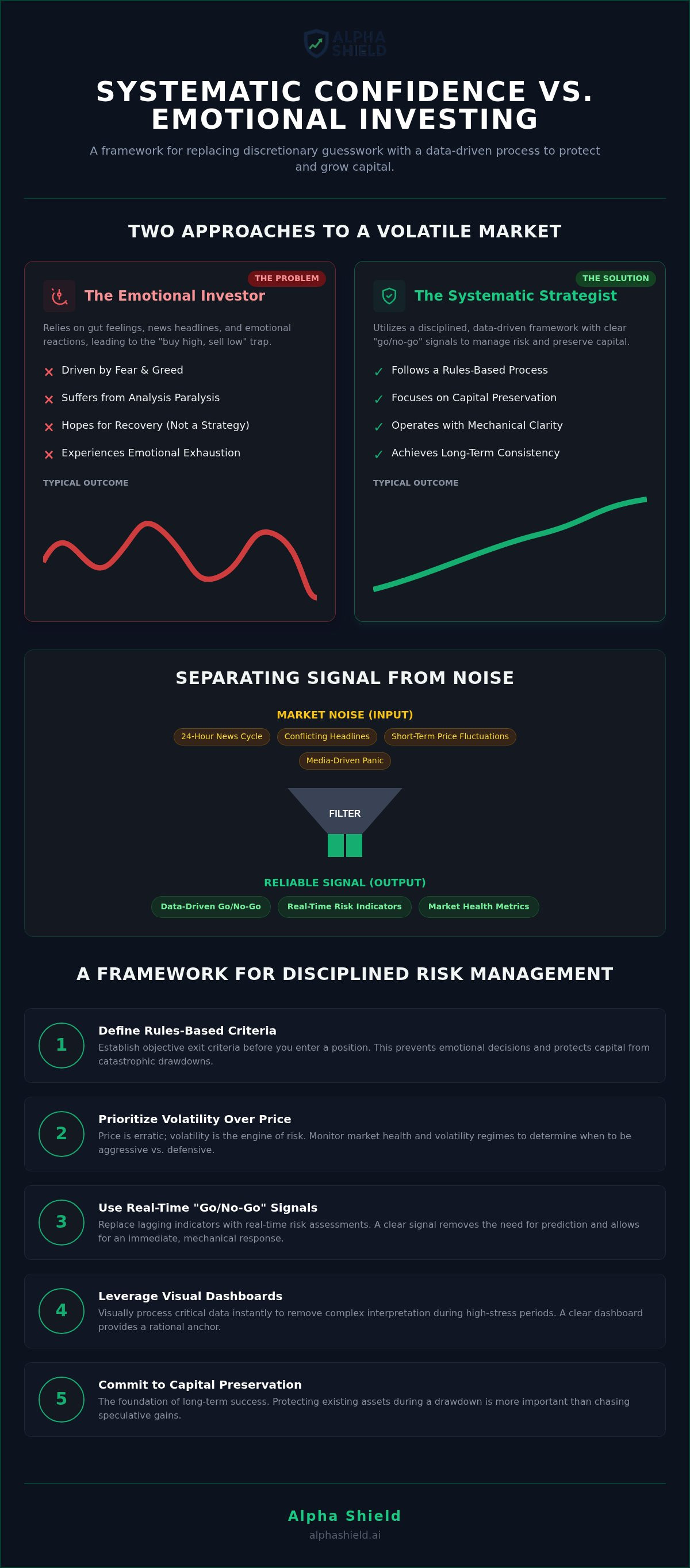
A 5-Step Framework for Building Investment Confidence
Confidence is the logical result of a repeatable process. To achieve consistency, you must move beyond the noise of individual stock picks and focus on a high-level investment decision making framework. This process begins with establishing a baseline for your risk tolerance. You must define your long-term capital goals before the market enters a period of stress. Without a clear objective, your decisions will naturally drift toward emotional reactions. Once your goals are set, you can identify a primary market signal that filters out daily volatility. This signal acts as your rational anchor, ensuring you only participate when the environment is healthy.
The next phase involves commitment to non-discretionary execution. If the signal mandates a reduction in exposure, you must act without hesitation. Reviewing portfolio health through a dedicated risk dashboard provides the visual clarity needed to maintain this discipline. Finally, you must audit your decisions. This step ensures your actions align with the system rather than your internal biases. If a decision was made out of fear or greed, it's a failure of the framework, regardless of the financial outcome. This audit creates a feedback loop of professional discipline.
Step 1: Selecting Your Risk Indicators
Effective risk management focuses on macro market indicators. Individual stock tips are often based on lagging sentiment or speculative rumors. In contrast, macro signals provide a view of the overall market health. You must understand the difference between market timing and systematic participation. Market timing is an attempt to predict the future. Systematic participation is a rule-based response to current conditions. Simple signals are often more effective than complex algorithms. A binary "go/no-go" indicator reduces the mental load and prevents analysis paralysis during high-stress events.
Step 2: Automating the Exit Strategy
The most critical component of wealth preservation is a pre-defined exit strategy. You must have rules for reducing exposure during high-risk regimes. This "if-then" logic provides a significant psychological benefit by removing the need for real-time debate. If market volatility exceeds a specific threshold, then you reduce risk. This prevents you from holding through a major drawdown out of hope or stubbornness. You can explore how to integrate these rules by reading about Alpha Shield: The Systematic Market Signal for Capital Preservation. Implementing an automated exit ensures your capital remains protected when the broader market enters a catastrophic phase.
Leveraging Alpha Shield for Disciplined Risk Management
Alpha Shield provides the mechanical engine required for a professional investment decision making framework. It serves as a rational anchor in a volatile environment. The system prioritizes capital preservation and emotional detachment over speculative excitement. By utilizing the Alpha Shield Market Signal, you move from a state of reactive stress to one of disciplined observation. This transition is essential for protecting long-term security. The focus remains strictly on systematic calculation and data-driven objectivity. A disciplined investor knows that the goal isn't to beat the market every day. The goal is to remain in the market over the long term by avoiding the errors that destroy wealth.
The Alpha Shield Dashboard delivers institutional-grade clarity to the individual investor. It reduces complex global data into a single, actionable instruction. This simplicity is a luxury in a world of infinite, conflicting information. If the dashboard indicates a risk-off environment, the system mandates protection. If the signal is green, the system participates. This binary clarity strips away the noise and allows you to manage risk with absolute certainty. It provides the "if-then" logical framework needed to navigate periods of high market stress without the burden of discretionary guesswork.
Stripping Away Market Noise
Alpha Shield deliberately avoids the sensationalism and aggressive urgency found in retail trading environments. It doesn't provide individual stock picks or day-trading tools. Instead, it filters out the hype of short-term speculation to find true market health indicators. This subtraction technique ensures that your strategy remains focused on what matters: the avoidance of catastrophic errors. The system acts as a methodical strategist that values consistency above all else. By systematically avoiding major drawdowns, you ensure that your portfolio benefits from the steady compounding effect of long-term growth. You aren't chasing the "big win" but rather preventing the "big loss" that halts progress.
Getting Started with Data-Driven Confidence
Integrating systematic signals into your investment decision making framework is a straightforward process of calibration. Professional-grade tools are now necessary for individual investors who value stability over gambles. You don't need to be a market guru when you have a battle-tested philosophy working behind the scenes. The system decodes market mechanics so you don't have to. This approach reduces the mental load of investing and provides a clear, unobstructed path to understanding market risk. Empower your decisions with the Alpha Shield Dashboard and secure your financial future through disciplined risk management.
Transitioning to Systematic Discipline
Building confidence in the markets is a process of subtraction. You subtract emotional noise and replace it with a calibrated investment decision making framework. True security doesn't come from predicting the next market top; it comes from having a rule-based response to current risk levels. By prioritizing capital preservation over speculative excitement, you protect your wealth from the catastrophic drawdowns that derail long-term growth. Alpha Shield provides this rational anchor. Founded by professionals with over 50 years of combined institutional experience, our system is designed for those who value stability. It's not a tool for day-trading; it's a mechanical signal for serious wealth management. We offer simplicity as a luxury by filtering complex data into actionable clarity.
You can now move from a state of uncertainty to one of disciplined execution. The clarity of a data-driven dashboard ensures your portfolio remains secure during periods of high volatility. This transition allows you to become a calm observer of market mechanics rather than a victim of sentiment. Your long-term success depends on the consistency of your process and the absolute protection of your capital.
Frequently Asked Questions
What is the difference between market timing and systematic risk management?
Market timing is a speculative attempt to predict the future, while systematic risk management is a reactive, rule-based response to current data. Guesswork and intuition drive timing strategies, which often lead to high-stress errors. A systematic investment decision making framework relies on measurable volatility metrics to dictate exposure. If the data indicates a high-risk regime, the system mandates a reduction in risk. This approach focuses on disciplined execution rather than predicting the exact moment a trend shifts.
Can a rules-based system really protect my portfolio from a market crash?
A rules-based system protects your portfolio by identifying market stress before it translates into a catastrophic collapse. By monitoring indicators like the VIX term structure, the system detects when the environment is unstable. If these parameters are breached, the framework mandates an immediate reduction in exposure. While no system eliminates all risk, this mechanical approach prevents you from holding through a major drawdown because it removes the hope-based delays typical of discretionary investing.
How do I stop making emotional investment decisions during high volatility?
You stop making emotional decisions by replacing your intuition with an objective market signal that acts as a circuit breaker. Fear and greed are variables that must be managed through a pre-defined execution plan. When market volatility increases, the human brain often defaults to irrational fight-or-flight responses. By following a systematic signal, you create a boundary between your emotions and your capital. You simply execute the data-driven instructions, which reduces the mental load of investing.
Why is capital preservation more important than high-risk stock picking?
Capital preservation is the mathematical foundation of wealth because large drawdowns are disproportionately difficult to recover from over time. A 50% loss requires a 100% gain just to return to the break-even point. High-risk stock picking often leads to significant losses that destroy the power of compounding. By prioritizing protection, you ensure that your assets remain available to participate in healthy market cycles. Consistency and the avoidance of catastrophic errors lead to superior long-term results.
What are macro market risk indicators and why should I track them?
Macro market risk indicators are broad metrics, such as volatility regimes, that track the health of the entire financial system. You should track them because systemic risk affects all assets simultaneously, regardless of individual stock performance. Tracking these indicators allows you to calibrate your exposure based on the overall environment. This is a core component of a robust investment decision making framework. It ensures you aren't caught in a systemic collapse while others are distracted by news headlines.
How does a market signal dashboard improve investment confidence?
A market signal dashboard improves confidence by translating complex institutional data into a single, actionable instruction. It provides visual clarity that strips away the noise of the 24-hour news cycle. When you can see a clear "go" or "no-go" indicator, your confidence increases because the decision is no longer a guess. It is the mechanical output of a disciplined system. This allows for calm, professional execution even during periods of extreme market panic and uncertainty.
Do I need professional experience to use institutional-grade investment signals?
You don't need professional institutional experience to use these signals because the system decodes complex mechanics for you. Alpha Shield is designed to provide individual investors with the same risk management rigor used by global banks. While the underlying engine is sophisticated, the output is direct and accessible. This allows any disciplined investor to manage their portfolio with the authority of a seasoned professional. The system acts as a protective guide, simplifying data into actionable rules.


