

Wealth preservation is not simply avoiding market risk. It means managing savings so they can support your needs and retain purchasing power through a retirement that may last 30 or more years. Practical wealth preservation strategies for retirees combine a balanced, diversified portfolio with tax-aware withdrawals and a plan for unexpected expenses; diversification can reduce risk, but it cannot prevent losses in a broad market decline.
Protecting assets from a specific threat is related to, but not the same as, preserving wealth over time. Both matter in retirement, and confusing them can leave gaps in a financial plan. This article explains the difference, then looks at how tax-efficient accounts, cash-flow analysis, and stress tests can help you assess whether your plan is prepared for changing markets, inflation, and shifting expenses. The aim is clarity: understand the levers you can review and how they work together to support a more resilient retirement plan.
Key Takeaways
- Separate long-term wealth preservation from protection against specific risks, then identify which gaps your plan needs to address.
- Review how account type and withdrawal timing can affect taxes, including the required minimum distribution starting age.
- Map income, spending, and withdrawal sources to see how retirement cash flow may respond to changing conditions.
- Stress-test your plan against market downturns, unexpected expenses, and other disruptions before they occur.
- Use these insights to decide which parts of your retirement strategy may need closer attention.
1. What is wealth preservation?
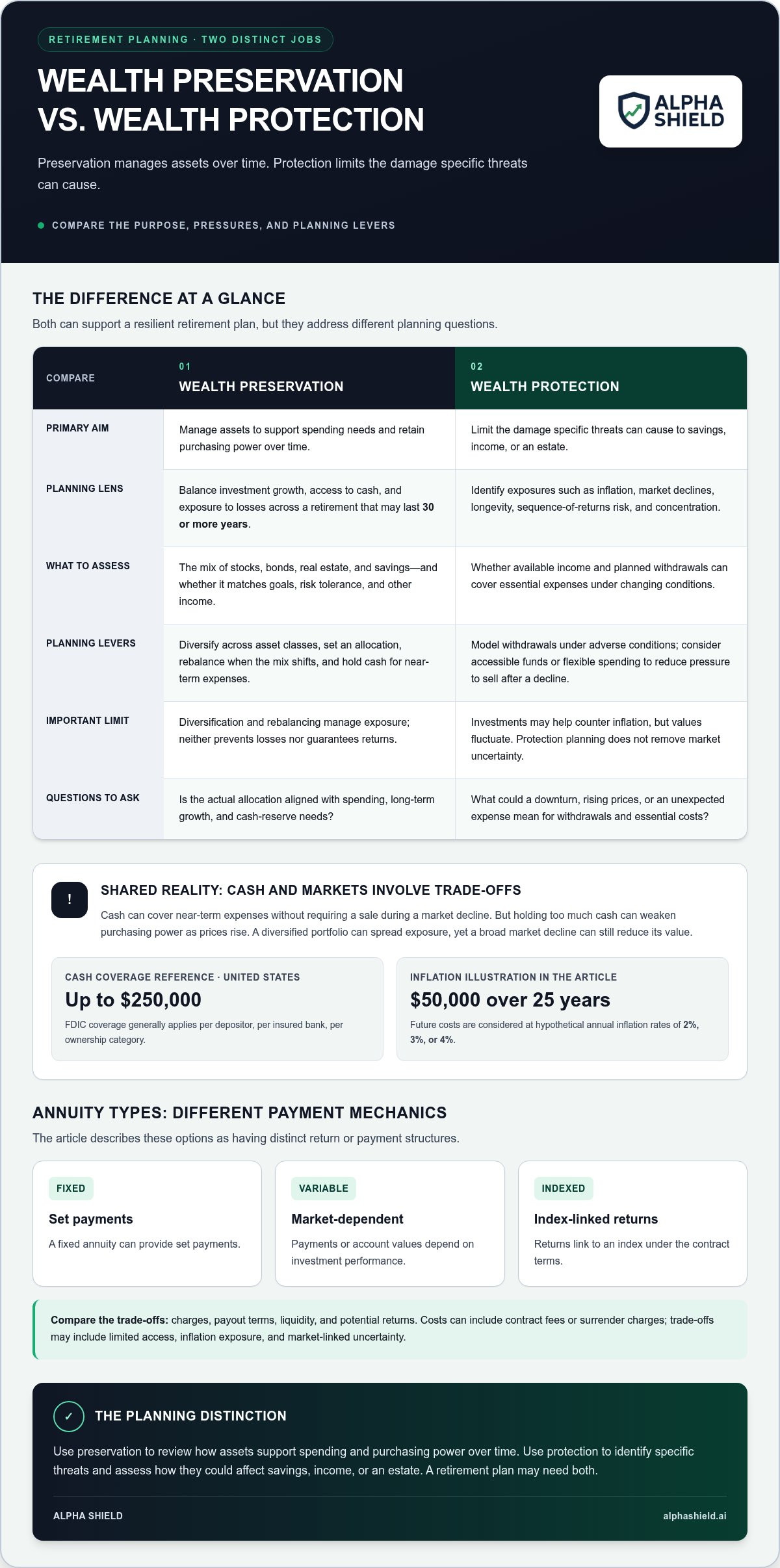
Wealth preservation means managing assets to support spending needs and retain purchasing power over time. For retirees, that means balancing investment growth, access to cash, and exposure to market losses. A portfolio holding stocks, bonds, and real estate spreads investments across asset classes. The right mix depends on retirement goals, risk tolerance, and income from other sources.
Diversification is a risk-management method, not a guarantee. If one company or asset class falls sharply, holdings in other areas may soften the impact. For example, a retiree with investments across several sectors, bonds, and property is less dependent on one company than someone holding a single stock. But a broad market decline can still reduce the value of a diversified portfolio.
Balance matters because retirement can last decades. A portfolio invested too conservatively may struggle to keep pace with inflation, taxes, and withdrawals over time. One concentrated in stocks can face sharp declines just when money is needed for living costs. Asset allocation sets the intended mix of investments, balancing growth potential with the need for stability and accessible funds.
Rebalancing helps keep that allocation aligned with the plan. Suppose stocks rise and become a larger share of the portfolio than intended. Selling some shares or directing new contributions toward bonds can restore the target mix. Review the allocation when market movements or changes in spending needs shift the balance. Rebalancing manages exposure, but it does not prevent losses or guarantee returns.
Cash has a different role from investments. It can cover near-term expenses without requiring a sale during a market decline, but holding too much cash can weaken purchasing power as prices rise. In the United States, the Federal Deposit Insurance Corporation generally covers up to $250,000 per depositor, per insured bank, per ownership category. That limit matters when deciding how much cash to hold at an insured bank.
Preservation can also include planning how assets transfer to family. In 2026, the U.S. lifetime gift tax exemption is $15 million, according to the Internal Revenue Service. That figure is one part of tax-aware estate planning, not an investment allocation rule. Account ownership, beneficiaries, and the timing of gifts can affect how a transfer fits into the wider retirement plan.
Start by listing each asset, its purpose, and the risk it carries. Then compare the portfolio’s actual allocation with the mix needed for spending, long-term growth, and cash reserves. This turns a broad goal into decisions about stocks, bonds, real estate, and savings. The result is a clearer view of concentration, liquidity, and inflation exposure.
2. What is the meaning of wealth protection?
Wealth protection limits the damage specific threats can cause to savings, income, or an estate. Inflation is one such threat: as prices rise, the same dollar amount buys less. For a retiree, purchasing power matters more than the account balance alone. If investment returns stay below inflation, the portfolio may grow on paper while covering fewer expenses.
Consider a $50,000 basket of goods and services over 25 years. A hypothetical annual inflation rate of 2%, 3%, or 4% produces different future costs, so the rate assumption changes the result. This illustration shows why a fixed cash balance can lose spending power over time. Market investments may help counter inflation through returns, but their values fluctuate and can fall when withdrawals continue.
Protection therefore needs to address several risks together. Longevity risk means savings must support an extended retirement, potentially 30 or more years. Market risk arises when investments decline; sequence-of-returns risk is especially relevant when losses occur early and withdrawals continue. Concentration risk develops when too much wealth depends on one company, asset class, or property. Review each exposure, then match available income and planned withdrawals to essential expenses.
To address inflation, downturns, and poor early returns, combine a diversified investment mix with accessible funds for near-term spending, then model withdrawals under adverse market conditions. For inflation, review whether expected portfolio returns can support future purchasing needs. For sequence risk, assess whether cash reserves or flexible spending could reduce the need to sell investments after a decline.
Fixed annuities can provide set payments, while variable annuity payments or account values depend on investment performance. Indexed annuities link returns to an index under contract terms. Costs can include contract fees or surrender charges, and trade-offs may include limited access, inflation exposure, and market-linked uncertainty. Compare charges, payout terms, liquidity, and potential returns with the income need the annuity would cover.
Wealth protection also supports a legacy plan. Review account beneficiaries and estate documents with an attorney so they reflect current intentions and family circumstances. If market volatility is a material portfolio risk, the Alpha Shield Market Signal provides a systematic market signal focused on navigating volatility and drawdowns. It can inform risk awareness, but it does not replace cash-flow planning or protection against inflation.
3. Tax-efficient accounts and Roth IRA conversions
Account type affects when retirement savings are taxed and how withdrawals fit into your income plan. Traditional retirement accounts generally defer taxation of investment growth until withdrawal. Qualified Roth IRA withdrawals in retirement are typically tax-free, and Roth IRAs held by the original account owner aren’t subject to required minimum distributions.
A Roth conversion moves assets from a traditional tax-deferred IRA into a Roth IRA. The converted amount may increase taxable income in the conversion year, so compare that added income with expected future tax exposure and the cash available to pay taxes. A conversion may suit someone who expects higher future taxes, but it isn’t automatically advantageous. Consider its effect on current expenses, other income, and estate planning before converting.
Required withdrawals also shape the decision. According to the Internal Revenue Service, individuals in the United States must begin taking required minimum distributions from retirement accounts at age 73. A Roth conversion may change future tax treatment, but it doesn’t remove applicable distribution rules for traditional accounts. Map expected withdrawals alongside other income before choosing a conversion amount.
Asset location is another planning lever. Tax-inefficient investments may fit better in tax-deferred accounts, while tax-efficient investments may suit taxable accounts. Consider each holding’s tax impact across the entire portfolio, not just within one account. For example, compare interest-producing assets with investments that generate fewer taxable distributions, then assess how each placement affects future withdrawals.
Creditor protection depends on account type and applicable law. Many U.S. retirement accounts, including 401(k) plans, have protections under federal law. That protection shouldn’t be assumed to cover every asset or every legal situation. Keep account records clear, review beneficiary designations, and include ownership details in estate planning documents.
Offshore accounts require separate scrutiny. An account’s location alone doesn’t explain its tax treatment, privacy rules, custody arrangements, or access conditions. Before including one in a retirement plan, identify the jurisdiction, account terms, reporting responsibilities, and how funds could be transferred. Privacy should not be confused with tax efficiency or asset protection.
To reduce investment-fraud risk, pause before acting on an unsolicited offer, promised returns, or pressure to transfer funds quickly. Independently verify the firm and the person contacting you, and confirm payment instructions through a trusted channel before moving money. These steps help prevent urgency from overriding careful review.
Education helps make these choices more systematic. Gather statements for each account, label its tax treatment, and list expected withdrawals and beneficiaries. Then compare conversion timing, asset location, and creditor protections as connected decisions. The goal is a plan that coordinates taxes, access, and ownership, rather than treating each account as an isolated balance.
4. Cash-flow analysis and financial-plan stress testing
A cash-flow analysis compares retirement income with essential and flexible spending. Start by listing Social Security, pensions, investment withdrawals, housing, healthcare, and everyday expenses. Then mark which costs could change if markets fall or income shifts. A monthly view can reveal whether withdrawals cover a temporary gap or create lasting strain on the financial plan.
Next, test the plan against distinct conditions, not one average forecast. Model a market downturn early in retirement, an unexpected expense, and a longer-than-expected retirement lasting 30 or more years. If income falls or costs rise, identify which spending can adjust and which assets would fund the shortfall. Stress testing shows where the plan is sensitive, before a real disruption forces rushed decisions.
Review withdrawal order alongside account type. For example, compare taxable savings, a traditional retirement account, and a Roth IRA, considering each account’s tax treatment and role in future income. An accessible emergency fund can help cover an unexpected bill without selling investments during a downturn. Review your financial plan at least once a year and after a major change in income, health, or household spending.
Healthcare needs deserve a separate stress test. Nearly 70% of people in the United States aged 65 and older will require some type of long-term care service. A 65-year-old retiring in the United States in 2026 may need $185,500 in after-tax savings for healthcare expenses in retirement. Include potential care needs in spending scenarios, then assess how savings, insurance, and family support could affect available assets.
Set goals that guide specific choices. Separate required income for housing and healthcare from goals such as travel, gifts, or charitable giving. A financial professional can review assumptions, tax exposure, withdrawal sequencing, and how assets fit your goals. If estate planning includes trusts, coordinate their intended role with the cash-flow plan. The aim is a clear balance between current spending and future commitments.
Healthy financial habits make the analysis useful over time. Keep account statements and spending records together, update beneficiary details, and record major decisions. Regular reviews help identify changes before they compound. If your plan supports family education, discuss budgeting and long-term trade-offs with adult children using practical examples, such as how a large gift could affect later care reserves.
Teaching children financial responsibility can also strengthen a legacy. Explain how income, spending, saving, and risk fit together, and involve them in age-appropriate family discussions about goals. Keep private account credentials secure, and share estate documents only through deliberate planning. These steps build understanding without making children responsible for decisions that belong to the retiree.
5. Wealth preservation versus wealth protection
Wealth preservation and wealth protection address different risks. Preservation focuses on maintaining purchasing power and supporting income over time. Protection focuses on limiting damage from specific events, such as liability claims, fraud, or a financial institution’s failure. A retirement plan needs both: diversified investments may support long-term goals, while insurance and legal structures address other exposures.
Consider a retiree whose portfolio holds stocks, bonds, and real estate. Asset allocation and disciplined withdrawals aim to sustain resources through changing markets and expenses. That is preservation. If the same retiree faces a liability claim, umbrella insurance may help address that distinct exposure. Insurance products can protect against unforeseen events, but they don’t prevent investment losses or replace an income and spending plan.
Account protection also has limits. In the United States, Securities Investor Protection Corporation protection generally covers up to $500,000, including up to $250,000 for qualifying cash, when a SIPC member firm fails. It does not cover market losses. If a portfolio declines because its investments lose value, that is an investment risk, not a brokerage failure covered by SIPC.
Legal structures can address particular claims and liabilities. An asset protection trust or a separate business entity may form part of an asset-protection approach, while a will or trust can guide how assets transfer. These tools serve different purposes. A trust designed for estate planning, for example, addresses management or distribution rather than day-to-day portfolio volatility. Ownership, control, and intended beneficiaries matter when fitting structures into a wider plan.
A practical wealth management review starts by naming the risk, then matching it to the right response. Ask whether the concern is falling purchasing power, a concentrated holding, a liability, or a disrupted transfer to heirs. Investments across asset classes may address concentration, while insurance or legal arrangements may address other exposures. Interest income can support cash flow, but it does not by itself protect assets from inflation or claims.
The distinction matters because no single tool covers every threat. A market signal cannot replace liability insurance, and a trust cannot prevent market declines. List each major asset, its purpose, and the risks that could affect it. Then review whether the response protects income, value, ownership, or transfer. This makes gaps visible and keeps decisions tied to the risks they are meant to address.
Review a systematic market-risk signal as one input to a disciplined preservation plan.
Alpha Shield: Alpha Shield Market Signal
Alpha Shield Market Signal gives investors a systematic signal for navigating market volatility and managing drawdown risk. It can be useful when market uncertainty makes it harder to assess portfolio exposure within a long-term retirement plan. The signal supports risk awareness, but does not replace diversification, cash-flow planning, or tax decisions.
The Market crash and drawdown tool and Alpha Shield Dashboard provide clear indicators for market crash protection and risk management. Use them as inputs when reviewing how market conditions relate to your investment plan. Alpha Shield focuses on long-term capital preservation, not day trading, shorting, or individual stock recommendations.
For a measured next step, visit alphashield.ai to learn about Alpha Shield Market Signal.
Put your next retirement review into action
A useful next step is to turn your retirement plan into a working decision guide. Record the assumptions behind income, spending, tax choices, and portfolio risk. Then note what would prompt a review, such as a change in expenses, a major market shift, or a family transition. This creates a clear process instead of relying on memory when conditions change.
Strong wealth preservation strategies for retirees depend on coordinated choices, not one account or protection tool. Keep the purpose of each asset clear. Separate market risk from legal, tax, and healthcare concerns, then decide which part of the plan each action addresses. That discipline helps focus future discussions and keep decisions connected to your goals.
For a market-risk input, Alpha Shield offers Alpha Shield Market Signal, a Market crash and drawdown tool, and Alpha Shield Dashboard. Consider whether these fit your approach to monitoring volatility and drawdown risk.
Take the next step at a pace that suits your plan. Clear priorities make future decisions easier to organize.
Frequently Asked Questions
What is wealth preservation?
Wealth preservation is the coordinated management of assets so they can support spending needs and retain value over time. Start by listing each account, property, and income source, then connect each to a purpose. For example, a retiree might use a bond ladder for planned expenses and retain growth investments for longer-term needs. The approach depends on time horizon, taxes, liquidity, and tolerance for losses.
What is the meaning of wealth protection?
Wealth protection means reducing the impact of specific threats to assets or income. These may include liability claims, fraud, an unexpected health event, or the failure of a financial institution. Match each risk with a relevant safeguard, such as secure account practices or appropriate insurance. Protection measures have defined limits, so review what each covers and what remains exposed rather than assuming one measure shields every asset.
How should you handle concentrated assets and private equity?
First, calculate how much of your overall wealth depends on the concentrated holding, including related company shares or real estate. Then assess liquidity, taxes on a sale, transfer restrictions, and how a sharp decline could affect planned spending. Private equity may be difficult to sell quickly and can involve complex valuations. Consider staged diversification and coordinate any sale with your tax and cash-flow plans.
Is this only relevant for the ultra wealthy?
No. Preservation matters whenever retirement income depends on savings, whether the portfolio is modest or substantial. A retiree with a home, an IRA, and a few taxable investments still needs to manage withdrawal timing, unexpected expenses, and beneficiaries. Larger portfolios may face additional estate and concentration questions, but the basics apply at any scale: track assets, assign each a purpose, and review the plan as circumstances change.
What are the most effective wealth preservation strategies for retirees in the United States?
Useful wealth preservation strategies for retirees in the United States combine a spending plan, tax-aware withdrawals, diversified investments, and safeguards for specific risks. Start by separating essential expenses from discretionary goals, then identify which income sources cover each. Review account beneficiaries and estate documents after major life changes. The right sequence depends on available income, account types, health needs, and household flexibility.
How should retirees allocate assets between stocks, bonds, cash, and inflation-protected investments?
There is no universal allocation that fits every retiree. Set the mix by identifying near-term spending needs, income sources, time horizon, and ability to tolerate losses. Cash can support immediate expenses; bonds may provide income and reduce some portfolio volatility; stocks offer growth potential but fluctuate. Inflation-protected investments can address purchasing-power concerns. Review the total portfolio together, rather than choosing each holding in isolation.
What is a safe withdrawal rate for retirement savings, and how does the 4% rule work?
A withdrawal rate is a starting framework, not a guarantee that savings will last. One guideline suggests withdrawing 4%-5% of savings in the first retirement year, then adjusting that amount for inflation in later years. The outcome depends on market returns, fees, taxes, spending changes, and retirement length. Revisit withdrawals after major portfolio declines or income changes, and distinguish essential spending from costs that can be reduced.
How can retirees reduce taxes on Social Security, pensions, and retirement account withdrawals?
Coordinate withdrawals across taxable, tax-deferred, and Roth accounts instead of automatically drawing from one source. Social Security’s tax treatment can depend on a retiree’s other income, while pension payments and traditional retirement-account withdrawals may affect taxable income. Compare the timing and size of withdrawals with expected expenses and required distributions. Keep records of income sources, then review the combined tax impact before changing withdrawals.


