

A market crash doesn’t automatically mean you should sell. A sound set of 401k crash protection strategies starts with an allocation that fits your age and retirement timeline, then relies on steady contributions and planned rebalancing rather than a reaction to daily market moves. One rough guideline is to subtract your age from 110 to estimate the share of your portfolio in equities.
It’s reasonable to feel pressure to act when your account balance falls. But a downturn affects investors differently depending on when they expect to use their savings and how much risk their plan can absorb. This guide explains how to rebalance, keep contributing when appropriate, capture an available employer match, and think about retirement timing before making a change.
You’ll also see why a strategy suited to someone with decades until retirement may not fit someone approaching withdrawals. The aim is a clear decision framework, not a promise that any approach can prevent losses: align your portfolio with your time horizon and make changes according to a plan, not market noise.
Key Takeaways
- Set an allocation that reflects your retirement horizon and capacity to tolerate market swings, rather than reacting to a single downturn.
- Use a consistent rebalancing rule to bring your portfolio back toward its intended mix when market movements shift it.
- Before withdrawing during a crash, consider the potential tax consequences and whether other available savings can cover near-term needs.
- Review your contribution level and employer match together, then weigh any changes against your cash-flow needs and long-term plan.
- As retirement approaches, pay closer attention to when you may need to draw on your savings and how a downturn could affect those withdrawals.
1. How to Protect 401(k) from Stock Market Crash?
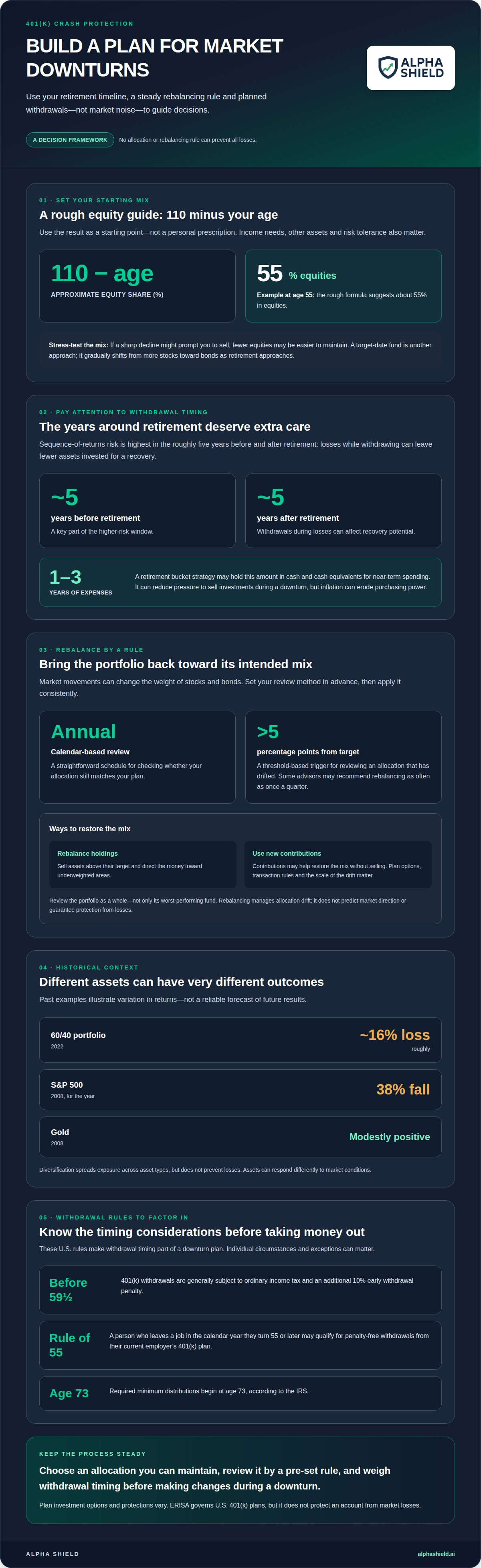
Start with the risk your retirement timeline can support, not with a prediction about tomorrow’s market. One rough allocation guide subtracts your age from 110 to estimate the percentage invested in equities. At 55, that suggests roughly 55% equities. It’s a starting point, not a personal prescription: income needs, other assets, and risk tolerance also matter.
Test your risk tolerance against a realistic downturn. If a sharp account decline might prompt you to sell, an allocation with fewer equities may be easier to maintain. If retirement is decades away and you can tolerate volatility, a higher equity share may fit your time horizon. A target-date fund offers another approach, gradually shifting from more stocks toward bonds as retirement approaches.
Timing matters most near withdrawals. Sequence-of-returns risk is highest in the roughly five years before and after retirement, because losses during withdrawals can leave fewer assets invested for a recovery. A retirement bucket strategy may keep one to three years of expenses in cash and cash equivalents for near-term spending. Cash can reduce pressure to sell investments during a downturn, but inflation can erode its purchasing power.
Employer plans differ in their investment options and protections. Each plan sets its own investment menu and rules, so your allocation choices depend on the funds and features your employer’s plan provides.
ERISA governs U.S. 401(k) plans. It does not protect an account from market losses, so plan protections and investment risk are separate issues.
Employer 401(k) assets generally receive protection from creditors, including in bankruptcy, but legal circumstances and exceptions can matter. ERISA’s role in governing a plan does not make every creditor situation identical.
Stable value and money market funds can reduce exposure to stock-price swings, but they don’t eliminate every risk or ensure purchasing power keeps pace with inflation. Costs depend on the fund and plan charges, so compare expense information and any plan-level fees when weighing the trade-offs.
A rollover changes which account holds your savings, not the market risk of its investments. A direct rollover to a traditional IRA can be tax-free when done correctly, but the new account’s allocation still determines its exposure to a downturn.
In the United States, withdrawals from a 401(k) before age 59½ are generally subject to ordinary income tax and an additional 10% early withdrawal penalty, according to the Internal Revenue Service. Under the U.S. Rule of 55, a person who leaves their job in the calendar year they turn 55 or later may qualify for penalty-free withdrawals from their current employer’s 401(k) plan, according to the Internal Revenue Service. Under SECURE 2.0, required minimum distributions begin at age 73, according to the Internal Revenue Service. These rules make withdrawal timing part of a crash plan, not an afterthought.
2. Rebalancing a retirement portfolio
Rebalancing restores your portfolio’s intended mix after market movements change the relative weight of its assets. If stocks rise faster than bonds, equities can take up a larger share than planned. If stocks fall, the portfolio may become more conservative without a deliberate decision. Set a review schedule before volatility rises. A consistent rule helps separate portfolio maintenance from short-term market reactions.
One practical schedule is to review your allocation annually or when it drifts more than five percentage points from its target. Some financial advisors may recommend rebalancing as often as once a quarter. A calendar-based review is straightforward, while a threshold-based review responds to larger shifts. Choose a method you can follow in changing market conditions, then apply it consistently instead of adjusting the rule after losses.
Rebalancing can mean selling assets that have grown beyond their target and directing the money toward underweighted areas. New contributions may also help restore the mix without selling. The right method depends on your plan’s investment options, transaction rules, and the scale of the drift. Review the portfolio as a whole, not just its worst-performing fund. A single weak holding may not justify changing an allocation that remains aligned with your plan.
Diversification spreads exposure across asset types, but it does not prevent losses. Stocks, bonds, cash equivalents, and other assets can respond differently to market conditions. Historical performance also shows why a familiar mix is not a guarantee: a 60/40 portfolio lost roughly 16% in 2022. In 2008, the S&P 500 fell 38% for the year, while gold finished modestly positive. Those examples illustrate differing returns, not a reliable forecast of future results.
Assess possible losses before a crash by reviewing how much of your retirement portfolio depends on stocks and whether that exposure fits your time horizon. Consider how a decline could affect your plans, rather than assuming diversification will eliminate downside risk. If a potential loss would trigger selling, revisit the target allocation and your risk tolerance while decisions are calm. An advisor can help translate those factors into a portfolio rule you can maintain. These 401k crash protection strategies work best as a consistent process, not a prediction.
Rebalancing manages allocation drift; it does not forecast market direction or guarantee protection from losses. As one element of 401k crash protection strategies, it can help keep portfolio decisions tied to a chosen risk level. For a separate view of market volatility, the market crash and drawdown tool can provide context alongside a scheduled portfolio review. Keep the roles distinct: use allocation rules to maintain your investment mix, and treat market signals as another input rather than a replacement for your plan.
3. Avoiding panic withdrawals during a market crash
A market crash can reduce a 401(k) balance quickly, but the size of the decline depends on its allocation. In 2008, the average 401(k) balance dropped by more than 30%, according to Fidelity. The S&P 500 fell 34% from February 19 to March 23, 2020. A 401(k) may experience declines of 30%, 40%, or 50%, especially when stocks make up a large share of its assets.
An index decline and an individual account decline aren’t identical. A portfolio holding bonds, cash equivalents, or other investments may move differently from the S&P 500. The mix matters, as do the funds held inside each category. Treat a headline market decline as context, not as a precise estimate of your own balance or a standalone reason to sell.
Put a pause between market news and a major decision. One behavioral guardrail is to wait a full 24 hours before making a large discretionary move out of equities. During that pause, write down the reason for the proposed change and compare it with your investment target. If the reason is a sudden price drop rather than a change in your retirement needs, avoid turning a short-term reaction into a permanent portfolio decision.
Separate urgent spending needs from reactions to account losses. An emergency fund covering three to six months of living expenses can help pay near-term bills without selling 401(k) investments during a downturn. Keep that reserve distinct from retirement assets. If savings outside the plan can meet the expense, a market decline alone may not require a withdrawal.
Use a simple decision sequence before changing investments. First, identify whether the money is needed for an immediate expense or whether the proposed sale is discretionary. Next, review the account’s allocation and compare it with the target you set before the downturn. Then consider whether the reason for changing that target still applies. This process keeps the decision evidence-based rather than driven by the latest market headline.
Selling during a decline turns a market loss into a realized loss on the assets sold. It also leaves less money invested if prices later rise, though there’s no assured recovery schedule. A disciplined response doesn’t mean ignoring a genuine change in income, retirement timing, or spending needs. It means evaluating that change separately from daily volatility. If your financial situation has changed, adjust your plan for that reason, not simply because your account balance is lower.
4. Continuing 401(k) contributions and capturing employer matches
A market downturn can make continued contributions feel counterintuitive, but each paycheck contribution buys investments at current prices. With dollar-cost averaging, a fixed contribution purchases more shares when prices are lower and fewer when prices are higher. This approach follows a schedule rather than trying to identify the market bottom. It doesn’t remove investment risk, but it keeps purchases consistent with your plan.
Start by reviewing your contribution rate, cash-flow needs, and employer match rules. If your employer matches contributions, understand the plan’s formula and the contribution level needed to receive the full available match. Contributing less may reduce the match you receive. If household expenses have changed, adjust your rate with a clear budget in mind rather than responding solely to market headlines.
The 2026 United States 401(k) contribution limit is $24,500, according to the Internal Revenue Service. For 2026, the United States 401(k) catch-up contribution limit is an additional $8,000 for participants age 50 and older, according to the Internal Revenue Service. For 2026, the United States 401(k) catch-up contribution limit is an additional $11,250 for participants turning 60 through 63, according to the Internal Revenue Service. These limits help frame contribution planning; your paycheck schedule and plan administration determine how contributions are applied.
For a practical review, compare your current contribution with three factors: your monthly budget, your employer’s match terms, and your retirement savings target. If your budget allows, steady contributions can maintain regular market participation during a downturn. If cash flow is strained, a temporary adjustment may be more workable than stopping contributions without a plan. Revisit the decision when your income or expenses change.
Check how your contributions are invested, not just how much you contribute. Some plans direct new contributions according to your existing investment election; others allow a different allocation. Target-date funds, for example, automatically shift their investment mix toward bonds as their target retirement date approaches. If your contribution election doesn’t match your intended allocation, new deposits may gradually move the account away from its target.
An employer match adds money according to the plan’s terms, but it doesn’t shield the account from market losses. Contributions and matching funds remain invested according to the options you select. Keep a record of your contribution rate, match terms, and investment election, then review them when your budget or retirement timeline changes. The goal is a repeatable contribution process, not a prediction of when a downturn will end.
5. Protection strategies by age and retirement timeline
Your age matters, but the date you expect to use your 401(k) matters more. If retirement is 25–30 years away, a market decline leaves more time before planned withdrawals. That longer horizon can support an allocation focused on growth, provided its risk level fits your finances and risk tolerance. If a steep decline would force you to sell or abandon the plan, reassess the mix before volatility rises.
Age-based formulas are starting points, not instructions. A rough variation subtracts your age from 120 for someone with high risk tolerance; subtracting age from 100 gives a more conservative variation. The difference changes the implied stock allocation, so treat each result as a prompt to consider capacity for losses, other income, and withdrawal timing. A formula alone can’t account for those factors.
Planning changes as retirement approaches. Someone five to ten years from retirement without a withdrawal plan may benefit from discussing the plan with a fiduciary advisor. Map expected income sources, essential spending, and the assets available for withdrawals. Then consider how a market decline could affect the timing of sales. The goal is to reduce the chance that near-term income needs dictate investment decisions during a downturn.
The retirement red zone is roughly five years on either side of retirement, when sequence-of-returns risk is highest. Losses during this period can have greater consequences if withdrawals begin while the portfolio is down. A reserve for near-term spending can reduce the need to sell investments at depressed prices. One retirement bucket approach holds one to three years of expenses in cash and cash equivalents, separate from assets intended for longer-term growth.
If retirement is within 12 months, the initial cash bucket may be established while markets are favorable. That timing connects the reserve to an actual spending plan rather than a reaction to a sudden decline. Set a process for replenishing the bucket, too: identify which income sources and portfolio assets could fund future spending, and when you would review that decision. A reserve supports withdrawals; it doesn’t remove inflation risk or market risk from the rest of the account.
Use your timeline to guide your next decision. With a long horizon, focus on whether your allocation can withstand volatility. Near retirement, prioritize withdrawal sequencing, income needs, and available reserves. At every stage, match risk exposure to when you’ll need the money, not age alone.
Alpha Shield: Market crash and drawdown tool
Alpha Shield’s Market crash and drawdown tool helps investors assess market volatility alongside their existing retirement plan. The Alpha Shield Market Signal is designed to support systematic decisions during changing market conditions, while the Alpha Shield Dashboard presents indicators for crash protection and risk management. Use these tools as context for reviewing your exposure and timing, not as a substitute for your 401(k) allocation, contribution, or withdrawal plan. Alpha Shield focuses on long-term capital preservation, not day trading, shorting, or individual stock recommendations. If you want a structured market signal to inform your risk-management process, contact Alpha Shield to discuss the available tools.
Make your next decision deliberate
Write down one decision rule before market conditions test it. For example, define what would prompt you to revisit your allocation, what would count as a genuine change in your retirement plans, and which actions you won’t take based only on headlines. A written rule gives you a reference point when emotions and market noise compete for attention.
Effective 401k crash protection strategies aren’t about predicting every downturn. They’re about establishing a process that fits your circumstances, then applying it consistently as those circumstances evolve. Revisit the plan when your retirement date, income needs, or capacity for risk changes. That keeps the next step connected to your real goals.
If you want a market signal to inform your risk-management process, contact Alpha Shield.
Stay focused on decisions you can control. A clear process is a practical foundation for moving forward with confidence.
Frequently Asked Questions
How to Protect 401(k) from Stock Market Crash?
Protect your 401(k) from avoidable decisions, not from every market loss. Confirm that your investments still match your retirement date, expected withdrawals, and tolerance for declines. For example, someone planning to use savings soon may prioritize access to planned spending money, while a long-term investor may focus on maintaining their chosen allocation. Avoid making a major change based only on a single day’s market move.
Can I lose my entire 401(k)?
A market crash can reduce your balance, but it doesn’t automatically erase your account. The outcome depends on the investments you hold and how they perform; a broad fund and a single-company stock have different exposures. Review what each fund owns and whether your account is concentrated in a narrow area. Also distinguish investment losses from account access problems, which are separate issues.
How do I protect my 401(k) without paying taxes?
Changing investments within a 401(k) is different from taking money out of it. A distribution can trigger taxes: in the United States, withdrawals before age 59½ are generally subject to ordinary income tax and an additional 10% early withdrawal penalty, according to the Internal Revenue Service. A direct rollover to a traditional IRA can be tax-free when completed correctly. Avoid receiving the funds yourself unless you understand the applicable rules.
Is it too late to protect my 401(k) if the market is already falling?
No. You can still review your allocation, upcoming cash needs, and investment choices after a decline begins. The key is not to treat a falling market as proof that a particular change is right. Write down the reason for any proposed adjustment, then compare it with your retirement timeline and existing plan. A change based on a genuine shift in your circumstances is different from a rushed reaction to price movements.
Should I move my 401(k) to bonds before a crash?
Not automatically. Bonds can behave differently from stocks, but they still carry investment risks and can lose value. Moving heavily into bonds based on a crash prediction may also leave you with a portfolio that no longer fits your time horizon. Consider the role bonds already play in your allocation and whether a change supports a specific retirement or spending need, rather than relying on a forecast.
Should I move my 401(k) to cash?
Cash can make near-term spending needs more accessible, but moving an entire account to cash changes its growth exposure and doesn’t remove every risk. The right amount depends on when you expect withdrawals and what other income or reserves you have. Before changing investments, separate money intended for near-term expenses from retirement assets meant to remain invested. Avoid making the decision solely to escape a market decline.
Should I rebalance my 401(k) before a recession?
Rebalance according to a preset allocation rule, not a recession forecast. Rebalancing can restore your chosen mix when market movements push it off target, but it can’t tell you when a downturn will begin. For example, if your plan is to review on a set schedule, apply that schedule in rising and falling markets alike. Consider whether new contributions can adjust the mix before selling investments.
How are 401(k) investments protected during a stock market crash?
A 401(k) is a retirement account, not a guarantee against investment losses. The market value of its funds can fall during a crash, depending on the assets held. Account protections and investment performance are distinct: rules governing a plan don’t prevent stock or bond prices from declining. Review your plan’s investment options and account statements to understand what you own and how market movements affect those holdings.


