

You can change the investments in your 401(k), but reliably timing a market crash and recovery isn’t a dependable retirement strategy. If you’re asking whether you can time the market in your 401(k), the practical answer is that reacting to a drop can mean missing the rebound as well as avoiding some losses.
A sharp decline can make your account balance fall, but the effect depends on your investment mix and how close you are to using the money. It’s understandable to want to act when the numbers move quickly. A steadier response is to review whether your allocation still fits your time horizon and risk tolerance, rather than making a sudden change based only on market headlines.
This guide explains what a market drop can mean for your 401(k), when it may make sense to review your investment mix, and how continuing regular contributions can help you keep investing through volatility. The focus is on decisions you can make systematically, not guesses about the market’s next move.
Key Takeaways
- A market decline can lower your 401(k) balance, but the impact depends on your investment mix and how long you have until retirement.
- Review your stock, bond, and cash allocation against your time horizon and risk tolerance, rather than reacting to headlines alone.
- Steady contributions keep your investment plan moving through market swings and may buy more shares when prices are lower.
- Trying to exit near a market peak and re-enter at the bottom means making two difficult timing decisions, with the risk of missing a rebound.
- A disciplined review of your plan can help you decide whether your current strategy still fits your retirement goals.
1. Continuing contributions and dollar-cost averaging
During a downturn, continuing regular 401(k) contributions keeps your retirement savings invested on a schedule. Each contribution buys shares at the prices available at that time. If prices are lower, the same contribution buys more shares; if prices rise, it buys fewer. This is dollar-cost averaging, not a way to guarantee gains or identify the market bottom.
For example, one illustration uses three contributions of $500 each to purchase a total of 21.67 shares. The number of shares bought with each contribution changes with its purchase price. A market decline of 10 to 15% can mean each contributed dollar buys more shares at lower prices. Those purchases may benefit if prices later recover, but the account can still lose value if investments fall further.
Instead of trying to time the market, consider regular contributions, an allocation suited to your time horizon, and rebalancing when your portfolio moves away from its target. If you have adequate emergency savings, continuing contributions can help you avoid basing retirement decisions on a guessed market bottom. Before changing payroll deductions, check whether doing so could reduce an employer match. Contributing enough to receive the full available match can support your retirement savings.
For 2026, the employee contribution limit for traditional and Roth 401(k) contributions combined is $24,500. Participants who are at least age 50 by year-end can make an additional $8,000 catch-up contribution. Those aged 60–63 may be able to contribute an additional $11,250 if their plan allows. These limits apply to employee contributions, so review your year-to-date total before adjusting payroll elections.
To check your employer 401(k) plan’s trading rules, review the plan’s investment materials and account platform for limits on exchanges, transfers, or trading frequency. If a rule is unclear, consult the plan administrator before placing transactions; contribution elections and investment-transfer rules may be separate.
Withdrawing money is different from changing investments inside the account. In the United States, 401(k) withdrawals made before age 59½ are generally subject to ordinary income tax and an additional 10% early withdrawal penalty, according to the Internal Revenue Service. A withdrawal before age 59½ may incur that 10% penalty in addition to income taxes, unless an exception applies, according to the Internal Revenue Service. The Rule of 55 may avoid the 10% early withdrawal penalty for distributions from that employer’s workplace plan when a person leaves the employer in or after the year they turn 55, according to the Internal Revenue Service. Consider the tax consequences before using a withdrawal to respond to market volatility.
2. How Should You Think About Your Strategy for Stocks, Bonds, and Cash?
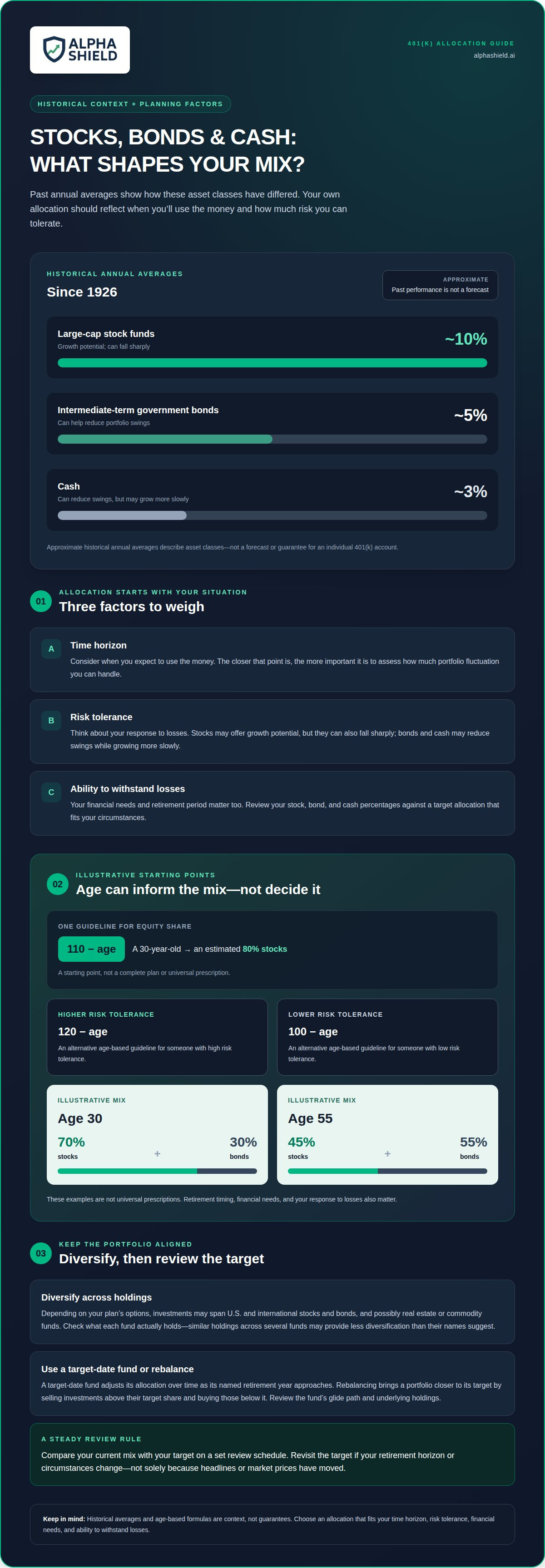
Set your 401(k) allocation around your retirement time horizon, risk tolerance, and ability to withstand losses. Stocks offer growth potential but can fall sharply; bonds and cash can reduce portfolio swings, but may grow more slowly. Historical annual averages since 1926 were approximately 10% for large-cap stock funds, 5% for intermediate-term government bonds, and 3% for cash. Those past averages describe different asset classes, not a forecast or guarantee for your account.
Start by checking the percentage of your account held in each asset class. Then compare it with a target allocation that reflects when you expect to use the money. For example, one guideline estimates the equity percentage by subtracting your age from 110. An investor aged 30 would get an 80% stock estimate under that formula. It is a starting point, not a complete plan.
Risk tolerance can adjust that starting point. The age-based guideline uses 120 minus your age for someone with high risk tolerance, or 100 minus age for someone with low risk tolerance. The examples in this approach suggest a 70% stocks and 30% bonds starting allocation for a 30-year-old, and 45% stocks and 55% bonds for a 55-year-old. These are examples, not universal prescriptions. Your retirement period, financial needs, and response to losses also matter.
Diversification means spreading investments across different asset types and markets rather than relying on one holding. Depending on the options in your 401(k), a portfolio could include U.S. and international stocks and bonds, and possibly real estate or commodity funds. Review what each fund holds. Several funds with similar holdings may provide less diversification than their names suggest.
A target-date fund combines investments and adjusts its allocation over time as its named retirement year approaches. Automatic rebalancing brings a portfolio closer to its target by selling investments that have grown beyond their target share and buying those that have fallen below it. Before choosing a fund, review its glide path and underlying holdings.
Rebalancing can also be done manually when market movements shift your allocation away from its target. Set a review period and use the same target-based rule each time, unless your retirement horizon or circumstances change. A traditional 401(k) investment adjustment inside the account is different from a withdrawal; allocation changes alone do not create a withdrawal penalty.
If market volatility is complicating your allocation decisions, a market-risk signal can provide another input alongside your plan’s target and time horizon.
3. Whether to change 401(k) investments during a market drop
A market decline alone doesn’t tell you to change your 401(k) investments. First compare your current portfolio with its target allocation and retirement time horizon. If the drop has pushed your mix away from that target, rebalancing may bring it back in line. If your goals and circumstances haven’t changed, selling solely because prices fell turns a long-term plan into a short-term market call. If you’re asking, “Can I time the market in my 401(k)?”, remember that a drop alone can’t identify the right time to sell.
Moving to cash requires two decisions: when to sell and when to reinvest. Investors who moved to cash during the spring 2025 market drop missed a 9.5% single-day rebound in the S&P 500 on April 9, 2025. That example shows the difficulty of predicting both a decline and a recovery. If you’re considering whether you can time the market in your 401(k), account for the possibility that a sharp rebound may happen before you decide to reinvest.
Buying during a decline can mean your ongoing contributions purchase more shares, but it doesn’t guarantee a quick recovery. Before shifting investments, ask whether the change supports your target allocation or simply reacts to recent prices. Since World War II, the average U.S. market pullback took a month and a half to recover its lost ground. This is historical context, not a timetable for the next downturn.
Recessions also test a portfolio’s time horizon. The United States has experienced approximately 16 recessions since 1926, each followed by a recovery. Research cited in the article finds positive U.S. stock-market returns in every recorded 20-year rolling period going back to 1926. These historical patterns don’t remove risk, but they help explain why a long-term investor may assess a downturn differently from someone nearing retirement.
Frequent-trading rules, restrictions, and any transaction fees depend on the 401(k) plan and its investment options. Check the plan’s investment materials or account platform for exchange limits, trading-frequency rules, and fee details. There’s no single number of permitted changes that applies to every plan; the plan’s own rules determine how often you can switch investments. Asking whether you can time the market in your 401(k) doesn’t change those plan-specific trading rules.
Changing investments within a 401(k) is different from withdrawing money. Selling one fund and buying another inside the account isn’t a distribution; investment gains are generally tax-deferred until distribution. So, you can adjust your mix without treating each exchange as taxable income, while an actual withdrawal follows separate tax rules. Judge changes by their effect on your allocation and long-term savings, not by a prediction about tomorrow’s market.
4. Avoiding attempts to time the market bottom
Market timing means deciding when to leave investments and when to re-enter. Both calls must be right for the strategy to work. That is the central risk: selling after a decline can lock in losses, while waiting for clear recovery signals can leave retirement savings out of the market during a rebound. A 20% market decline is generally considered a bear market, but that threshold does not reveal when prices will stop falling.
Recovery times vary. Since World War II, U.S. market corrections took less than four months on average to recover their lost ground. That historical average is not a countdown for the next correction: markets can recover quickly, fall again, or take longer. A strategy based on predicting the exact bottom relies on information investors only get after prices have moved.
Missing strong trading days is another timing risk. Research cited on the page indicates that missing the 10 best trading days in a decade can reduce long-term returns by more than half. Those days don’t arrive on a predictable schedule. An investor who sells during a downturn and waits for confidence to return can miss a sharp upward move before deciding to reinvest.
Instead, set a process before volatility rises. Identify your investment horizon, target allocation, and reasons for changing either. Someone investing for retirement over 10, 20, or 30 years can assess a drop against that timeline, rather than treating each market headline as a new instruction. If your allocation no longer fits your circumstances, make a deliberate adjustment; if only prices changed, review the plan before making a trade.
Keep investment changes separate from withdrawals. Selling one fund and buying another within a retirement account is different from taking a distribution. A withdrawal can have income tax consequences and potential penalties, so don’t treat it as an investment strategy. First identify the transaction’s purpose: changing your market exposure, accessing income, or using retirement savings for another need.
To limit impulsive decisions, write down what would prompt a portfolio review, such as a change in your retirement date or risk tolerance. Apply the same criteria in rising and falling markets. A repeatable process can help you tell a genuine change in your plan from a reaction to a temporary loss. Market timing requires a precise forecast; a disciplined strategy relies on decisions you can explain and apply consistently.
5. Dollar-cost averaging
Dollar-cost averaging means investing a set amount on a regular schedule instead of investing based on short-term price forecasts. In a 401(k), payroll contributions commonly follow this pattern: each deposit buys investments according to your current elections. The dollar amount stays steady, while the number of shares purchased changes with the fund price.
For example, imagine a retirement plan contribution buying units of a stock fund at both higher and lower prices. At a lower price, the same contribution buys more units; at a higher price, it buys fewer. This approach spreads purchases across changing prices, but it doesn’t guarantee a profit or prevent losses if the fund continues to fall.
Distinguish new contributions from the balance already invested. Dollar-cost averaging describes investing new money over time; it doesn’t automatically reduce the risk of shares already in your account. If your existing portfolio is concentrated in one asset type, scheduled contributions won’t fix that allocation unless you direct them to other investments available in your plan.
A market downturn can test whether your contribution schedule is based on a plan or on recent headlines. A 10% decline marks the lower threshold of a market correction, but it doesn’t identify a bottom. Keep the investment schedule consistent with your target allocation, then review whether your retirement horizon or financial needs have changed. A price decline by itself doesn’t say what the next price will be.
Use a straightforward process: confirm your contribution amount, check which funds receive each deposit, and compare the resulting allocation with your retirement goal. If all new contributions go to one fund, the schedule may be regular without providing diversification. If your plan offers automatic investing features, find out whether they affect new contributions, existing holdings, or both.
Dollar-cost averaging also differs from withdrawing money. Buying or selling investments within a qualified retirement plan isn’t the same as taking a distribution. In the United States, a withdrawal before age 59½ may be subject to ordinary income tax and a 10% early withdrawal penalty unless an exception applies, according to the Internal Revenue Service. A contribution schedule changes investment purchases, not those withdrawal rules.
Alpha Shield
Alpha Shield helps investors assess market volatility through the Alpha Shield Market Signal, a market crash and drawdown tool, and the Alpha Shield Dashboard. These tools offer a systematic way to consider market risk alongside your 401(k) allocation, contribution plan, and retirement horizon. They can be relevant when a sharp decline makes it harder to separate a planned portfolio review from a reaction to market noise.
Market signals do not replace your plan’s investment options or determine the right allocation for every saver. Use them as an additional input when reviewing risk, not as a promise of gains or a prediction of an exact market bottom. If you want a structured view of crash and drawdown risk, contact Alpha Shield.
Make your next move deliberate
If you’re still asking whether you can time the market in your 401(k), shift the focus from predicting prices to defining your decision process. Write down what would justify reviewing your plan, such as a change in your retirement timeline, income needs, or ability to tolerate volatility. When markets move sharply, use those criteria instead of letting each headline set a new direction.
Make your review routine specific: decide what you’ll assess, why it matters, and how it connects to your long-term goals. A clear process gives you a reference point when market noise rises and helps distinguish a considered adjustment from a decision made under pressure.
For a structured, data-driven view of market risk, explore the Alpha Shield Market Signal and dashboard subscription.
Build your approach around clear decisions, and let consistency guide your next review.
Frequently Asked Questions
What happens to my 401(k) if the market crashes?
Your balance may fall if your account holds investments whose prices decline. The change depends on what your plan investments own and how much of your account is exposed to those assets. A falling balance is not the same as a withdrawal: money remains invested unless you sell or take a distribution. Check your account’s holdings to understand which investments are driving the change.
Do I Adjust My 401(k) When Markets Are Down?
Adjust your 401(k) when your investment plan no longer fits your circumstances, not simply because prices are falling. For example, a changed retirement date or a new need for accessible savings may justify reassessing your strategy. Before trading, identify what changed besides market prices and whether the proposed adjustment addresses it. If the reason is only a recent loss, pause and compare your current allocation with your written plan.
How Should You Think About Your Strategy for Stocks, Bonds, and Cash?
Think of your mix of stocks, bonds, and cash as a balance between growth potential and the ability to withstand volatility. Start by considering your expected retirement date and how much fluctuation you can tolerate without abandoning your plan. Then review each fund’s holdings, not just its name. Funds with different labels may own similar investments, leaving your account less diversified than it appears.
Can you buy and sell investments frequently in a 401(k)?
Whether you can trade freely depends on your specific plan’s rules and investment options. Some plans or funds restrict frequent exchanges, limit how often you can move money, or charge transaction-related fees. Review the plan’s investment materials and transaction details before trading. If a rule is unclear, the plan administrator can explain how it applies to your account. Frequent changes can also make it harder to stick to a consistent investment strategy.
How does market timing compare with staying invested in a 401(k)?
Market timing aims to avoid declines by selling and then buying back at a favorable point. Staying invested leaves your account exposed to market movements, including both losses and recoveries. Timing requires two decisions: when to exit and when to return. Before making a change, write down your reason and the conditions for reversing it. If those conditions depend only on predicting prices, the plan may be difficult to follow consistently.


