

You can manage your own 401(k), but choosing investments is only part of the work. Managing my own 401(k) risk also means setting an allocation you can live with and sticking to it when markets swing. If you have the time and confidence to understand your plan’s investment options, a self-directed approach may suit you. If you want personalized guidance or help staying objective, a financial professional may be a better fit.
It’s reasonable to want control over your retirement savings and still feel uncertain about what to do during a downturn. A sound process can reduce guesswork, but it can’t remove market risk. This article explains how to decide between managing your 401(k) yourself and hiring help, build a diversified portfolio around your goals and time horizon, and keep emotions from driving abrupt changes.
You’ll also see how portfolio choices shape risk and why a clear decision rule matters more than reacting to every market move. The goal is a practical approach you can understand and follow as conditions change.
Key Takeaways
- Decide whether to manage your 401(k) yourself by weighing your investing knowledge, time, goals, and comfort with making decisions.
- Choose an asset mix that reflects your time horizon and ability to tolerate market losses, then review it when your circumstances change.
- Use diversification to spread exposure across investments rather than relying too heavily on a single holding or market segment.
- Set a clear plan for market downturns so short-term volatility doesn’t push you into impulsive portfolio changes.
- When you want a systematic view of market risk, learn how a market signal and drawdown tool can inform your portfolio decisions.
1. How to Manage Your 401(k) Investments: DIY or Hire a Financial Professional?
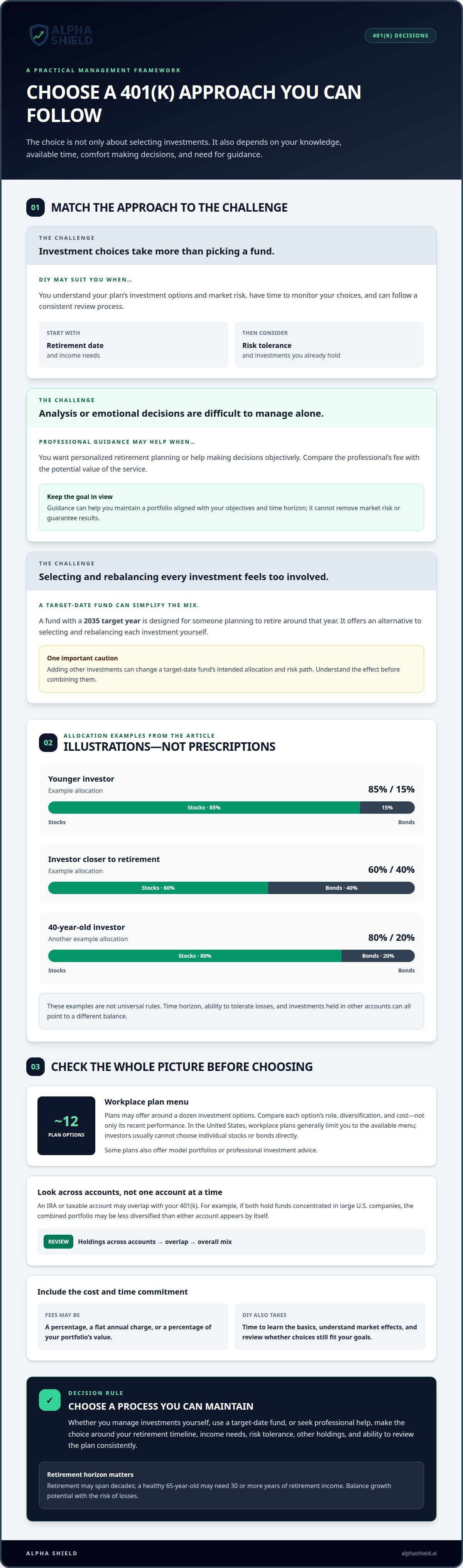
Managing your 401(k) yourself can work if you understand its investment options, market risk, and the time needed to monitor your choices. A financial professional may be useful if you want personalized retirement planning or help making decisions objectively. Compare the professional’s fee with the service’s potential value. Either way, start with your retirement date, income needs, risk tolerance, and the investments you already hold.
A target-date fund offers a simpler alternative to selecting and rebalancing each investment yourself. For example, a fund with a 2035 target year is designed for someone planning to retire around that year, while a DIY portfolio gives you direct control over its mix. A younger investor might use an example allocation of 85% stocks and 15% bonds; an investor closer to retirement might consider 60% stocks and 40% bonds. These examples are not universal prescriptions: time horizon and ability to tolerate losses matter.
In the United States, your workplace plan generally limits you to its available investment menu, and investors usually can’t choose individual stocks or bonds directly. Some plans offer model portfolios or professional investment advice. Fiduciary oversight relates to how a plan is administered and investment options are selected; it doesn’t prevent market losses or guarantee results. According to the Internal Revenue Service, cashing out a 401(k) generally incurs an extra 10% penalty for people under age 59 ½.
Look beyond the workplace account before choosing an allocation. An IRA or taxable account may hold investments that overlap with the 401(k), increasing exposure to the same companies or market segments. For example, if both accounts hold funds concentrated in large U.S. companies, the combined portfolio may be less diversified than either account appears alone. Consider all accounts together, then select investments that create a balanced overall mix.
Review your plan’s investment menu and fees before investing. Workplace plans may offer around a dozen options, so compare each investment’s role, diversification, and cost rather than choosing based only on recent performance. Fees may be a percentage, a flat annual charge, or a percentage of your portfolio’s value. Managing investments yourself also takes time: learn the basics, understand how markets affect your choices, and review whether they still fit your goals.
Retirement savings must balance growth potential against the risk of losses, because retirement may span decades. A healthy 65-year-old may need 30 or more years of retirement income. If you’re comfortable evaluating options and following a consistent review process, DIY management may suit you. If investment analysis or emotional decision-making is difficult, professional guidance may help you maintain a portfolio aligned with your objectives and time horizon.
2. Portfolio mix and asset allocation
Asset allocation determines how your portfolio is divided among stocks, bonds, and other plan investments. These categories respond differently to economic conditions, so combining them can reduce reliance on a single source of returns. Stocks may offer growth potential, while bonds can have different income and price patterns. Neither eliminates risk. Choose a strategy that reflects your retirement timeline, comfort with losses, and other accounts.
Start with a target allocation, then select investments that collectively match it. A 40-year-old investor might use an example allocation of 80% stocks and 20% bonds. That is an illustration, not a rule for every person of that age. A shorter time horizon, lower tolerance for declines, or substantial stock exposure outside the 401(k) could point toward a different balance. Consider the whole portfolio, not each account in isolation.
Base your choices on the plan’s investment menu and each option’s role. One fund may cover a broad market segment, while another focuses on a narrower category. Read the fund descriptions and holdings information provided by your plan. Check for overlap: funds with different names may own many of the same companies. If one type of investment dominates your portfolio, adding a similar fund may do little to diversify it.
Individual stocks create a different concentration risk. A single company can fall sharply because of business-specific events, even if the wider market is steadier. Active trading adds another risk: frequent decisions can shift your allocation away from its intended balance and encourage reactions to short-term price moves. A 401(k) portfolio designed for long-term retirement savings generally needs a repeatable strategy, not constant trading based on recent headlines.
Rebalancing brings your portfolio back toward its chosen allocation after market movements change its proportions. If stocks rise faster than bonds, for example, stocks may make up more of your portfolio than planned. A rules-based review can help you decide whether to redirect contributions or exchange investments to restore the intended mix. Make that decision according to your allocation plan, not a prediction about next week’s returns.
One important exception: don’t combine a target-date fund with additional investments without understanding the effect. The added holdings can alter the fund’s intended allocation and risk path. If you use a target-date fund, treat it as the portfolio’s allocation strategy rather than one component in a separate DIY mix. If you manage the mix yourself, document its purpose and review it on a planned schedule. A systematic market risk signal can also help put volatility in context.
3. Emotional discipline during market fluctuations
A market decline can make a long-term investment plan feel suddenly unsafe. Before changing a 401(k), separate what changed in the market from what changed in your life. A headline alone doesn’t alter your retirement date, spending needs, or ability to tolerate losses. If those personal factors remain stable, an impulsive trade may disrupt a strategy that still fits.
Set a decision rule before volatility arrives. For example, decide to review your portfolio when your goals, income, or timeline change, rather than in response to every alarming headline. Also commit to comparing your current allocation with your plan before making a trade. These rules give you a repeatable process, whatever the daily market noise.
Pause between feeling alarmed and placing an order. Close the trading screen, write down why you’re considering a change, and identify the evidence behind it. Ask whether that evidence relates to your circumstances or only to short-term price movement. If fear of a further decline is driving the decision, wait until you can assess it against your written plan.
Keep two decisions distinct. Rebalancing restores your intended allocation after market movements shift its proportions. Changing your allocation revises your underlying risk strategy. The first can follow a preset review process; the second should reflect a meaningful change in your retirement goals, financial capacity, or risk tolerance, not a prediction about what markets will do next.
Limit how often you check your account if frequent updates prompt emotional trades. A calendar-based review can keep your attention on the plan rather than every market move. Record your allocation, relevant life changes, and reasons for keeping or changing investments at each review. This gives you a decision record to consult before responding to another volatile period.
A financial advisor can offer perspective when it’s difficult to follow your own rules. Bring your target allocation, reasons for recent trades, and retirement-income concerns. Ask how a proposed change affects portfolio risk and long-term purpose. Advice should clarify the decision, not replace your understanding of why each investment belongs in your plan.
Discipline doesn’t mean ignoring new information. A job change, unexpected expense, or revised retirement timeline may affect your ability to bear losses, so reassess your plan deliberately. If only market prices have moved, compare your portfolio with your investment policy before acting. This distinction can help prevent a temporary reaction from becoming a lasting change to your retirement strategy.
4. Risk tolerance and diversification
Risk tolerance combines your financial capacity and willingness to endure investment losses without abandoning your plan. Consider them separately. Capacity depends on income stability, savings, debts, and years until retirement. Emotional tolerance describes how you respond when account values fall. For example, if you sell after a decline, you may need a less volatile mix, even with a long timeline. Your portfolio should fit both your finances and the behavior you can sustain.
Assess these factors before choosing funds. First, consider when you expect to use the money and whether other resources can cover retirement expenses. Then review emergency savings, expected income, and financial obligations. Your workplace plan is only part of the picture. An IRA, taxable account, or other household investments can increase or reduce your overall market exposure. Review your accounts together before deciding on an allocation.
Diversification spreads exposure across investments that don’t all respond the same way to market conditions. Owning several funds isn’t enough if they hold many of the same companies. A broad stock fund and one focused on large U.S. companies, for example, may overlap substantially. Review each fund’s holdings and purpose, then identify whether your portfolio depends heavily on one type of company, industry, or market segment.
Use a simple exposure map. Group the 401(k) options by their main investment role, such as stocks, bonds, or a target-date fund. Note overlapping holdings across your retirement accounts. Then decide whether each investment adds a distinct exposure or simply duplicates another holding. This step helps distinguish the number of funds from the actual range of risks represented in the portfolio.
Your capacity for risk can change with your circumstances. Job loss, new debt, a different retirement timeline, or greater family responsibilities may affect how much volatility you can absorb. Estate plans and intended beneficiaries also belong in a broader retirement review, although they don’t determine which market assets rise or fall. Reassess your portfolio when a significant life event changes your goals or financial obligations.
Keep your decision process consistent. Write down your investment goals, the risks you accept, and the circumstances that would justify changing your plan. If a fund no longer has a clear purpose, compare it with other available options before replacing it. If your tolerance feels different during a market decline, revisit your original reasons and your full account picture before acting. This helps ensure diversification serves your needs rather than becoming a collection of unrelated holdings.
5. How should I diversify a self-managed 401(k) portfolio?
Start with your workplace plan’s investment menu. Group each option by its primary exposure, such as domestic stocks, international stocks, bonds, or cash equivalents. Then define the role it could play in your retirement portfolio. This inventory helps reveal whether your choices cover different market segments or expose your savings repeatedly to the same risks.
Read each fund’s description and holdings information before investing. A domestic stock fund and a large-company fund may share many investments despite their different names. If both focus on similar companies, holding both may add less diversification than you expect. Compare their investment focus, geographic exposure, and major holdings. The goal is to understand what you own, not simply count the funds in your account.
Next, consider the combined picture across your 401(k), IRA, and other investment accounts. For example, a bond fund inside the workplace plan may balance stock-heavy investments in another account. The reverse can also happen: similar stock funds across accounts may create concentrated exposure. Make a simple list of the main investment categories and account locations. This reveals where the full portfolio relies heavily on one market segment.
Choose an allocation that fits your goals and risk tolerance, then use your plan’s options to put it into practice. A broad-market fund may offer exposure to many securities within its stated market, while a narrower fund may add a specific segment. Neither label alone tells you whether it’s suitable. Check the fund’s strategy and holdings, then decide whether its role complements your other investments.
Use contributions and periodic rebalancing to keep your portfolio aligned with its intended mix. If market movements increase the share of one category, you may be able to direct new contributions toward other categories. Alternatively, exchanges between plan investments can restore the target allocation. Base changes on your allocation rules, not on which fund has recently performed best.
A target-date fund is designed to follow a managed allocation path based on an expected retirement year. Adding separate funds can alter that intended mix, so understand your combined allocation before holding both. If you manage the mix yourself, keep it simple enough to monitor. A brief note on each holding’s purpose can make future reviews more consistent.
Review fees as well as diversification. Funds with overlapping holdings may add costs without serving distinct portfolio purposes. Compare the plan information available to you, and don’t choose investments just because their names suggest broad exposure. A disciplined process gives each holding a purpose, checks for overlap across accounts, and maintains an allocation you can follow through market changes.
Alpha Shield
Alpha Shield can add a systematic market-risk perspective to your 401(k) decisions. Alpha Shield Market Signal and the Market crash and drawdown tool are designed to help investors interpret volatility and manage exposure to potential drawdowns. The Alpha Shield Dashboard presents indicators for market crash protection and risk management, giving you another input when reviewing your portfolio choices.
Use market signals as context, not as a replacement for your plan’s investment options, personal risk assessment, or professional retirement advice. They don’t remove market risk or guarantee a particular result. If you want a structured way to consider market conditions alongside your long-term allocation, Alpha Shield may be relevant to your process.
Contact Alpha Shield to discuss how its market-risk tools fit your investing approach.
Put your risk approach into practice
A portfolio plan is most useful when it guides decisions before pressure builds. Write down what would justify a change, what information you’ll review, and how you’ll distinguish a lasting change in your circumstances from ordinary market movement. You’ll have a practical reference point instead of relying on instinct during a volatile period.
A disciplined approach to managing my own 401(k) risk also means knowing when you want added perspective. If market signals are part of your decision process, consider how they fit alongside your investment plan, not in place of it. Keep the purpose clear: support measured decisions, not reactions to every shift in the market.
Build a process you understand, review it deliberately, and let consistency guide your next move.
Frequently Asked Questions
Can I Manage My Own 401(k)?
Yes, you can manage your own 401(k) by choosing investments from the options available in your workplace plan. The practical test is whether you can explain why each holding belongs in your portfolio and follow your strategy during volatile periods. If you struggle to make those decisions consistently, consider plan-provided advice or a financial professional. Self-management means taking responsibility for investment choices, not gaining access to every investment available outside the plan.
How to Manage Your 401(k) Investments: DIY or Hire a Financial Professional?
Manage your investments yourself if you’re prepared to choose them, understand their risks, and maintain your portfolio as your needs change. Professional support can help with personalized retirement planning or coordinating multiple accounts. Some workplace plans also offer model portfolios or investment advice. A hybrid approach is another option: use professional guidance to shape a plan, then manage the account yourself, weighing any advisory fee against the support provided.
Where Should I Put My 401(k) Money?
Place your contributions in investments within your plan that match your chosen allocation and investment horizon. Start by identifying the purpose of each option, then consider how it fits with other retirement accounts you hold. For example, if an IRA already supplies broad stock exposure, your 401(k) choices can be evaluated as part of the combined portfolio. Avoid leaving the investment decision unfinished: contributions need an intentional destination within the plan.
What does managing your own 401(k) mean, and what investment choices are available?
Managing your own 401(k) means directing contributions among the investment options offered by your employer’s plan and deciding whether to change that mix. Depending on the plan, options may include stock funds, bond funds, target-date funds, or model portfolios. The menu is plan-specific, and individual stocks or bonds usually aren’t directly selectable. Read each option’s description to understand its role, investment focus, and costs before allocating contributions.
How do I assess my risk tolerance and investment time horizon for a 401(k)?
Start with the date you expect to use your retirement savings, then consider how much your income and other resources can support you before that point. Next, picture a substantial decline in your account and decide whether you could keep following your plan. If you would feel compelled to sell, that response matters. Managing my own 401(k) risk requires an allocation that fits both financial capacity and the decisions you can maintain under pressure.
How often should I rebalance my 401(k), and how do I do it?
Follow a consistent review schedule or a predetermined allocation-drift rule instead of changing investments after every market move. Compare your holdings’ current percentages with your intended mix. If they have moved materially away from the plan, direct new contributions toward underweighted categories or exchange investments, if your plan allows. Record why you make each adjustment. The appropriate review frequency depends on your plan and strategy, not a universal calendar rule.
What should I do with my 401(k) during a market downturn?
First ask whether your circumstances have changed or market prices alone have fallen. If your retirement timeline, income needs, and ability to bear risk are unchanged, avoid a sudden portfolio change based only on alarming headlines. Compare your investments with your written plan and follow its decision rules. If a life change has affected your financial needs, reassess your allocation deliberately rather than treating every decline as a signal to sell.
When should I consider getting professional financial advice for managing my 401(k)?
Consider professional advice if you can’t determine an appropriate allocation, have multiple accounts with overlapping investments, or face a major change in income or retirement timing. An advisor can connect portfolio decisions with broader retirement planning and explain the tradeoffs. Before engaging one, understand what advice you’ll receive and how the fee works. Professional support may be especially useful if uncertainty leads you to delay decisions or repeatedly change investments.


