

A fixed allocation can be disciplined and still miss important changes in market opportunity. Strategic asset allocation sets a long-term mix of stocks, bonds, and cash around an investor’s goals, risk tolerance, and time horizon, then maintains it through rebalancing. One key limitation of strategic asset allocation is that it reflects the investor’s profile, but not whether available investments are attractively valued.
The appeal is clear: a stable policy can keep portfolio decisions consistent during volatile markets. But consistency doesn’t eliminate investment risk, guarantee diversification will prevent losses, or ensure target weights remain suitable as circumstances and markets change.
This article explains how strategic asset allocation works, where its trade-offs arise, and how tactical adjustments differ from the Total Portfolio Approach. You’ll see what a fixed allocation can and can’t do, why periodic review matters, and how a systematic market signal may fit when volatility and drawdown risk become central concerns.
Key Takeaways
- Build a long-term allocation around goals, risk tolerance, and time horizon, then review it periodically even if personal circumstances stay the same.
- Assess alternative investments not only for their portfolio role, but also for liquidity, forecast uncertainty, and the governance capacity needed to oversee them.
- If you make tactical shifts, define in advance when to return to the strategic mix and account for potential trading and tax costs.
- The Total Portfolio Approach evaluates investments against a shared reference portfolio and opportunity cost, but requires integrated data and advanced risk systems.
- Fixed targets can overlook changing valuations, and diversification cannot eliminate losses; a market signal can add a risk-monitoring input without replacing an investment policy.
What is a Strategic Asset Allocation?
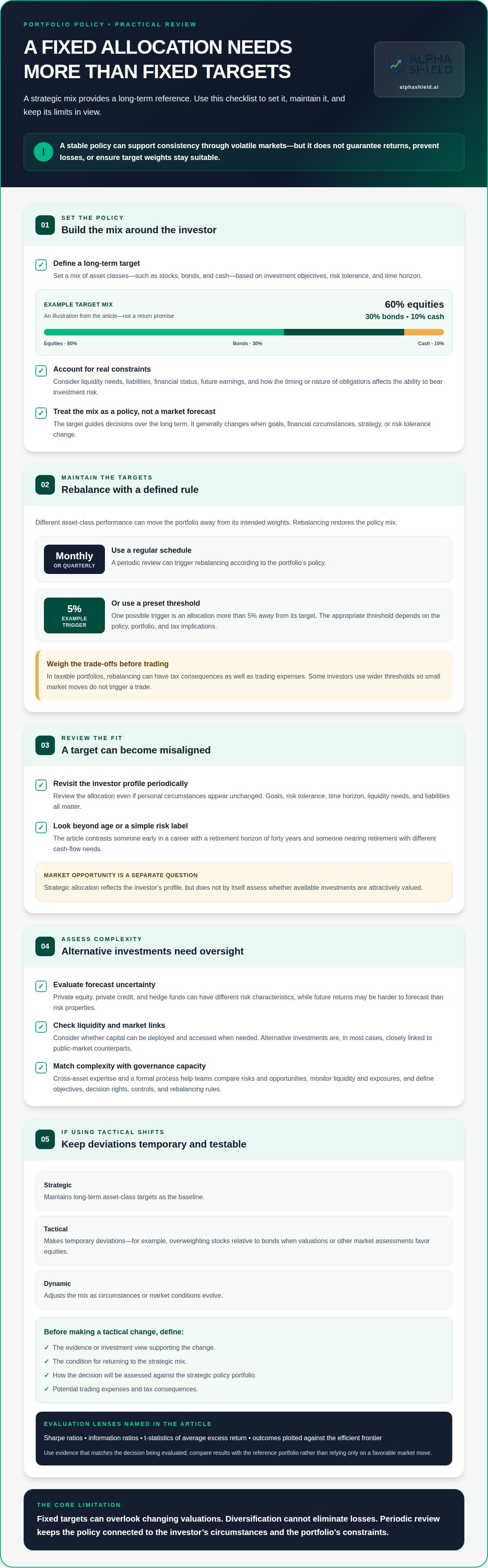
Strategic asset allocation sets a long-term target mix of asset classes, such as stocks, bonds, and cash. The mix reflects an individual’s investment objectives, risk tolerance, and horizon. For example, a portfolio might target 60% equities, 30% bonds, and 10% cash. The percentages provide a reference for portfolio decisions, not a promise of returns. The strategy generally maintains its targets unless the investor’s goals, financial status, strategies, or risk tolerance change.
How often should investors rebalance a strategic asset allocation portfolio? They can use a regular schedule, such as monthly or quarterly, or rebalance when an allocation moves beyond a preset threshold. For example, an allocation more than 5% away from its target is one possible trigger. The appropriate approach depends on the policy, portfolio, and tax implications.
Long-term investing makes the target mix a policy, rather than a response to every market move. Rebalancing restores the portfolio’s intended weights after asset classes perform differently. If equities rise faster than bonds, their share of the portfolio may exceed its target. Selling some equities and adding to bonds can bring the portfolio back in line. In taxable portfolios, however, rebalancing can have tax consequences. Some investors use wider thresholds so small market movements don’t trigger a trade.
The investor profile must reflect more than age or a simple risk label. Investment objectives, time horizon, liquidity needs, and liabilities all shape the allocation. Someone early in a career may have a retirement horizon of forty years, while someone nearing retirement may face different cash-flow needs. Human capital also changes over time: future earnings and the timing or nature of liabilities affect how much investment risk a person can bear. A target that ignores these factors may not match the investor’s actual constraints.
Alternative investments add another layer of analysis. Private equity, private credit, and hedge funds can have risk characteristics that differ from public assets, but their future returns may be harder to forecast than their risk properties. Private assets can also be modeled as leveraged versions of public-market counterparts, without the short-term excess volatility embedded in public prices. That framing doesn’t make them independent of public markets: in most cases, alternative investment performance is closely linked to public-market counterparts. Liquidity and access matter too. An asset owner must consider whether capital can be deployed and accessed when needed.
Effective oversight requires an investment culture and cross-asset expertise. A team assessing public equities, private credit, and real estate needs a shared way to compare risks and opportunities across asset classes. Complex investment vehicles also require enough governance capacity to monitor decisions, liquidity, and portfolio exposures. A formal process can define investment objectives, decision rights, controls, and rebalancing rules. That structure helps limit decisions driven by behavioral biases and gives the investment team a consistent framework for evaluating strategies and reporting whether the portfolio remains aligned with its long-term policy.
Combining strategic and tactical approaches
A strategic policy sets the portfolio’s baseline; tactical decisions can depart from it as conditions change. The distinction matters because flexibility also adds costs, judgment calls, and a need for clear controls.
Comparing Allocation Approaches
Strategic allocation maintains long-term asset-class targets, tactical allocation makes temporary deviations, and dynamic allocation adjusts the mix as circumstances or market conditions evolve. The choice determines how much discretion investment decisions allow and what evidence supports a change.
A tactical investor might overweight stocks relative to bonds when valuations or other market assessments favor equities. That shift doesn’t replace the strategic policy. The portfolio needs a defined condition for returning to its original allocation, such as a change in the investment view or the end of the intended opportunity.
Discretionary tactical decisions rely on qualitative interpretations of political, economic, and financial conditions. They also assume that short-term market-timing skill can persist. Make those assumptions explicit. Otherwise, an allocation change can become an open-ended reaction rather than a controlled adjustment.
Investors can assess tactical decisions against the strategic policy portfolio. Measures include Sharpe ratios, information ratios, t-statistics of average excess return, and outcomes plotted against the efficient frontier. These comparisons help show whether a tactical choice added value relative to its reference, rather than simply benefiting from a favorable market move. The evidence used should match the decision being evaluated.
Rebalancing Costs and Tax Consequences
In the United States, rebalancing costs can include trading expenses and tax consequences in taxable portfolios. These matter because frequent or large adjustments can reduce after-tax returns, even when they restore the intended allocation.
The impact depends on which assets are sold, how much the portfolio has shifted, and the account’s tax treatment. Tax considerations can affect return and standard-deviation assumptions. Some taxable portfolios use wider rebalancing thresholds, since larger asset-class movements may be needed to materially change the portfolio’s risk profile. The appropriate threshold depends on the portfolio’s targets and constraints.
A disciplined process weighs the cost of a trade against the risk of leaving the portfolio outside policy. If a tactical position is opened, the investment policy can specify its permitted size, review criteria, and exit conditions. That gives each committee member a consistent basis for deciding whether to hold, reduce, or close the position.
To assess whether tactical activity is helping, compare its results with the strategic baseline and account for trading and tax effects. A market-risk signal can also provide an additional input to that review; it doesn’t replace allocation policy or remove investment risk. Explore systematic market-risk monitoring as one way to add structured information to portfolio decisions.
Potentially missed short-term market opportunities
A fixed strategic mix can leave a portfolio exposed to short-term changes in asset prices. If equities fall sharply, the target weights may not adjust until scheduled rebalancing or a policy review. The 2008-09 decline in equities was 57%, illustrating how a long-term allocation can experience a severe drawdown before its next review. A fixed policy also may not capture a temporary opportunity to shift capital toward assets whose valuations have changed.
Inflation and changing interest rates affect asset values and risk profiles, so they can change how a strategic allocation behaves. Rising rates can pressure bond prices, while inflation can erode the purchasing power of cash and fixed income. A portfolio built around historical return and risk assumptions may therefore behave differently as rates and prices move. Investors should assess whether those changes affect their objectives, liabilities, or tolerance for losses.
Tactical allocation adds flexibility by allowing temporary departures from strategic targets. It may overweight or underweight stocks, sectors, or regions to pursue short-term opportunities or mitigate risks. Each shift should have a defined rationale, a permitted size under the investment policy, and a condition for returning to the target. Without those controls, a temporary adjustment can become an unintended new strategy. Market monitoring can identify conditions for review, but it can’t establish that a short-term move will be profitable.
Monitoring should connect market signals to portfolio decisions, not turn every price change into a trade. For example, if equity valuations change materially, an investment team can compare current exposure with its strategic target and assess the case for a tactical deviation. It can then record the rationale, risk limits, and conditions for returning to policy. This process separates evidence-based adjustments from reactions to market noise.
Liquidity is another consideration in stressed markets. Asset owners should assess potential cash needs under extreme market stress before relying on an investment that may be difficult to sell. A large portfolio may benefit from operating efficiencies, yet still struggle to deploy capital in some active strategies because of liquidity conditions and trading costs. If cash is needed during a downturn, selling less-liquid holdings may be harder or more costly than selling marketable assets.
That constraint can limit the value of apparent opportunities. A discounted asset may look attractive, but the investor must also consider whether capital can be committed without disrupting near-term obligations. Under stress, trading costs and available liquidity can affect both entry and exit decisions. Strategic targets help maintain discipline, while tactical flexibility can respond to new information. Neither approach eliminates losses, and market monitoring works best when it informs a defined review rather than dictates an automatic trade.
Strategic Asset Allocation compared with the Total Portfolio Approach
Strategic Asset Allocation sets asset-class targets, while the Total Portfolio Approach (TPA) allocates capital across the portfolio against shared risk limits. The distinction affects how investments are selected, measured, and governed.
Asset Classes and Portfolio Weightings
Strategic allocation assigns portfolio weights to defined classes, while TPA assesses each investment against its opportunity cost of capital. The method matters because asset buckets can shape which opportunities receive attention.
For example, a strategic portfolio worth $500,000 might allocate 65% to stocks, or $325,000, and 30% to fixed income, or $150,000. The same example assigns $25,000, or 5%, to cash. Under TPA, an investment isn’t selected simply to fill a stocks, bonds, or cash bucket. Staff assess whether it offers value relative to other available uses of capital.
Governance also differs. Under Strategic Asset Allocation, boards set fixed asset-class targets and ranges, and investment staff manage the portfolio within them. Rebalancing brings actual weights back toward those targets. Under TPA, boards define risk through a Reference Portfolio and active risk limits. Staff can then allocate dynamically across opportunities rather than treating asset-class weights as fixed destinations.
Portfolio Size and Asset-Class Access
Portfolio size can determine whether an investor can access and manage certain asset classes efficiently. This matters because the theoretical benefit of a diversified strategy may not translate into practical access.
A smaller portfolio may have limited access to private equity, private real estate, hedge funds, and infrastructure. Minimum investment requirements and regulatory restrictions can constrain participation. Smaller organizations may also lack enough diversification across managers or the staff needed to monitor a complex program. In those cases, adding more asset classes can increase oversight demands without creating a workable investment structure.
TPA requires more than a flexible mandate. It relies on integrated data across public and private assets, advanced risk systems, and real-time analytics. Transitioning an institutional investment organization to TPA is a multi-year effort. Boards and staff need consistent ways to assess risk, compare opportunities, and assign accountability. Without those capabilities, dynamic allocation can outpace the organization’s ability to govern it.
Performance measurement changes too. Strategic Asset Allocation typically uses multiple benchmarks tied to asset classes, while TPA evaluates performance against a single Reference Portfolio. That comparison can clarify whether active decisions add value across the whole portfolio. Yet deviations from an equity-heavy Reference Portfolio can create tracking error, which may discourage defensive positioning. The appropriate framework depends on an institution’s governance, data, and risk capacity, not just its preferred allocation model.
Limitations of strategic asset allocation
A strategic target provides a consistent framework for distributing risk, but it doesn’t assess whether each available investment is fairly valued. That distinction is central: an allocation can suit an investor’s profile and still direct capital toward asset classes with unattractive current valuations. Its advantage is discipline, not the ability to identify the best opportunity at every point in a market cycle.
Historical assumptions create another constraint. Expected returns, volatility, and correlations are often estimated from past market behavior, but historical trends aren’t reliable indicators of future market behavior or a particular investment’s performance. If two asset classes behaved differently in earlier periods, their relationship may change under new market conditions. A portfolio built around fixed assumptions can then carry more risk, or deliver different returns, than its original model projected.
Diversification helps spread exposure across investments, but it doesn’t eliminate losses. For example, if several holdings depend on related economic conditions, a broad downturn can pressure them together. A portfolio may therefore contain many securities yet remain exposed to common drivers, such as interest rates, credit conditions, or investor demand. The number of holdings alone doesn’t show how much protection diversification provides.
Taxes can also change the assumptions behind allocation decisions. Tax effects influence expected returns and standard-deviation assumptions, while correlation assumptions don’t need adjustment. In a taxable portfolio, selling assets during rebalancing may also have tax consequences. The practical trade-off is between restoring the target mix and accounting for the effect of a sale on after-tax results.
A policy can become outdated without a major personal change. Market valuations, available investment opportunities, and relationships between assets can shift while the investor’s goals remain steady. That’s why an asset owner should review the allocation periodically, even when circumstances haven’t changed. A review can test whether the original assumptions about returns, risk, liquidity, and correlation still provide a useful decision framework.
These limits don’t make strategic allocation useless. They define what it can do: set a durable policy around investment objectives and risk capacity. They also define what it can’t do: forecast future returns, guarantee losses will be avoided, or automatically respond to changing valuations. A disciplined review separates changes in investor circumstances from changes in market assumptions, then determines whether the target remains appropriate or needs revision.
Alpha Shield
Alpha Shield offers tools that add a market-risk input to decisions about a long-term allocation. The Alpha Shield Market Signal and market crash and drawdown tool help investors navigate volatility and manage significant drawdown risk. The Alpha Shield Dashboard provides indicators for market crash protection and risk management.
These tools don’t replace an investment policy, determine the right asset mix, or eliminate the risk of loss. They can support investors who want a systematic signal alongside their existing portfolio framework, particularly when market volatility makes risk monitoring more important.
If you’re assessing how market signals could fit into your investment process, contact Alpha Shield to discuss the next step.
Make Your Allocation More Responsive
Recognizing the limitations of strategic asset allocation isn’t a reason to discard a long-term policy. It’s a reason to make the decision process explicit. Set out which changes merit review, what evidence would support an adjustment, and how any change will be assessed afterward. That creates a clearer bridge between a durable portfolio framework and new market information.
Before acting, distinguish a signal that warrants attention from a decision to trade. Then consider whether the information fits your objectives, constraints, and established risk controls. A measured process keeps market noise from becoming an automatic instruction and makes each portfolio decision easier to explain.
To consider how market-risk signals could support your investment process, explore Alpha Shield’s systematic Market Signal and Dashboard.
Keep refining the framework as your objectives and circumstances evolve. Clear rules can help you move forward with greater discipline.
Frequently Asked Questions
What is strategic asset allocation, and what assumptions does it rely on?
Strategic asset allocation is a long-term policy for distributing a portfolio across investment categories. It assumes the investor’s objectives, risk capacity, and constraints can be translated into target exposures. It also relies on estimates of future returns, volatility, and relationships between assets. These inputs are planning assumptions, not forecasts. A practical policy records them clearly so later reviews can distinguish changed circumstances from assumptions that no longer fit.
What are the main limitations of strategic asset allocation?
The main limitations of strategic asset allocation are its reliance on assumptions and its limited response to changing investment conditions. A target mix can remain in place even when relative valuations or an investor’s needs shift. Use a review framework that tests the portfolio under different market conditions, checks whether its exposures still serve the investor’s objectives, and records why any policy change is warranted. This helps separate deliberate adjustments from reactions to short-term market noise.
How does strategic asset allocation handle market volatility and sudden crashes?
Strategic allocation doesn’t automatically change its targets when volatility rises or markets fall. Its response depends on the policy’s rebalancing rules and any separate risk controls. For example, a sharp decline can reduce an equity holding’s share of the portfolio, prompting a rebalance if the policy’s conditions are met. Before acting, distinguish a temporary market move from a lasting change in risk capacity or investment objectives.
Can strategic asset allocation account for changing goals, time horizons, or income needs?
Yes. The policy can be reviewed when an investor’s goals, horizon, or expected cash needs change. For example, a planned retirement date may move, or an investor may expect to draw more income from the portfolio. Those changes can affect the level of risk the investor can accept and the assets available to meet withdrawals. Updating the policy keeps its assumptions relevant to the new plan instead of relying on outdated priorities.
How can inaccurate risk tolerance or return assumptions undermine an asset allocation plan?
Inaccurate assumptions can make a portfolio unsuitable even when its target weights are followed precisely. If an investor underestimates how they respond to losses, they may sell during a downturn and disrupt the plan. If expected returns are too optimistic, projected resources may not support the intended goal. A useful review compares stated risk tolerance with the losses the investor could financially absorb, then tests whether the plan remains workable under less favorable outcomes.
What role do alternative investments and illiquid assets play in strategic asset allocation?
Alternative investments can provide exposures beyond publicly traded stocks and bonds, but their role in a portfolio depends on risk, liquidity, and oversight needs. An illiquid holding may be difficult to sell when cash is needed, so its allocation should be considered alongside planned withdrawals and other available resources. Investors should also assess whether its economic drivers overlap with existing holdings. A distinct label alone doesn’t establish that an asset diversifies the portfolio.


