

The safest-looking retirement portfolio can carry a risk of its own: too little growth to support a long retirement. Managing retirement portfolio risk usually means balancing stocks for growth with bonds and cash for stability and near-term spending. A 60% stocks and 40% bonds allocation is a common model, but the right mix depends on your time horizon and tolerance for market losses.
It’s reasonable to want dependable income and less exposure to sharp declines as retirement approaches. But reducing risk too far can leave a portfolio more vulnerable to inflation and the demands of a retirement that may last 20 to 30 years or longer.
This article explains how to choose an allocation, balance growth and risk, and plan for longevity. It also covers why sequence-of-returns risk matters near retirement: losses early in the withdrawal period can have a different effect from losses later, especially when you’re drawing income from your portfolio. The goal is a clear framework for making decisions, not a one-size-fits-all formula.
Key Takeaways
- Set your stock-and-bond mix around your spending needs, time horizon, and ability to tolerate losses, then review it on a regular schedule.
- Keep enough accessible assets for near-term expenses so you’re less likely to sell growth investments during a downturn.
- Plan income with longevity and inflation in mind; a portfolio that supports early retirement may need to keep working for decades.
- Pay close attention to losses near the start of withdrawals. The order of returns can affect how long a portfolio lasts, even when long-term average returns are similar.
- Use a systematic market signal as one input for monitoring volatility and drawdown risk, not as a substitute for a retirement income plan.
1. Choosing a stock-and-bond allocation based on risk tolerance and time horizon
Start by assigning each asset a role. Stocks provide growth potential, bonds can support income and moderate volatility, and cash can cover near-term spending. A 50% stocks and 50% bonds portfolio is one possible balanced allocation, not a universal prescription. These choices form the foundation for managing retirement portfolio risk because they determine how the portfolio may respond to losses and withdrawals.
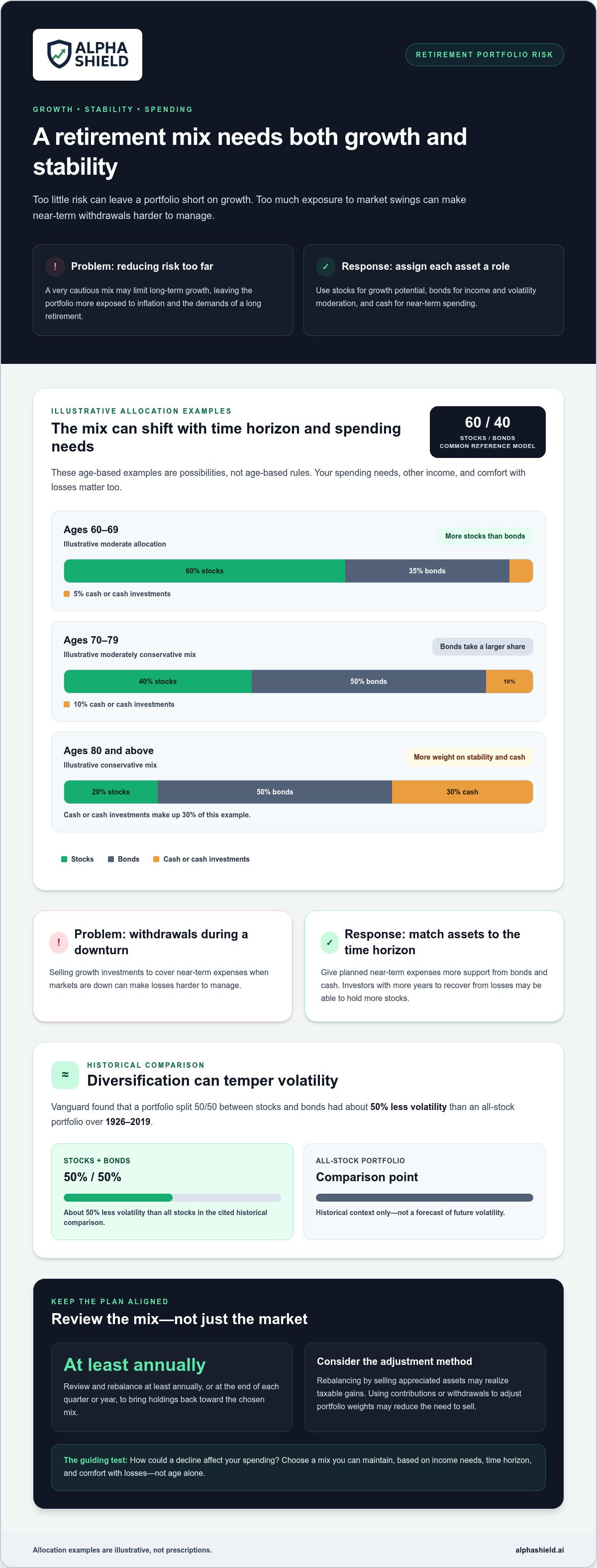
Time horizon affects the balance. Investors with more years to recover from market losses may be able to hold more stocks. Those expecting withdrawals soon may give more weight to bonds and cash for planned expenses. A commonly used 60% stocks and 40% bonds model offers a reference point, but spending needs and comfort with losses should shape the actual mix.
Age-based examples illustrate possible allocations. An illustrative moderate allocation for ages 60-69 is 60% stocks, 35% bonds, and 5% cash or cash investments. For ages 70-79, an illustrative moderately conservative mix is 40% stocks, 50% bonds, and 10% cash or cash investments. For people aged 80 and above, an illustrative conservative mix is 20% stocks, 50% bonds, and 30% cash or cash investments.
These examples aren’t age-based rules. A retiree with dependable income outside the portfolio may be able to tolerate more market movement. Someone relying on investments for essential expenses may need more liquidity. Consider how a decline could affect your spending, then choose an allocation you can maintain. This practical test keeps managing retirement portfolio risk tied to real income needs, not age alone.
Diversification complements allocation. Stocks spread across companies and sectors reduce dependence on one business. Bonds with different issuers and maturities can reduce concentration in a single interest-rate exposure. Vanguard found that a portfolio split 50/50 between stocks and bonds had about 50% less volatility than an all-stock portfolio over 1926-2019. That historical comparison illustrates a trade-off, not a forecast.
Review and rebalance at least annually, or at the end of each quarter or year, to bring holdings back toward the chosen mix. Rebalancing may involve selling appreciated assets, which can realize taxable gains. According to the Internal Revenue Service, selling an investment held for more than one year may result in capital gains tax. The rate can be 0 percent for people in the lowest two tax brackets, according to the Internal Revenue Service.
The United States tax code imposed a 3.8 percent Net Investment Income Tax starting January 1, 2013, on investors who meet certain income thresholds and other criteria, according to the Internal Revenue Service. Tax consequences depend on the account and transaction. Using contributions or withdrawals to adjust portfolio weights may reduce the need to sell. Include tax effects in your process for managing retirement portfolio risk, alongside allocation and spending needs.
2. Balancing investment risk and growth potential
The main risks in a retirement portfolio include market losses, inflation, interest-rate changes, concentration, and withdrawals during downturns. These can reduce purchasing power or force you to sell assets when prices are depressed. The right balance depends on your expenses, income sources, and investment time horizon.
Investor concerns can influence decisions. In the Schroders US Retirement Survey 2023, 82% of investors worried that a major market downturn could significantly reduce their assets. In that same survey, 59% of US investors aged 55-64 said their portfolio declined a lot in 2022, and six in 10 older investors feared losing money. Those concerns are relevant, but they don’t determine an appropriate asset allocation on their own.
Timing the market adds another risk: missing strong days while waiting for conditions to feel safer. A J.P. Morgan study found that an investor fully invested in the S&P 500 earned an annualized return of 9.52% over 2002-2021. Missing its 10 best market days over that period would have reduced annualized returns to 5.33%. The practical response is to set a plan for growth and income, then follow it through changing market conditions.
Cash can help with planned expenses, but a large cash position may limit long-term growth. In the Schroders survey, 31% of surveyed investors’ retirement assets were held in cash. Consider the role each source of retirement income plays, including Social Security, before deciding how much of a portfolio must provide income. A retirement lasting 30 years calls for a different balance than one with a shorter horizon.
Review your plan when spending needs, income sources, or tolerance for losses change. For example, if Social Security covers essential expenses, you may have more flexibility with portfolio withdrawals during a decline. If investments must fund essential costs, your allocation and withdrawal plan need to account for that dependence. A written review process can help you distinguish lasting changes in circumstances from reactions to market volatility.
Taxable investments add another factor. Selling an investment held for more than one year may result in capital gains tax, according to the Internal Revenue Service. In the United States, the capital gains tax rate can be 20 percent for people in the highest tax bracket, according to the Internal Revenue Service. Consider the tax impact alongside allocation decisions, rather than treating a portfolio sale as a purely investment choice.
For a structured way to monitor market volatility while following a long-term plan, the Alpha Shield Market Signal is designed to help investors assess market crash and drawdown risk. Use a signal as one input to a decision process, not as a substitute for your income plan or asset allocation.
Longevity and retirement income needs
A healthy 65-year-old may need 30 or more years of retirement income. Plan for a long horizon rather than assuming withdrawals will end after a short period. Estimate essential and flexible expenses separately, then identify which income sources cover each category. This makes the amount your savings must provide clearer.
Start with reliable income. In January 2026, the average United States Social Security benefit for a retired worker was around $2,071 a month. Social Security benefits increase by about 8% for each year a person waits to claim after reaching full-benefit age, up to age 70. Compare the value of claiming earlier with the income available from savings while you wait.
Next, calculate the portfolio income gap. Subtract expected Social Security and other steady income from planned annual expenses. If the result is a shortfall, savings must supply it through investment income, withdrawals, or both. Revisit the calculation after major changes in spending, health needs, or household income. In the April 2025 U.S. Retirement Confidence Survey, 45% of retirees said their spending was higher than expected, a reminder to build flexibility into estimates.
For a sustainable plan, set a withdrawal approach and review it against the portfolio’s performance and spending needs. Expert opinions on annual retirement portfolio withdrawals tend to cluster in the 3 to 5 percent range. For savings intended to last 20-30 years, one approach is a first-year withdrawal of no more than 4%-5%, with the percentage adjusted for inflation in later years. Treat these ranges as planning reference points, not fixed income promises.
Dividends and interest can contribute to retirement income, but they are part of total portfolio return, not a separate guarantee. A diversified portfolio can combine income-producing assets with investments held for growth. Track the cash each investment generates and compare it with your expenses. If income falls short, planned asset sales can fill the gap.
Selling investments isn’t automatically a failure of the plan. It turns portfolio assets into spending money. The key is to set a withdrawal sequence that considers account type, tax effects, and market conditions. Selling during a decline can lock in losses, so account for near-term spending needs before a downturn occurs.
Healthcare deserves its own estimate. A 65-year-old individual retiring in the United States in 2026 may need $185,500 in after-tax savings for health care expenses in retirement. Include this potential need alongside routine spending, then review the estimate as circumstances change. A retirement income plan works best when its income sources, withdrawals, and expense assumptions are assessed together.
4. What Should Your Retirement Portfolio Include?
A retirement portfolio can combine growth assets, short-term bonds, and liquid cash. Cash can support immediate spending, while short-term bonds may be used for expected withdrawals over the next several years. The right balance depends on planned expenses, risk tolerance, and how much wealth must stay invested for future needs.
Target-date funds can simplify portfolio management by adjusting their investment mix over time. After investors reach retirement age, the example allocation described here typically remains at 30% equities and 70% bonds and cash. That fixed mix may not match every retiree’s income needs or tolerance for volatility. Annuities can provide structured income, while bond ladders stagger maturities to align proceeds with planned expenses; each approach has trade-offs in flexibility, liquidity, and growth potential.
Build liquidity around a specific spending plan. One approach is to keep a year’s worth of spending in cash to supplement regular annual retirement income. Another is to hold two to four years of living expenses in short-term bonds, CDs, or other reasonably liquid accounts. These are planning approaches, not universal requirements. A cash reserve may reduce pressure to sell stocks during a downturn, but inflation can erode its purchasing power.
For a practical estimate, start with monthly expenses of $5,000. A reserve of $60,000 to $90,000 represents 12 to 18 months of those expenses. Short-term, high-quality bonds can be considered separately for expected withdrawals over one to five years. Keep the roles distinct: cash covers immediate needs, while bonds may provide liquidity for later spending.
Early retirement makes market volatility more consequential because withdrawals may begin while the portfolio still needs to grow. During the 2008 financial crisis, U.S. Treasury bonds rose by about 20% while the S&P 500 fell by 37%. That episode shows how different asset classes can behave differently, but it doesn’t establish a reliable pattern for every downturn.
Recovery math matters. The average peak-to-peak recovery time for a diversified stock index in bear markets was roughly three and a half years from the 1960s through 2023. If withdrawals continue during that period, selling depressed assets can leave fewer shares to participate in a recovery. A liquidity reserve can help cover planned spending while longer-term holdings remain invested.
A decline also changes what a fixed withdrawal represents. In one hypothetical example, a $1-million retirement account would provide a $24,000 withdrawal at a 3% rate after a 20% market decline. Review the withdrawal amount, cash reserve, and bond maturities together. That process helps connect immediate liquidity with the portfolio’s longer-term growth and income needs.
5. Sequence-of-returns risk near retirement
Sequence-of-returns risk is the effect of investment gains and losses arriving in a particular order while you’re making withdrawals. A loss early in retirement can be more damaging than the same loss later, because you may have to sell assets after prices fall to fund spending. A disciplined approach to managing retirement portfolio risk accounts for this interaction between market returns and spending.
Consider an illustration with a $1 million portfolio, a 50% stock and 50% bond allocation, annual distributions of $50,000, and average annual returns of 5.1%. If a down market occurs at the beginning of the 10-year period, the portfolio ends with $598,417. If the down market occurs at the end, it ends with $1,059,088. The average return and withdrawals are the same; the sequence changes the outcome.
This is why the first years of retirement deserve specific attention. In another hypothetical example, positive returns of 25% in year one, 10% in year two, and 5% in year three support the desired income for 40 years. A negative return in the first retirement year instead leads to the portfolio running out after 25 years. Early losses can compound with withdrawals, reducing the assets available for later years.
Sequence risk doesn’t mean abandoning growth investments or moving entirely into conservative assets. It means planning how to fund spending if markets decline near retirement. Identify essential expenses, reliable income, and the assets you would use for withdrawals during a downturn. This creates a defined income plan without making every market movement a reason to change course.
Use a written withdrawal process. Set the annual amount you need from investments, then decide how cash, bonds, and growth assets will contribute. If stocks fall, liquid assets may cover near-term spending and help you avoid having to sell depressed holdings. Revisit the plan as spending needs and portfolio values change, rather than automatically selling the same assets after every decline.
Recent market performance shows why the return order is difficult to predict. The S&P 500 Index returned -18.11% in 2022 and +26.28% in 2023. For someone withdrawing income, those consecutive annual returns affect portfolio value differently from the same returns in reverse order. Each year’s withdrawals interact with the assets remaining after market performance.
If you’re managing retirement portfolio risk, test your income plan against an early decline. Identify which holdings would fund spending, how long that approach could continue, and when to review your allocation. The goal is disciplined decision-making, not predicting the next market move.
Alpha Shield: Alpha Shield Market Signal
Alpha Shield Market Signal gives investors a systematic signal for assessing market volatility and potential drawdown risk. Its daily IN or OUT signal can provide a clear input alongside your allocation, withdrawal plan, and time horizon. It is designed to support long-term capital preservation, not replace a diversified portfolio or guarantee that losses will be avoided.
The Market crash and drawdown tool and Alpha Shield Dashboard provide clear indicators for monitoring market conditions and risk. Use them to inform a disciplined review, not as a prompt for day trading, shorting, or individual stock selection. The signal is most relevant when you’re evaluating how volatility may affect a retirement plan.
Visit alphashield.ai to explore the Alpha Shield Market Signal.
Make Your Next Portfolio Review Deliberate
Your next step is to turn your retirement plan into a repeatable decision process. Set a review date, write down what would prompt a change, and distinguish planned adjustments from reactions to market noise. That structure makes managing retirement portfolio risk an ongoing practice rather than a decision made under pressure.
For investors seeking a market-risk signal as one input to this process, Alpha Shield offers its Market Signal subscription and dashboard. The service provides a daily IN or OUT signal, ETF allocation guidance, a live performance and metrics dashboard, and educational resources. These tools focus on market volatility and drawdown indicators. They can inform a review, but your allocation and income plan remain the foundation of retirement decisions.
At your next review, identify what information would make your decisions clearer, then explore whether Alpha Shield Market Signal fits that need.
A disciplined process won’t remove uncertainty, but it can give each decision a clearer purpose. Build your plan one deliberate step at a time.
Frequently Asked Questions
What Should Your Retirement Portfolio Include?
A retirement portfolio usually combines growth-oriented investments, income-producing assets, and liquid reserves. The exact mix should reflect which expenses depend on portfolio withdrawals and which are covered by other income. For example, someone whose pension covers basic costs may structure investments differently from someone relying heavily on savings. Review account types, withdrawal timing, and tax exposure together so your portfolio decisions support your full income plan.
What is sequence of returns risk?
Sequence-of-returns risk is the effect the order of investment gains and losses has on savings during withdrawals. Two portfolios with the same average return can end up differently if one experiences losses earlier. For example, a decline in the first years of retirement can force you to sell assets to fund spending, leaving fewer assets invested for a recovery. The risk is most relevant when withdrawals coincide with falling markets.
How should retirees allocate stocks and bonds by age and risk tolerance?
Age-based mixes can offer reference points, but risk tolerance and spending needs should guide the final allocation. Illustrative examples include 60% stocks, 35% bonds, and 5% cash for ages 60-69; 40% stocks, 50% bonds, and 10% cash for ages 70-79; and 20% stocks, 50% bonds, and 30% cash for people aged 80 and above. Adjust the mix if a decline would disrupt essential spending.
What is a safe withdrawal rate for retirement portfolios in 2026?
For savings intended to last 20-30 years, a common planning reference is a first-year withdrawal of no more than 4%-5%, with the amount adjusted for inflation in later years. Treat the rate as a starting point for building a spending plan, not a fixed annual entitlement. Portfolio size, other income, spending flexibility, and market returns affect how withdrawals influence future assets.
How can retirees protect against inflation and longevity risk?
Combine a long-term growth allocation with a spending plan that can adjust as costs rise. At 2.5% annual inflation, a dollar’s spending power declines by 46% over 25 years; $1 million in purchasing power at age 60 equals $539,391 at age 85. Review expenses regularly and avoid relying only on assets whose income may not keep pace with rising costs.
How much cash should retirees keep in an emergency reserve?
A useful reserve benchmark is 12 to 18 months of expenses, held separately from investments intended for longer-term growth. Calculate essential monthly costs first, then consider which expenses could arise unexpectedly and which income sources remain dependable. Cash can provide ready access during a downturn, while holding substantially more may leave less invested to address inflation and future income needs.
How do Social Security, pensions, and required minimum distributions affect retirement portfolio risk?
Social Security and pension income can reduce how much retirees need to withdraw from investments, especially for essential expenses. Required minimum distributions create another cash-flow consideration: annual minimum distributions from 401(k) plans and IRAs are required under federal tax law once a person reaches their early seventies. Include those withdrawals in the income plan, since required distributions may not match the amount needed for spending.
What portfolio strategies can reduce risk without sacrificing long-term growth?
Diversify across asset types, maintain liquid funds for near-term expenses, and rebalance to keep your chosen allocation from drifting. These steps can reduce reliance on any single investment while preserving exposure to assets intended for long-term growth. Set review rules in advance, such as reassessing the plan when income needs change, rather than making allocation decisions solely in response to market headlines.


