

A market drop is not, by itself, a reason to abandon a sound investment plan. To understand how to stick to your investment strategy, first check that it still fits your finances, goals, cash needs, and tolerance for risk. If those foundations remain in place, follow your plan through short-term volatility rather than reacting to every market move.
It’s understandable to feel pressure when your portfolio falls in value. But a fear-driven decision can pull you away from the goals your strategy was designed to serve. Staying disciplined doesn’t mean ignoring real changes in your circumstances. It means distinguishing those changes from temporary market noise.
This guide explains how to assess your financial position and time horizon, match investments to your need for cash, and set an allocation you can maintain. You’ll also learn practical ways to review your plan without letting daily market swings dictate your next move.
Key Takeaways
- Set investment goals around your time horizon and financial priorities so each decision has a clear purpose.
- Match your investments to when you may need the money and how much portfolio movement you can tolerate.
- Use an asset allocation that fits your circumstances, then review and rebalance it as your needs change.
- Build a routine for reviewing your plan so market swings don’t become automatic trading signals.
- Use systematic market signals as an additional input when assessing volatility and drawdown risk.
Assessing finances and investment goals
Start with your current financial situation, then define what each investment needs to accomplish. Clear goals give you a basis for choosing investments and deciding whether market volatility calls for a change.
-
Understand Investment Goals and Needs
Write down each goal, its target amount, and what the money will fund. Include a home purchase, education costs, or retirement, then compare each goal with your income, savings, debt obligations, and expected contributions. This gives you a clearer picture of how much you can invest without compromising essential expenses.
Next, identify what matters most for each goal. A fixed purchase date may leave less time to recover from losses than a flexible retirement goal. Record your priorities and values, too, so your investment choices reflect what you want the money to support.
-
Prioritize Goals by Time Horizon
Sort goals by when you expect to use the funds. Short-term goals have a 1-3-year horizon; medium-term goals span 3-10 years; long-term goals extend beyond 10 years. This classification helps distinguish money needed soon from capital that can remain invested through market fluctuations.
Plan for near-term needs first. A long-term investment horizon should ideally keep money invested for at least five years. If a goal is coming up sooner, pay close attention to liquidity and potential losses. If goals compete for contributions, rank them by deadline and importance before deciding how much to allocate to each.
-
Set SMART Investment Goals
Turn a broad intention, such as saving for a home, into a specific, measurable target with a deadline. One example is saving $50,000 for a down payment in seven years by investing $500 each month and seeking a 6% annual return. The figures make the objective trackable; they are planning assumptions, not a promise of performance.
Make sure your contributions fit your finances and your deadline matches the purchase. Then decide how often to review your progress and what changes would justify revising the target. A clearly defined goal makes it easier to distinguish a real change in your situation from anxiety about a temporary market decline.
-
Align Investment Choices With Goals
Match each goal to an investment approach and an asset allocation you can maintain. Scheduling contributions in advance can make it easier to invest consistently. Dollar-cost averaging means investing a fixed amount regularly, regardless of market conditions, which may reduce the temptation to time purchases.
A written investment policy statement can help keep you on track. Record your goals, allocation, contribution schedule, and reasons for changing the plan. Review it before reacting to market moves. If your goals, deadline, or finances change, use your written criteria to assess the strategy instead of making an impulsive decision.
Matching investments to liquidity needs and risk tolerance
Build your strategy around each goal’s deadline, your need for accessible cash, and your tolerance for losses. If a major life change affects any of these, reassess the plan before changing your investments.
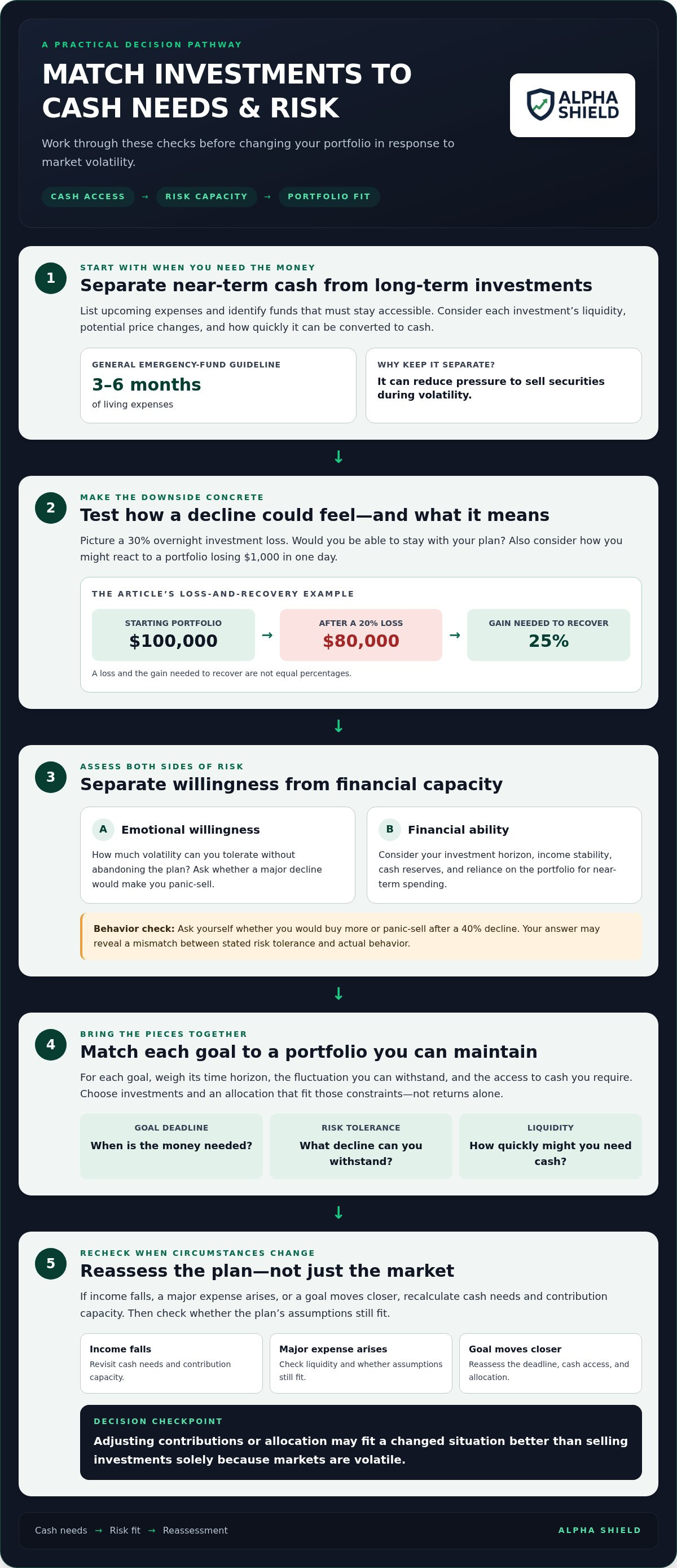
- Separate money by when you may need it. List upcoming expenses and identify which funds need to remain accessible. A general emergency-fund guideline is three to six months’ worth of living expenses. Keeping emergency savings separate from long-term investments can reduce pressure to sell securities during volatility. Consider each investment’s liquidity, potential price changes, and how quickly it can be converted to cash.
- Test your tolerance for market declines. Picture a 30% overnight investment loss, then consider whether you could stay with your plan. Make the test concrete: how would you react if a portfolio lost $1,000 in one day? A 20% loss turns $100,000 into $80,000, and recovery requires a 25% gain. If that decline would prompt a panic sale, your allocation may exceed your practical tolerance.
- Assess both emotional and financial capacity for risk. Your willingness to tolerate volatility is only one factor. Your ability to bear losses also depends on your investment horizon, income stability, cash reserves, and reliance on the portfolio for near-term spending. Ask whether you would buy more or panic-sell after a 40% decline. Your answer can expose a mismatch between stated risk tolerance and actual behavior.
- Match the portfolio to goals, liquidity, and tolerance. For each goal, consider its time horizon, how much fluctuation you can withstand, and how much access to cash you require. Choose securities and an allocation that fit those constraints rather than pursuing returns without considering stability. This provides a practical basis for creating an investment strategy around your goals, time horizon, and risk tolerance.
- Reassess after a life change or emergency. If income falls, a major expense arises, or a goal moves closer, first recalculate cash needs and contribution capacity. Then decide whether the plan’s assumptions still fit. Adjusting contributions or allocation may be more appropriate than selling investments solely because markets are volatile. For added context on market risk, the market crash and drawdown tool can support your assessment alongside your own liquidity needs and risk limits.
An adviser can help you assess your risk tolerance and put uncertainty in perspective, especially if emotional reactions make your plan difficult to follow. Income investing can provide steady financial support without requiring you to constantly sell assets. A CD ladder can spread investments across CDs with different terms, such as six months, one year, two years, and longer.
Yuvaraj E says he prefers a share price that varies by less than 20% from his theoretical valuation, an example of a valuation-based limit rather than a measure of cash access.
Asset allocation
Set an allocation that balances risk and return across asset classes. Review the portfolio every 3-6 months, then rebalance when its mix no longer matches your plan.
-
Set an Asset Allocation
Choose how to divide investments among stocks, bonds, and cash based on your goals, life stage, and ability to tolerate fluctuations. Asset allocation structures the portfolio; it does not predict which asset will lead next. One fund’s return variability over time can be explained by asset allocation by up to 90%, so the mix deserves deliberate attention.
Write down the target allocation and the reason for each asset class. Avoid choosing a mix solely because one category has recently performed well. A mid-career saver, for example, may gradually shift toward a more conservative allocation at age 55 as retirement approaches.
- Diversify across different assets. Spread investments across stocks, bonds, and real estate rather than relying on a single market segment. Asset classes can respond differently to economic and market conditions. Diversification can reduce concentration in one area, but it doesn’t ensure a profit or protect against losses when markets decline.
Check what each holding adds to your portfolio. If several funds own similar companies, their labels may suggest variety even though their underlying investments overlap. Review the assets inside your accounts, not just the number of funds. Aim for meaningful diversification that supports your allocation, not complexity for its own sake.
-
Review and Rebalance the Portfolio
Review your portfolio every 3-6 months and compare its current mix with your written allocation. Rebalancing means adjusting holdings to bring the portfolio back toward its target. For example, if stocks rise and become a larger share than planned, rebalancing can restore the intended balance rather than letting market performance set it.
Use each review to check whether your goals, life stage, or financial needs have changed. Don’t treat every market dip as a reason to trade. Rebalance when your portfolio has moved away from its plan or your circumstances have changed, not simply because volatility makes an asset feel uncomfortable.
- Coordinate allocation across accounts. Consider your investments across all accounts rather than judging each account in isolation. One account may hold bonds while another holds stocks; the combined allocation is what matters. List the holdings and asset classes in each account, then assess whether your overall portfolio still reflects your target.
An adviser can help assess whether your allocation fits your goals and life stage, and whether holdings overlap across accounts. Bring your written target and a current list of assets to the discussion. Use the same criteria at each scheduled review to keep decisions consistent as markets move.
Consider working with a financial professional
A financial professional can help turn a broad investment intention into a plan with clear priorities and review rules. Consider seeking support when your income, wealth, portfolio, or financial responsibilities make decisions harder to assess on your own.
- Identify the decision you need help making. Write down the specific issue before seeking guidance. It might be a portfolio that no longer matches your goals, uncertainty about your risk tolerance, or competing demands across brokerage and retirement accounts. A focused question keeps the discussion practical and makes it easier to assess whether the guidance addresses your situation.
Bring the facts that shape the decision: income, savings, debts, upcoming expenses, investment holdings, and the purpose of each account. These details help connect recommendations to your actual financial position. Without them, a suggested allocation may not reflect your cash needs or the losses you could withstand.
- Use the discussion to test your plan’s assumptions. Explain the goals, timelines, contributions, and allocation behind your strategy. Then consider what might change if your income fell, a major expense arose, or a goal moved closer. The aim isn’t to replace your plan at every review. It’s to identify which changes matter and which market movements leave the original reasoning intact.
Ask for the reasoning behind proposed adjustments. A change, for example, should relate to a shift in your goals, ability to take risk, or portfolio structure, rather than short-term market noise alone. Clear reasoning gives you a basis for staying consistent after the discussion.
- Make the advice measurable and usable. Turn broad recommendations into decisions you can track, such as contribution priorities, target allocation, or conditions for reviewing the plan. Record the agreed actions and how they support your goals. If a recommendation affects multiple accounts, assess the combined portfolio rather than treating each balance as a separate strategy.
A 2025 study estimated that financial advice can add up to 4.87% to portfolio returns over the long term, depending on the period and return calculation. Treat this as a study estimate, not a personal return forecast. The practical value of advice depends on whether it improves decisions and helps you follow a plan suited to your circumstances.
- Keep responsibility for the final decision. Use professional input to understand trade-offs, not to outsource your judgment. Before acting, compare each recommendation with your written goals, cash needs, and tolerance for volatility. If you can’t explain how a proposed change supports those priorities, pause and put the reasoning into plain language.
Set a regular review schedule with the professional, based on meaningful changes in your finances or objectives. Bring updated account balances and income details to each discussion. Consistent records help distinguish a genuine change in your situation from a temporary reaction to market movement.
Stay invested during market volatility
Common mistakes include panic-selling after a decline, checking balances constantly, and changing course to chase recent winners. These reactions can turn temporary market volatility into a lasting change to a retirement plan.
- Separate market movement from a change in your plan. Before selling, write down what has changed: your goals, time horizon, income, or ability to tolerate losses. If none of these has changed, a price decline alone may not justify abandoning your strategy. Pausing helps distinguish new financial information from pressure caused by a volatile market.
A 20% investment loss requires a 25% gain to recover the initial value. That arithmetic shows why avoiding a rushed sale matters, but it doesn’t make every holding appropriate to keep. Revisit the reason for owning an investment and whether it still serves your plan. This is a practical starting point for how to stick to your investment strategy when prices fall.
- Reduce emotional triggers. Avoid checking investment performance every day. Frequent balance checks can intensify fear and disappointment, making a sale feel urgent even when your long-term objectives are unchanged. Set a review schedule and use it to assess your plan instead of reacting to every market headline or short-term move.
In February and March 2025, one in four investors said they experienced loss aversion and panic-sold holdings during volatility. Recognize that response as a behavioral risk. If you feel compelled to act, write down the reason and compare it with your investment policy before placing a trade.
- Focus on time in the market, not market timing. Missing a small number of strong trading days can materially affect an investment outcome. A hypothetical $10,000 invested in the S&P 500 Index from January 1, 1988, through December 31, 2025, illustrates the risk: being out for the five best days could have reduced hypothetical returns by 38%.
This example doesn’t predict future performance. It shows why trying to exit before declines and re-enter before rebounds requires two difficult decisions. To stick to your investment strategy, compare each potential move with your long-term horizon instead of trying to call every turning point.
- Keep your process consistent through different periods. If your plan uses regular contributions, follow the schedule in rising and falling markets, as long as your financial situation still supports it. Dollar-cost averaging means investing a fixed amount regularly, regardless of market conditions. It can smooth average purchase costs over time and reduce the urge to time the market.
Use your portfolio’s written rules as a filter. A change should follow a change in your goals, cash needs, or ability to take risk, not just a sharp news cycle. This keeps decisions connected to your circumstances.
- Make volatility a review signal, not an automatic sell signal. When markets fall, compare your current allocation with your target and revisit the reasons behind each holding. If the plan still fits your goals and risk tolerance, patience and consistency can keep short-term disruption from dictating long-term decisions.
Staying invested doesn’t mean ignoring risk or holding every asset indefinitely. It means following a defined process instead of reacting emotionally. Revisit your rationale, make only plan-based adjustments, and preserve your ability to act deliberately through future periods of uncertainty.
Alpha Shield: Alpha Shield Market Signal
Alpha Shield Market Signal provides a systematic market signal for investors managing volatility and drawdown risk. Use it as an additional input when deciding whether current market conditions warrant a closer review of your investment plan. It doesn’t replace the need to align your portfolio with your goals, cash needs, and risk tolerance.
The Market crash and drawdown tool and Alpha Shield Dashboard provide indicators focused on market crash protection and risk management. They support a disciplined approach to long-term capital preservation, not day trading, shorting, or individual stock selection. Explore how these tools can inform your review of market volatility.
Visit alphashield.ai to learn more about Alpha Shield Market Signal.
Make your next decision deliberate
Your strategy is useful when it guides decisions before pressure builds. Write down the conditions that would justify a change, such as a shift in your goals, cash needs, or ability to accept risk. Then decide how you’ll respond if those conditions arise. Clear decision rules give you something to return to when headlines, market swings, or emotions compete for your attention.
A practical test of how to stick to your investment strategy is whether you can explain your next action without relying on fear or excitement. If the reason isn’t clear, pause and compare the decision with your written plan. If your circumstances have genuinely changed, review the plan deliberately and adjust for that reason.
Use this process as a repeatable discipline, not a prediction of what markets will do. A measured next step can keep uncertainty from making the decision for you.
Keep your rules clear, your reviews purposeful, and your decisions grounded in your goals.
Frequently Asked Questions
You've Picked Your Strategy, Now What?
Turn your strategy into instructions for each account, then make sure every holding has a defined role. Check that purchases match your intended asset classes, contributions go to the right accounts, and idle cash isn’t accidental. Save a dated snapshot of your holdings and balances. Compare future statements with it to catch execution errors, not to judge your strategy by a few days of performance. Correct mismatches before adding complexity.
What rules help investors avoid emotional decisions during market volatility?
Keep a decision log before making a trade. Record the date, action you’re considering, evidence, and emotions driving the decision. Then note whether your strategy’s criteria were met. At your next portfolio review, look for patterns, such as repeated urges to sell after negative news. This record helps separate evidence-based changes from reactions and shows where your process may need clearer decision rules.


