

The counterintuitive answer: keeping a lump sum in cash avoids immediate market exposure, but it can delay potential growth. Investing it all at once puts the full amount to work sooner, while phasing it in spreads out the entry points. A lump-sum investment means investing a single amount rather than contributing gradually. The right approach to protecting a lump sum investment from market risk depends on your time horizon, cash needs, and tolerance for volatility.
It’s reasonable to hesitate before investing a large amount when markets could fall soon after you enter. But waiting for a “safer” moment is also a timing decision, and gradual investing won’t prevent losses if markets decline. This article explains how immediate exposure, holding cash, volatility, and a long-term plan affect the trade-off. Compare the main approaches and use the practical decision guide to choose a strategy suited to your circumstances.
Key Takeaways
- Compare investing the full amount with phasing it in, weighing earlier market exposure against the comfort of spreading out entry points.
- Set aside cash for near-term needs before deciding how much of the lump sum belongs in investments.
- Match your portfolio to your goals, time horizon, and tolerance for volatility; diversification can manage exposure but cannot eliminate losses.
- Use a clear plan to avoid letting short-term market moves dictate repeated changes to your investment approach.
- Explore Alpha Shield Market Signal and its dashboard for systematic market-risk indicators when you want added structure around drawdown risk.
Market volatility and investment timing
Volatility changes an investment’s value, but it can’t tell you when a market will recover. Compare approaches by their market exposure, potential downside, and the discipline each requires.
Market Timing Risk
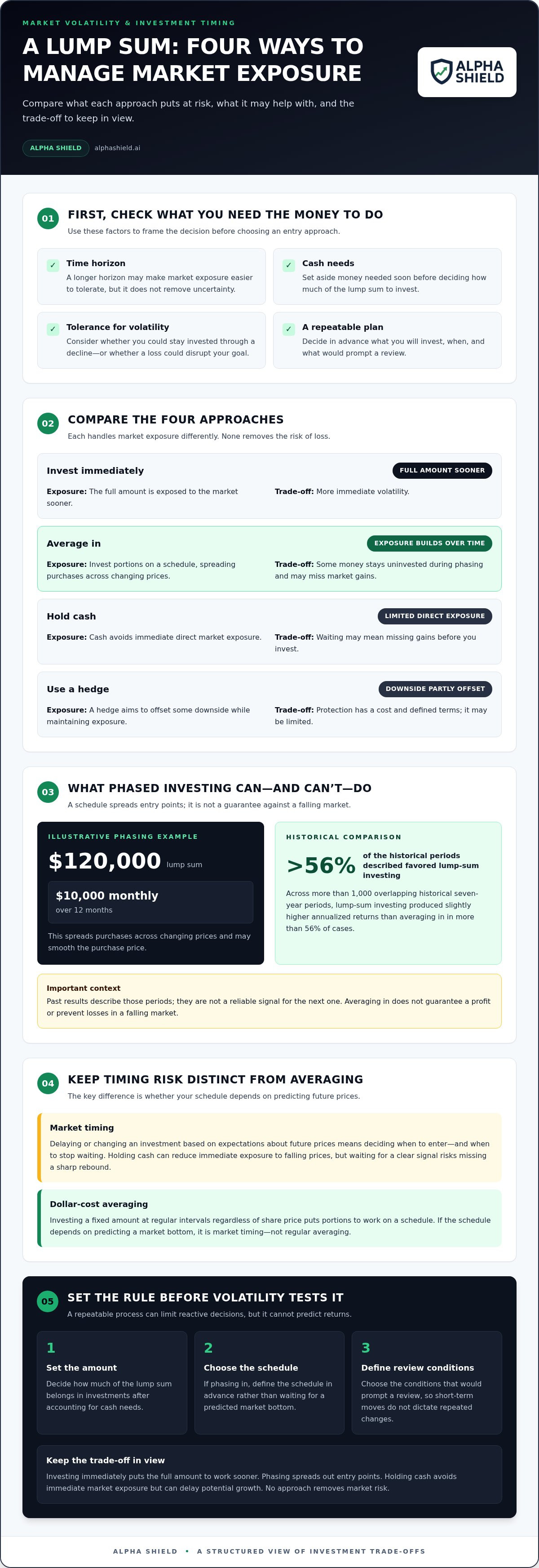
Market timing means delaying or changing an investment based on expectations about future prices. It differs from dollar-cost averaging, which invests a fixed amount at regular intervals regardless of share price, and from investing immediately, which exposes the full amount sooner. Timing requires two decisions: when to enter and when to stop waiting. Missing a recovery can reduce returns and wealth, even when the goal is to protect your capital.
For example, an investor could phase $120,000 into $10,000 monthly installments over 12 months. This spreads purchases across changing prices and may smooth the purchase price, but it doesn’t guarantee a profit or prevent losses in a falling market. Across more than 1,000 overlapping historical seven-year periods, lump-sum investing produced slightly higher annualized returns than averaging in more than 56% of cases. Past results describe those periods, not a reliable signal for the next one.
Downside Risk from Market Timing
The main downside is being out of the market during a sharp rebound after a decline. Holding cash can reduce immediate exposure to falling prices, but waiting for a clear signal risks missing gains before you invest. This differs from phased investing: timing can leave the entire amount on the sidelines, while averaging puts portions to work on a schedule. Neither approach removes market risk.
Choose a rule before volatility tests your resolve. Set the amount to invest, the schedule for a phased entry, and the conditions that would prompt a review. If your schedule depends on predicting a market bottom, it is market timing. If it follows regular intervals, it is averaging. A repeatable process can limit reactive decisions, but it can’t predict returns.
Put Options and Other Hedges
A put option gives its buyer the right to sell an asset at a specified price, potentially offsetting some portfolio losses if that asset falls. The cost is the option premium, which depends on factors such as the asset, strike price, expiration, and market volatility. Other hedges can also reduce exposure, but their costs and effectiveness depend on how they are structured.
A hedge differs from holding cash or averaging into investments: it aims to offset some downside while maintaining exposure. The premium reduces returns if protection isn’t needed, and the protection may be limited by the hedge’s terms. Before relying on it, understand what loss it is designed to offset and how long the protection lasts.
| Approach | Market exposure | Main trade-off |
|---|---|---|
| Invest immediately | Full amount exposed sooner | More immediate volatility |
| Average in | Exposure builds over time | Some money stays uninvested during phasing |
| Hold cash | Limited direct market exposure | May miss market gains while waiting |
| Use a hedge | Exposure is partly offset | Protection has a cost and defined terms |
Match the approach to your time horizon, cash needs, and tolerance for losses. Then follow a schedule rather than trying to forecast every market move.
Long-term investing and financial advice
Set the portfolio’s risk level according to its purpose, your time horizon, liquidity needs, and tolerance for losses. Money needed soon belongs in accessible, lower-volatility holdings. Money set aside for a distant goal can generally support more market exposure if you can withstand declines.
Start with the goal and horizon
Name the goal before selecting investments. Retirement, a home purchase, and education funding create different timelines and cash demands. If you can’t commit to a five-year horizon, equities are generally unsuitable for that money. For goals 20 years or more away, equities can play an important role, provided their volatility fits your risk tolerance.
Time can change the range of historical outcomes, but it doesn’t remove uncertainty. Historical investment outcome ranges and risk of loss narrowed substantially across five-, ten-, and twenty-year periods. The worst historical rolling twenty-year return was positive for stocks, bonds, and a balanced 60/40 portfolio. Use that record as context, not as a promise about future returns.
Protect liquidity before investing
Separate near-term spending from long-term capital in your financial plan. List known expenses, such as housing costs, tuition, and planned repairs, then keep enough accessible cash to meet them without selling investments during a decline. An emergency fund at a bank or credit union can reduce the likelihood of borrowing to cover unexpected bills.
Review high-interest debt before investing every available dollar. For many investors, paying down expensive debt is preferable because its interest rate usually exceeds likely investment returns. Base the decision on actual borrowing costs, repayment terms, and cash needed for upcoming obligations.
Calibrate risk and review the plan
Risk tolerance is more than a stated preference. It includes whether you can stay invested when your portfolio falls and whether a loss would disrupt your goal. If a potential decline would prompt you to sell, reduce exposure before investing. Your financial plan should define the target allocation, cash needs, and conditions for reviewing that allocation.
Next, consider implementation costs and your behavior. Investment fees and costs can materially affect portfolio value over time, even when each charge seems small. Frequent trading has generally been more harmful than helpful to long-term returns. Review the portfolio on a set schedule and after meaningful changes to your goal, income, or liquidity needs, rather than reacting to every market move.
- Near-term goal: prioritize access to funds and limit exposure to sharp price swings.
- Long-term goal: select a diversified allocation you can hold through volatility.
- Unclear risk capacity: test how a substantial portfolio decline would affect spending and decisions before investing.
When discussing advice, ask what services the professional provides and how they’re paid. The answers can help you assess whether the guidance fits your plan, portfolio, and investment horizon.
Lump-sum investing and immediate market exposure
A lump sum puts the full amount into the chosen asset allocation at once. A $200,000 investment made all at once gives every dollar market exposure immediately. If prices rise, more of the capital participates from the start. If prices fall, the whole invested amount experiences that decline. The decision is not simply about predicting volatility. It is about whether the allocation and timing fit the money’s purpose, liquidity needs, and planned holding period.
Gradual investing changes the timing of exposure, not the portfolio’s underlying risk. An investor could deploy a $100,000 lump sum through regular purchases rather than investing it immediately. This can reduce the impact of entering at one particular price, but some money remains uninvested during the transition. Cash may earn interest, depending on its account, but its value can also lose purchasing power over time. The longer the phasing period, the longer part of the lump sum waits outside the target allocation.
Consider a hypothetical $100,000 portfolio invested entirely in equities. Its median one-year ending wealth was $111,940 with lump-sum investing, compared with $109,580 with dollar-cost averaging. The lump-sum approach held a $2,360 median advantage in that example. In a hypothetical 60% equity and 40% bond portfolio, median ending wealth was $109,360 with immediate investing and $107,453 with averaging, a $1,907 advantage for the lump sum.
Portfolio mix changed the comparison, but the same pattern appeared in a hypothetical 40% equity and 60% bond portfolio. Median one-year ending wealth was $107,648 with lump-sum investing and $106,400 with averaging, giving immediate investment a $1,248 advantage. These are modelled comparisons, not a forecast for an individual account. A different start date, market path, or asset allocation can produce a different result.
Use a practical sequence before investing. First, set aside cash for near-term expenses and potential tax bills. Next, choose a target asset allocation based on your goal and the level of loss you can tolerate. Then decide whether to invest the remainder immediately or phase it in on a defined schedule. Staging the investment may make volatility easier to manage emotionally, but it can’t eliminate market losses or ensure better returns.
Immediate exposure may suit you when the target allocation is clear, your investment horizon is long, and temporary declines won’t force a sale. Phasing may help when a written schedule can keep a sudden market move from derailing your plan. Either way, don’t change the purpose or allocation simply because prices move soon after you invest.
Market timing and the opportunity cost of holding cash
Cash avoids immediate exposure to market price changes, but waiting can mean missing investment gains. Treasury bills, certificates of deposit (CDs), money market funds, and bonds differ in access, maturity, and risk. Compare those features with your cash needs before choosing where to hold funds.
Holding Cash and Opportunity Cost
Holding cash while waiting for a particular market entry point is a timing decision. Its opportunity cost is the return the money might have earned if invested sooner. For example, $10,000 invested in the S&P 500 from January 2003 through December 2022 grew to approximately $64,844 if left invested. Missing the 10 best-performing days would have left approximately $29,708.
The full-period investment had an annual return of 9.8%. That historical example shows why waiting for a more comfortable entry can carry a cost, not what a future investment will return. Alpha Shield research and broader market studies show that dollar-cost averaging often beats simply holding cash. A fixed monthly schedule can reduce the temptation to keep delaying, but it doesn’t remove the risk of loss.
Keep savings for planned expenses and emergencies separate from money intended for long-term investment. Decide in advance how much cash is earmarked for a purpose, such as an upcoming bill, and how much is waiting only for a market decline. If you’re holding cash for the latter reason, set a written investment schedule instead of repeatedly changing your entry point.
Treasury Bills, CDs, and Money Market Funds
These options can hold short-term funds, but their terms and protections differ. U.S. Treasury bills mature in one year or less; CDs may have fixed terms such as six months, one year, or five years. A bank CD may incur a penalty for early withdrawal, while FDIC coverage for CDs is generally limited to $250,000 for each applicable account category at an institution.
A money market fund is an investment, not a bank account. A bond can also fluctuate in market value before maturity, especially as interest rates change. Consider its maturity and issuer when weighing price volatility and access.
| Holding | Term or access | Key risk or protection |
|---|---|---|
| Treasury bills | Mature in one year or less | Value can differ if sold before maturity |
| CDs | May have fixed terms | Early withdrawal may trigger a penalty; FDIC limits apply |
| Money market funds | Fund shares | Variable yield, not FDIC insured |
| Bonds | Maturity varies by type | Market value can change with interest rates |
Choose where to hold money based on when you need it, whether early access matters, and how much fluctuation you can tolerate. For a specific cash need, match the maturity date to the expected spending date. For investment capital, don’t treat temporary savings as a risk-free substitute for a long-term plan.
How should you build a diversified portfolio to protect a lump sum?
Start with the risk your lump sum must support, then spread exposure across investments that respond differently to market conditions. Diversification can reduce concentration in one company or asset type, but it doesn’t ensure a profit or protect against loss. The historical record shows why allocation matters: from 1926-2025, the worst calendar-year return for a 100% stock portfolio was -43%.
Build the portfolio around its purpose, not recent performance. Money for long-term growth may call for a different mix from funds needed for planned spending. Before investing, identify the goal, expected withdrawals, and decline you could tolerate without selling. These factors help determine how much to allocate to stocks, bonds, and cash-like holdings.
Diversify across asset types and individual holdings. Mutual funds and exchange-traded funds can provide exposure to a range of securities, while U.S. savings bonds and certificates of deposit may serve different roles. A fund holding many companies can reduce dependence on one issuer, but it can still fall when its broader market segment declines. Check what each holding owns and how it fits into the full portfolio.
- Separate liquidity: keep money for near-term spending accessible, so a market decline doesn’t force an untimely sale.
- Set an allocation: choose stock, bond, and cash proportions based on the goal and your capacity for volatility.
- Spread exposure: avoid placing the entire investment in one company, sector, or asset class.
- Review overlap: compare fund holdings, since several funds can own many of the same companies.
Next, define a review process. Revisit the portfolio when your goal, spending needs, or ability to tolerate risk changes, rather than reacting to every price move. If stocks rise faster than bonds, your portfolio can drift from its intended allocation. Rebalancing restores the chosen mix by directing new contributions or selling part of an overweight holding. It’s a risk-control routine, not a forecast of which asset will perform best next.
Consider how each holding can lose value. Stocks can fall because of company-specific or broader market conditions. Bonds can fluctuate as interest rates change, and cash-like holdings may not keep pace with rising costs. Diversification combines different exposures, but doesn’t make risk disappear. The right mix depends on the lump sum’s time horizon, withdrawal needs, and losses you can withstand while sticking to the plan.
For a systematic view of market crash and drawdown signals, explore market risk signals.
Alpha Shield: Alpha Shield Market Signal
Alpha Shield Market Signal is designed to help investors navigate volatility and manage the risk of significant drawdowns. Its subscription delivers one daily “IN” or “OUT” signal through the dashboard, email, and Telegram, alongside ETF allocation and position-sizing guidance. The Alpha Shield Dashboard provides market-health indicators to support risk-management decisions during unsettled markets.
Use the signal alongside your investment horizon, liquidity needs, and chosen asset allocation. Alpha Shield focuses on long-term capital preservation, not day trading, shorting, or individual stock recommendations. A signal can inform your plan, but it doesn’t replace decisions about your portfolio’s purpose and risk level.
Visit alphashield.ai to learn more about Alpha Shield Market Signal.
Make your next investment decision deliberate
A practical approach to protecting a lump sum investment from market risk starts with a written decision rule, not a prediction about tomorrow’s prices. Decide how much cash to keep accessible, what allocation supports your goal, and what circumstances would prompt a review. This gives you a reference point when volatility makes every choice feel urgent.
Before investing the remaining capital, make sure your plan reflects your actual time horizon and ability to tolerate declines. If those conditions change, revise the plan deliberately. If they haven’t, don’t treat every market move as a reason to abandon it. The aim isn’t to remove uncertainty, but to make the next step consistent with your financial purpose.
Alpha Shield’s market-risk tools may suit investors who want systematic signals to inform their approach. They support decision-making, but don’t replace your own investment plan.
Choose a process you can follow through changing markets, then give it room to work.
Frequently Asked Questions
What is a lump-sum investment?
A lump-sum investment puts a single pool of available money into investments, rather than adding only new income over time. For example, someone receiving an inheritance could invest part of it in a portfolio instead of making recurring contributions from a paycheck. The key is deciding how much is genuinely available to invest after accounting for planned spending, debt obligations, and cash reserves.
Is a blended investment approach a sensible compromise?
Yes. A blended approach can invest part of the lump sum immediately and phase the rest in on a preset schedule. This keeps one entry date from determining the outcome for the entire investment, while limiting how long all the money sits outside the portfolio. Decide on the schedule in advance, then follow it through rising and falling prices instead of changing it in response to headlines.
What if markets are going up?
If markets rise after your first investment, that portion participates in the gains. Money waiting for later installments won’t share the full increase, and each scheduled purchase could buy fewer shares at a higher price. That’s the trade-off for spreading entry points. Follow the allocation and schedule chosen for your goal. A recent rally alone doesn’t show that prices will keep rising.
…But what if they go down?
If prices fall after you invest, your portfolio’s market value declines. A phased plan puts later installments into investments at lower prices, but doesn’t erase losses on earlier purchases. If you need money during the decline, selling can turn a temporary drop into a realized loss. That’s why it’s important to separate planned withdrawals from long-term investments before choosing an allocation or entry schedule.
What does market risk mean for a lump sum investment?
Market risk is the chance that changing prices reduce an investment’s value. With a lump sum, a decline soon after investing affects the entire amount exposed to that market. The impact also depends on what you own: a concentrated holding can behave differently from a mix of assets. If you’re withdrawing during retirement, the timing of declines can affect how much remains invested afterward.
How can you reduce market risk when investing a lump sum?
A plan for protecting a lump sum investment from market risk starts by setting aside money for near-term needs, then choosing a diversified allocation for the remainder. Write down the investment schedule and the conditions for reviewing it before market swings begin. Check whether your holdings overlap, and avoid concentrating the lump sum in one company or asset type. Review progress against your goal, not daily price changes.
Is dollar-cost averaging safer than investing a lump sum all at once?
Dollar-cost averaging reduces the risk of investing the entire amount just before a price decline. It doesn’t make the investment safe: the portfolio can still lose value, especially in a falling market. It also leaves part of the lump sum uninvested while installments are made. The useful question is which approach you can maintain while keeping your time horizon, cash needs, and risk tolerance aligned.


