

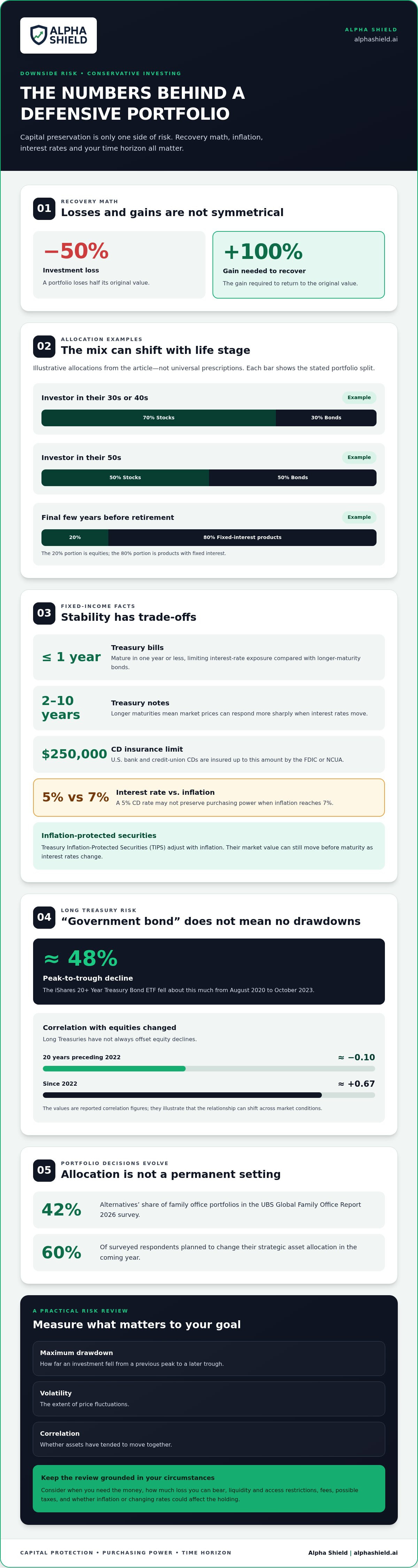
A 50% investment loss requires a 100% gain to return to the original value. A conservative investor prioritizes protecting original capital while seeking reasonable returns, generally accepting lower potential returns and holding more low-risk fixed-income investments than stocks or funds. That’s why downside risk management for conservative investors must account for both market losses and the risk that cautious choices may not keep pace with inflation.
Seeking stability makes sense when your savings have a defined purpose or a shorter time horizon. But the label “conservative” alone doesn’t determine the right level of risk. Your goals, when you’ll need the money, and how you respond to market declines all shape the trade-offs.
This article explains what defines a conservative investor and how to weigh the benefits and drawbacks of a defensive approach. It also explores how Treasury bills, notes, and inflation-protected securities may fit into a portfolio, and why risk decisions should reflect your goals and time horizon. The aim is a clearer framework for protecting capital without overlooking the long-term cost of too little growth.
Key Takeaways
- Conservative investing prioritizes capital preservation, but your risk tolerance should shape how much exposure you keep to growth assets.
- Match portfolio risk to when you’ll need the money; a near-term goal calls for different choices than a distant one.
- Treasury securities and CDs can play a stabilizing role, but inflation and interest-rate changes affect their value and purchasing power.
- Weigh the trade-off between reducing volatility and maintaining enough growth potential to support long-term goals.
- Alpha Shield Market Signal offers a market crash and drawdown tool with a dashboard for investors seeking systematic market signals.
Why should investors care about downside risk management?
Downside risk management means limiting the damage a portfolio may suffer during falling markets. A 50% investment loss requires a 100% gain to return to the original value, so loss size matters.
Fees, taxes, and restrictions on access can reduce returns or limit access to assets. Consider fund expenses, potential tax consequences when selling, and whether you can sell an investment when you need the funds.
Risk Tolerance and Asset Allocation
Risk tolerance is the level of investment loss you can withstand financially and emotionally. It matters because asset allocation shapes how market declines affect your portfolio. Conservative investors typically hold more lower-risk fixed-income investments than stocks or stock funds, but the mix should reflect their goals and capacity for loss. A strategy you can tolerate is easier to maintain through volatility.
Allocation examples show how choices can differ across investors. Someone in their 30s or 40s might hold 70% of a portfolio in stocks and 30% in bonds. An investor in their 50s might choose a 50/50 mix. In the final few years before retirement, an example allocation is 20% equities and 80% products with fixed interest. These are examples, not universal prescriptions.
Family offices also use varied asset mixes. Alternatives accounted for 42% of family office portfolios in the UBS Global Family Office Report 2026 survey. In that survey, 60% of respondents planned to change their strategic asset allocation in the coming year. Such changes can reflect shifting goals, market views, or risk capacity. They also show that asset allocation is a continuing decision, not a permanent setting.
Rebalancing Conservative Portfolios
Portfolio rebalancing restores your intended allocation when market movements push it out of line. If stocks rise faster than bonds, equities may make up a larger share than planned. Selling some of that exposure and adding to underweighted assets can bring the portfolio back toward its target. Rebalancing keeps risk aligned with your strategy rather than recent performance.
Rebalancing also means weighing transaction fees, possible tax consequences, and the liquidity of assets you sell. A portfolio that holds alternatives may be harder to adjust than one made up of publicly traded investments. You can set rules based on calendar reviews or allocation drift, then apply them consistently instead of reacting to headlines.
Your conservative asset allocation may need to change as your goals and circumstances evolve. A portfolio built for growth may require a different balance as retirement approaches or planned withdrawals draw nearer. Review the purpose of each holding, the level of loss you can bear, and when you’ll need the funds. Then adjust deliberately, keeping risk clearly connected to the goal your assets must serve.
Treasury bills, notes, and inflation-protected securities
For investors prioritizing lower price volatility, Treasury bills and insured certificates of deposit can serve as capital-preservation holdings. U.S. Treasury bills mature in one year or less, which limits exposure to changing interest rates compared with longer-maturity bonds. Treasury notes mature in 2 to 10 years, so their market prices can respond more sharply when rates move. Treasury Inflation-Protected Securities adjust with inflation to help protect purchasing power.
In the United States, bank and credit-union CDs are insured up to $250,000 by the Federal Deposit Insurance Corporation or the National Credit Union Administration. CDs can provide a defined interest rate and maturity, while Treasury bills provide a government-security option with shorter terms. Either may suit a reserve for near-term spending, but access and reinvestment terms matter. An investor who needs funds before a CD matures may face restrictions or penalties under its terms.
Lower day-to-day price movement doesn’t remove every form of downside risk. Inflation can erode purchasing power when interest earned falls below the rate of rising prices. For example, a 5% CD interest rate may not preserve purchasing power when inflation reaches 7%. TIPS address inflation adjustments differently, but their market value can still move before maturity as interest rates change. The appropriate choice depends on the spending date, liquidity needs, and risk tolerance.
Long-duration Treasuries show why a government bond isn’t automatically free of significant drawdowns. The iShares 20+ Year Treasury Bond ETF fell about 48% from peak to trough between August 2020 and October 2023. Long Treasuries also haven’t always offset equity declines. Their correlation with equities was roughly -0.10 over the 20 years preceding 2022, then approximately +0.67 since 2022. Those figures illustrate how the relationship can shift across market conditions.
Assess downside exposure by comparing a holding’s maximum drawdown, volatility, and response to equity declines. Maximum drawdown measures the fall from a previous peak to a later trough. Volatility describes the extent of price fluctuations, while correlation shows whether assets have tended to move together. Compare each measure over the same period and against your planned holding period. A short-term reserve has a different purpose from a bond allocation intended to provide income over the longer term.
For a practical review, identify the amount needed soon, the maturity date of each fixed-income holding, and the effect of rising rates or inflation. Then assess how a sharp bond decline would affect the portfolio’s purpose. Investors seeking a systematic market perspective can explore a market crash and drawdown tool as one input to risk decisions, not a substitute for matching assets to goals.
Treasury bills and insured certificates of deposit are lower-volatility options described for capital preservation. Treasury bills’ short maturities limit exposure to changing interest rates, while CDs offer insured deposits and defined terms. Inflation and restrictions on access can still pose risks.
Assessing risk tolerance, goals, and time horizon
A risk plan starts with the purpose and timing of each financial goal. The same portfolio may suit retirement decades away but be a poor fit for a house down payment planned in five years. Identify when you need the money, how much loss the goal can absorb, and whether you might have to sell stocks during a downturn. Effective downside risk management for conservative investors connects these decisions instead of treating risk tolerance as a label.
Time horizon affects how much room an investor has to recover from falling markets. Conservative investors with shorter timelines of 3 to 5 years often need more caution because losses may arrive near the spending date. A horizon of 10 years or longer may allow modest growth exposure, depending on the goal and ability to withstand declines. Retirement savings intended for 30 years differ from funds reserved for a near-term purchase.
Risk tolerance has two parts: your financial capacity to bear losses and your willingness to stay invested through volatility. You may have a long investment horizon but still need cash soon for planned spending. Or you may be comfortable with market swings but lack the financial capacity for aggressive risks if withdrawals are approaching. Test your strategy against a downturn scenario and consider whether you would need to sell stocks. That assessment is central to downside risk management for conservative investors.
For people in or near retirement, spending needs can help define a reserve. You may want cash to cover a year’s worth of spending after accounting for other income, plus cash or short-term bonds for an additional one to three years. This structure can reduce pressure to sell longer-term holdings during a market decline. Set the reserve based on actual withdrawals, income sources, and when expenses are due.
Inflation also affects how much risk a goal can tolerate. The Federal Reserve generally aims to keep inflation in the United States at around 2%. If returns consistently trail rising prices, purchasing power can weaken over a long horizon. If a portfolio takes aggressive risk, a downturn near the goal date can damage its funding plan. The balance depends on the spending date and the growth the goal requires.
A practical downside risk management for conservative investors framework links each goal to a time horizon, cash reserve, and acceptable portfolio decline. Set an allocation suited to those constraints, then review it when income, withdrawals, or the goal date changes. For example, separate a five-year house goal from retirement savings intended for 30 years ahead. Give each goal its own asset mix and liquidity needs.
What is a conservative investor?
A conservative investor prioritizes capital preservation, choosing lower-risk investments while accepting lower potential returns than aggressive strategies. The aim isn’t to eliminate every market fluctuation. It’s to limit the chance that a loss disrupts a defined financial goal, such as funding retirement income or preserving savings for planned withdrawals.
That priority affects how well a conservative portfolio can absorb volatility. Fixed-income investments may provide interest, while cash supports liquidity. But low volatility doesn’t ensure that a portfolio will keep pace with inflation or meet future spending needs. The right balance depends on your goal, withdrawal schedule, and capacity to tolerate declines.
Some investors also seek current income. A current-income strategy targets investments with above-average distributions, such as dividends and interest. Those payments can support spending, but distributions and asset values can change. For example, a dividend-paying stock may generate income while its market price falls. Income alone doesn’t show whether the overall investment remains suitable.
Diversification can reduce dependence on a single investment, sector, or geographic region. A portfolio spread across different asset types may be less affected when one holding performs poorly. Diversification doesn’t remove market risk. Instead, it limits how much your outcome depends on one area while preserving exposure to assets that may support longer-term growth.
Inflation also tests a preservation strategy. The Federal Reserve generally aims to keep inflation in the United States at around 2%. If income and investment returns consistently trail rising prices, the money’s purchasing power can weaken over time. Carefully selected growth exposure may help address that risk, especially when an investor’s horizon extends beyond near-term spending needs.
Some conservative investors consider fixed annuities for income. They can provide guaranteed interest rates and a steady retirement income stream, but the guarantee depends on the issuing insurance company’s financial strength and ability to pay claims. Annuities are long-term investment vehicles with terms for keeping them in force. Those terms matter if you may need access to the funds sooner.
To prepare for an emergency during a downturn, keep accessible cash separate from long-term investments and base the reserve on essential expenses and other income. Use the reserve for urgent withdrawals first to reduce pressure to sell stocks after prices have fallen.
Capital preservation requires more than choosing assets with steady interest or distributions. Compare each holding’s role, liquidity, income potential, and exposure to inflation. If your portfolio must support withdrawals, map those cash needs against the assets available. This helps distinguish money intended for stability from money that still needs to grow.
Benefits and drawbacks of conservative investing
Conservative investing can reduce exposure to severe portfolio losses, but lower risk comes with trade-offs. The key is whether that stability supports your financial goals without weakening your future purchasing power.
Benefits of Conservative Investing
A conservative strategy can help limit volatility and reduce the chance that a downturn forces you to sell assets at depressed prices. That matters if you’re drawing retirement income, since planned withdrawals may continue even when markets fall. A portfolio with government securities and other fixed-income holdings may provide more predictable interest than one concentrated in stocks.
Stability can also make a plan easier to follow. For example, keeping near-term spending needs separate from long-term wealth goals may help you avoid selling growth assets just to cover an upcoming bill. Diversifying across asset types can reduce reliance on a single source of returns. These choices don’t eliminate losses, but they can make portfolio risk more deliberate.
Drawbacks of Conservative Investing
Lower-risk assets can offer lower potential returns than aggressive strategies, which may slow wealth accumulation over a long retirement horizon. If returns remain below inflation, your portfolio’s purchasing power can decline even without a large market loss. A cautious allocation therefore reduces some risks while increasing the risk of insufficient growth.
Future expenses add pressure. Health care costs in the United States are projected to rise by 5.6% annually through 2032. Those projections illustrate why capital preservation alone may not fund every future need. Investors must weigh the cost of market volatility against the cost of limited growth.
Treasury securities can support stability, but their prices can fall when interest rates rise, especially for longer-duration holdings. This creates a potential mismatch if you need to sell before maturity. The right balance depends on your spending timeline, income from other sources, and ability to withstand declines. Assess a government security’s role alongside its liquidity and exposure to inflation.
The practical takeaway is to judge conservative investing against a specific goal, not a label. List expected withdrawals, identify which assets can meet them, then assess whether the remaining allocation can support long-term growth. If retirement spending will continue over a long horizon, a portfolio with no growth exposure may create a different risk from short-term market losses.
Alpha Shield: Alpha Shield Market Signal
Alpha Shield Market Signal helps investors navigate market volatility and manage exposure to significant drawdowns. It can inform your risk decisions alongside your goals, time horizon, and asset allocation, using a single daily IN or OUT signal.
The Market crash and drawdown tool and Alpha Shield Dashboard provide a daily IN or OUT signal, ETF allocation guidance, and a live performance and metrics dashboard. The service is designed for long-term, systematic risk management, not day trading or individual stock recommendations. Use the signal as one input in your process, and consider how any portfolio decision affects liquidity needs, growth exposure, and your ability to stick to your plan.
Visit alphashield.ai to learn more about Alpha Shield Market Signal.
Turn Risk Principles Into Clear Decisions
The next useful step is to turn your investment principles into written decision rules. Define which portfolio changes relate to your goals, which call for a scheduled review, and which would simply react to market noise. That distinction makes downside risk management for conservative investors more consistent when markets test a carefully chosen allocation.
Before changing positions, record your reason, the effect on planned withdrawals, and how the change affects your portfolio’s growth needs. Revisit the rules when your income, spending plans, or timing changes, rather than only when headlines grow more dramatic. A written framework helps distinguish a genuine change in circumstances from a short-lived market response. It also gives you a basis for assessing market signals without treating any single indicator as a complete investment plan.
Keep your plan accessible and review it when your financial priorities shift. Clear criteria can help you respond deliberately instead of improvising under pressure.
A disciplined process starts with one clear decision at a time.
Frequently Asked Questions
How do Treasury bills, CDs, money market funds, and bonds compare for capital preservation?
Treasury bills have short maturities, CDs have stated terms, money market funds offer access through fund shares, and bonds carry price risk before maturity. In the United States, bank and credit-union CDs are insured up to $250,000 by the Federal Deposit Insurance Corporation or the National Credit Union Administration. Compare access rules, interest-rate exposure, and how each holding fits the date you expect to use the funds.
What asset allocation is appropriate for a conservative investor nearing retirement?
There’s no single allocation for everyone nearing retirement. Start by separating essential spending from income sources such as pensions or Social Security, then identify which portfolio assets can support withdrawals. If you have reliable income from other sources, your portfolio needs may differ from those of someone funding most expenses from investments. Also account for planned large expenses, tax treatment, and your ability to tolerate losses without abandoning the strategy.
How can diversification and rebalancing reduce portfolio losses?
Diversification limits dependence on a single company, sector, or asset type, while rebalancing restores the portfolio’s intended risk mix after market movements. For example, if your technology holdings have grown faster than other assets, you can direct new contributions toward underweighted areas before selling. This can reduce concentration and trading activity. Neither method prevents losses, but both help keep one market segment from dominating portfolio risk.
What are the risks of using stop-loss orders, options, and hedging strategies?
A stop-loss order triggers a sale when a security falls below a preset price, but a fast market gap can lead to an execution below that level. Options, futures, and inverse ETFs can hedge exposure, but they add costs and complexity. Their behavior can differ from the asset being protected, especially over different holding periods. Before using a hedge, define the exposure and intended protection, and assess how its cost affects your portfolio.
How do inflation and interest rate changes affect conservative investments?
Inflation reduces what a fixed interest payment can buy, while rising rates generally lower the market value of existing bonds. The effect is more pronounced for bonds with longer maturities because their payments are locked in for longer. The Federal Reserve generally aims to keep U.S. inflation at around 2%. Treasury Inflation-Protected Securities adjust with inflation, while shorter maturities reduce, but don’t eliminate, exposure to rate changes.
Which investments have historically had the lowest downside risk?
Treasury bills and insured certificates of deposit are described as lower-volatility holdings for capital preservation. Treasury bills’ short maturities limit exposure to changing interest rates.


