

A clear rule can make investing more consistent, but it can’t make losses impossible. Implementing a rules-based investment strategy means setting observable conditions for buying, selling, holding, and adjusting portfolio exposure, then applying them consistently. For example, a strategy might use a move above a 50-day moving average as a buy signal.
It’s reasonable to want investment decisions grounded in more than market hunches. A rules-based approach ties actions to measurable inputs, such as price, trend, volatility, earnings, or cash flow, which can help limit emotional decisions. Its discipline comes from following the process in both favorable and difficult markets, not from expecting every signal to be right.
This article explains how rules guide buy, sell, and hold decisions, support diversification and rebalancing, and where systematic approaches can fall short. Risk controls matter: markets can move against a strategy, defensive signals may respond slowly to a rebound, and investing can result in loss of principal.
Key Takeaways
- Define observable conditions for buying, selling, and holding so decisions follow a consistent process rather than shifting with market noise.
- Set position-sizing and rebalancing rules that reflect your goals, time horizon, and tolerance for losses.
- Understand the trade-off: systematic signals can reduce reactive decisions, but may lag during sharp market rebounds.
- Review how volatility and potential losses could affect near-term plans, retirement withdrawals, and your ability to stay invested.
- Use a market signal as one input to risk management, not as a promise that losses can be prevented.
Investment risk and potential loss of principal
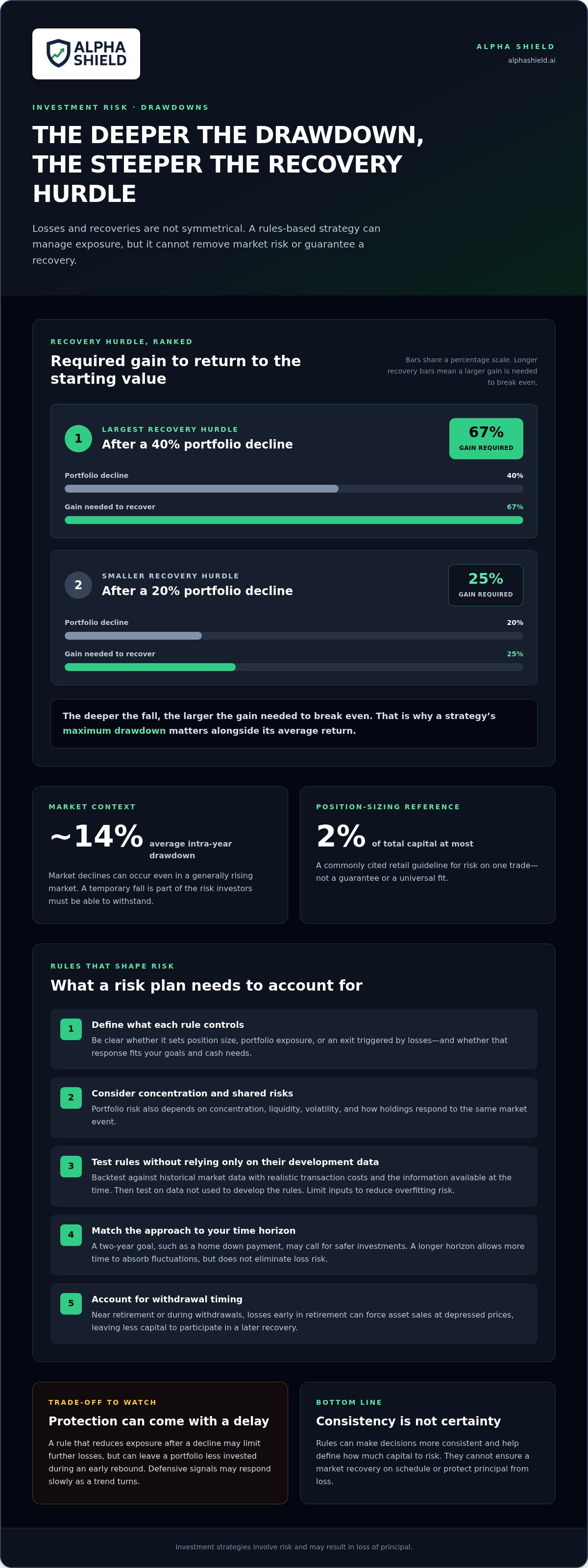
A rules-based approach can define how much capital to risk, but it cannot remove market risk. A commonly cited retail guideline is the 2% rule: risk no more than 2% of total capital on one trade. Treat it as a position-sizing reference, not a guarantee or a universal fit. A portfolio’s risk also depends on concentration, liquidity, volatility, and how holdings respond to the same market event.
To backtest a strategy, apply its written rules to historical market data, accounting for realistic transaction costs and when information became available. Then test the rules on data that was not used to develop them. Limit the number of inputs to reduce the risk of overfitting.
Drawdowns create a mathematical hurdle. A portfolio decline of 20% requires a 25% gain to return to its starting value. After a 40% decline, the required recovery is 67%. Losses and recoveries are not symmetrical: the deeper the fall, the larger the gain needed to break even. This is why a strategy’s maximum drawdown matters alongside its average return.
Market declines can happen even in a generally rising market. Intra-year market drawdowns average around 14%, so a temporary fall is part of the risk investors must be able to withstand. If a rule reduces exposure after a decline, it may limit further losses, but it can also leave the portfolio less invested during an early rebound. That trade-off affects both the plan and the investor’s ability to follow it.
Your time horizon changes the risks you face. Someone nearing retirement or beginning withdrawals faces sequence-of-returns risk: losses early in retirement can force asset sales at depressed prices, leaving less capital to participate in a later recovery. A two-year goal, such as a home down payment, may call for safer investments because volatility could jeopardize the plan. A longer horizon allows more time to absorb market fluctuations, but does not eliminate the risk of loss.
Account structure also matters when developing a risk plan. According to the Internal Revenue Service, the 2025 maximum individual IRA contribution in the United States is $7,000. According to the Internal Revenue Service, the 2025 maximum individual IRA contribution in the United States is $8,000 for people aged 50 or older. Contribution limits are separate from investment risk, but account choices and compliance with contribution rules belong in the broader plan.
Before adopting a rule, define what it controls: position size, portfolio exposure, or an exit triggered by losses. Consider whether that response fits your goals and cash needs. Rules can make decisions more consistent, but cannot ensure a market recovery on schedule or protect your principal. All investment strategies involve risk and may result in loss of principal.
Systematic investment management advantages and limitations
Systematic management uses predefined criteria for portfolio decisions rather than relying on discretionary judgment. Its value depends on how well the rules fit your goals, capital needs, and tolerance for periods of underperformance.
Systematic Management Trade-offs
A systematic approach uses measurable inputs and repeatable rules to decide when portfolio exposure should change. This structure can help limit personal bias and support consistent decisions in changing markets. Position sizing is one example: setting exposure with a formula can prevent a single investment from dominating the portfolio.
Discipline has limits. A defensive rule may reduce equity exposure after a decline, then participate more slowly in a sudden rebound while waiting for a confirmed trend. A system may also miss an opportunity to reduce risk when an analyst has a correct, uncommon view. Systematic position sizing can boost annual performance by 1.2%, but that result does not remove the possibility of losses or underperformance.
Comparing Investment Approaches
Rules-based, passive, and active management differ in how they make portfolio decisions and define success. Passive management seeks to replicate an index’s returns; active management aims to outperform a benchmark and generate alpha. A rules-based strategy applies defined criteria that may guide asset allocation, security selection, and changes in exposure.
These categories can overlap: an investor can follow systematic rules while holding index-tracking funds. The practical question is what the approach is designed to do. Passive investing suits a goal of benchmark replication. Active management aims to exceed a benchmark, often with higher fund-management and transaction costs. Rules support a consistent process, but do not guarantee outperformance.
Effects of Costs, Taxes, and Fees
Trading costs, taxes, and management fees reduce the return left after a strategy’s decisions. Rules that prompt frequent portfolio changes can increase transaction costs and, in taxable accounts, may realize capital gains more often. Higher turnover can therefore weaken net results, even when the signals appear effective.
Compare approaches using returns after their relevant costs, not just headline performance. Passive management generally has lower costs than active management, while a rules-based approach’s costs depend partly on its turnover and implementation. In the United States, investors can consider how account structure affects the handling of capital gains; tax-advantaged accounts such as IRAs or 401(k)s may be relevant for higher-turnover strategies. Fees and trading expenses compound over time, so include them when assessing whether a system’s expected benefit justifies its activity.
For a practical comparison, establish the benchmark, decision rules, turnover, and after-cost results before choosing an approach. Investors and their financial partners can then assess whether the system’s discipline fits their objectives, rather than treating a backtested advantage as a guaranteed result.
Buy, sell, and hold rules
Buy, sell, and hold decisions become more consistent when each action has a defined trigger, an observable measure, and a clear role in the portfolio. For example, a rule might screen a security for fundamentals, then use technical signals to monitor entry or exit. This sequence separates investment selection from timing.
To automate and execute rules, translate each condition into a measurable signal, define the resulting order or review action, and test the process before using it. Then monitor execution records and exceptions to confirm that the system is following its rules.
Set a buy condition
A buy rule should state what qualifies an investment and what market condition permits entry. For example, a strategy could first require a company to pass a fundamental-analysis test, then buy when its share price breaks above its 50-day moving average. The first test addresses the investment’s characteristics; the second gives a technical entry signal.
Rules can also govern allocation rather than individual securities. A portfolio might use a 70% stocks and 30% bonds allocation as a diversification target. The figures are a model, not a universal prescription. The investor’s objectives and risk capacity determine whether that mix is appropriate. Institutions may use different measures, but the rule still needs a clear target and a defined response when holdings drift.
Define sell and hold conditions
A sell rule can specify an exit when a signal changes, a position no longer meets its original criteria, or a risk limit is reached. An example uses a 1:2 risk-reward ratio for a take-profit target. This means the target gain is twice the defined amount at risk. The rule must also explain how the initial risk and target are measured.
Holding is an active decision when an investment still meets its criteria and no exit signal has occurred. In a rules-based process, technical analysis can monitor holdings for buy, sell, or hold decisions after they pass fundamental analysis. This sequence helps prevent a short-term price move from replacing the original investment test without a defined reason.
Make rules executable
Write every trigger so another person or system could identify the same signal. Specify the data input, observation timing, action, and what happens when signals conflict. For example, a rebalancing rule might prompt changes when an allocation drifts 3-5% from its target. A consistent threshold helps control when the portfolio returns to its planned weights.
Before executing a strategy, map each signal to an action: buy, sell, hold, or rebalance. Record the signal and decision, then review whether execution followed the rule. This audit trail can reveal data errors, missed instructions, or exceptions. Clear rules support systematic decisions while preserving a review process for unexpected conditions.
Consistency and decision-making under stress
Market stress can tempt investors to abandon a plan just when its rules matter most. A written process gives each signal a defined response, helping separate observed conditions from headlines, forecasts, and impulse. Rules do not remove uncertainty; they make the decision path visible before pressure rises.
When economic news moves equity prices, use a short review sequence. First, record the signal and its data source. Next, compare it with the portfolio’s written entry, exit, or allocation criteria. Then act only if the stated condition is met. This keeps a dramatic headline from prompting an unplanned change.
A fundamental screen can test whether a company still meets its investment criteria. A separate market rule can determine whether its price trend supports holding or reducing exposure. Keeping these tests distinct is useful during a sector sell-off. A decline may affect many holdings at once, but does not automatically mean every company has failed its fundamental test.
Stress can also distort how investors interpret gains and losses. During the 2010s, investors who missed the 10 best market days earned 95% for the decade, compared with 190% for investors who stayed fully invested. This comparison shows why reacting to every decline can carry a cost. It does not prove that staying invested always suits every goal or risk limit.
Use a decision log to stay consistent during volatile periods. For each review, note the date, signal, rule applied, and resulting action. If you make an exception, record why and whether the written rule needs revision. This helps distinguish a deliberate update from a reaction under pressure and makes later reviews more useful than relying on memory.
Before changing a rule, ask whether the evidence changed or only the market mood. For example, if a trend rule calls for reduced equity exposure, follow its stated trigger and review timing. Don’t add a new condition after prices fall. If the rule repeatedly conflicts with your time horizon or capacity for loss, reassess it during a planned review.
Keep reviews bounded. Set a regular schedule for evaluating the rules, and use unscheduled reviews only when a defined signal or material portfolio change requires one. During a broad market decline, this prevents repeated checking from turning ordinary volatility into repeated trading. Consistency does not mean rigid obedience: changes should follow a documented process, not fear, confidence, or a single forecast.
A useful stress test is to write down the action each rule requires before the next difficult market period. Include the signal, the response, and the condition that would reverse it. With all three defined, you can compare new information with your plan instead of improvising under pressure.
Rules-based investing
Rules-based investing applies documented conditions to portfolio decisions instead of relying on forecasts or hunches. Its strength comes from using observable inputs consistently and reviewing whether the rules still fit your investment goals.
Data and Implementation Tools
A rules-based system needs reliable inputs, written decision criteria, and a way to track signals. Useful measures include prices, trends, volatility, earnings, cash flow, valuations, interest rates, and liquidity. A spreadsheet can record inputs and decisions; software can process data and flag conditions. In either case, use consistent data definitions. If a moving average uses inconsistent prices, its signal may mislead.
For automated strategies in the United States, automated execution does not remove tax obligations or applicable securities requirements. Account type, realized gains, and trading activity all affect the tax and compliance considerations built into a system.
Before implementing a rules-based investment strategy, define the data source, update schedule, and response to missing or conflicting inputs. Test these conditions with historical data, then compare results with data excluded from strategy design. Keep a record of signals and trades to help identify whether an outcome came from the rule, faulty data, or execution.
Momentum, Value, and Trend-Following Strategies
Momentum rules favor assets with stronger recent performance, while value rules screen for investments that appear inexpensive according to selected measures. Trend-following rules respond to the direction of market prices. For example, a rule might reduce equity exposure when an index falls below a moving average defined in advance. Each approach uses a different signal, so results can vary across market conditions.
These methods can draw on international markets and public company information, but the rules must specify which assets and data they evaluate. Economic uncertainty may affect prices across a sector, while momentum, valuation, and trend signals point in different directions. Political statements, including those from a president, may contribute to headlines but should not replace a measurable investment condition.
Rules can combine factors without giving every signal equal weight. For example, a value screen could identify eligible companies, while a trend rule determines when market conditions permit an investment. Write the sequence before signals appear; otherwise, investors may change the process to fit recent results.
A useful review compares the strategy with its stated objective, benchmark, and risk limits. If the rule seeks trend exposure, assess whether it follows trends as designed, not whether it predicted every market turn. Document changes and test them separately. The key is to choose signals for a defined purpose and keep their roles distinct.
Alpha Shield: Alpha Shield Market Signal
Alpha Shield Market Signal helps investors interpret market volatility within a broader risk-management process. Its daily IN or OUT signal can complement your portfolio’s own buy, sell, or hold criteria when you want a market-level risk indicator. It is not a substitute for your investment plan, and no signal can prevent every loss.
The Market crash and drawdown tool and Alpha Shield Dashboard provide indicators focused on market crash protection and risk management. Use them as context for decisions about exposure, not as individual stock recommendations or a guarantee of results. Consider how a market signal fits your existing rules and risk limits.
Contact Alpha Shield to explore its market-risk tools.
Make your next investment decision deliberate
Use your written rules as a decision framework, then review whether each signal still serves your goals and risk limits. Implementing a rules-based investment strategy takes ongoing discipline: market conditions change, and a process should be assessed without being rewritten in response to every short-term move. No system can remove investment risk, so keep potential losses and your time horizon in view.
If market-level context would help you apply that discipline, Alpha Shield offers the Alpha Shield Market Signal, a Market crash and drawdown tool, and the Alpha Shield Dashboard. These tools focus on market volatility and risk management, giving you indicators to consider alongside your own portfolio rules.
Choose your next step with care, and keep your decisions aligned with the plan you can follow.
Frequently Asked Questions
What is a rules-based investment strategy?
A rules-based investment strategy is a documented method that maps observable data to portfolio actions. For example, an investor could define when a broad-market fund qualifies for inclusion and set a separate portfolio allocation limit. The defining feature is not automation; it is that the same inputs lead to the same planned response. This makes decisions easier to review and separates rule-driven actions from discretionary changes.
How do you define rules for a rules-based investment strategy?
Start by identifying the decision the rule should govern, such as eligibility, position size, or rebalancing. Specify the data input, trigger, resulting action, and how to handle conflicting signals or missing data. Then document when the rule will be reviewed. For example, a portfolio rule could set a target allocation and define what to do when holdings move outside its stated range.
What risks and limitations should investors consider with rules-based strategies?
Rules can fail when market conditions change, data is inaccurate, or a strategy is tailored too closely to past results. A signal may also prompt frequent trades, increasing transaction costs or taxable gains. Delayed or missed execution can create a gap between the intended and actual portfolio. Rules cannot prevent declines or loss of principal. Consider whether the system’s behavior fits your goals and cash needs.
What U.S. tax and regulatory rules apply to automated investment strategies?
Higher turnover can generate more frequent capital gains, so account structure matters; tax-advantaged accounts such as IRAs or 401(k)s may be relevant. For 2025, the maximum individual IRA contribution is $7,000, or $8,000 for people aged 50 or older.


