

The safest retirement portfolio isn’t necessarily the one with the most bonds. A practical way to de-risk a portfolio before retirement is to gradually shift toward a more balanced mix, with the article’s guidance suggesting 50% to 60% stocks by the retirement date when making that transition in the five to ten years beforehand. Cash and short-term bonds can help cover near-term withdrawals, while stocks may still be needed for long-term growth.
It makes sense to reduce exposure to a sharp market decline as retirement approaches. But moving too much into cash or bonds can create another risk: not keeping pace with inflation or supporting a retirement that may last 30 years or more.
This guide explains how sequence-of-returns risk affects retirement withdrawals, how to balance stocks and fixed income, and how cash and short-term bonds can help fund spending through market turbulence. It also covers rebalancing and how to weigh your time horizon, income needs, and risk tolerance before changing your portfolio.
Key Takeaways
- Sequence-of-returns risk makes the timing of losses and withdrawals matter; plan how near-term spending will be funded during a downturn.
- Consider a gradual shift toward fixed income as retirement approaches, while retaining stocks to support longer-term growth.
- Use rebalancing to keep your portfolio aligned with your risk tolerance, and consider tax effects before selling appreciated investments.
- Cash and short-term bond buckets can help cover planned withdrawals, but holding too much cash may weaken inflation protection and growth potential.
- Alpha Shield Market Signal and the Alpha Shield Dashboard provide market signals and indicators focused on volatility, drawdowns, and risk management.
1. What are the different types of risks in retirement, and how can you de-risk a portfolio?
Retirement risk is not limited to a stock-market downturn. Inflation, healthcare expenses, longevity, and withdrawal timing can each pressure savings differently. A retirement plan should account for the possibility that retirement lasts 30 years or more. A healthy couple aged 65 should plan for at least one spouse to reach their mid-90s.
Inflation reduces what savings can buy over time. At 3% annual inflation, purchasing power is cut in half in about 24 years. Healthcare needs can also change, adding uncertainty to future spending. Longevity risk compounds these pressures because savings may need to support more years of withdrawals than expected.
Market risk is the possibility that securities lose value, reducing assets available to fund spending. A stock-market correction is a loss of 10% or more. Diversifying among stocks, bonds, and cash can reduce exposure to any single risk, though no allocation removes every risk. The right mix depends on risk tolerance, retirement goals, and financial needs.
Sequence-of-returns risk occurs when investment returns arrive in an unfavorable order, especially alongside withdrawals. It is concentrated in the 10-to-15-year period around retirement, and people are most vulnerable during the first five years of retirement. If a downturn occurs while withdrawals continue, selling shares at depressed prices leaves fewer assets to participate in a recovery.
Consider a retiree who starts with $1 million, withdraws $50,000 in the first year, and then experiences a 30% market decline. Roughly $665,000 remains after the withdrawal. A smaller balance must support future spending, and withdrawals can make recovery more difficult. By contrast, someone whose Social Security, pension, or rental income covers 80% of spending may face relatively little sequence risk from portfolio withdrawals.
To stress-test a portfolio for inflation, longevity, and market crashes, model a retirement lasting 30 years or more, apply 3% annual inflation, and test an early downturn alongside planned withdrawals. Then check whether essential expenses remain covered under each scenario, including changing healthcare needs.
A practical way to think about how to de-risk a portfolio before retirement is to assess which risks matter most to your spending plan. Bond yields also affect the balance between stability and growth. Over the past decade, the Morningstar US Market Index gained nearly 12%, while the Morningstar US Core Bond Index gained 1.4%. The yield on 10-year US Treasury bonds was about 4.2% at the time described. Across US recessionary periods over the past 100 years, stocks often contracted while bond returns were reliably positive.
These figures describe different periods, not a forecast. Bonds can diversify a portfolio, but their return history is a reminder not to replace growth assets automatically. When deciding how to de-risk a portfolio before retirement, consider bond exposure alongside withdrawals, inflation, and how long your savings may need to last.
2. Shifting toward fixed-income investments before retirement
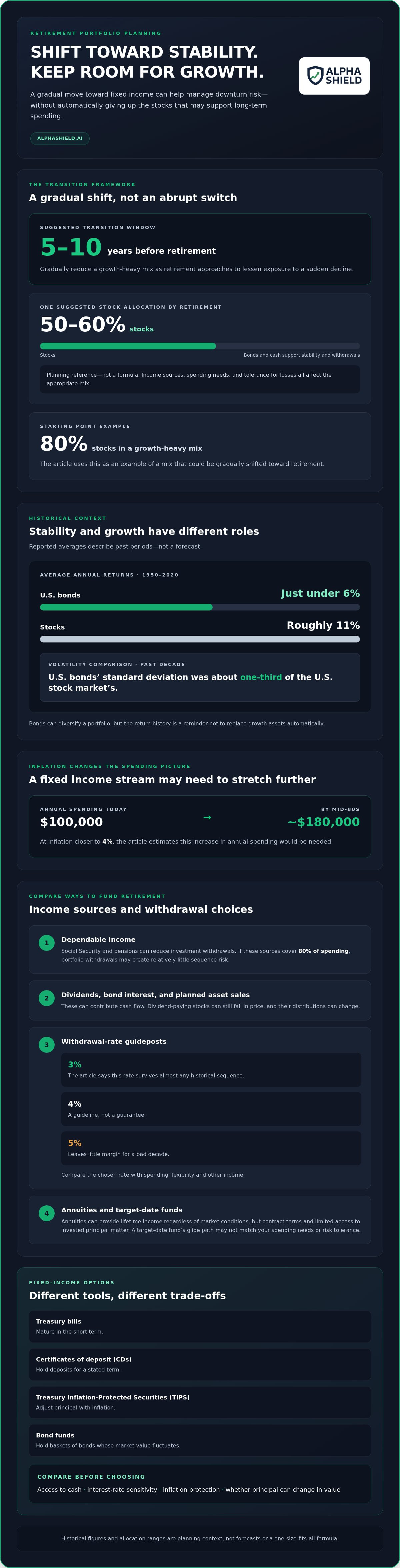
In the five to ten years before retirement, gradually moving from a growth-heavy mix such as 80% stocks can reduce exposure to a sudden decline. One suggested target is 50% to 60% stocks by retirement, with bonds and cash supporting stability and withdrawals. Treat that range as a planning reference, not a formula: income sources, spending needs, and tolerance for losses all affect the allocation.
Fixed income has a different role from stocks. From 1950 through 2020, U.S. bonds averaged just under 6% annually, while stocks averaged roughly 11%. Over the past decade, US bonds’ standard deviation was about a third of the US stock market’s. Those figures describe different periods, not a forecast. Investors still need growth exposure because inflation can erode the purchasing power of a fixed income stream. At inflation closer to 4%, someone spending $100,000 annually today would need roughly $180,000 annually by their mid-80s.
Treasury bills, certificates of deposit (CDs), Treasury Inflation-Protected Securities (TIPS), and bond funds work differently. Treasury bills mature in the short term; CDs hold deposits for a stated term; TIPS adjust principal with inflation; and bond funds hold baskets of bonds whose market value fluctuates. Compare access to cash, interest-rate sensitivity, inflation protection, and whether principal can change in value before choosing.
Social Security and pensions can reduce the amount a retiree must withdraw from investments each month. If those sources cover 80% of spending, portfolio withdrawals may create relatively little sequence risk. Estimate essential expenses first, then compare them with dependable income; the remaining gap helps determine how much the portfolio must supply.
Income can also come from dividends, bond interest, and planned asset sales. Dividend-paying stocks may contribute cash flow, but their share prices can fall and distributions can change. The 4% withdrawal strategy is a guideline, not a guarantee: a 3% rate survives almost any historical sequence, while a 5% rate leaves little margin for a bad decade. Compare the chosen rate with spending flexibility and other income.
Annuities can provide lifetime income regardless of market conditions, but contract terms and limited access to invested principal matter. Target-date funds also have trade-offs: their glide paths may not match your spending needs or risk tolerance. Compare a fund’s stock-and-bond mix with your intended retirement allocation before relying on it alone.
Investors seeking a systematic market-risk reference alongside allocation decisions can review market crash and drawdown signals.
3. Should Your Portfolio Become More Conservative as You Approach Retirement?
If retirement is five to 10 years away, review whether your allocation still matches your loss tolerance and spending plan. A more conservative mix can reduce exposure to a sharp decline, but shifting too far from stocks may weaken growth potential over a long retirement. The target depends on your income, financial needs, and how much volatility you can absorb without changing your plan.
A retirement glide path is a planned change in asset allocation as retirement approaches or progresses. It typically shifts a portfolio from growth-heavy holdings toward more bonds over time, according to a schedule or target date. The traditional age-based rule described here would place 35% of a 65-year-old’s portfolio in equities and 65% in bonds, but age alone doesn’t capture spending needs or risk tolerance.
Rebalancing restores the intended mix after market movements change the percentages. For example, a portfolio that held 60% stocks and 40% bonds five years earlier could have become nearly 80% equity without additional stock purchases. That drift increases exposure to stock-market losses, even though the investor made no deliberate allocation change. Regular rebalancing brings the portfolio closer to its chosen risk level.
Use a repeatable rule instead of reacting to daily market moves. Review your allocation annually, or rebalance when an asset class drifts five percentage points from its target. If stocks rise above their target, selling some shares and moving the proceeds into bonds can restore balance. If stocks fall, the same rule may direct you to buy equities rather than let fear drive the decision.
Tax-aware rebalancing can reduce the need for large sales that trigger taxes. In a taxable portfolio, direct new contributions to underweight assets first. Before selling appreciated equity holdings, consider the potential tax impact. Rebalancing within tax-sheltered accounts does not trigger taxes, so these accounts can be useful for adjusting holdings while managing taxable-account sales.
Account placement matters because the same asset mix can have different tax consequences across account types. List the holdings in each account and calculate your combined portfolio allocation. Compare the total with your target, then use contributions or transactions in tax-sheltered accounts to address any gap. This portfolio-level view helps prevent overcorrecting one account while leaving the household allocation unchanged.
Use a gradual transition rather than a sudden overhaul. The traditional age-based rule was designed for a world where the average retiree lived 15 to 18 years beyond their last paycheck. Retirement can extend longer, so a fixed age formula may not reflect an individual’s full horizon. A clear glide path, reviewed annually, connects allocation changes to actual goals rather than market noise.
4. Cash and short-term bond spending buckets
A spending-bucket plan separates near-term withdrawals from investments intended for later years. In a standard three-bucket setup, hold one to two years of withdrawals in cash and five to eight years of portfolio withdrawals in bonds. Keep the remaining portion invested for longer-term growth. These ranges are a framework, not a universal allocation; the right amounts depend on spending needs and dependable income.
Use cash first for planned withdrawals. It can cover expenses without requiring you to sell stocks during a downturn, when prices may be depressed. Bonds are the next layer, providing assets to draw on after cash is used. Short-term bonds can be less exposed to interest-rate changes than longer-duration bonds, though their values can still fluctuate. The bucket is designed to support access to funds and spending continuity, not eliminate investment risk.
Build a cash reserve when retirement is a few years away. Estimate annual portfolio withdrawals after accounting for Social Security, pensions, and other income. Calculate the reserve from that withdrawal gap, not from total household spending, and revisit the estimate as expenses or income change. Moving too much into cash can increase inflation risk and reduce long-term growth potential.
A safety bucket can hold high-quality bonds, cash, or fixed annuities to help fund essential expenses during market turbulence. First, separate essential costs from flexible spending. If markets fall, use the designated safety assets for planned withdrawals rather than automatically selling growth assets. If markets recover, replenish the bucket according to your target allocation, not a sudden market forecast.
Set a written refill rule before taking your first withdrawal. For example, review the buckets on a regular schedule and direct portfolio income or rebalancing proceeds to cash when its allocation falls below the planned level. During a prolonged downturn, do not treat every temporary decline as a reason to sell the entire growth portion. A defined process helps keep the transition consistent.
Before retirement, compare debt interest costs and required payments with the liquidity you need for near-term expenses. Preserve enough accessible cash for planned withdrawals and emergencies, then consider whether paying down costly debt would improve your monthly retirement cash flow.
Size your buckets according to the withdrawal gap, not a guess about market direction. If pension and Social Security income already cover essential costs, your portfolio may need to supply less cash. If portfolio withdrawals will cover most spending, maintain a clearly defined reserve. As retirement approaches, review the plan and adjust cash and bond holdings when spending needs, income, or risk tolerance changes.
5. Market risk in retirement
Retirement planning must account for volatility after paychecks stop, not only losses before retirement. During the global financial crisis, stocks fell about 60% from peak to trough. A portfolio exposed to that decline may force difficult choices if withdrawals continue while asset values fall. The practical goal isn’t to remove market risk entirely. It’s to set an allocation and withdrawal plan you can maintain through a downturn.
Losses and recoveries are asymmetric. After a 30% decline, a portfolio needs to grow about 50% to regain its prior value, before ongoing withdrawals. A hypothetical portfolio falling from $1 million to $900,000 also illustrates how even a smaller loss can reduce the base available for future spending. Selling investments during a downturn to avoid further declines can compound the damage if markets rebound soon afterward.
A hypothetical 5-10% market dip might prompt someone nearing their 60s to consider de-risking. A measured response starts with the reason for the change: portfolio allocation, planned withdrawals, time horizon, and risk tolerance. Selling all stocks and moving entirely into safety can leave a retiree without enough growth exposure. A gradual adjustment can reduce risk without making a sudden, all-or-nothing bet on market direction.
There isn’t one glide path that fits every retirement. Research cited for this topic found that a rising-equity glide path, starting retirement conservatively and increasing stock exposure over time, lowered the odds of running out of money compared with the alternatives tested. Balanced stock-and-bond portfolios also allow a higher starting withdrawal percentage than more equity-heavy portfolios across a 30-year retirement horizon. These findings make the trade-off clear: lower volatility is useful, but a portfolio still needs to support spending over time.
Withdrawal rate changes the risk calculation. If withdrawals are under 3.5% of the portfolio, market risk may threaten a retiree less than expected. If spending is less flexible or withdrawals are higher, an early decline can have greater consequences. Stress-test the plan against a severe market scenario, continued withdrawals, and a slower recovery. A financial adviser can run a stress test to compare potential outcomes under worst-case conditions.
Structured notes can be designed to offer principal protection with limited upside linked to market performance. That trade-off differs from a diversified stock-and-bond allocation, so consider how each holding fits your plan’s goals and risk tolerance. The aim is not to avoid every decline, but to fund planned spending without being forced into a rushed decision during volatility.
Alpha Shield: Alpha Shield Market Signal
Alpha Shield Market Signal provides a systematic reference for navigating market volatility and managing drawdown risk. If retirement is approaching, its daily market signal can inform your allocation and withdrawal rules, but it does not replace them.
The Market crash and drawdown tool and Alpha Shield Dashboard provide clear indicators for market crash protection and risk management. Use those signals as one input alongside your time horizon, income needs, and risk tolerance. They don’t remove market risk or replace a diversified retirement plan.
If you want to explore how these market signals fit your retirement planning, visit alphashield.ai.
Turn Your Retirement Plan Into Clear Rules
To decide how to de-risk a portfolio before retirement, turn your intentions into rules you can follow. Write down what would trigger an allocation review, how you will fund withdrawals during market stress, and when you will rebalance. A written process helps distinguish deliberate decisions from reactions to headlines or short-term volatility.
Keep the plan tied to your actual retirement needs. As income, spending, or priorities change, review whether your approach still fits. Market signals can add context, but they should inform your process, not replace your allocation decisions. The goal is not to predict every downturn, but to decide how you will respond before one arrives.
Alpha Shield’s market signal and dashboard can support your market-risk monitoring. Explore them as you build a disciplined approach to retirement investing.
A clear plan gives you a steadier basis for decisions as retirement approaches. Take the next step at a pace that keeps your long-term priorities in view.
Frequently Asked Questions
Should Your Portfolio Become More Conservative as You Approach Retirement?
Often, the portfolio should shift gradually as retirement nears, but the right mix follows spending needs, income sources, and risk tolerance, not age alone. An investor planning to retire in five to 10 years can compare the current allocation with expected withdrawals and decide whether a lower stock exposure fits. Keep enough growth potential for later retirement years, and avoid making abrupt changes solely in response to market headlines.
What are the different types of risks in retirement, and how can you de-risk a portfolio?
Retirement plans face market, sequence-of-returns, inflation, healthcare, and longevity risks. Each affects a different part of the plan: market declines reduce asset values, inflation weakens future purchasing power, and longer lives extend the funding period. First, map essential expenses against dependable income. Then assess portfolio withdrawals, diversify across asset classes, and test whether the plan remains workable if returns fall early or expenses rise.
How should asset allocation change as retirement approaches?
Adjust allocation in stages rather than making a single large shift. For someone retiring in five to 10 years, compare the current holdings with the projected retirement mix and use new contributions or account-level trades to reduce gaps. A suggested target is 50% to 60% stocks by retirement, but spending, other income, and tolerance for portfolio losses affect the decision. Revisit the target as retirement plans change.
How much should retirees hold in stocks, bonds, and cash?
Use the portfolio’s job to determine its mix: stocks support long-term growth, bonds diversify and fund later withdrawals, and cash covers near-term spending. One suggested approach targets 50% to 60% stocks by retirement, with cash and bonds sized around expected portfolio withdrawals. The remainder should reflect the time horizon, reliable income, and capacity to withstand losses. Review the household’s combined holdings, not each account in isolation.
How many years of expenses should be kept in cash before retirement?
A standard three-bucket framework sets aside one to two years of portfolio withdrawals in cash. Calculate this amount from the gap between planned spending and dependable income, not from total expenses alone. Build the reserve a few years before retirement so the cash has a defined purpose. Holding more cash than the plan requires can increase inflation exposure and reduce the amount available for long-term growth.
How do sequence-of-returns risk and a market downturn affect retirement withdrawals?
Sequence risk arises when poor returns coincide with withdrawals: selling assets after losses leaves fewer investments to participate in a recovery. The same market decline can affect a plan differently depending on withdrawal timing and outside income. Test your plan against an early downturn alongside scheduled withdrawals, then identify which expenses could be reduced or covered by other income. This clarifies your response before volatility hits.
What are the tax consequences of rebalancing a portfolio before retirement in the United States?
Selling appreciated investments in a taxable account may have tax consequences, so where practical, use new contributions to buy underweighted assets. Consider the tax impact before selling appreciated equity holdings. Rebalancing within tax-sheltered accounts does not trigger taxes, making those accounts useful for allocation adjustments. A practical sequence is to review the household mix, use contributions or tax-sheltered accounts first, and then assess taxable sales.
How often should a pre-retiree rebalance, and what thresholds should trigger it?
Set a consistent review rule: rebalance annually, or when an asset class moves five percentage points from its target. If stocks rise above the chosen range, for example, trim the excess and direct the proceeds toward underweighted holdings. If stocks fall, the same rule may prompt you to restore the target allocation. A preset threshold keeps adjustments tied to your plan rather than short-term market reactions.


