

The order of returns can matter as much as their average when you’re withdrawing from a portfolio. In a hypothetical five-year comparison, two retirees each started with $1 million, withdrew $60,000 at the end of each year, and earned the same average annual return of 6 percent, yet one finished with $83,288 more because the returns came in a different sequence. Managing sequence of returns risk means understanding how early losses and withdrawals can compound their effects.
It’s easy to focus on long-term averages when assessing a portfolio. But a loss during the withdrawal phase can have a different impact than the same loss before retirement, because selling assets to fund spending leaves fewer invested to participate in a recovery.
This article explains how return order affects retirement portfolios and why withdrawal timing matters. It also looks at how equities, bonds, cash, real estate, alternatives, and diversification relate to sequence risk, so you can understand the role each may play in a broader risk-management approach.
Key Takeaways
- Assess portfolio performance alongside withdrawal timing; the same average return can produce different retirement outcomes.
- Consider how selling assets after losses can reduce the capital available to participate in a recovery.
- Compare the roles of equities, bonds, cash, real estate, and alternatives rather than treating any one asset class as a complete solution.
- Review whether diversification across asset classes, sectors, geographies, and investment styles can help manage portfolio risk.
- Use market signals as one input to a disciplined risk-management approach, not as a substitute for a broader retirement plan.
What Is Sequence-of-Returns Risk?
Sequence-of-returns risk is the effect of investment gains and losses arriving in a different order while you withdraw retirement income. It matters because early losses can leave fewer assets invested to support later withdrawals and participate in a recovery.
Loss Timing and Retirement Withdrawals
Sequence risk describes how the timing of portfolio losses can affect retirement withdrawals, even when long-term average returns appear similar. If a retiree sells investments after prices fall, those shares cannot benefit from a later recovery. This can make the first years of retirement especially consequential for a plan that may need to fund income for 20 to 30 years.
The issue can affect workers who accumulated savings through workplace defined contribution plans over careers lasting 20, 30, or 40 or more years. A long saving period doesn’t remove the risk: once contributions stop and withdrawals begin, early losses change how much capital remains invested. Inflation-adjusted spending can add pressure because withdrawals may rise while the portfolio is recovering.
Return Order and Portfolio Longevity
Return order is the sequence in which a portfolio experiences gains and losses. It can influence how long savings support retirement income. A decline early in the withdrawal phase can reduce the balance even as scheduled withdrawals continue, leaving later gains to apply to a smaller base. If returns arrive in a stronger order, more capital may be available when withdrawals begin.
Consider two retirees with the same average return but different timing. The retiree facing losses near retirement may need to sell more assets to fund the same spending, leaving less invested for a rebound. That’s why managing sequence of returns risk means looking beyond average returns and considering withdrawal timing, spending needs, and inflation adjustments together.
Comparing Retirement Return Sequences
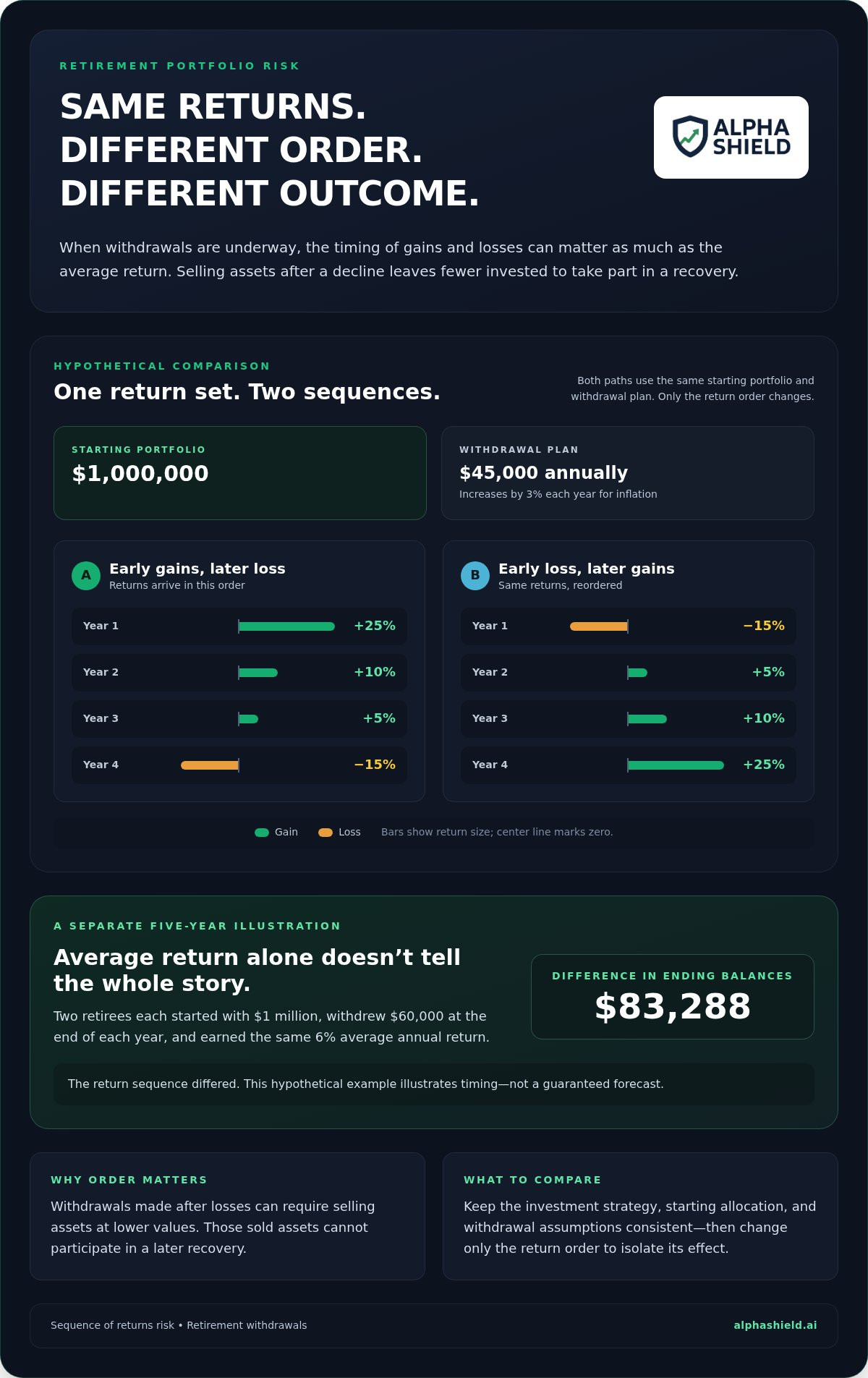
A hypothetical comparison shows how different sequences can change balances despite matching assumptions. Each retiree starts with $1,000,000 and plans to withdraw $45,000 annually, increasing withdrawals by 3% each year for inflation. One receives returns of 25% in year 1, 10% in year 2, and 5% in year 3, followed by -15% in year 4.
The second retiree receives -15% in year 1, followed by 5%, 10%, and 25% in the next three years. The withdrawal plan and returns are the same, but their order differs. Another five-year comparison found that retirees who each withdrew $60,000 annually and earned the same average annual return of 6 percent ended with balances differing by $83,288. The example isolates timing, not a guaranteed forecast.
Income Sources and Poor Early Returns
There is no single withdrawal rate that is safe in every market sequence. During poor early returns, reducing withdrawals can ease pressure on the portfolio. In one hypothetical recovery example, an investor withdrawing 2% annually returned to the starting balance after roughly 11.5 consecutive years of 6% gains. At 4% withdrawals, the same recovery required 28 straight years of 6% gains.
Those figures illustrate how withdrawal size can affect recovery, but they don’t establish a universal rate. Pensions and annuities may mitigate sequence risk by providing income that doesn’t depend on selling fluctuating portfolio assets each year. If that income covers some essential spending, fewer portfolio withdrawals may be needed during a downturn. The remaining investment balance still faces market risk, so consider income sources and portfolio withdrawals together.
Comparing hypothetical portfolios with different return sequences
Asset allocation affects sequence risk near retirement by shaping exposure to losses and determining which assets are available for withdrawals. Diversification can spread risk, but it cannot eliminate market declines.
Hypothetical Portfolios with Different Returns
A return-sequence comparison holds key assumptions constant, then changes when gains and losses occur. This isolates timing as a factor in portfolio outcomes. For example, one hypothetical portfolio gains 6% annually for its first nine years, loses 15% in years 10 and 11, then gains 6% annually in years 12-18.
Compare that path with the same returns in a different order, using identical withdrawals and a constant-dollar withdrawal strategy. The annual average alone won’t reveal the full difference. Track each year’s opening balance, investment return, withdrawal, and closing balance. This shows when withdrawals require selling assets after losses.
Keep the investment strategy, withdrawal assumptions, and starting allocation consistent between scenarios. Then change only the return order. Changing the allocation as well would mix two effects and make the comparison harder to interpret. This approach helps isolate return timing from portfolio design.
Portfolio Depletion Near Retirement
Portfolio depletion occurs when withdrawals and investment losses reduce savings faster than future returns can rebuild them. Near retirement, asset allocation matters because it influences how much the portfolio may fluctuate and which holdings can fund income needs.
A common retiree allocation is 60% stocks and 40% bonds. It is an example, not a universal prescription. A risk-profiled multi-asset portfolio may combine equities, bonds, and other diversified investments according to an individual’s risk tolerance and spending needs. The allocation influences both potential growth and the size of losses the portfolio may experience.
Risk profiling involves more than comfort with market movements. Consider planned withdrawals, income sources, time horizon, and whether spending can be reduced after losses. If withdrawals must continue, selling depressed assets can deepen depletion. If spending is flexible, adjusting withdrawals may preserve more capital for a recovery.
Diversification can distribute exposure across asset classes, sectors, geographies, and investment styles. Still, diversification doesn’t ensure that every holding will rise when another falls. In 2022, stocks and bonds both fell, illustrating why allocation alone cannot eliminate sequence risk. The aim is to understand how a portfolio behaves under different sequences, not to assume a specific outcome.
Use comparisons to identify where a plan is most sensitive: early losses, fixed withdrawals, or a concentrated allocation. A disciplined review of market-risk signals can add context when assessing changing market conditions.
Sequence risk across equities, bonds, cash, real estate, and alternatives
Each asset class responds differently to market declines, income needs, and demands for access. To stress-test sequence risk, model negative returns alongside planned withdrawals, expenses, and cash reserves. Then assess whether the portfolio can sustain its balance.
Cash-Flow Modelling
Cash-flow modelling maps expected income, expenses, withdrawals, and investment returns across retirement. It matters because a portfolio’s ability to fund spending depends on when money is needed, not just its ending balance. Enter essential expenses, flexible spending, and cash equivalents separately. Then test whether cash flow remains workable when market returns turn negative.
Equities can support long-term growth, but losses near the start of retirement can pressure withdrawals. Since 1950, the S&P 500 has experienced a correction of at least 10 percent roughly every three years. Bonds are generally less volatile than equities, which can make them useful for preserving value as withdrawals begin. Yet bonds are not a fixed-value substitute for cash.
In 2022, stocks and bonds both fell as inflation spiked. That episode shows why asset-class labels alone cannot protect against losses. Interest-rate changes can reduce bond values, while inflation can increase the amount retirees need to withdraw. A cash reserve may help cover near-term expenses without selling fluctuating assets at depressed prices.
A retirement liquidity bucket may hold enough liquid, low-fluctuation assets to cover the first three to five years of needs. Cash, cash equivalents, and short-term, high-quality bonds can each play a role in that reserve. Keep emergency cash separate from the investment portfolio when possible. This can reduce pressure to sell long-term holdings during a downturn.
Real estate and alternative investments add different exposures, but their role depends on liquidity, valuation, and behavior during economic stress. A property may provide rental income, yet it may not be quickly convertible to cash. Alternatives also vary widely. Model their income and access limits separately rather than treating them as funds immediately available for withdrawals.
Permanent life insurance cash value may be considered alongside other resources, but it is not the same as a cash reserve. Access depends on policy terms, and loans or withdrawals can affect policy values and benefits. Include only the cash flow available under the policy’s actual structure.
Stress-Testing Retirement Portfolios
Stress-testing applies adverse return sequences to a retirement cash-flow model and tracks withdrawals against remaining assets. Assess equities, bonds, cash, real estate, alternatives, and insurance cash value according to their liquidity and income roles. Compare essential expenses with available income, then identify whether a negative market period would require selling investments or reducing discretionary spending.
Review the results when spending needs, income sources, or asset values change. The key question is whether liquid resources can meet withdrawals while the rest of the portfolio remains exposed to market movements.
Diversification across asset classes
Diversification spreads retirement savings across assets with different return drivers. Equities, bonds, cash, real estate, and alternative investments can respond differently to economic conditions. If one holding declines, others may perform differently, reducing reliance on a single source of return. That can matter when withdrawals continue through a market downturn.
Asset allocation determines how much of a portfolio is assigned to each category. Diversification adds breadth within those categories, such as holding equities across sectors, geographies, and investment styles. A portfolio concentrated in a few companies may behave differently from one spread across industries and regions, even if both are labelled stock portfolios. This distinction helps reveal concentration hidden behind broad asset-class labels.
Retirement investors can assess diversification by asking what drives each holding’s returns. A bond fund and a stock fund represent different asset classes, but either may still have concentrated exposures. A real estate investment may respond to property income, financing conditions, and economic demand. Alternatives have their own liquidity and valuation characteristics. Reviewing these drivers shows where holdings overlap and where they may contribute distinct risks.
Correlation describes how holdings tend to move in relation to one another. Diversifying across asset classes, sectors, geographies, and investment styles can reduce correlation among holdings and help mitigate sequence risk. It doesn’t mean every asset will rise when another falls. During a broad market shock, different investments can decline together, so the portfolio’s behavior under stress still matters.
For example, imagine a retiree whose savings are concentrated in domestic equities and who needs portfolio withdrawals to fund spending. A downturn affecting those holdings could force sales at reduced values. Adding bonds, cash, and investments with different return drivers can broaden the sources available to support the plan. The key question isn’t whether every asset can recover quickly, but how the combined allocation may behave while withdrawals continue.
A practical review starts by grouping holdings by asset class, then identifying sector, geographic, and investment-style concentration within each group. Next, compare those exposures with planned spending and the portfolio’s need for growth. If several holdings depend on the same economic conditions, they may provide less diversification than their variety suggests. This turns asset allocation into a risk map, rather than a list of fund names.
Rebalancing also links diversification to withdrawal planning. When one part of a portfolio grows while another falls, restoring the intended allocation can affect which assets are sold or retained. The decision should reflect spending needs, market conditions, and the role assigned to each holding. Diversification is most useful when it supports a defined plan, not simply when it increases the number of assets owned.
Definition of sequence of returns risk
Sequence-of-returns risk is the possibility that the order of investment gains and losses changes how long retirement savings last. It matters most when withdrawals begin, because money taken out after a decline can’t participate in a later recovery. A portfolio’s annual average return alone doesn’t show the balance available to fund future income.
During accumulation, contributions add money after market changes, so return order can affect the value of those contributions. During retirement, withdrawals remove assets instead. If an equity decline arrives early in retirement, selling shares to meet spending needs can lock in losses and leave fewer shares invested for a recovery. That’s the key distinction: the same market path can affect savers and retirees differently.
Ending balances can still differ if returns arrive in a different order. The comparison holds the starting balance, annual withdrawals, and average return steady. Timing is the variable that changes.
Sequence risk is particularly relevant early in retirement, when withdrawals and market losses may occur together. Losses in the first 10 years of retirement are estimated to explain 77% of the final retirement outcome. That estimate highlights why a plan should examine the return path, not only a projected average. A retirement may last 20 to 30 years or longer, extending the period in which withdrawals interact with market fluctuations.
To assess your exposure, consider three connected factors: the size and timing of withdrawals, the portfolio’s asset allocation, and spending flexibility. If essential expenses require fixed withdrawals, a downturn can leave less room to wait for assets to recover. If some spending can be reduced, smaller withdrawals may help preserve the remaining balance. Annual returns aren’t guaranteed, so projections shouldn’t treat a smooth average as a dependable sequence.
A disciplined approach to managing sequence of returns risk tests more than one return order against the same retirement plan. Compare early losses with later losses while keeping withdrawals and other assumptions consistent. Then review how equity allocation, income sources, and spending adjustments affect portfolio longevity. The practical takeaway: plan for a sequence that could strain cash flow, not just an average that looks acceptable.
Alpha Shield: Alpha Shield Market Signal
Alpha Shield Market Signal helps investors interpret market volatility and monitor drawdown risk as part of a disciplined portfolio approach. Its subscription provides a daily IN or OUT signal, ETF allocation guidance, and access to the Alpha Shield Dashboard, with delivery through the dashboard, email, or Telegram. Use these tools alongside your retirement plan, asset allocation, and withdrawal assumptions. The service focuses on long-term capital preservation, not day trading, shorting, or individual stock recommendations. A market signal can inform risk decisions, but it doesn’t replace a withdrawal plan or eliminate market losses. Visit alphashield.ai to explore Alpha Shield Market Signal and decide whether it fits your approach.
Turn Risk Awareness Into a Consistent Plan
A useful next step is to turn your risk assessment into written decision rules. Define which expenses are essential, which can be adjusted, and what conditions would prompt a portfolio review. Clear criteria make it easier to respond methodically when markets shift, rather than making reactive decisions under pressure.
A disciplined approach to managing sequence of returns risk also connects investment decisions to real cash-flow needs. Revisit your assumptions when income sources, spending priorities, or personal circumstances change. The aim isn’t to predict every market move. It’s to understand how your plan responds and which choices remain available.
Alpha Shield’s market-risk tools can support a more structured review of changing conditions. Use them as one input alongside your portfolio plan and withdrawal decisions.
Move forward with clear criteria, a steady process, and decisions grounded in your retirement needs.
Frequently Asked Questions
How does inflation play into sequencing risks?
Inflation can increase the withdrawals needed to maintain the same standard of living, putting more pressure on a portfolio after losses. For example, if household expenses rise while investment values fall, a retiree may need to sell more assets to cover the gap. Review essential costs separately from discretionary spending, then test how inflation-adjusted withdrawals affect cash flow during weak market periods.
Why does the order of returns matter if the average is the same?
Because deposits and withdrawals happen at specific points, the order of gains and losses affects the dollars exposed to each return. In one hypothetical example, investing $100,000, then adding $100,000 at the start of year two, produced $218,360 when returns were 12% then 3%. Reversing the returns produced $227,360. The cash flow changed the result despite the same two returns.
What is sequence of returns risk in retirement?
Sequence-of-returns risk is the risk that the timing of portfolio returns changes how effectively savings can fund retirement spending. It becomes especially relevant when withdrawals replace contributions. A practical review compares the portfolio under different return orders while keeping spending assumptions consistent. If one sequence creates a much tighter cash-flow position, examine withdrawal flexibility, income sources, and asset allocation.
How does sequence of returns risk affect retirement withdrawals?
Withdrawals after a decline can leave fewer assets invested for future growth. The effect depends on how much the retiree withdraws, which holdings are sold, and whether spending can adjust. For example, meeting a fixed expense by selling an equity holding after a loss turns a temporary market decline into a lasting reduction in the number of shares owned. Reviewing withdrawal sources helps clarify this exposure.
How can retirees reduce sequence of returns risk?
Retirees can reduce pressure on investments by adjusting spending during poor performance, maintaining suitable liquid resources, and coordinating withdrawals with other income. Continuing to save and invest after retirement can also add capital, if income permits. A useful planning exercise separates essential expenses from optional purchases, then identifies which costs could be delayed if a downturn coincides with withdrawals.
What is the bucket strategy for managing sequence of returns risk?
The bucket strategy separates assets by when they may be needed, rather than treating the entire portfolio as one pool for withdrawals. Near-term spending can be matched with more liquid holdings, while longer-term assets remain invested. One approach uses an income ladder built from CDs or U.S. Treasuries in three-month increments. This links expected cash needs to asset maturity dates.
How do cash reserves help protect retirement income during a market downturn?
Cash reserves can fund expenses without requiring immediate sales of investments that have fallen in value. Financial advisors often recommend keeping one to three years of living expenses in cash or cash equivalents as a buffer during downturns. Set the reserve based on actual spending needs and replenishment rules. Cash can reduce forced selling, but it doesn’t remove the portfolio’s broader market risk.
How does a dynamic withdrawal strategy reduce sequence risk?
A dynamic strategy adjusts withdrawals to portfolio conditions instead of automatically increasing spending every year. If returns are poor, reducing discretionary withdrawals can leave more assets invested; if conditions improve, spending can be reviewed against the plan. Define adjustment rules in advance, including which expenses are flexible and what portfolio changes trigger a review. This makes responses more systematic during volatility.


