

No single asset can reliably protect a portfolio from both inflation and a market crash. Protecting assets from inflation and a market crash usually means combining investments with different risk drivers, keeping accessible cash for near-term needs, and deciding in advance how much volatility you can tolerate. Hedging reduces the impact of a particular risk, it does not eliminate risk altogether.
It’s reasonable to want your savings to retain purchasing power while avoiding a steep, sudden loss. The challenge is that assets that may help during inflation can still fall in value, while cash can lose purchasing power as prices rise. A disciplined plan weighs these trade-offs instead of relying on a single presumed safe haven.
This guide explains how diversification can spread exposure, where cash fits, and how real estate, inflation-linked investments, and other assets may respond to changing conditions. You’ll also learn how to assess market risk, set priorities, and decide whether your portfolio reflects your time horizon and liquidity needs. The aim is a clearer framework for managing uncertainty, not a promise that losses can be avoided.
Key Takeaways
- Review how concentrated your portfolio is, then assess whether different asset types respond to risks in different ways.
- Compare inflation-linked bonds, commodities, and natural resources by how they behave, not by assuming any one is a universal hedge.
- Separate cash for near-term needs from investments intended for longer-term goals, and consider how inflation affects each role.
- Assess gold as a potential inflation hedge while recognizing that its price can also move with market conditions and investor demand.
- Evaluate real estate and REITs by weighing their potential inflation exposure against costs, income variability, and market risk.
1. Why Is It Important to Diversify?
Diversification spreads exposure so one failing company or asset class doesn’t dictate a portfolio’s outcome. On October 19, 1987, the Dow Jones Industrial Average fell 22.6% in one day, illustrating how quickly a concentrated position can lose value. A diversified portfolio can still decline, but different holdings may respond differently to the same shock. This is one reason investors consider protecting assets from inflation and market crash risk through a balanced mix rather than one presumed safe holding.
Start by reviewing exposure across asset classes, sectors, company sizes, and geographies. Stocks may support long-term growth, while bonds and cash can serve different roles. Within equities, holding only large U.S. companies leaves different risks than including smaller companies and international markets. The S&P 500 tracks 500 large U.S. public companies, but it doesn’t represent every sector or geography.
Sector balance matters too. Technology and communication services make up 35% of the S&P 500, so owning several index funds may not provide as much sector diversification as their names suggest. Check the underlying holdings for overlap. If a portfolio relies heavily on one sector, consider whether other industries have a role that fits your risk tolerance and time horizon.
Diversification can also help manage inflation exposure, though it doesn’t guarantee returns above rising prices. Inflation measures changes in the average price of a basket of goods and services. Stocks have historically tended to produce total returns above inflation, while bonds, cash, and real assets can behave differently across periods. The Federal Reserve’s inflation target is 2%; inflation in 2022 exceeded 8%. These examples show why protecting assets from inflation and market crash risks requires considering more than one economic scenario.
Asset allocation turns diversification into a practical plan. Decide how much exposure to assign to growth-oriented assets, income-producing holdings, and liquid reserves. Compare your current mix with your intended mix, and rebalance when market movements materially change it. Dividend-paying stocks can contribute income, but their prices can still fall. Treat each asset as one component, not a standalone hedge against every risk.
Tax rules also affect portfolio adjustments. According to the Internal Revenue Service, a wash sale occurs when you sell or trade stock or securities at a loss and, within 30 days before or after the sale, buy substantially identical stock or securities. Before realizing a loss, consider whether a recent or planned purchase could trigger this rule. A deliberate review of holdings, overlap, and tax consequences makes diversification more systematic.
2. REITs, inflation-linked bonds, commodities, and natural resources
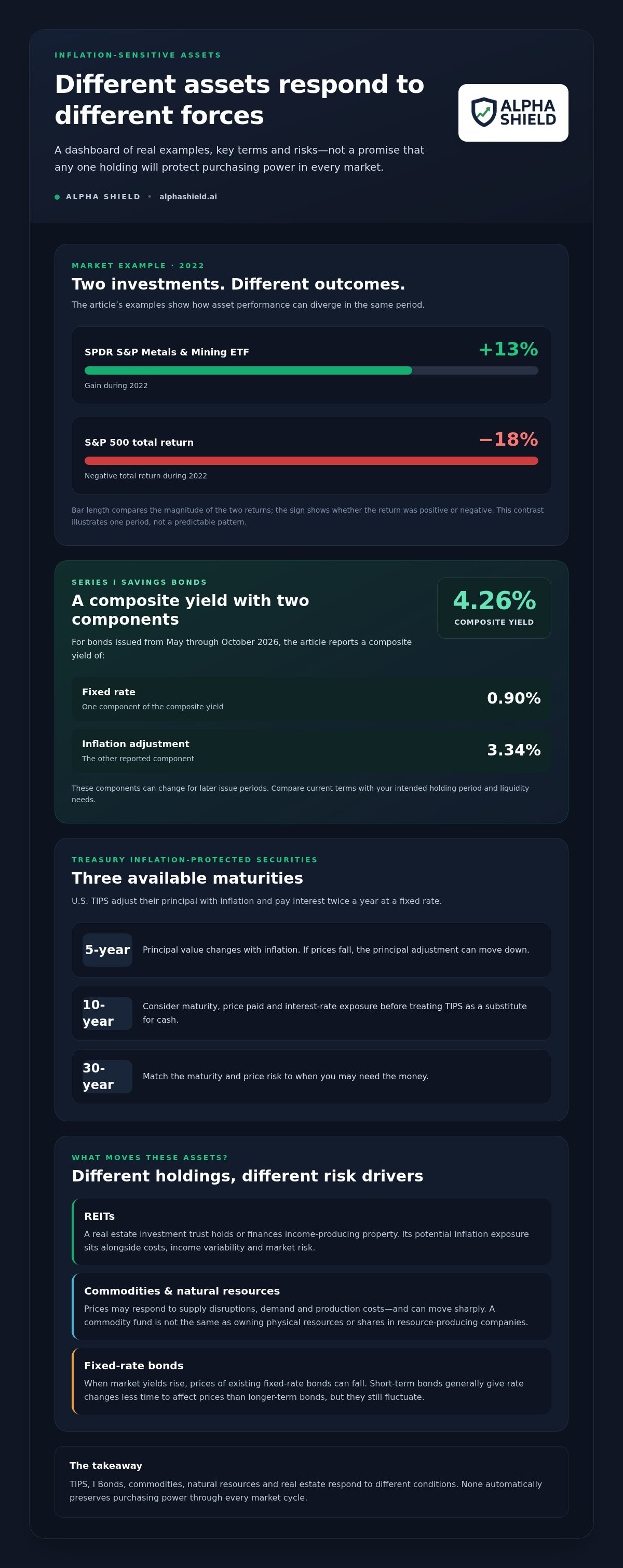
Inflation-sensitive assets respond to different forces. A real estate investment trust (REIT) holds or finances income-producing property, while Treasury Inflation-Protected Securities (TIPS) adjust their principal with inflation. Commodities and natural resources may respond to supply disruptions, demand, and production costs. None automatically preserves purchasing power through every market cycle.
U.S. TIPS are issued with five-year, 10-year, and 30-year maturities. Their principal value changes with inflation, and they pay interest twice a year at a fixed rate. If inflation rises, the adjusted principal can increase; if prices fall, the principal adjustment can move down. Consider maturity, price paid, and interest-rate exposure before treating TIPS as a substitute for cash.
Series I Savings Bonds combine a fixed interest rate with an inflation adjustment. For bonds issued from May through October 2026, the composite yield was 4.26%, comprising a 0.90% fixed rate and a 3.34% inflation adjustment. These components can change for later issue periods, so compare the bond’s current terms with your intended holding period and liquidity needs.
Commodities and natural resources can diversify exposure, but their prices can move sharply. As one example, the SPDR S&P Metals & Mining ETF gained 13% during 2022, while the S&P 500 had a negative 18% total return. That contrast illustrates different performance in one period, not a predictable pattern. A commodity fund also differs from owning physical resources or shares in resource-producing companies.
How have stocks, bonds, cash, and real estate performed during past inflationary periods and market crashes? They haven’t followed one reliable pattern: in 2022, the S&P 500 had a negative 18% total return, while the metals and mining ETF example gained 13%. Cash, bonds, and real estate respond to interest rates, inflation, property income, and valuations, so assess each period and asset separately.
What are the tax implications of TIPS, I Bonds, gold, and other inflation hedges in the U.S.? For U.S. tax planning, track interest, inflation adjustments, dividends, and realized gains separately, since treatment varies by investment and account. Keep transaction and distribution records for TIPS, I Bonds, gold, REITs, and annuity products, then weigh their tax impact against expected returns.
Bonds also carry interest-rate risk: when market yields rise, prices of existing fixed-rate bonds can fall. Short-term bonds generally give rate changes less time to affect their prices than longer-term bonds, but they still fluctuate. Compare a bond’s maturity with when you may need the money, rather than choosing by yield alone.
Annuities and insurance products involve different trade-offs from Treasury securities. A fixed annuity payment may lose purchasing power as prices rise. Use that example to test how fixed income may cover expenses over time, then weigh payment terms, access to funds, and how inflation affects future spending.
3. Cash, money market funds and high-yield savings accounts
Cash has a clear role: cover near-term spending without forcing you to sell investments during a downturn. Set an emergency reserve based on essential expenses, and keep it accessible in a suitable deposit account. A common guideline is enough to cover three to six months of essential expenses. Treat the reserve as a liquidity tool, not a long-term growth asset, since inflation can erode its purchasing power.
Compare high-yield savings accounts by their interest rate, access rules, and account protections. As of September 2026, savings account rates of 3.5% or more were available from reputable banks. Rates can change, so review the account’s current terms when setting savings goals. A government-backed FDIC-insured bank can provide deposit insurance within applicable limits; that protection applies to eligible deposits, not every investment bearing a similar name.
Money market accounts and money market funds are different products. A bank money market deposit account is a deposit account; a money market fund is an investment fund. Before choosing, identify which product you’re considering, how quickly you can access funds, and what protections apply. Don’t assume a fund has the same deposit insurance as an account at an FDIC-insured bank.
Certificates of deposit (CDs) can suit savings with a known time horizon. Bank CDs typically have terms ranging from 30 days to five years, and early access can be restricted or costly. Match the maturity to the date you expect to need the money. CDs issued by an FDIC-insured bank are generally insured within applicable limits. A ladder of staggered maturities can make portions available at different times, while reducing the need to lock every dollar into one term.
Make savings goals specific. Separate emergency funds, planned purchases, and long-term investments, then match each with an appropriate level of liquidity. If an expense is approaching, keep its funding accessible rather than exposing it to stock-market volatility. An advisor can help align those priorities with your asset allocation, risk tolerance, and time horizon.
Include debt management in the same review. List balances, interest costs, and payment obligations, then prioritize costly debt while preserving cash for essential expenses. Inflation can reduce the real value of fixed-rate debt over time, but it doesn’t remove required payments or interest costs. For example, a household with a fixed mortgage and variable-rate credit-card debt should assess each obligation separately before changing its cash reserve.
Investors at or near retirement may be advised to shift much of their portfolio into cash and fixed-income investments during normal inflation. That doesn’t mean holding everything in cash. Set a liquidity target, check whether it still covers planned spending, and review it when income, expenses, or market values change. This keeps cash purposeful within a broader risk-management plan.
4. What Does It Mean to Hedge Against Risk?
A hedge is a position intended to offset a specific risk in another holding. Gold, put options, and short positions work differently, so identify the threat first. Inflation risk is the loss of purchasing power as prices rise; market risk is the possibility that securities decline in value. A dollar’s purchasing power can differ over a 10-year period because inflation changes what it can buy.
Gold is often considered an inflation hedge, but its price doesn’t mechanically track consumer prices. It can also respond to interest rates, currency movements, investor demand, and uncertainty. If you’re considering gold, decide whether you want physical bullion or exposure through a fund, then account for storage or fund-specific costs. A diversified portfolio treats gold as one possible holding, not a substitute for a plan across asset classes.
Past price movements don’t establish how gold will perform during the next inflationary period. First clarify why you’re buying it: to preserve purchasing power, diversify market exposure, or respond to uncertainty. These are different aims. Set a target allocation in advance, review it periodically, and avoid increasing your position solely because recent price movements feel reassuring.
Short selling aims to profit from a decline by borrowing securities, selling them, and trying to buy them back at a lower price. If the price rises instead, losses can grow as the position moves against you. Short selling is materially different from owning a hedge whose downside is limited to its initial cost. It also involves borrowing costs, margin requirements, and the risk of being forced to close a position.
A put option may give its buyer the right to sell an underlying security under specified terms. A put can offset part of a portfolio decline if the covered asset falls enough. The buyer pays a premium, and the option can expire worthless if the expected decline doesn’t happen in time. Match the option’s underlying asset and expiration to the risk you intend to reduce.
What are the risks and costs of using options or inverse funds to hedge a market crash? Options have premiums, expiration dates, and changing market values; buyers can lose the premium paid. Inverse funds seek returns opposite to an index over a stated period. Frequent rebalancing can make their performance diverge from the index’s opposite return over longer holding periods.
Before buying either instrument, define the exposure, holding period, and maximum loss you can accept. Check how the hedge may behave if markets rise, fall gradually, or move sharply. A hedge can reduce one risk while adding costs, complexity, or another source of loss.
What is the difference between inflation risk and market risk when choosing investments? Inflation risk reduces what money can buy, while market risk concerns declines in the prices of securities or other investments. An investment may address one exposure without protecting against the other, so assess them separately.
5. Real estate, REITs and related investments
Real estate exposure can come from direct property ownership or publicly traded real estate investment trusts (REITs). A rental home, apartment building, warehouse, or office property can have different income and cost patterns. Direct ownership gives the investor control, but also concentrates capital in a specific asset and location. REIT shares provide access to property portfolios without direct ownership of each building, though their prices can move with broader equities.
Rental income depends on occupancy, lease terms, maintenance, and local demand. When reviewing a rental property, compare rent collected with operating expenses, mortgage payments, and planned repairs. Rising rents may support revenue over time, but vacancies or higher maintenance costs can offset the increase. REIT investors should review property types, geographic exposure, debt, and distribution history instead of treating every REIT as equivalent.
Property taxes also shape operating performance. REIT property taxes can account for as much as 25% of total operating expenses. That cost affects the income available for upkeep, debt service, and shareholder distributions. Compare the REIT’s expense structure with its rental revenue, and consider how tax assessments or local property conditions could alter operating margins.
Dividends require a separate review. A high percentage of REIT dividends are treated as ordinary income, usually taxed at a higher rate than the 15% rate mentioned for most dividends. The tax treatment of distributions can affect the income an investor keeps after taxes. Before purchasing REIT shares, identify whether they belong in a taxable account or a tax-advantaged account, and assess their role alongside other income-producing investments.
Direct real estate and REITs also differ in liquidity and diversification. Selling a building takes a transaction process, while publicly traded REIT shares can be bought and sold on an exchange during trading hours. A single property may depend heavily on one tenant or local market; a REIT may hold properties across multiple locations or sectors. Neither structure removes exposure to falling property values, financing conditions, or changing demand.
Before adding real estate exposure, record expected income, operating costs, debt obligations, liquidity needs, and concentration in property-related assets. Compare those factors with your broader investment plan. A financial advisor can help assess how a rental property or REIT fits your objectives, tax situation, and risk tolerance.
For a systematic view of market drawdown risk alongside property exposure:
Alpha Shield: Alpha Shield Market Signal
Alpha Shield Market Signal helps investors navigate market volatility with a focus on long-term capital preservation. It provides systematic market timing signals designed to help identify elevated market risk and manage exposure to potential drawdowns. The accompanying Market crash and drawdown tool and Alpha Shield Dashboard present indicators for assessing market conditions and portfolio risk.
Consider a systematic signal when you want a structured input to your risk-management process rather than short-term trading decisions or individual stock recommendations. Alpha Shield delivers its daily signal through the dashboard, email, and Telegram, with simple ETF allocation guidance. Use it alongside your review of diversification, liquidity needs, and investment time horizon. A market signal is one input to a broader plan, not a substitute for understanding the risks in your holdings.
Visit alphashield.ai to explore Alpha Shield Market Signal.
Make Your Next Review Deliberate
A resilient plan is not a fixed collection of assets. It is a set of decisions you can revisit as your goals, spending needs, and market conditions change. Set a regular review point, then check whether your assumptions still fit: which risks matter most, which funds need to stay accessible, and what changes would justify adjusting your approach.
Protecting assets from inflation and a market crash is less about reacting to headlines and more about applying clear criteria. Write down your decision rules before volatility rises. If conditions shift, compare them with those rules before making a change. No strategy can remove market uncertainty, but a defined process can help keep decisions consistent.
If you want a systematic perspective on market risk, explore the Alpha Shield Market Signal and Dashboard subscription.
Build your plan one considered decision at a time. Clarity and discipline can help you move forward with greater confidence.
Frequently Asked Questions
What Does It Mean to Hedge Against Risk?
Hedging means taking a position intended to offset a specific potential loss. For example, an investor concerned about a decline in a particular stock could reduce that holding or consider an option tied to it. Each approach has trade-offs: selling changes market exposure, while options involve premiums and expiration dates. Define the risk, the protection you want, and what you’re willing to give up before choosing a hedge.
Why Is It Important to Diversify?
Diversification limits how much one company, sector, or asset type can influence your overall results. If one holding falls, others may respond differently, reducing reliance on a single outcome. Review your portfolio for overlapping funds, since several products may own many of the same companies. Then assess whether the mix fits your goals, time horizon, and ability to withstand losses without rushed decisions.
What Assets Tend to Protect Against Inflation in the United States?
No asset reliably protects every portfolio from inflation. U.S. Treasury Inflation-Protected Securities and Series I Savings Bonds adjust with inflation, while real estate, REITs, commodities, and stocks have different potential links to prices, income, and economic growth. Consider liquidity and price volatility alongside inflation sensitivity. An asset that may respond to rising prices could still be difficult to sell at a favorable value during market stress.
How Do Gold and Commodities Perform During Inflation and Stock Market Crashes?
Gold and commodities can move differently from stocks, but neither responds predictably to every inflationary period or crash. Gold prices may reflect investor demand and broader market conditions; commodity prices can shift with supply and demand. Compare an asset’s behavior with the conditions you’re concerned about, then consider its role and allocation. Past performance in one period doesn’t establish how it will behave in another.
How Can Diversification and Asset Allocation Reduce Losses During a Market Crash?
Diversification spreads exposure, while asset allocation determines how much of your portfolio goes into each investment type. Together, they can limit dependence on one source of returns, though they can’t prevent losses. Set a target mix based on your time horizon and risk tolerance. If a market decline pushes the portfolio away from that mix, assess whether rebalancing would restore your intended risk level instead of reacting to headlines.
How Much Emergency Cash Should I Keep to Protect Against a Market Downturn?
A common emergency-savings guideline is enough to cover three to six months of essential expenses. Calculate necessities such as housing, food, utilities, and required debt payments, then consider how predictable your income is. A household with irregular earnings may need a different reserve than one with stable income. Keep emergency money accessible so an unexpected bill doesn’t force you to sell long-term investments during a downturn.
How Can I Protect Retirement Savings From Inflation and a Market Downturn?
Coordinate your investment mix with planned withdrawals, essential expenses, and how long each portion of your savings must remain invested. Keep near-term spending needs separate from money intended for longer-term growth, and consider whether inflation could erode future income. Avoid large portfolio changes based solely on market declines. A financial advisor can help assess withdrawals, tax considerations, and risk tolerance within a retirement plan.
What are the tax implications of TIPS, I Bonds, gold, and other inflation hedges in the U.S.?
Track interest, inflation adjustments, dividends, and realized gains separately, since tax treatment varies by investment and account. Keep transaction and distribution records for TIPS, I Bonds, gold, REITs, and annuity products, then weigh their tax impact against expected returns.


