

A low-risk investment strategy for wealth preservation balances protection of existing assets with the need to maintain purchasing power. In the United States, eligible bank deposits are FDIC-insured up to $250,000 per depositor, per ownership category, per institution, while money market mutual funds aren’t FDIC-insured. No single asset removes every risk, and an investment’s social or environmental profile doesn’t by itself make it safe.
It makes sense to want stability without setting aside your values. The practical task is to understand what each option protects against, what risks it carries, and how easily you can access your money. This guide explains how certificates of deposit and money market funds work, how their risks differ, and why wealth preservation means protecting what you have rather than pursuing growth at any cost. It also considers liquidity, inflation, market volatility, and responsible-investing priorities when building a disciplined approach.
Key Takeaways
- Compare money market funds with bond mutual funds and ETFs by considering how market movements can affect their value.
- Diversify across conservative investments to avoid relying on a single asset type or source of stability.
- Match CD maturity terms to when you may need access to your money, and understand the cost of early withdrawal.
- Assess inflation, interest-rate, market, and liquidity risks together; each can affect how well your assets hold value.
- Define wealth preservation as protecting existing assets while balancing purchasing power, liquidity, and your personal priorities.
1. Can Money Market Funds Ever Result in a Loss?
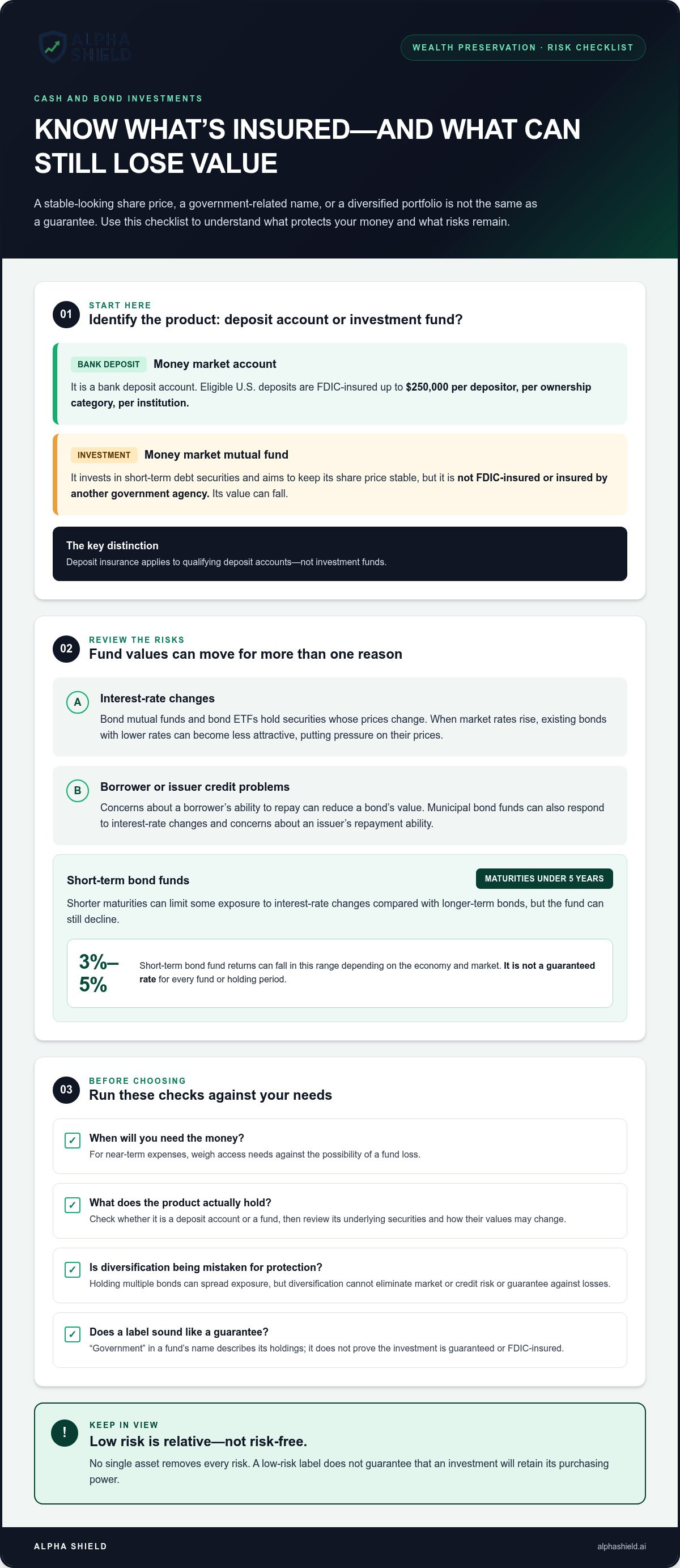
Yes. Bond funds and money market mutual funds can lose value, unlike eligible insured deposits. In the United States, FDIC insurance covers eligible deposits up to $250,000 per depositor, per ownership category, per institution. That protection applies to qualifying deposit accounts, not investment funds.
A money market mutual fund invests in short-term debt securities and aims to keep its share price stable. Money market funds aren’t insured by the FDIC or another government agency.
Don’t confuse a money market fund with a money market account. A money market account is a bank deposit account, and eligible U.S. deposits receive FDIC protection within the stated coverage limit. A fund is an investment that holds securities.
Bond mutual funds and bond exchange-traded funds (ETFs) also carry investment risk. They hold bonds, but their share prices change as the value of those securities changes. When market interest rates rise, existing bonds with lower rates can become less attractive, putting pressure on their prices. Borrower credit problems can also reduce a bond’s value. Diversifying across multiple bonds may spread exposure, but it can’t eliminate market or credit risk.
Short-term bond funds typically hold bonds with maturities of less than five years. Shorter maturities can limit some exposure to interest-rate changes compared with longer-term bonds, but the fund can still decline. Short-term bond fund returns can range from 3% to 5%, depending on the economy and market. That range isn’t a guaranteed rate for every fund or holding period.
Municipal bond funds invest in debt issued by state and local governments. Their values can respond to interest-rate changes and concerns about an issuer’s ability to repay. A fund may hold many municipal bonds, so any one issuer represents only part of its holdings. Still, diversification doesn’t guarantee against losses, and municipal status doesn’t make a bond fund equivalent to insured cash.
Before choosing, identify whether the product is a deposit account or a fund, then review what it holds and how its value can change. For money needed for near-term expenses, weigh access needs against the possibility of a fund loss. Treat “government” in a fund’s name as a description of its holdings, not proof that the investment is guaranteed or FDIC-insured.
2. What is a low-risk investment?
In the United States, lower-risk options include eligible bank deposits, certificates of deposit, Treasury bills, and short-term bonds. Each offers a different balance of access, price stability, and exposure to inflation. A low-risk label describes relative risk, not a guarantee that an investment will retain purchasing power. A low-risk investment strategy for wealth preservation starts by identifying which risk matters most for each financial goal.
Separate savings for near-term expenses from investments intended for longer-term goals. An emergency fund covering three to six months of living expenses can reduce the chance of selling investments during a market decline. Money needed soon generally calls for greater liquidity, while money with a longer horizon can withstand more fluctuation. This distinction helps determine which assets belong in each part of a portfolio.
Diversification means spreading a portfolio across investments that respond differently to market conditions. For example, a mix of bank deposits, Treasury securities, and bonds avoids relying on a single issuer or asset type. Broader diversification can include stocks, bonds, real estate, and private equity, though each comes with distinct risks and access conditions. A diversified fund can spread exposure across many companies or securities, but it can still lose value.
Conservative diversification works at more than one level. A Treasury bill has a defined maturity, while a bond fund holds a changing basket of securities. A savings account prioritizes access, while a CD ties money to a term. Combining these categories can reduce dependence on a single outcome. Review the underlying holdings, maturity dates, withdrawal terms, and whether the money is intended for spending or long-term growth.
Inflation creates a separate challenge: cash may hold a stable dollar value while buying less over time. Equities can help protect a portfolio’s purchasing power over longer periods, but stock prices can fall sharply. A measured allocation to stocks alongside bonds and cash can balance growth potential with stability. The suitable mix depends on how much fluctuation you can tolerate and when you’ll need the funds.
Investment choices should reflect your time horizon, income needs, and risk tolerance. If you need regular income or expect to spend the money soon, emphasize liquidity and holdings that are less sensitive to price changes. If the goal is farther away, a diversified mix can include more growth-oriented assets, provided you can tolerate temporary declines. Adjust the balance as your spending needs or income sources change.
To build a low-risk investment strategy for wealth preservation, identify upcoming expenses, protect emergency savings, then diversify the remaining portfolio across suitable asset classes. For example, someone with near-term bills and a distant retirement goal can keep spending reserves accessible while investing long-term savings across bonds and equities. Review the allocation after a major life change, such as retirement or a shift in household income.
3. Certificates of deposit, maturity terms, and early-withdrawal penalties
A certificate of deposit (CD) exchanges access for a stated term and interest arrangement. U.S. CDs commonly run from six months to five years, with examples including six months, one year, or five years. Eligible deposits at insured institutions receive applicable deposit insurance. A CD’s stated return applies when held to maturity, while an early withdrawal can trigger a penalty that reduces earnings.
High-yield savings accounts and money market deposit accounts are deposit accounts designed for accessible savings. CDs set a maturity date and can restrict access before it. A money market deposit account differs from a money market mutual fund, which is an investment rather than an insured deposit. Compare access rules, rate terms, account requirements, and early-withdrawal costs before choosing where to place cash.
Match the maturity to the date you expect to need the funds. If expenses are approaching, a shorter CD term can reduce the chance of withdrawing early. If the money is reserved for a later goal, a longer term can lock in its stated rate, but it also limits access. A CD ladder with staggered maturity dates can create planned opportunities to access part of the deposit without closing every CD at once.
For fixed-income choices, compare the holding period with the timing of your spending needs and your tolerance for volatility. Short-term investments generally provide earlier access or maturity dates; longer-term investments keep funds committed longer and can be more sensitive to changing rates. Choose a term that fits the goal, rather than relying solely on the quoted return.
Annuities have different withdrawal rules from CDs. Deferred fixed annuities generally allow 10% annual penalty-free withdrawals, while withdrawals during a surrender-charge period can incur surrender charges and, where applicable, a market value adjustment. Taxable annuity withdrawals before age 59½ may face a 10% federal tax penalty in addition to ordinary income tax. Read the contract’s withdrawal provisions before treating annuity value as available income.
Tax-aware retirement withdrawals also depend on account type and timing. Roth IRA earnings can be withdrawn tax-free after age 59½ under the stated conditions. Roth conversions can be considered in lower-income years before required minimum distributions begin at age 73. Since conversion income can affect a tax year, map the amount and timing with an advisor rather than treating a conversion as a simple transfer.
The 4% rule is a common retirement withdrawal framework: it starts with withdrawing 4% of a portfolio in the first retirement year and is designed around savings lasting 30 years. It’s a planning reference, not a fixed fit for every income need. Portfolio volatility, spending changes, and the balance of stocks, bonds, and cash all affect how withdrawals interact with retirement assets.
4. Inflation, interest-rate, market, and liquidity risks
Inflation and taxes can reduce the purchasing power of low-risk investment returns. If interest earned doesn’t keep pace with rising prices, the account balance may grow while buying less; taxes on interest income can further reduce what remains. According to the Internal Revenue Service, interest from Treasury bills, notes, and bonds is subject to federal income tax but exempt from state and local income taxes.
Treasury Inflation-Protected Securities (TIPS) address one specific risk: inflation. Their principal adjusts with changes in the Consumer Price Index, so the security’s value reflects inflation over its term. TIPS still carry market risk if sold before maturity, because market prices can move as interest rates change. Match the maturity to your investment horizon rather than assuming inflation adjustment removes every source of volatility.
Interest-rate risk affects bonds and bond funds differently from cash deposits. When market rates rise, existing bonds with lower rates can become less attractive, pushing their prices down. A fund’s value can therefore decline even when its underlying issuers continue making payments. Consider the fund’s maturity profile and holdings before relying on it for a fixed spending date.
Market volatility can also affect whether you can sell an investment at a favorable price. A Treasury security held to maturity follows its payment terms, while selling it beforehand exposes you to the current market price. This distinction matters for retirement income: a planned withdrawal during a market decline may require selling more shares or securities to raise the same amount of cash.
Liquidity risk is the possibility that money won’t be available when expenses arrive. Money market mutual fund investors may have to wait up to one trading day to access funds. Keep liquid assets in an emergency fund so an unexpected expense doesn’t force you to sell long-term investments at an inopportune time. For example, reserve accessible cash for a near-term repair instead of depending on a bond fund sale.
Retirement inflation risk continues beyond the first year of withdrawals. A fixed income amount can cover fewer expenses as prices rise, so a retirement plan should account for changing purchasing power. TIPS may provide inflation exposure within a diversified plan, while other assets serve different roles. Compare the expected timing of withdrawals with each security’s maturity and access conditions.
Use a simple risk review before committing funds: identify the expense date, estimate how quickly you can access the investment, and assess how a rate change could affect its value. Then consider whether inflation-adjusted purchasing power matters more than short-term price stability. A low-volatility choice can still carry inflation, tax, or liquidity risk, so evaluate each exposure separately.
5. Meaning of wealth preservation
Wealth preservation focuses on protecting assets already built. Wealth accumulation prioritizes growing wealth through investments. The difference changes how you judge returns: a portfolio designed to fund near-term spending has different priorities from one built for distant financial goals. Preservation isn’t simply avoiding stocks or holding cash. It means managing risks that could interrupt your plans while keeping purchasing power in view.
Start by identifying what your assets need to do. A homebuyer saving for a down payment may prioritize access and value stability. Someone funding retirement may need assets to support income over time while accounting for inflation. Write down each goal, its expected timing, and the consequences of a loss. This turns “low risk” from a vague label into practical requirements.
Preservation also requires distinguishing visible price changes from less visible risks. A stock portfolio can fall during market volatility, while cash can lose purchasing power when prices rise. Concentrating savings in one asset type may leave your plan exposed to a single economic change. Diversifying among asset classes can reduce reliance on one market, though it cannot eliminate every risk.
Credit and debt belong in the same assessment as investments. High-interest credit card debt creates a cost that investment returns may not reliably overcome. Paying down that balance can support preservation by reducing a known financial burden. Review debts alongside cash reserves, income needs, and investments. The goal is to understand your full household balance sheet, not only your brokerage account.
A broader risk plan should account for events outside financial markets. Health issues, legal challenges, and unforeseen personal events can affect financial well-being. Life, health, disability, and property insurance can help protect against losses from unexpected events. Trusts can support estate planning and help protect assets from potential creditors and legal claims. Each measure addresses a different exposure, so match it to the risk it is meant to manage.
Values and risk are related, but they aren’t interchangeable. A socially responsible investment may reflect your priorities, yet its label alone doesn’t establish capital stability. Assess its underlying holdings, concentration, and exposure to market changes, just as you would for any investment. The practical test is whether it fits both your values and financial goals without relying on unsupported promises.
Use a disciplined review process. List your assets, debts, income needs, and foreseeable obligations, then identify what could threaten each goal. Review the plan at least annually or after significant life changes. Be cautious of promises of high guaranteed returns with little or no risk, which are warning signs of investment fraud. The principle is straightforward: preserve what matters by matching each protection to a defined risk.
Alpha Shield: Alpha Shield Market Signal
Alpha Shield Market Signal helps investors navigate market volatility and manage exposure to significant drawdowns. It can inform your approach after you’ve decided how much stability, liquidity, and market exposure your wealth-preservation plan requires. Use it as a systematic market-risk signal, not as a substitute for insured deposits or a diversified portfolio.
The Market crash and drawdown tool and Alpha Shield Dashboard provide clear indicators for market crash protection and risk management. These can help bring structure to decisions when market conditions shift, while keeping the focus on long-term capital preservation rather than short-term trading.
If market volatility is a central concern in your investment plan, visit alphashield.ai to learn about Alpha Shield Market Signal and its dashboard subscription.
Turn your priorities into a decision framework
Make your decisions explicit before market conditions become stressful. Write down what each part of your portfolio is meant to do, which risks matter most, and what would prompt you to review your approach. A low-risk investment strategy for wealth preservation should reflect your priorities, not a generic label or a reaction to short-term market noise.
Decide how you’ll assess new information, including market signals, against the plan you’ve already set. A signal can inform a decision, but it shouldn’t replace your assessment of goals, liquidity needs, and risk tolerance. Clear rules can help keep changes deliberate rather than reactive. Revisit those rules when your financial goals or circumstances change.
Progress comes from consistent, informed decisions. Choose a next step that fits your plan, then move forward with discipline.
Frequently Asked Questions
Are There Safe Assets That Are Also Socially Responsible?
Some investments combine social or environmental screening with comparatively conservative holdings, but responsible-investing criteria don’t eliminate financial risk. For example, a bond fund may screen issuers against environmental or labor standards while remaining exposed to interest-rate and credit changes. Review the fund’s stated screens, holdings, and investment objective. Compare those details with your priorities rather than treating a sustainability label as evidence of safety.
Can Money Market Funds Ever Result in a Loss?
Yes. A money market mutual fund can lose value because it holds securities rather than insured bank deposits. Losses among its holdings or repayment problems, for example, could affect its share price. Before using one for a planned payment, distinguish the fund from a bank money market deposit account and consider how quickly you may need access. The product type determines which protections and risks apply.
What is a low-risk investment?
A low-risk investment has comparatively limited exposure to a particular type of loss, not no risk at all. A Treasury bill may have low price fluctuation if held to maturity, while a stock fund can fluctuate more but offer growth potential. Assess the specific risk you need to limit, such as loss of principal, delayed access, or reduced purchasing power, before deciding whether an option fits.
Where Is the Safest Place to Put Your Money?
For money needed soon, an eligible insured deposit account can offer principal protection within applicable coverage limits. In the United States, FDIC insurance covers eligible deposits up to $250,000 per depositor, per ownership category, per institution. Match the account to the purpose: emergency savings need access, while funds assigned to a later date may suit a fixed-term deposit. Safety also depends on keeping balances within coverage rules.
Why Is There a Risk-Return Tradeoff?
Investments with greater uncertainty often need to offer the possibility of higher returns to attract buyers. A bond with weaker credit quality, for instance, may offer more income than a similar bond from a stronger issuer, reflecting greater repayment risk. That potential return isn’t assured. Investors seeking lower volatility generally accept less growth potential or reduced access in exchange for a different risk profile.
How do Treasury bills, notes, bonds, and TIPS compare for safety and returns?
Treasury bills mature in one year or less, notes span up to 10 years, and Treasury bonds typically mature in 20 to 30 years. Longer maturities can expose market prices to greater changes before maturity. TIPS adjust principal with inflation, while bills, notes, and bonds have fixed principal terms. According to the Internal Revenue Service, Treasury interest is federally taxable but exempt from state and local income taxes.
How can investors build a diversified portfolio focused on capital preservation?
Begin by separating near-term spending needs from long-term assets. Keep planned bills and emergency reserves accessible, then distribute longer-term investments across asset classes with different sources of risk. For example, a portfolio might combine deposits, Treasury securities, and diversified bond or stock funds. Set target ranges based on income needs and tolerance for declines, then rebalance when allocations drift instead of reacting to every market headline.
What fees, withdrawal penalties, and liquidity limits should investors check?
Review account maintenance charges, fund expense ratios, transaction costs, CD early-withdrawal penalties, and restrictions on selling or transferring assets. For annuities, read the surrender-charge terms and any market value adjustment provisions. Check settlement timing too: an investment that can be sold may not provide spendable cash immediately. Compare these costs and access rules with the date you expect to use the money.


