

Protecting an IRA from a market crash starts with a plan, not a prediction. A traditional withdrawal guideline is to take 4% of retirement savings each year, but the right amount can vary. To understand how to protect an IRA from a market crash, coordinate withdrawals with your time horizon, portfolio allocation, and income needs.
Market declines can make it tempting to change course quickly. But selling investments during a downturn can lock in losses and leave less invested if markets recover. A disciplined plan keeps short-term spending needs and long-term goals in view.
This article explains practical ways to manage IRA risk through withdrawal planning, diversified asset allocation, income investments, and consistent decision-making during volatility. You’ll see how each choice can affect your portfolio and why your plan should reflect both current cash needs and your retirement horizon.
Key Takeaways
- Adjust withdrawals to market conditions and understand how IRA distributions can affect your retirement plan.
- Set an asset mix that reflects your risk tolerance and time horizon, then rebalance to keep it aligned.
- Weigh the income potential of bonds and dividend-paying stocks against their specific risks.
- Build cash reserves and a practical spending plan to reduce pressure to make rushed portfolio decisions.
- Use consistent long-term habits to stay focused through volatility instead of reacting to every market move.
1. Adjusting withdrawals to market performance
A withdrawal plan is one practical part of how to protect an IRA from a market crash. The U.S. Securities and Exchange Commission commonly defines a bear market as a sustained decline of 20% or more from recent market highs. That threshold describes a market decline, not an automatic instruction to change an IRA strategy. Set withdrawal rules before volatility rises, then apply them consistently.
A traditional guideline is to withdraw 4% of retirement savings each year, although the appropriate amount can vary. Treat it as a planning reference, not a fixed rule for every portfolio. One approach described by an adviser is to turn off portfolio distributions if the total portfolio declines by greater than 10%. If using a trigger like this, define which withdrawals it affects and how essential expenses will be covered. Otherwise, pausing distributions can solve one problem while creating another.
If you’re deciding how to protect an IRA from a market crash, separate spending needs from investment decisions. List essential and discretionary costs alongside income sources, then identify which expenses you could reduce during a downturn. Adjusting optional withdrawals may preserve more principal for a potential recovery. Selling only because prices have fallen can lock in losses and leave less invested if markets later recover.
Tax treatment also matters. In the United States, distributions from qualified retirement plans, including traditional IRAs, are generally taxed as ordinary income. When possible, withdrawing from taxable accounts before tax-advantaged accounts can allow the latter to keep growing longer. For 401(k) withdrawals before age 59½, the Internal Revenue Service says they are generally subject to ordinary income tax and an additional 10% early withdrawal penalty. That specific rule concerns 401(k) withdrawals; don’t assume it describes every IRA distribution or exception.
Required minimum distributions can limit how much an IRA owner can defer taking during a downturn. In the United States, the starting age is 73 for people born after 1950 but before 1960, and 75 for people born after 1959. A required withdrawal may mean selling investments when prices are down, leaving fewer assets invested for a later recovery. Include these distributions in cash-flow planning instead of treating them as unexpected withdrawals.
What scams or high-fee products should IRA owners avoid when seeking crash protection? Be wary of pitches promising to eliminate market risk, and review costs, restrictions, and withdrawal terms before committing savings. An income feature does not remove tradeoffs: a basic annuity provides fixed income that may not offer growth potential. Compare its role with your needs for liquidity, income, and long-term returns before deciding.
2. Aligning asset allocation with risk tolerance and time horizon
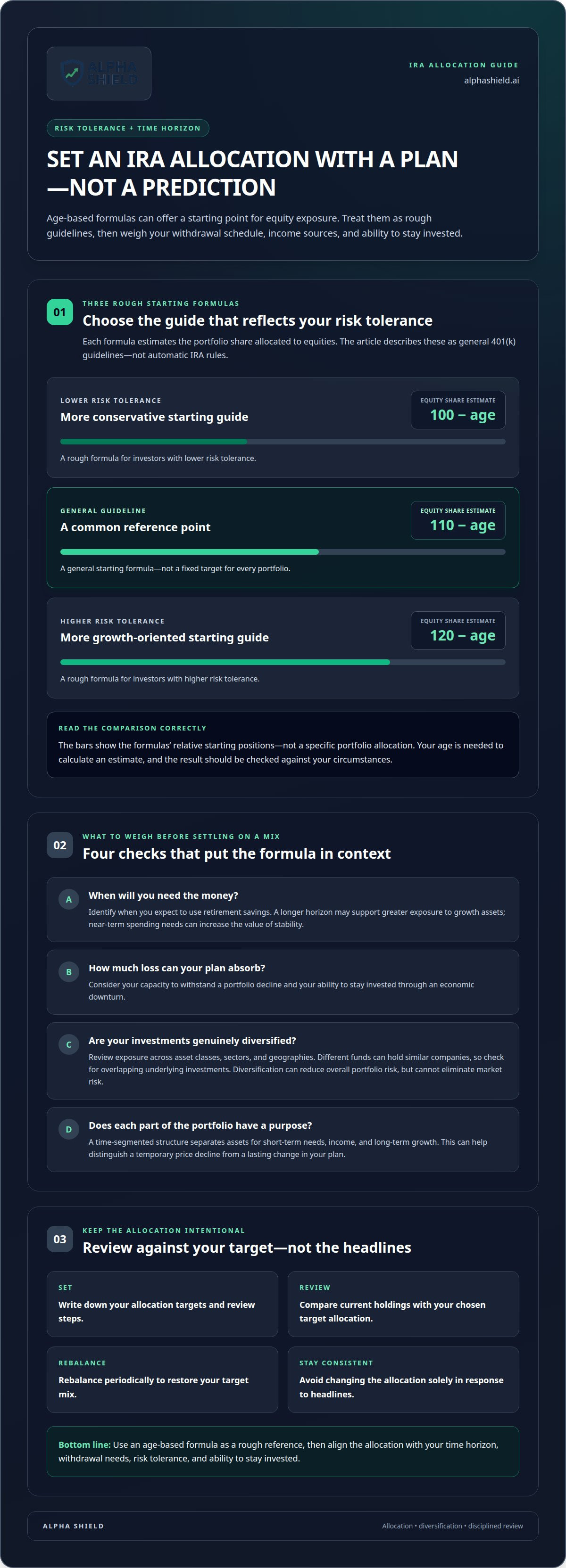
An IRA’s allocation should reflect both when you’ll need withdrawals and your capacity to absorb losses. Identify when you expect to use retirement savings, then consider how much the plan could withstand a portfolio decline. A longer horizon may support greater exposure to growth assets, while near-term spending needs can increase the value of stability. The goal is a deliberate balance, not a prediction of the next market move.
Age-based formulas can provide a starting point. A general 401(k) guideline subtracts an investor’s age from 110 to estimate the portfolio share allocated to equities. For higher risk tolerance, the suggested starting formula subtracts age from 120; for lower tolerance, it subtracts age from 100. These are rough allocation guides, not automatic IRA rules. Compare the result with your withdrawal schedule, income sources, and ability to stay invested through an economic downturn.
Diversification spreads exposure across asset classes, sectors, and geographies. Investments may react differently to the same economic conditions, so concentrating in one company, industry, or region can expose retirement savings to a narrower set of risks. Review what each holding contributes. If several funds own similar companies, their names may differ while their underlying exposures overlap. Diversification can reduce overall portfolio risk, but it cannot eliminate market risk.
A time-segmented structure can link investments to spending horizons. Divide assets by purpose: short-term needs, income, and long-term growth. The short-term pool is intended for nearer expenses, while the growth pool stays invested for future needs. This makes the portfolio’s purpose clearer during volatility and helps distinguish a temporary price decline from a lasting change in your plan.
What investment strategies can reduce IRA losses during a market crash? Diversify across asset classes, sectors, and geographies, then align your stock allocation with your time horizon and risk tolerance. Set aside shorter-term needs from long-term growth so a market decline doesn’t dictate every investment decision.
Should you rebalance an IRA during a market crash, and how often? Rebalance periodically to restore your chosen target allocation, rather than changing it solely in response to headlines. Set a regular review routine and compare current holdings with your target. The appropriate interval depends on how you manage the portfolio.
Use a written allocation plan with clear targets and review steps. If you also want a separate market-risk input, a market crash signal can inform your assessment without replacing diversification or a time-based plan.
3. Investment-grade bonds and dividend-paying stocks for retirement income
Income investments can support retirement spending, but each has distinct risks. Investment-grade bonds pay interest under stated terms, while dividend-paying stocks may provide income and potential share-price growth. Neither removes market risk. Build your portfolio around the role each holding serves, not its label or advertised yield.
Bond maturities can range from one to 30 years, depending on the agreement, and investors usually receive interest twice a year. Bond prices generally fall when interest rates rise, with longer-maturity bonds typically more sensitive to that risk. Before choosing a bond, consider its credit quality, maturity, interest payments, and how soon you may need the principal. A bond’s income stream does not mean its market value stays constant.
Dividend-paying stocks involve a different tradeoff. Companies can reduce or stop dividends, and share prices can fall during market stress. Assess whether a stock’s income fits its role in your portfolio instead of relying on its dividend alone. A diversified mix can reduce dependence on any one company’s payout. Keep future growth needs in view, especially if your savings must support spending over a long retirement.
Can cash, bonds, Treasury securities, or money market funds protect an IRA during a downturn? They can reduce exposure to stock-price swings as part of a diversified portfolio, but they don’t eliminate risk. Cash and fixed-income holdings also have tradeoffs, including inflation’s effect on purchasing power and potential price changes in bonds.
A bucket strategy organizes assets by purpose: short-term needs, income, and long-term growth. Match near-term spending with liquid assets, then assign bonds and dividend-paying stocks to income roles according to their risks. Reserve growth investments for future needs. This structure can help identify which holdings fund spending, instead of selling across the portfolio without a plan.
Planning near retirement deserves special attention. Someone a year from retirement may still have a large share of investments in stocks, leaving the portfolio exposed to volatility just before withdrawals begin. Review expected spending dates, income sources, and the purpose of each holding. As retirement approaches, gradually align the allocation with those needs instead of relying on a sudden shift after markets fall.
Contributions also shape future income capacity. If you have access to a workplace 401(k), consider how employer matching affects your contribution plan; one example is a match of up to $2,000. Keep contribution decisions separate from IRA withdrawal planning, then coordinate both with your retirement goals.
For tax-aware distributions, map which accounts and holdings will fund spending, and consider the tax impact and timing of withdrawals. Coordinating income sources can help preserve flexibility when markets are unsettled.
Financial planning and risk preferences
A retirement plan should connect monthly expenses with income, savings, and the time horizon for each goal. List essential costs, flexible spending, and income sources, then identify which expenses you could reduce if markets fall. This separates what you need to live on from investments intended for future growth. It also clarifies how much volatility the plan can absorb without losing sight of its purpose.
Build cash reserves around the role they need to serve. One guideline recommends an emergency fund covering six to nine months of living expenses before investing additional cash for retirement. For retirees, another guideline suggests cash reserves covering three to six months of living expenses. A financial adviser quoted in the article says retired clients may keep 12 to 18 months of expenses in cash. These are different planning approaches, not a single universal target. Income stability, spending needs, and comfort with market fluctuations influence which reserve fits.
Calculate your reserve from actual costs, not a rounded estimate. Add housing, food, healthcare, insurance, and other essential expenses, then separate discretionary spending. If you rely on portfolio withdrawals, a larger cash reserve may reduce the need to sell investments during a downturn. If reliable income covers essential costs, the reserve may serve another purpose. Revisit the calculation when household expenses or income change.
Test your risk tolerance by considering how you would respond to a portfolio decline while paying current bills. If a downturn would force an immediate sale or disrupt essential expenses, your plan may carry more risk than you can tolerate. Adjust your portfolio, spending flexibility, or cash reserve before volatility arrives. Record what would prompt a review, such as a change in income, expenses, or retirement timing.
Don’t assume you will cash out all retirement savings at age 65. A retirement horizon can extend beyond the date work ends, so the plan must account for later expenses and the possibility of recovery after market losses. Separate near-term spending from assets intended for longer-term needs. That distinction can prevent a short-term market decline from dictating the treatment of every account.
Proactive planning can also shape behavior under pressure. A financial adviser said her clients were remarkably calm during 2020, attributing that response to planning done in advance. Use that principle by documenting the withdrawal approach, spending adjustments, and conditions for reviewing risk. Revisit the plan on a regular schedule and after major life changes. A written process gives each decision a reference point, rather than letting headlines set the response.
5. Long-term investing through market volatility
Long-term investing means judging an IRA by its purpose and horizon, not one market session. The S&P 500 fell approximately 56.8% from its peak between October 2007 and March 2009. That history shows the scale of a severe decline, not how quickly any future market will recover. A durable plan must account for both substantial losses and uncertain recovery timing.
Retirement account balances can also experience sharp declines. The average U.S. 401(k) balance dropped by more than 30% in 2008. For an investor with years before withdrawals, that decline and the ability to remain invested may matter differently than for someone relying on the account for current expenses. Connect each holding to its intended use before volatility rises.
Use a written review process instead of reacting to headlines. First, consider whether the market move changes your investment timeline or cash needs. Next, check whether your portfolio still matches its intended allocation. Then decide whether an adjustment is warranted under your plan. This sequence helps separate a change in personal circumstances from discomfort caused by price movements alone.
An average investment return of about 7 percent is a broad planning reference, not a steady annual outcome. Actual returns vary, and a strong year can be followed by weaker performance. The article’s example of a 30 percent return in one year may be followed by a decline in returns. Avoid building retirement spending around a single unusually strong year.
Consistency matters during volatility because timing decisions affect how much capital remains invested. Selling after a decline may mean missing a later rebound; taking more risk than your horizon supports may leave the plan exposed to another disruptive drop. Set review points in advance and use the same criteria in calm and turbulent markets. The goal is disciplined adaptation, not automatic inaction.
For a practical review, compare your plan with your expected retirement timeline, spending needs, and comfort with losses. Record what would justify a change, such as a revised goal or new cash need, and distinguish that trigger from a temporary market move. This creates a repeatable process instead of a series of unrelated reactions.
Long-term discipline doesn’t mean ignoring risk. It means keeping volatility in context, making portfolio changes for defined reasons, and avoiding assumptions that recent returns will continue. A written decision process gives each adjustment a clear purpose.
Alpha Shield: Alpha Shield Market Signal
Alpha Shield Market Signal helps investors navigate volatility and manage drawdown risk with a systematic daily IN or OUT signal. Delivered through the dashboard, email, or Telegram, it also provides ETF allocation and position-sizing guidance. The Alpha Shield Dashboard offers live performance and metrics to support a focused review alongside your broader portfolio plan.
Use a signal as one input, not a substitute for withdrawal planning, diversification, or decisions about income needs. It cannot remove market risk or guarantee that losses will be avoided. Its role is to support a more structured review when volatility raises questions about exposure and long-term capital preservation.
If a systematic market signal fits your approach to risk management, contact Alpha Shield to learn more.
Make your next decision deliberate
Knowing how to protect an IRA from a market crash is less about finding a perfect forecast and more about deciding what information will guide your next move. Before changing your portfolio, write down the reason, the intended effect, and what might make you reconsider. This creates a record to compare with future decisions, rather than judging each choice by the market’s next move.
Choose a regular time to review your record and update it when your goals or circumstances change. If you use market signals, treat them as one input in your broader decision process. The objective is clarity: a plan you understand well enough to follow when volatility makes a quick reaction tempting.
Steady decisions begin with a clear process. Keep refining yours as your retirement needs evolve.
Frequently Asked Questions
How should IRA asset allocation change based on age and retirement timeline?
Shift your allocation as your spending timeline changes, not simply because you reach a particular age. Someone nearing retirement who expects to draw from an IRA soon may need different access to funds than someone with years to go before withdrawals begin. Consider planned expenses, other reliable income, and how you would respond to a decline. Review the plan after a major change, such as retiring earlier or delaying withdrawals.
What are the risks and costs of moving an IRA to cash before a market crash?
Moving investments to cash can reduce exposure to market declines, but you could miss a recovery if markets rise after you sell. The longer cash remains outside growth investments, the more it may affect your portfolio’s ability to meet future goals. Before acting, decide what would prompt you to reinvest and how you’ll make that decision. Review any transaction terms and account-specific charges that may apply.
How do target-date funds compare with DIY portfolios for managing IRA market risk?
Target-date funds offer a preset allocation that typically adjusts as the selected retirement date approaches, potentially reducing the need for hands-on rebalancing. A DIY portfolio gives you more control over holdings and allocation, but you must monitor and maintain it. Compare whether a fund’s investment mix suits your expected withdrawal timing and risk tolerance, rather than relying on its target year alone.
Can diversification across stocks, bonds, and international investments help protect an IRA?
Yes. Combining stocks, bonds, and international investments can spread exposure across different markets and economic drivers, so one concentrated position doesn’t determine the entire portfolio’s result. Diversification doesn’t prevent losses, especially when multiple markets fall together. Check what each holding actually owns: funds with different names may share securities or sector exposure. Reviewing holdings can reveal overlap and clarify each investment’s role.
How do traditional and Roth IRA withdrawal rules affect access to funds during a downturn?
Traditional IRA distributions are generally taxed as ordinary income, and required minimum distributions can require withdrawals during a downturn once applicable starting ages are reached. Include required withdrawals in your cash-flow plan.


