

The answer to whether buy-and-hold investing is dead in 2026 is no. For investors with a horizon of 10 years or more, a diversified equity portfolio through ETFs has historically delivered the best risk-adjusted returns. The approach still depends on choosing a suitable time horizon and accepting that markets can fall along the way.
It’s reasonable to question a strategy that asks you to stay invested while returns shift and uncertainty persists. But long-term investing doesn’t have to mean constant monitoring: managing a passive portfolio of diversified ETFs requires 1 to 2 hours per year. The discipline lies in matching your investments to your goals, not reacting to every market move.
This article compares buy and hold with shorter-term investing, explains how diversified equity ETFs can fit into a portfolio, and explores what changing market gains may mean for your time horizon. You’ll also see where active risk management can complement a long-term plan, and when a shorter horizon calls for a different approach.
Key Takeaways
- See how diversified ETFs can spread exposure and why an appropriate portfolio balance matters more than holding a long list of investments.
- Match your strategy to when you’ll need the money: short horizons put capital preservation ahead of equity-market growth.
- Understand why broad market gains can give way to narrower leadership, and what that shift means for relying on index returns alone.
- Compare buy-and-hold with active risk management using performance evidence through June 30, 2026, while keeping the limits of each approach in view.
- Learn how a market signal and drawdown tool can support risk awareness without turning a long-term plan into day trading.
Long-term investing through diversified equity ETFs
In U.S. taxable accounts, dividends and realized gains can create tax obligations, while retirement accounts follow rules based on account type and withdrawals. The practical impact depends on where assets are held and when income or gains are recognized.
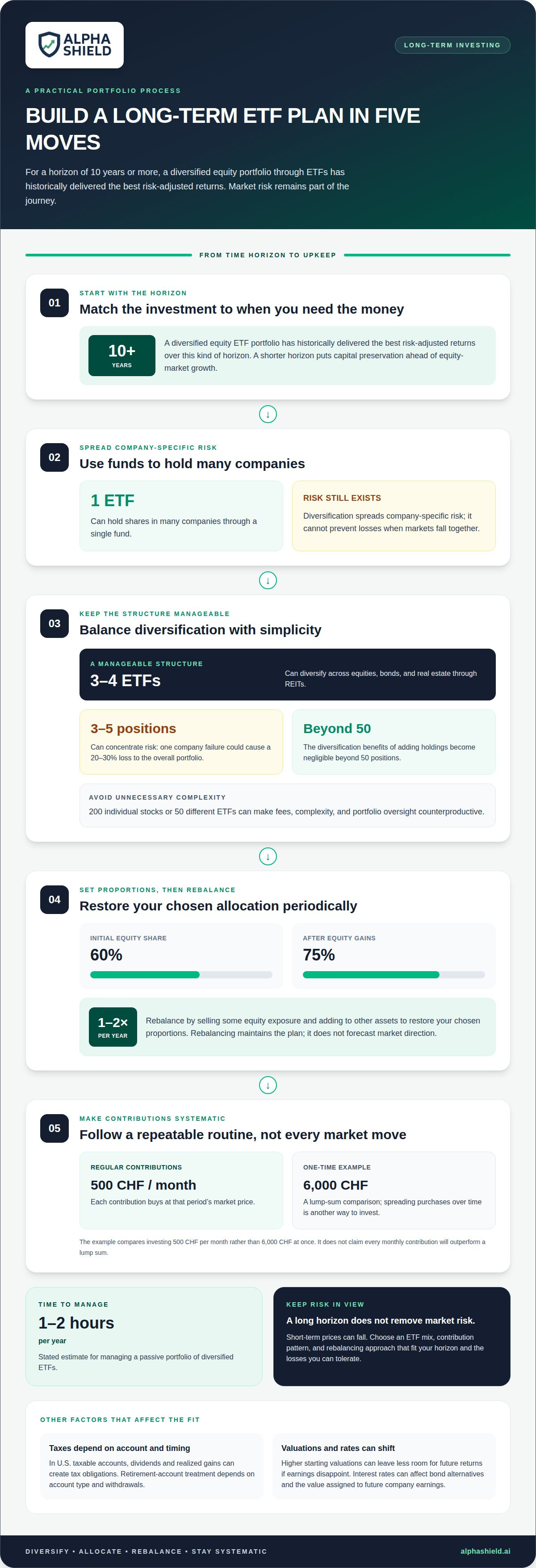
For a horizon of 10 years or more, a diversified equity portfolio through ETFs has historically delivered the best risk-adjusted returns. That history doesn’t remove market risk. It gives investors time for company profits and reinvested distributions to contribute to results, while short-term prices can still fall.
An ETF can hold shares in many companies through a single fund. A broad fund reduces reliance on any one company, but it cannot prevent losses when markets fall together.
Diversification works by spreading company-specific risk, not by adding holdings endlessly. The benefits become negligible beyond 50 positions. By contrast, holding only 3 to 5 positions can concentrate risk: one company failure could cause a 20 to 30% loss to the overall portfolio.
- Keep the structure manageable: 3 to 4 well-chosen ETFs can diversify across equities, bonds, and real estate through REITs.
- Avoid unnecessary overlap: 200 individual stocks or 50 different ETFs can make fees, complexity, and portfolio oversight counterproductive.
Set a target allocation, then rebalance one to two times per year. For example, if equities rise from 60% to 75% of a portfolio, selling some equity exposure and adding to other assets can restore the chosen proportions. Rebalancing maintains the plan; it doesn’t forecast market direction.
Regular contributions can also make the process systematic. Investing 500 CHF per month rather than 6'000 CHF at once spreads purchases over time, so each contribution buys at that period’s market price. A passive approach using diversified ETFs requires 1 to 2 hours per year to manage, according to the stated estimate.
Current U.S. valuations affect what investors pay for expected profits. Higher starting valuations can leave less room for future returns if earnings disappoint. Interest rates affect both bond alternatives and the value assigned to future company earnings, so rate changes can shift valuations without changing a business’s underlying operations.
For a long-term investor, the decision is not simply whether markets will rise next month. It is whether the ETF mix, contribution pattern, and rebalancing approach fit the available time horizon and the losses the investor can tolerate.
Short-term versus long-term wealth building
Buy and hold keeps investments through market cycles; active investing changes exposure as conditions shift. The trade-off is between patience and making repeated decisions.
Buy and Hold Versus Active Investing
Buy and hold means following an investment plan instead of reacting to every market move. Active investing attempts to improve results by deciding when to buy, sell, or change exposure. The distinction matters because broad participation can benefit investors in a rising market, while a downturn can test their ability to stay invested. Neither approach removes risk or guarantees profits.
From 2020 through 2024, about 90% of S&P 500 companies had positive annualized returns. That breadth shows how many companies contributed gains during that period, but it doesn’t establish that active investing would have produced better results. A comparison also needs to account for the chosen benchmark, holding period, trading costs, and the timing of investment decisions.
Regular contributions can support a long-term plan without requiring a prediction about the next market move. One example compares investing 200 CHF per month over 20 years with making a one-off 5'000 CHF deposit. The example emphasizes the cumulative effect of steady contributions and time, rather than a claim that every monthly contribution will outperform a lump sum.
Market Timing After Taxes and Fees
Market timing means changing investments in response to expected market movements. Results depend on getting both the exit and re-entry right, making taxes and fees important to the comparison. Buy-and-hold investors usually trade less; active investors may face more transaction costs and taxable events, depending on the account and jurisdiction.
In a U.S. taxable account, selling an investment can create a taxable gain or loss, and dividends may also affect taxes. Retirement accounts have different tax treatment depending on account type and withdrawals. Compare results after taxes and fees, not just market returns before costs.
A timing decision must overcome its costs and the returns an investor misses while out of the market. If a sale avoids a decline but re-entry happens after prices recover, the avoided loss may not improve the final result. Conversely, staying invested means remaining exposed to market declines. The decision affects portfolio risk as well as potential return.
Investors considering a systematic approach to market volatility can use the Alpha Shield Market Signal as a risk-management reference alongside a long-term plan. It focuses on market crash and drawdown signals, rather than day-trading decisions. The useful question is whether risk adjustments fit the investor’s objectives and time horizon.
The shift from broad market gains to more selective investing
Broad participation can support index returns, but market leadership changes. In 2026, investors need to distinguish diversified exposure from reliance on a narrow group of companies.
Concentration makes a portfolio more vulnerable to setbacks at an individual company or sector. A diversified index fund spreads exposure across businesses, so a single company’s decline has less influence than it would in a portfolio dominated by that holding. Diversification cannot prevent losses during a market-wide selloff or recession, but it reduces reliance on any one investment’s outcome.
As 2025 wound down, around 40% of S&P 500 companies were heading for a negative year. That spread points to uneven company-level results, not a guarantee that the index itself would fall. For investors, the distinction matters: an index can rise while some holdings weaken, and individual stock selection can miss gains elsewhere.
The 2026 U.S. outlook in the provided market indicators points to real private domestic final purchases consistent with around 2% real economic growth. That is an economic-growth signal, not a return forecast for the S&P 500 or the total stock market. Equity returns also depend on company earnings, valuations, and what investors already expect.
Interest-rate changes affect existing bond prices and the income available from newly issued bonds. A diversified stock-and-bond portfolio responds to different drivers: equities depend more directly on company performance, while bonds carry interest-rate and credit risks. The balance should reflect the investor’s goals and ability to tolerate losses.
Selective investing can involve assessing whether a business has durable profits, manageable debt, and a clear source of future earnings. It does not require abandoning broad index exposure. For example, an investor could keep a diversified market fund as the portfolio’s core and limit additional company or sector positions so they do not dictate the overall result.
A recession can pressure earnings, employment, and investor confidence at the same time. A concentrated portfolio may suffer more if its few holdings face similar business risks. An index fund spreads company-specific exposure, but still participates in broad market declines. The choice is not between risk and no risk, but between different risk profiles.
Use three checks to assess market breadth: compare index performance with the results of its constituent companies, identify whether gains rely on a narrow group, and test whether your allocation matches your time horizon. The 2025 S&P 500 company split illustrates why index-level performance alone can hide uneven results. A disciplined allocation can preserve broad exposure without assuming every company will prosper equally.
Investment time horizons
Historical data show that market downturns can interrupt buy-and-hold returns, while recoveries can reward investors who remain invested. A comparison of Vanguard Value ETF and Vanguard Total Stock Market ETF identifies underperformance during 2007 through 2008 and early 2020.
Buy and Hold During Market Crashes
Buy and hold during a market crash means keeping investments through a sharp decline rather than selling in reaction to it. Selling realizes the loss and removes exposure to a later recovery.
The Vanguard comparison highlights relative performance, not a guarantee that every asset recovers on the same schedule. During 2007 through 2008 and early 2020, Vanguard Value ETF underperformed Vanguard Total Stock Market ETF. The difference shows that even within equities, strategies can behave differently during downturns.
Your time horizon helps determine whether volatility is manageable. Money needed soon cannot depend on an equity recovery arriving before a planned expense. If you can leave funds invested longer, patience can preserve exposure to a rebound, though the market’s path remains uncertain.
Performance During Market Recoveries
During a recovery, buy and hold maintains exposure to rising prices without requiring an investor to time a re-entry. Recovery timing is difficult, and staying invested avoids making a second decision after selling.
The supplied comparison identifies relative ETF performance during downturns, not a specific recovery return. The useful lesson is to distinguish market direction from fund selection: Vanguard Value ETF and Vanguard Total Stock Market ETF represent different exposures, so their results may differ at each stage.
For investment horizons under 5 years, high-quality bonds or money market funds are presented as better options for preserving capital. Investing is framed as a long-term activity with a minimum horizon of 5 to 10 years. Those ranges clarify why money needed soon has a different risk profile from retirement savings.
For a goal more than 10 years away, diversified equity exposure can give market returns more time to compound. The investor still needs to account for the possibility of a decline near the withdrawal date. Matching the portfolio to the date funds are needed can reduce pressure to sell equities during a downturn.
Before choosing an allocation, identify the purpose and timing of each investment. Money for a near-term expense has a different role from money intended for a distant goal. A long horizon can support patience, while a fixed withdrawal date makes capital stability more important. Exchange prices can change daily, but a spending deadline may not.
How has buy-and-hold investing performed compared with active investing through 2026?
There is no single result for either strategy: performance depends on the asset, period, and comparison benchmark. Through June 30, 2026, a chart comparing Vanguard Value ETF with Vanguard Total Stock Market ETF offers one reference point, but it does not represent every active strategy.
Buy and hold maintains exposure according to a chosen allocation. Active investing changes holdings or market exposure based on analysis and decisions. To compare the approaches fairly, use the same starting date, ending date, and asset class. Then account for distributions, fees, taxes, and the risks taken to achieve each result.
The Vanguard comparison illustrates why the benchmark matters. Vanguard Value ETF and Vanguard Total Stock Market ETF represent different investment approaches, so their performance can diverge. A value-focused strategy selects stocks based on valuation characteristics; a total-market fund tracks a broader slice of the U.S. equity market. To compare either with an active investor’s result, match the relevant exposure.
Value investing has struggled over the past two decades, despite Benjamin Graham’s lasting influence. Graham published Security Analysis in 1934 and The Intelligent Investor in 1949. His approach emerged when relatively few investors understood the advantages of buying stocks considered cheap. As more investors adopt a method, its earlier edge may become harder to capture. That history makes a useful distinction: a sound investing principle can remain relevant even when its relative performance changes.
From 2020 through 2024, more than half of S&P 500 companies delivered annualized returns above 15%. That evidence describes company returns, not the performance of every active fund or the full index. It also shows why outcomes can vary within the same market period. An active investor’s result depends on which companies they held and when they held them.
Use the following checks when assessing a performance comparison:
- Match the benchmark: compare a U.S. large-company strategy with a relevant U.S. large-company index.
- Include distributions and costs: use total returns after applicable fees and taxes.
- Consider risk: compare how much exposure or volatility each strategy accepted.
- Keep the period consistent: the June 30, 2026 chart endpoint is a reference date, not a forecast.
For a long-term investor, the practical question is whether active decisions add value after costs while remaining aligned with the plan. If you take an active approach, define the benchmark and review rules before interpreting performance. One strong period does not establish a lasting advantage.
Alpha Shield: Alpha Shield Market Signal
Alpha Shield Market Signal gives long-term investors a systematic reference for navigating market volatility and managing drawdown risk. It complements a buy-and-hold plan with market-risk signals, rather than replacing portfolio allocation or turning investing into short-term trading.
The Market crash and drawdown tool and Alpha Shield Dashboard provide indicators designed to support risk awareness. They may be useful when market declines challenge an investor’s rules for staying invested. Use the signals within a defined decision process, alongside your time horizon and tolerance for losses.
For a structured view of market risk, Alpha Shield offers a focused next step. Visit alphashield.ai to learn more.
Set a plan you can follow through changing markets
The question of whether buy-and-hold investing is dead in 2026 is less useful than asking whether your plan fits your goals. A sound approach defines what the money is for, when you may need it, and how you’ll respond when markets move against you. Those decisions give you a reference point before volatility tests your discipline.
Choose a review process you can maintain. Decide what would justify changing your allocation and what would simply be market noise. If you use risk signals, establish how they fit your long-term objectives rather than letting each new signal dictate a decision. The aim is a repeatable framework, not a prediction of every market turn.
Assess whether your current approach gives you enough structure to act consistently. Alpha Shield Market Signal provides a systematic daily reference for managing market risk, so you can consider how signals fit your investing objectives.
Build your plan around your time horizon, then give it the discipline to work.
Frequently Asked Questions
How much time does managing investments require?
For a straightforward portfolio, review contribution settings, check that holdings still match the chosen allocation, record taxable distributions, and rebalance according to your rules. Multiple accounts, individual securities, and frequent allocation changes can add complexity. A calendar-based review helps prevent daily headlines from triggering unnecessary decisions. Keep tax records organized throughout the year so portfolio maintenance and tax preparation do not become one rushed task.
What is the best investment for your money in 2026?
There isn’t one investment that suits every goal in 2026. Start with the date you expect to use the money, your ability to tolerate losses, and whether you need income or growth. Money intended for near-term spending has different needs from retirement savings. Compare investments by their role in your plan, including liquidity, diversification, and potential volatility, rather than choosing an asset solely because it recently performed well.
How should U.S. investors build a buy-and-hold portfolio for 2026?
U.S. investors can start by defining the portfolio’s purpose, then selecting diversified stock and bond exposure that fits. Decide in advance how you will handle contributions, distributions, and rebalancing. Consider how each holding fits across taxable and retirement accounts, since account treatment can affect the experience of owning the same investment. Write down your allocation and review rules so market moves do not quietly change the plan.
When might buy-and-hold investing be unsuitable, such as for short-term goals or near retirement?
Buy-and-hold equities may not suit money needed on a fixed, near-term date, because a market decline could coincide with the planned withdrawal. Near retirement, withdrawals can make the order of returns especially important: selling assets after a fall leaves fewer shares invested for a recovery. Separate essential spending needs from longer-term growth goals, and align each portion with its withdrawal timing and tolerance for volatility.
What do financial experts and research studies say about whether buy-and-hold is dead in 2026?
The evidence doesn’t establish that buy-and-hold investing is dead in 2026. Historical performance depends on the asset and period studied; a comparison between two ETFs cannot settle how every active strategy performs. Treat claims of universal superiority cautiously. A more useful assessment asks whether a strategy matches the investor’s time horizon, diversification needs, and ability to stay with its rules through declines and recoveries.


