

Staying invested for the long term can test your risk tolerance and discipline. The problems with a buy-and-hold strategy include deep drawdowns, pressure to sell, opportunity cost, and the risk of buying at inflated prices. Although the strategy avoids frequent trading, it does not eliminate the risk of loss or guarantee recovery.
Buy and hold can suit investors who can tolerate volatility and stick with their investment choices. But a plan that seems simple in a rising market can be harder to follow when prices fall, stagnate, or appear expensive.
This article compares buy and hold with active trading and explains how overconfidence, discipline, tied-up capital, and high purchase prices can affect results. It also considers how systematic market signals can help investors assess drawdown risk.
Key Takeaways
- Understand how long-term investing differs from active trading, and why fewer transactions don’t remove market risk.
- Recognize how overconfidence can lead investors to underestimate the difficulty of outperforming the market.
- Assess whether you can maintain your investment plan through drawdowns and extended periods of weak performance.
- Weigh the opportunity cost of keeping capital invested against other possible uses for it.
- Consider how paying a premium price can affect an investment’s long-term prospects, and how market signals may help assess drawdown risk.
Buy-and-hold investing versus active trading
Buy-and-hold investing keeps assets invested through market fluctuations, while active trading involves more frequent buying and selling. Both approaches carry risk. Even buy-and-hold investors must decide how to respond to losses, maintain their asset mix, and adapt when circumstances change.
Drawdowns and Tolerance for Portfolio Losses
A drawdown is a decline from a portfolio’s previous peak to a lower value. A 50% loss requires a 100% gain just to return to the starting point, so the size of a decline affects recovery needs. An all-stock portfolio averaged an annual return of 10% from 1926 to 2012, but could have lost 43% in its worst year. Historical averages don’t prevent severe losses along the way.
Your personal risk tolerance matters: an investor who cannot withstand a sharp decline may sell before a recovery. Inflation adds another pressure by reducing what portfolio gains can buy, even as the account balance rises. The practical test is whether you can meet your needs and stick to your plan during a downturn, not whether a loss seems tolerable in theory.
Panic Selling After Losses
Panic selling means exiting investments because prices are falling or you fear further losses. It can turn a temporary decline into a realized loss and leave you out of the market if prices recover. Buy and hold therefore takes more than patience through ordinary volatility. You need a plan for deciding whether a decline changes the investment case or simply tests your resolve.
Active trading can bring its own pressure to react to every market move. Frequent decisions may increase transaction costs and make it harder to distinguish a deliberate adjustment from an emotional response. Set a clear investment timeframe and reasons for selling so you can tell a genuine change in circumstances from a reaction to a falling portfolio.
Individual Stocks and Diversified Index Funds
An individual stock exposes your portfolio to company-specific risks, such as deteriorating finances or a weaker competitive position. A diversified index fund spreads exposure across multiple holdings, reducing dependence on one company, but remains vulnerable to broad market declines. Diversification changes how risk is concentrated; it does not eliminate losses.
Buy-and-hold investors may assess a company’s financial health, competitive advantage, and growth prospects before investing. Those factors can change, so holding indefinitely without reassessment may leave you exposed after the original rationale weakens. Index funds can also fall when their underlying market declines. Your choice partly depends on whether you can assess individual businesses and tolerate concentrated losses.
Selling Investments, Rebalancing, and Tax Consequences
Selling can make sense when an investor needs capital, the investment case changes, or the portfolio no longer fits their goals. In 2016, an investor who had saved nearly $190,000 in a brokerage account sold investments to buy a house and pay down student loans. That example shows how real-life priorities can interrupt a long-term holding plan. Retirement investors also face sequence-of-returns risk: withdrawals during falling markets can force sales at depressed prices and leave fewer assets for a recovery.
Rebalancing restores a portfolio’s chosen asset mix by selling holdings that have grown beyond their target allocation and buying others. In a taxable US account, selling at a gain can create a taxable event, and repeated trades can add transaction costs. According to the Internal Revenue Service, long-term capital gains treatment applies to investments held for more than a year. Inflation, withdrawal needs, tax consequences, and a changed investment thesis all matter when deciding whether to hold, rebalance, or sell.
Overconfidence and attempting to outperform
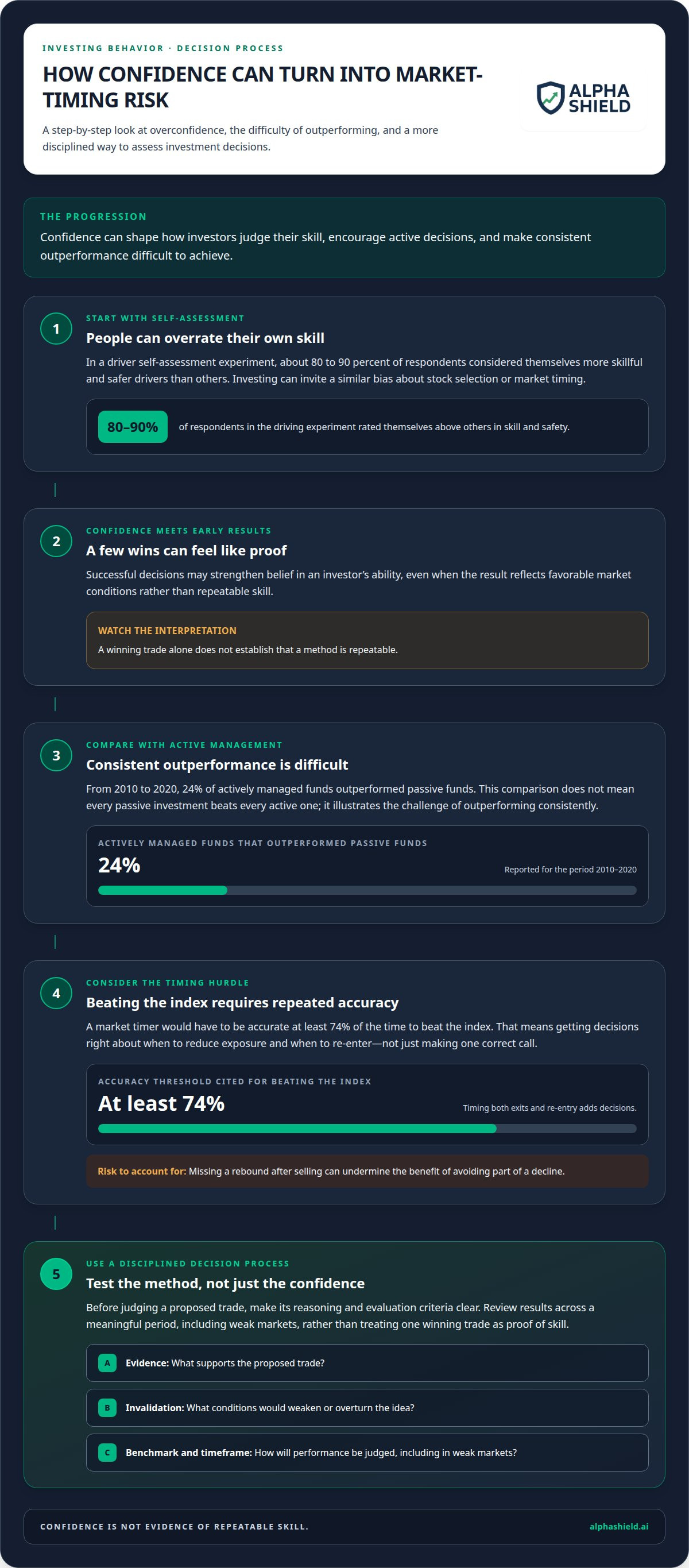
Overconfidence can lead investors to overestimate the accuracy of their judgment. It may prompt frequent trades, concentrated bets, or attempts to time market turns. The risk is not simply making a prediction. It is treating confidence as evidence that the prediction will be right.
A driver self-assessment experiment found that about 80 to 90 percent of respondents considered themselves more skillful and safer drivers than others. Investing can invite a similar bias: people may rate their stock selection or timing ability above average. A few successful decisions can strengthen that belief, even when results reflect favorable market conditions rather than repeatable skill.
Active management offers a useful comparison. From 2010 to 2020, 24% of actively managed funds outperformed passive funds. That figure does not prove every passive investment will beat every active one. It does show how difficult consistent outperformance can be, even for professional fund managers making deliberate investment decisions.
Market timing adds another challenge. A market timer would have to be accurate at least 74% of the time to beat the index. That means making not one correct call, but a series of decisions about when to reduce exposure and when to re-enter. Missing a rebound after selling can undermine the benefit of avoiding part of a decline.
A confident forecast does not remove uncertainty. A company may report strong results while its share price falls, or a market decline may reverse before an investor acts. Index funds, by contrast, track a defined market benchmark rather than relying on repeated individual timing decisions. That reduces the number of active choices but leaves investors exposed to the benchmark’s movements.
A disciplined comparison starts with the decision process, not your confidence. Identify the evidence behind a proposed trade, the conditions that would invalidate it, and the benchmark for judging the result. Then compare performance across a meaningful period, including weak markets, instead of treating one winning trade as proof of skill. This helps distinguish a repeatable method from luck.
Investors who want a more systematic perspective on market timing can explore market timing signals as one input to risk decisions.
Difficulty of maintaining a buy and hold strategy
Buy and hold means staying invested over the long term, not simply choosing stocks and waiting. Investors may define “long term” differently, and both financial needs and market conditions can change. A strategy built around patience can be difficult to follow when results disappoint or circumstances create a need for cash.
For one investor, a year may feel long; another may regard 3-5 years as a lengthy commitment. A long-term investing strategy is often framed as lasting 10 years or more, but that horizon can feel distant when an account is falling or barely progressing. The intended period matters because an investor who expects quick results may abandon the plan before it has time to work.
Extended weak performance can test your commitment. Stock values may decline or remain flat for a couple of decades, and some European indices have taken decades to recover previous peaks. These examples show why a fixed holding period alone cannot make an investment comfortable. Consider whether you can stay invested while other assets or markets seem to perform better.
Discipline means distinguishing a temporary market setback from a lasting change in an investment’s prospects. For example, a company’s falling share price alone does not show whether its financial health or competitive position has weakened. If the original reasons for holding the stock no longer apply, reassessing it may be more rational than treating “never sell” as an absolute rule.
Life events can disrupt even a carefully planned investment horizon. A job change, house purchase, or unexpected expense may create a need for cash during a market decline. Selling then can lock in losses or reduce the capital left invested. This risk is especially relevant if you have no separate cash reserve for planned expenses.
Before choosing this approach, match your portfolio to the time your money can remain invested. Funds for near-term spending serve a different purpose from retirement assets intended for a longer horizon. Separating them can reduce pressure to sell stocks to meet an immediate cash need. It also makes the limits of the strategy clearer: long-term holdings still fluctuate, and patience cannot guarantee a recovery.
Reviewing an investment strategy means looking beyond recent performance. Revisit the investment rationale, portfolio purpose, and cash needs when circumstances change. If the rationale remains intact and you do not need the money soon, short-term weakness alone may not call for selling. If the investment case or financial goal has changed, a deliberate adjustment may be more appropriate than following a holding rule without regard to context.
Opportunity cost of tied-up capital
Opportunity cost is the benefit you give up by keeping capital in one investment instead of putting it to another use. With buy and hold, the comparison is not simply stocks versus cash. It also depends on your portfolio’s purpose, your time horizon, and whether you may need the money for a house, education, or another planned expense.
Historical returns illustrate why allocation choices matter. From 1926 to 2012, a portfolio invested entirely in bonds had an average annual return of 5.5%. That figure describes one historical period, not a forecast or a return available every year. It also shows why an investor comparing stocks with bonds should consider both potential growth and the risk of loss, rather than treating one asset class as automatically superior.
Capital can be tied up without being literally inaccessible. You can sell holdings, but a sale may happen during a decline, interrupt compounding, or create tax consequences in a taxable account. For example, someone saving for a home may need to sell stocks before the planned purchase. If markets are down, the timing of that expense can affect how much capital remains available.
Opportunity cost also works in reverse. Moving out of stocks to avoid a possible downturn can leave you with less market exposure if prices rise afterward. Choosing among assets involves trade-offs, not simply seeking the highest return. Stocks may offer growth potential, while bonds can play a different role in balancing portfolio risk and planned cash needs.
Past-period statistics can clarify these trade-offs, but they cannot identify the best allocation for every investor. A portfolio designed for long-term growth may be poorly matched to money needed soon. Conversely, holding too much in lower-growth assets can limit capital available for future goals. Ask whether each holding supports a specific time horizon and financial purpose.
Start a practical review by separating near-term spending from long-term investing. List upcoming needs, identify which assets will fund them, then assess whether the remaining portfolio reflects your intended balance of growth and risk. For example, if a planned property purchase depends on selling volatile holdings, reconsider the timing or funding plan. You do not need to predict the stock market to make liquidity needs explicit.
Buy-and-hold investors should compare the cost of staying invested with the cost of changing course. Selling can trigger transaction costs or taxable gains, while holding through a prolonged weak period can delay another financial goal. The right decision depends on the asset’s role, your time horizon, and the consequences of needing the capital before market conditions improve.
Overvaluation and buying at premium prices
One problem with a buy-and-hold strategy is buying an asset when market expectations already seem excessive. Even a strong business can be a poor investment at an unjustifiably high valuation. If future earnings fail to meet those expectations, the share price may fall even while the company continues to operate.
Enron shows how sharply a popular stock can reverse. Holding through that decline would not have restored the original investment. The example illustrates why a long holding period cannot compensate for every company-specific failure.
Broad markets can face valuation pressure too. The internet bubble occurred during 1999 and early 2000, while 2000, 2007, and 2021 are cited as periods when stocks were severely overvalued. Buying during speculative enthusiasm can expose investors to losses if prices later adjust to weaker expectations. The exact path and timing of that adjustment are difficult to know in advance.
A premium price matters because it shapes the return you can earn from future business growth. If a company’s earnings grow but its valuation falls, that decline can offset some or all of the growth. You may correctly identify a successful company yet earn disappointing returns if you buy at a price that already assumes unusually strong results.
Market timing is no simple cure. Waiting for a lower price can mean missing further gains, while buying immediately can expose your capital to a valuation decline. A disciplined assessment considers a company’s financial health, competitive advantage, growth prospects, and purchase price. These factors help distinguish business quality from market enthusiasm.
Volatility can make an expensive asset look less attractive after a decline, but a falling price alone does not prove the original valuation was excessive. Distinguish changing expectations from deteriorating fundamentals. If a company’s outlook has weakened, holding solely because you already own it can deepen losses. If its fundamentals remain sound, the decline may instead reflect shifting market sentiment.
Problems with a buy-and-hold strategy can include overpaying and treating patience as a substitute for reassessment. A long horizon may help absorb ordinary market fluctuations, but it cannot eliminate overvaluation, speculative cycles, or permanent business decline. Reviewing both the asset and its purchase price gives you a more disciplined basis for deciding whether the original investment case still holds.
Alpha Shield
Alpha Shield offers a systematic market signal for investors concerned about volatility and drawdown risk. The Alpha Shield Market Signal and Market crash and drawdown tool support long-term capital preservation, not day trading or individual stock selection.
The Alpha Shield Dashboard provides a clear daily “IN” or “OUT” signal, with delivery through the dashboard, email, or Telegram. It combines market-risk indicators with ETF allocation and position-sizing guidance, offering a structured input when a buy-and-hold portfolio faces elevated risk. A signal can inform your decision process, but it cannot guarantee against losses or replace consideration of your goals and risk tolerance.
For a systematic perspective on market drawdowns, explore the Alpha Shield Market Signal and dashboard subscription.
Set rules you can follow through market stress
Understanding problems with a buy-and-hold strategy starts with knowing what would make you change course. Before the next period of volatility, define when you will review your investment thesis, what changes would justify selling, and how much capital you need to keep available for planned expenses.
Tie those decisions to your goals, not daily price movements. A written framework can help you distinguish a meaningful change in an investment from short-term market noise. It also gives you a consistent basis for reviewing your approach as your circumstances evolve.
If you want a more systematic perspective on market risk, Alpha Shield can help you explore its market signals and drawdown tools.
A clear process will not remove uncertainty, but it can make your next decision more deliberate. Build a strategy you understand and can apply with discipline.
Frequently Asked Questions
What are the main disadvantages of a buy-and-hold investment strategy?
The main disadvantages are exposure to prolonged declines, the risk of holding an underperforming investment, and limited flexibility when you need the money. A portfolio can also drift from its intended asset mix as holdings perform differently. For example, if stocks grow to dominate a portfolio, its risk profile may no longer match the original plan. Periodic reviews can identify changes that passive holding alone will not address.
How does buy and hold perform during prolonged bear markets and market crashes?
During a bear market or crash, a buy-and-hold portfolio remains exposed to falling prices unless its allocation includes assets that behave differently. The account value may decline substantially, even if the investor does not sell. Historically, the S&P 500 has recovered from deep losses and reached new highs, but recovery does not prevent interim losses or establish when a future recovery will occur. Portfolio mix and withdrawal needs affect the experience.
How long can it take for the stock market to recover after a major decline?
There is no single recovery period that applies to every market decline or index. The S&P 500 has historically recovered from deep losses and reached new highs, while some European indices have taken decades to regain previous peaks. Recovery also depends on what is being measured: an index returning to its earlier price level differs from an individual investor’s account recovering after withdrawals or changes to holdings.
How does buy and hold compare with active investing and dollar-cost averaging?
Buy and hold describes how long you keep investments; active investing involves more frequent decisions about buying and selling. Dollar-cost averaging describes how you invest money, typically through repeated purchases over time rather than choosing a single purchase point. You can combine these approaches by regularly buying an index fund and holding each purchase. The trade-off is between making fewer timing decisions and taking a more active role in managing your investment choices.


