

A more active approach is not automatically a more controlled one. In the buy and hold vs tactical asset allocation decision, buy and hold maintains a chosen investment mix and periodically rebalances it, while tactical allocation makes shorter-term adjustments around long-term targets. Strategic asset allocation sets those targets.
Both approaches can be disciplined. The difference is how much the portfolio changes in response to market conditions, and how much judgment and monitoring that takes. Adjustments may create opportunities, but they also add decisions.
This comparison explains how strategic targets are set, how tactical shifts work, and where buy and hold fits. You’ll see how the approaches differ in process, risk management, and effort, then use a practical guide to consider which better matches your time horizon and comfort with active decisions.
Key Takeaways
- Set long-term asset targets around your time horizon and tolerance for portfolio risk, then review them when major life circumstances change.
- Use rebalancing to bring a portfolio back toward its targets after market movements shift the asset mix.
- Before making tactical changes, define the signals and rules that would trigger them. A clear process can limit decisions driven by short-term market noise.
- Compare the approaches by the work they require, the risks they introduce, and how consistently you can follow the plan.
- Use the decision guide to determine whether a steady target-based approach or a more active allocation process better fits your investing style.
What is a Strategic Asset Allocation?
Strategic asset allocation sets long-term target percentages for investments such as equities, fixed income, and cash. Those targets reflect an investor’s goals, time horizon, knowledge, and risk tolerance. Once established, the portfolio generally maintains its chosen mix for years or decades. Changes are relatively infrequent and may follow major life events, such as retirement.
Buy-and-hold investing puts this long-term plan into practice. An investor chooses an asset mix, holds those investments through market movements, and periodically rebalances if their proportions drift. Rebalancing restores the planned mix; it does not require predicting which asset will perform best next. The approach still involves decisions, but reduces the need to react to every short-term market move.
For example, one illustrative allocation for a younger investor assigns 70 percent to equities, 20 percent to fixed income, and 10 percent to cash. The equity share gives growth a larger role, while fixed income and cash contribute different risk and liquidity characteristics. These percentages are an example, not a universal formula. A person’s risk tolerance and investment horizon affect whether such a mix is suitable.
For someone nearing retirement, an example allocation assigns 20 percent to equities, 60 percent to fixed income, and 20 percent to cash. Compared with the younger investor example, this mix places less emphasis on equity growth and more on fixed income and cash. The shift illustrates how expected income needs, time horizon, and comfort with portfolio fluctuations can change allocation decisions.
Tactical allocation involves actively adjusting a portfolio around long-term targets. This can mean monitoring market conditions and changing the proportions of stocks, bonds, or cash. The process calls for market knowledge and ongoing attention, and trading may add brokerage fees. Investors who prefer fewer market-driven decisions may find buy and hold easier to maintain. Those considering tactical changes need a clear process for making them.
| Approach | Portfolio decisions | Monitoring demands | Typical fit |
|---|---|---|---|
| Buy and hold | Maintain long-term targets; rebalance periodically | Review allocation and drift | Investors seeking a steady process |
| Tactical allocation | Adjust asset proportions in response to market conditions | Monitor markets and apply an active method | Investors able to support ongoing analysis |
A time horizon of 10 or more years can make buy and hold a suitable approach for some investors, but duration alone does not determine the allocation. A long horizon may allow more focus on growth, while lower risk tolerance can call for a different balance. Investment knowledge also matters: tactical decisions require the ability to interpret market signals and act consistently rather than changing course with every fluctuation.
Choose an approach you can follow consistently, based on your time horizon, risk tolerance, knowledge, and willingness to make active portfolio decisions.
Tactical asset allocation and active portfolio adjustments
Tactical allocation adds active decisions around a strategic portfolio target. Its value depends on having a defined method for changing exposures, not simply reacting to market headlines.
Strategic-Core and Tactical-Overlay Portfolios
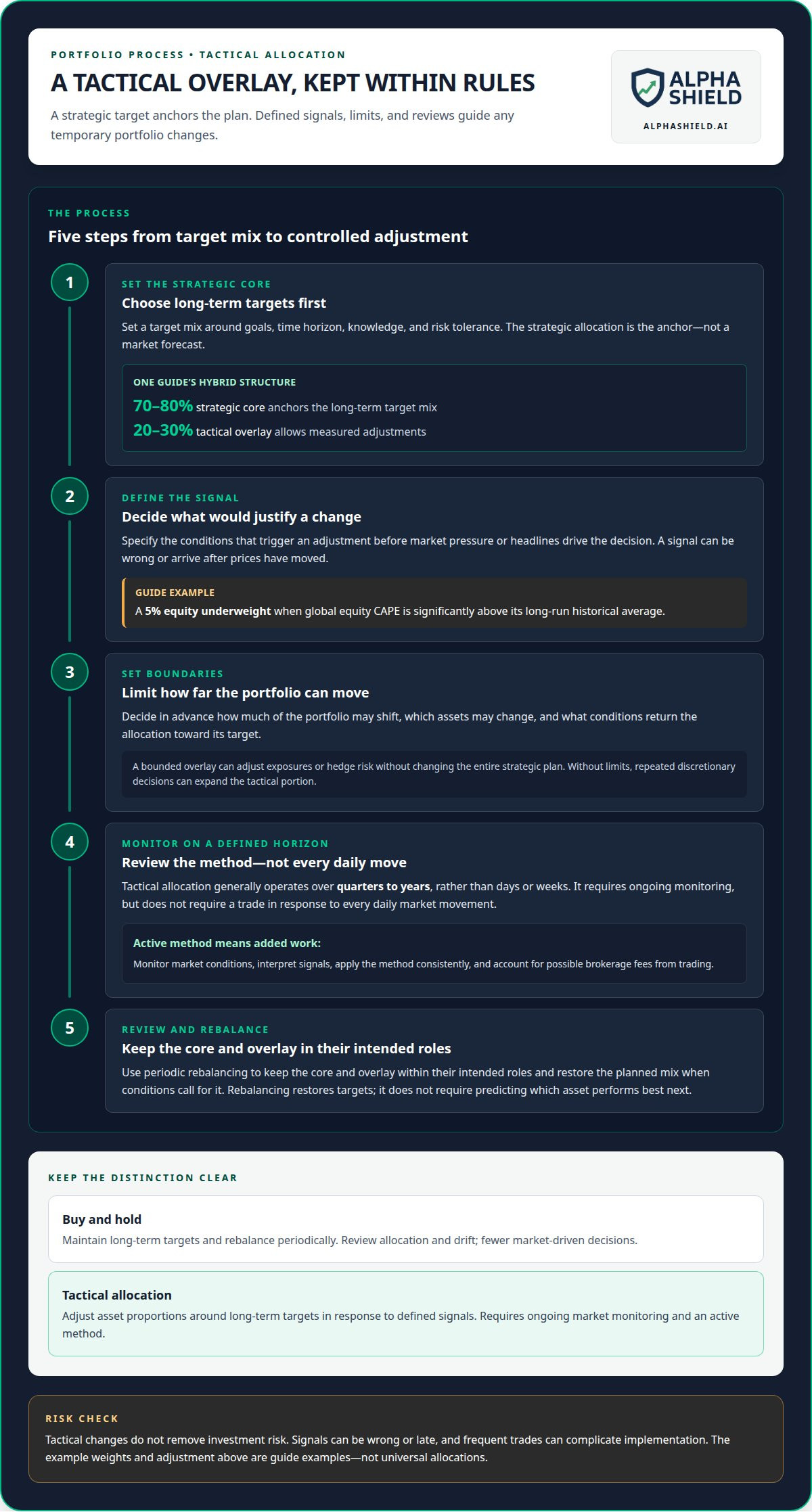
A hybrid portfolio keeps a strategic core while adding a smaller tactical overlay. One guide proposes a core of 70-80% of the portfolio and an overlay of 20-30%. The core anchors the long-term target mix; the overlay allows measured adjustments. This structure differs from a fully static allocation because part of the portfolio can respond to market signals without changing the entire plan.
The tactical overlay still needs clear rules. Decide in advance which signals trigger a change, how much of the portfolio can shift, and what conditions return it toward its target. Without limits, repeated discretionary decisions can expand the tactical portion. Periodic rebalancing helps keep the core and overlay within their intended roles.
Tactical Adjustments and Portfolio Hedging
Tactical adjustments change portfolio weightings as market conditions or defined signals change. Hedging is one possible risk-management action; moving between stocks, bonds, and cash is another. Unlike a fixed strategic mix, dynamic weightings can alter exposure over time. Define the signal, adjustment, and review process before market pressure makes decisions more difficult.
These changes do not remove investment risk. A signal can be wrong or arrive after prices have moved, and frequent trades can complicate implementation. A modest adjustment, such as the guide’s 5% equity underweight when global equity CAPE is significantly above its long-run historical average, shows how a tactical decision can remain bounded rather than overhaul the portfolio.
The author’s examples illustrate that tactical portfolios can take different forms. The author allocates 25% of a portfolio to Generalized Protective Momentum and allocated 39% to Hybrid Asset Allocation. The author also tracked a tactical allocation portfolio for 4.5 years and says it was mainly in cash in 2022. These are individual portfolio choices, not standard weights for every investor.
To implement an active method, first define a target mix, then specify which conditions justify a temporary change. Set limits on how far the allocation can move and identify when rebalancing restores the original mix. Tactical allocation generally operates over quarters to years, rather than days or weeks. It requires ongoing monitoring, but not a trading decision in response to every daily market move.
Investors who want a more systematic way to interpret market risk can explore systematic market signals as one input to their decision process.
Strategic asset allocation and long-term target percentages
Strategic asset allocation sets target percentages for asset classes and maintains them over the long term. The target mix changes infrequently, while tactical allocation allows shorter-term adjustments around that plan.
Strategic Allocation as a Buy-and-Hold Approach
Strategic allocation supports a buy-and-hold strategy: choose a target mix, hold the selected investments, and rebalance when their weights drift. It establishes a portfolio structure rather than seeking opportunities through frequent market shifts. A tactical strategy differs because it may change asset proportions in response to market trends, with the strategic target remaining the reference point.
For example, a 60% stocks and 40% bonds target remains the plan through changing economic conditions. If stocks outperform, their share can rise above the target; the strategic method responds by rebalancing rather than changing its market outlook. Investors can review targets after major life changes, but routine market movements alone do not require a new strategy.
Long-Term Target Percentages
Target percentages define how much capital goes to each asset class. A guide’s example assigns 60% to global equities, 30% to bonds, and 10% to alternatives. That allocation provides a reference for future decisions: portfolio changes can be assessed against the chosen mix instead of made in isolation.
The percentages should reflect the purpose of the portfolio, its time horizon, and the investor’s tolerance for fluctuations. For instance, a 50% stocks and 50% bonds-and-cash mix has a different balance from a portfolio holding more stocks. The target is not a forecast of returns. It is a planned distribution that determines how growth exposure and other assets are combined.
Periodic Portfolio Rebalancing
Rebalancing restores the portfolio toward its target after asset performance changes the weights. If a portfolio begins at 60% stocks and 40% bonds, then stocks rise to 75% of its value, selling some stocks and buying bonds can bring the mix closer to its original allocation. The trigger is allocation drift, not a prediction that stocks will fall.
Investors can rebalance annually or when an allocation drifts more than 5% from its target. Strategic portfolios may also be rebalanced monthly, quarterly, or annually, depending on performance and drift. The useful choice is a repeatable schedule or threshold. Frequent reviews without a rule can invite unnecessary decisions; a defined process keeps adjustments tied to the target.
Strategic and tactical allocation both involve periodic rebalancing, but for different purposes. Strategic rebalancing corrects drift toward a stable target. Tactical rebalancing may also implement a temporary change based on market conditions while preserving the long-term plan. The distinction matters: changing a target alters the strategy, while ordinary rebalancing restores the existing one.
Before changing a target, identify what has changed in the investor’s goals, time horizon, or capacity to accept portfolio risk. If only market prices have moved, rebalancing may be enough. If the original plan no longer fits, revise the target deliberately and use it consistently for future portfolio decisions.
Tactical asset allocation and short-term market adjustments
Tactical allocation changes portfolio exposure in response to market conditions while retaining long-term objectives. Its effectiveness depends on signal quality, timing, and consistent execution.
Short-Term Market Adjustments
Tactical allocation adjusts a portion of stocks, bonds, or cash in response to market trends. Unlike a fixed target mix, it permits temporary shifts intended to manage risk or seek opportunities. This approach typically operates over quarters to years, rather than days or weeks, but still requires a defined signal and review process.
For example, an investor might reduce equity exposure after a specified risk signal, then restore it when conditions meet a predetermined rule. The decision should serve portfolio objectives, not just respond to a market headline. A tactical adjustment changes exposure, but does not ensure better returns. If a signal is late or misleading, the portfolio may miss a recovery.
Intermediate-Term Market Trends
Intermediate-term methods evaluate trends over a period longer than daily price movement. One example is factor momentum, which measures asset-class returns over the past 12 months, excluding the most recent month. Tactical investors use indicators like this to compare assets, then adjust weightings according to their method. The aim is a systematic response, not a prediction based on one day’s news.
Valuation-based signals may have predictive value over 3-10-year horizons, while tactical allocations commonly adjust over quarters to years. These horizons are distinct from short-term trading. A US equity CAPE above 30 has historically been followed by below-average 10-year returns, but a valuation indicator does not specify exactly when markets will turn.
Historical Returns and Secular Bear Markets
Long stretches of weak stock returns show why averages cannot describe every investor’s experience. The historical periods identified include 1929 -1945, the 1970s, and 2000-2010. These secular bear markets differ from shorter declines because market conditions can weigh on returns across an extended span. A tactical strategy may seek to adjust exposure during such periods, but selecting the right change remains difficult.
Stocks had an average total return of 10 % going back to 1925. That average does not mean each year, or each decade, delivers the same result. Historical data indicates investment markets always rise over periods longer than 10 years, but an investor nearing retirement may have less time to wait through a prolonged decline. Objectives and withdrawal timing shape how much risk the portfolio can absorb.
Market-Timing Skill and Time in the Market
Market timing requires decisions about both when to reduce exposure and when to return. William Sharpe’s analysis said a manager should probably avoid market timing unless able to predict whether each year’s market would be good or bad correctly at least 7 times out of 10. Treynor and Mazuy found significant timing ability in 1 fund out of 57 in their sample.
Missing the best 10-20 market days over a decade can dramatically reduce total returns. This creates a practical tension: holding through volatility preserves exposure to recoveries, while tactical changes attempt to manage drawdowns. Before using signals, define the trigger, the size of each adjustment, and the condition for returning to the target. Consistent rules connect timing decisions to objectives instead of reaction.
Buy-and-hold versus tactical asset allocation
Historical evidence shows that tactical allocation must make accurate decisions repeatedly to match static portfolios. In one simulation, tactical investors needed to select the higher-performing asset class correctly about 66% of the time to match a static portfolio’s risk-adjusted performance before taxes. After taxes, the required accuracy rose to about 70%.
Buy and hold maintains a chosen asset mix, with periodic rebalancing to restore targets. Tactical allocation changes asset weights based on signals or market analysis. That flexibility may reduce exposure during declines, but introduces timing decisions: investors must decide both when to shift and when to return, rather than simply maintain the target.
The simulation also found that tactical investors had to choose the higher-returning asset class correctly 54% of the time to achieve the same return as a static 50/50 allocation before taxes. This measures a different outcome from risk-adjusted performance. The result highlights why an allocation method should define its objective first: matching return, managing risk, or balancing both.
Historical comparisons also show a challenge for active methods: tactical allocation funds have a history of underperforming benchmark indexes, including on a risk-adjusted basis. A separate analysis found that most actively managed equity funds underperformed their benchmarks after costs over 10-15 year periods. These findings do not establish that every tactical strategy performs alike, but they make selection skill and implementation central to the comparison.
Frequent changes can also create tax drag in taxable accounts. For the range of short-term tax rates considered, a paper reported an after-tax performance reduction of 50 to 90 basis points for tactical portfolios. It also reported that tactical portfolios paid roughly twice as much in total taxes, relative to total account dollars, as static portfolios on an annual basis. Account type and turnover therefore matter alongside investment returns.
Use a structured comparison before choosing a method:
- Define the objective: decide whether the priority is maintaining exposure, reducing drawdowns, or targeting risk-adjusted returns.
- Set the decision rule: specify what signal changes the allocation and what condition restores the target.
- Include implementation effects: account for rebalancing, taxes, and the possibility of missing strong market days.
- Match the method to the investor: consider time horizon, retirement needs, and willingness to monitor signals.
Buy and hold may suit an investor who values a stable process and can remain invested through declines. Tactical allocation calls for ongoing analysis and consistent application of a method, even when a signal conflicts with recent market moves. If active decisions add complexity without serving a defined objective, a strategic target with periodic rebalancing is the clearer choice.
Alpha Shield
Alpha Shield helps investors assess market volatility and consider portfolio risk alongside a long-term allocation plan. Alpha Shield Market Signal, the Market crash and drawdown tool, and Alpha Shield Dashboard support a systematic view of market conditions and potential drawdown risk. They can be relevant when a buy-and-hold investor wants additional risk indicators, or when an investor evaluating tactical adjustments wants a defined signal to inform decisions.
Alpha Shield focuses on long-term capital preservation and risk management, not day trading, shorting, or individual stock recommendations. Its signals do not replace a strategic target or remove market risk. They provide a systematic view of market conditions to help investors make decisions within their chosen approach.
Contact Alpha Shield to discuss how its market signals may fit your investing process.
Set a Process You Can Follow
Turn the decision into a written process before your next portfolio review. State your objective, the conditions that justify a change, and how you’ll respond if market signals conflict with your long-term plan. Clear rules help distinguish deliberate adjustments from reactions to uncertainty.
The right buy and hold vs tactical asset allocation approach is the one that fits your goals and that you can apply consistently. If you’re weighing how market signals could inform your investment decisions, Alpha Shield’s systematic signal and dashboard can help you monitor market risk as part of your process.
A defined process gives your next decision a steadier foundation. Refine it as your goals and circumstances evolve.
Frequently Asked Questions
What’s the Right Investment Strategy for Your Portfolio?
The right strategy aligns with your financial objectives and the decisions you can maintain consistently. Start by considering when you expect to use the invested capital, how much volatility you can tolerate, and how often you want to monitor the portfolio. For example, an investor who prefers fewer market decisions may favor a stable target mix, while someone prepared to follow defined signals may consider tactical adjustments.
Which Method Can the Average Retirement Saver Use?
Buy and hold may be more practical for retirement savers who lack the time or interest for ongoing market analysis. It centers on a planned portfolio mix and scheduled reviews, rather than repeated decisions about market direction. A saver with a long horizon can use a target-based approach and adjust the plan as retirement approaches. Tactical allocation requires more monitoring, market knowledge, and disciplined implementation.
What is buy-and-hold investing?
Buy-and-hold investing means keeping chosen investments over the long term instead of frequently changing them in response to market movements. For example, an investor can select a diversified mix, continue contributions according to their plan, and review the allocation on a set schedule. The method still requires decisions about goals, investment selection, and rebalancing, but does not treat every market fluctuation as a reason to trade.
What is tactical asset allocation?
Tactical asset allocation changes portfolio weights in response to market indicators or a defined investment signal. An investor might temporarily reduce equity exposure when a predetermined risk condition appears, then restore the previous mix when the rule calls for it. The process needs clear entry, adjustment, and exit criteria. Without them, decisions can become inconsistent, especially when market movements conflict with expectations.
How do buy-and-hold and tactical asset allocation compare in returns and risk?
Neither approach guarantees a particular return or removes investment risk. Buy and hold retains exposure to the selected mix during declines and recoveries. Tactical allocation can change exposure, but results depend on the accuracy and timing of decisions. Historical comparisons show that tactical funds have underperformed benchmark indexes, including on a risk-adjusted basis. Compare methods by their objectives, process, and implementation, not by a single result.
What are the costs and tax implications of tactical asset allocation in the United States?
Tactical allocation can involve trading costs, brokerage fees, and fund expenses. Selling investments in a taxable account can also have tax consequences when gains are realized; the outcome depends on the holding period, account, and applicable tax rules. Frequent changes may increase turnover compared with a static allocation. Consider these effects alongside investment results, since gross performance does not show the full outcome.
How often should investors rebalance a buy-and-hold portfolio?
A practical rule is to review the portfolio annually or rebalance when an allocation drifts more than 5% from its target. For example, if a stock allocation rises beyond its planned range, rebalancing restores the intended risk mix. The schedule and threshold should be chosen in advance and applied consistently. Rebalancing responds to drift; it isn’t a forecast that the asset which gained will soon decline.
What signals or rules are used for tactical asset allocation?
Tactical methods can use valuation measures, momentum, trend indicators, or market-risk signals. A rule should specify which indicator matters, what change it triggers, how much of the portfolio can shift, and what condition ends the adjustment. For example, a valuation signal could justify a modest equity underweight rather than a complete exit. Consistent criteria help distinguish a planned decision from a reaction to headlines or recent price movements.


