

The best way to protect a large investment portfolio is to match its stock and bond mix to your time horizon, keep cash available for near-term needs, and diversify across holdings. People in the workforce can use a cash reserve equal to three to six months of expenses as a planning guide; retirees can consider one to two years of living expenses. Protection comes from a system, not a single investment.
It’s reasonable to seek growth from a substantial portfolio while limiting the damage a downturn can cause. The right balance depends on when you’ll need the money: a longer horizon may support greater stock exposure, while near-term spending needs call for more stability and accessible cash.
This guide covers practical steps for setting stock and bond exposure, planning a cash reserve, diversifying holdings, and understanding historical market losses and recovery periods. Use it to assess risk and make disciplined decisions instead of reacting to short-term market noise.
Key Takeaways
- Spread exposure across different holdings, then reassess the mix when your goals, timeline, or financial circumstances change.
- Use a repeatable review process to keep portfolio risk aligned with your plan instead of reacting to short-term market moves.
- Historical market recoveries can take time, so consider whether your strategy can withstand a prolonged downturn.
- A 60% stock and 40% bond portfolio recovered within two years during each of the last two bear markets described.
- Separate inflation risk from market risk, then assess how each could affect your portfolio’s purchasing power and resilience.
Adjusting stock and bond exposure by age and time horizon
- Start with when you expect to use the money, not age alone. List major goals, such as retirement spending, a home purchase, or a planned gift. Separate near-term needs from assets intended to stay invested for decades. If you need to fund spending soon, a steep decline could force you to sell at unfavorable prices. A longer horizon gives investments more time to recover, but it doesn’t remove risk.
- Use age as context, then test the allocation against your timeline and capacity for loss. An allocation of 80% to 100% stocks may be reasonable for investors in their 20s, 30s, or 40s. That range isn’t a personal prescription. Someone in their 40s with an imminent cash need may require a different mix from a peer whose portfolio is earmarked for later retirement.
- Compare your plan with its assumptions. The asset allocation models assume a retirement age of 65 and a withdrawal horizon of 30 years. If your intended retirement date or spending period differs, revisit the assumptions rather than copying a model’s stock-and-bond percentages. Write down when withdrawals may begin, how much flexibility you have, and which assets would fund the first years.
- Before setting stock exposure, consider how much loss you can tolerate financially and emotionally. Estimate how a market decline could affect planned withdrawals, then ask whether you could maintain your allocation without selling stocks under pressure. If a decline would disrupt essential spending, adjust the plan’s risk exposure or the order of withdrawals. A written rule makes decisions less dependent on market headlines.
- Consider account protections separately from investment risk. FDIC and SIPC protection aren’t a single limit covering every asset in a portfolio. The applicable protection depends on account type, ownership, institution, and covered property. Identify each cash balance and investment before relying on either safeguard. Neither determines whether a stock-and-bond allocation suits your time horizon.
- Include taxes and advice fees when deciding how to rebalance. In a U.S. taxable account, selling an appreciated investment can create a capital gain; the account type, cost basis, and transaction affect the result. Compare rebalancing methods before trading. A fiduciary financial advisor can help coordinate allocation, withdrawals, and tax-aware decisions, but advice fees reduce portfolio returns. Weigh the fee structure and services against your plan’s complexity.
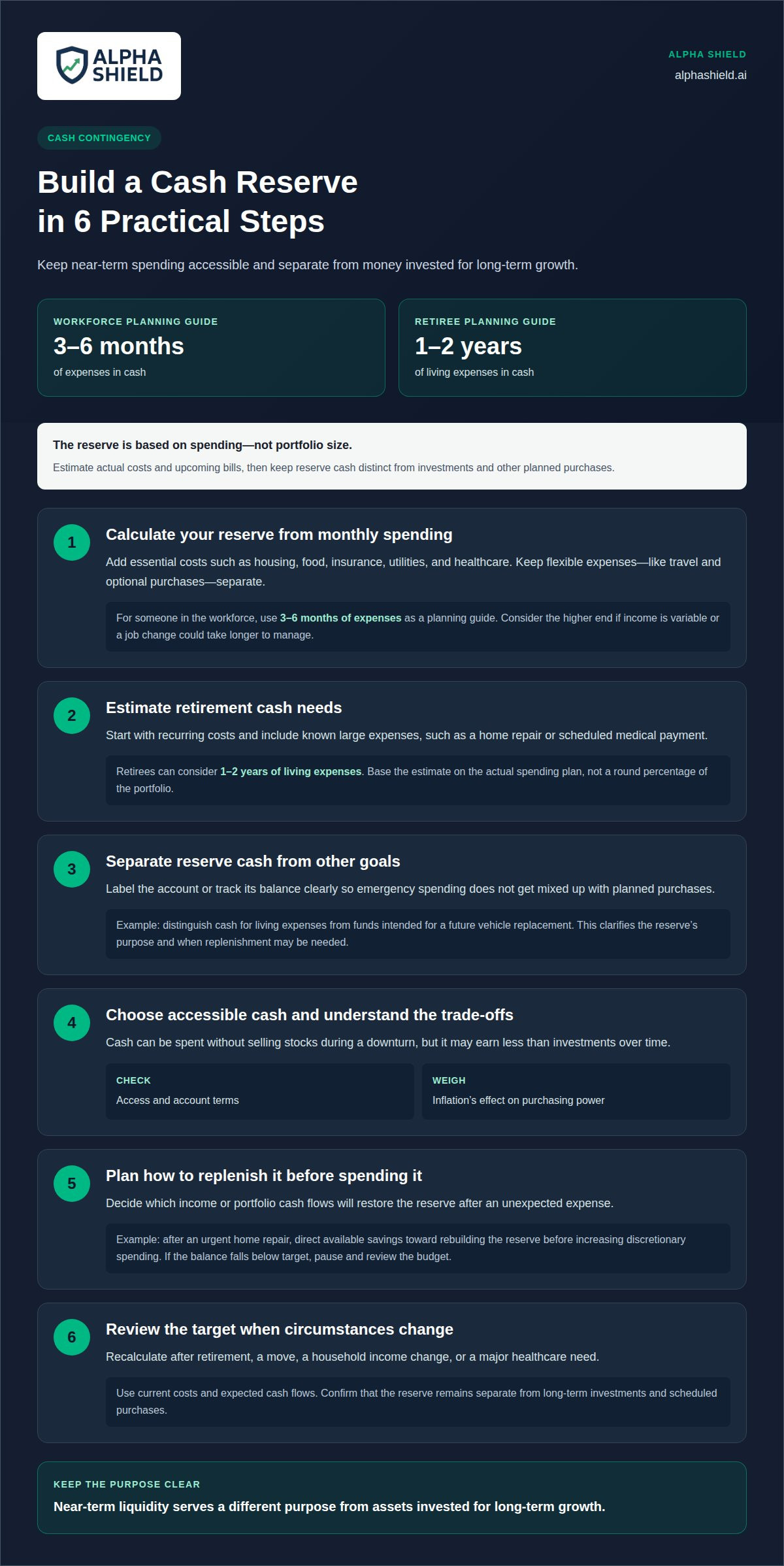
Building a cash contingency
- Calculate your reserve from spending, not portfolio size. Add essential monthly costs, such as housing, food, insurance, utilities, and healthcare, then separate flexible expenses like travel and optional purchases. A cash reserve for someone in the workforce can equal three to six months of expenses. Consider the higher end if income is variable or a job change could take longer to manage. The goal is liquidity for planned needs, not an estimate based on account value.
- If you’re retired, estimate the cash needed for withdrawals and near-term bills. Retirees can consider a cash reserve equal to one to two years of living expenses. Start with recurring costs and include known large expenses, such as a home repair or scheduled medical payment. Base the estimate on your actual spending plan. A reserve set as a round percentage of your portfolio may not match the timing or size of your cash needs.
- Keep reserve cash separate from money assigned to other goals. Label the account or track its balance clearly, so emergency spending doesn’t get mixed up with planned purchases. For example, a retiree could distinguish cash set aside for living expenses from funds intended for a future vehicle replacement. This makes the reserve’s purpose clear and signals when a withdrawal calls for a deliberate replenishment decision.
- Choose an accessible place for your reserve and understand the trade-offs. Cash is available to spend without selling stocks during a downturn, but it may earn less than investments over time. Compare access, account terms, and the effect of inflation on purchasing power. Keep the reserve aligned with upcoming bills. Money needed soon serves a different purpose from assets invested for long-term growth.
- Decide how you’ll replenish the reserve before you use it. Identify which income or portfolio cash flows will restore it after an unexpected expense. For example, after paying for an urgent home repair, direct available savings toward rebuilding the reserve before increasing discretionary spending. If the balance falls below your target, pause and review the budget. A written rule makes replenishment a planned task rather than an improvised market decision.
- Review your target when circumstances change. Recalculate expenses after retirement, a move, a change in household income, or a major healthcare need. A three-to-six-month reserve for someone in the workforce may no longer fit after retirement, when the one-to-two-year planning range may be more relevant. Update the estimate using current costs and expected cash flows. Confirm that the reserve remains separate from long-term investments and scheduled purchases.
Diversifying and reassessing asset allocation
A resilient allocation spreads exposure across investments with different roles and risk drivers. For investors seeking the best way to protect a large investment portfolio, diversification and periodic reassessment offer a practical framework.
-
Diversify Portfolio Holdings
Map your holdings by asset class, sector, geography, and issuer before changing positions. Several funds may own the same large companies, creating concentration despite a long fund list. Compare their underlying holdings and identify whether one company, industry, or economic factor dominates results. Then check that each investment serves a clear purpose, such as growth, income, or liquidity.
For example, domestic and international stocks can reduce reliance on one country’s market, but both remain exposed to broad equity declines. Bonds may behave differently, yet issuer and interest-rate risks still matter. Don’t add an investment simply because it performed well recently. A useful holding should address an identified gap without making the portfolio harder to understand.
-
Reassess Asset Allocation
Review your allocation after a meaningful change in goals, spending needs, or portfolio composition. If one asset class grows substantially, your exposure can shift even without new purchases. Compare current holdings with your target and identify what caused the difference. Then consider whether contributions, income, or sales can bring the mix back into alignment.
Choose a consistent review method, such as a scheduled check or a preset tolerance range. Before trading, consider how your account type and tax consequences affect the appropriate adjustment. Record the reason for each change and the goal it supports. The best way to protect a large investment portfolio isn’t necessarily frequent trading; a documented rule can keep reviews focused on your plan.
-
Consider Inflation and Market Downturns
Test whether your portfolio can address rising costs and falling asset values without relying on one holding to solve both risks. Inflation can reduce the purchasing power of money set aside for future spending, while a market decline can lower investment values. Identify which assets would support a planned expense if stocks fell, then assess whether that approach leaves long-term goals exposed.
In the United States, account protection depends on account registration, institution, and asset type. These protections don’t prevent losses caused by market movements. Review the protections for each account separately from allocation decisions. Compare holdings by liquidity, inflation sensitivity, and potential behavior during a downturn to identify where your portfolio relies on a single outcome.
Historical stock market losses and recovery periods
- Use several measurement periods to understand how losses differ. The S&P 500 has experienced years of substantial losses, though how often they occur depends on the period and measure used. That annual view captures calendar-year results, not every decline that occurred within a year. The stock market chart’s annual returns begin with calendar year 1995, so read its starting point before comparing displayed results.
- Compare single-year results with rolling periods. Across rolling five-year periods in the 50 years ending December 31, 2025, the S&P 500 had double-digit losses three times. A rolling measure shifts the start and end dates, revealing outcomes that fixed calendar-year summaries can miss. It also shows why an investor’s entry date and withdrawal timing matter when evaluating a specific portfolio.
- Assess longer horizons without treating history as a promise. The S&P 500 had no negative returns in any rolling 15-calendar-year period during the 50 years described. The chart’s rolling 15-calendar-year annualized returns begin with calendar year 1980. This historical record provides context for long-term planning, but it doesn’t establish what future returns will be or guarantee an individual investor’s outcome.
- Allow for recovery time in your plan. Stocks have historically taken three to five years to recover from a bear market. Recovery time matters when assessing whether you might need to sell assets while prices are depressed. Before relying on a portfolio withdrawal, identify which holdings would fund it and whether your schedule allows investments time to recover. This historical recovery period is not a forecast for the next downturn.
- Compare balanced-portfolio history with your actual allocation. A 60% stock and 40% bond portfolio recovered within two years during each of the last two bear markets described. That result offers a historical example, not a universal recovery timetable. Your portfolio may differ in holdings, withdrawal needs, and timing. Use past periods to test whether your plan can withstand losses, rather than to predict the precise length or depth of a future decline.
What are the best ways to protect a portfolio against inflation and market downturns?
Build protection around two distinct risks: rising costs and falling asset values. Use the steps below to assess how each could affect your spending plan.
- Map which portfolio assets support future spending and which are intended for long-term growth. Inflation can erode the purchasing power of money set aside for years, while market declines can reduce investment values. Separate a planned near-term withdrawal from assets intended to stay invested. This helps reveal whether your plan depends on selling growth investments at an unfavorable time.
- Review the role of each holding in different conditions. Ask whether it primarily supports growth, income, liquidity, or diversification, then identify what could weaken that role. A bond holding, for example, may provide income but still fluctuate in value; a stock holding may offer growth potential but fall during a downturn. Don’t assume any one holding protects against both risks.
- Test your spending plan against rising costs. List recurring expenses, identify which could increase, and decide which withdrawals would cover them. Compare expected cash flows with the portfolio’s intended use. If essential spending depends on a fixed amount staying available for years, consider how inflation could reduce its purchasing power. Use this review to decide whether the plan needs adjustment instead of relying on a broad inflation prediction.
- Model a market decline before one occurs. Ask which investments you would sell to fund planned withdrawals if prices fell, and whether selling them would disrupt long-term goals. For example, a retiree could map the order of withdrawals across cash, bonds, and stocks. The goal is to identify pressure points in advance, not to treat past market patterns as a precise forecast.
- Set a rule for reviewing risk when circumstances change. Revisit your plan after a major change in spending or income, or a portfolio shift that alters your exposure. Check whether inflation concerns are pushing you toward concentrated investments or unfamiliar risks. If a holding no longer serves its intended role, assess the whole portfolio before making a change. A written rule can limit reactive decisions.
- Track purchasing power and drawdown exposure separately. A portfolio can maintain its nominal value while buying less over time, or retain long-term growth potential while suffering a sharp temporary decline. For each scenario, record the risk, the affected goal, and your planned response. This helps distinguish a short-term valuation loss from a lasting change in your ability to meet planned expenses.
Alpha Shield: Alpha Shield Market Signal
Alpha Shield Market Signal helps investors interpret market volatility and manage exposure to potential drawdowns. It adds a systematic signal to portfolio reviews; it doesn’t replace decisions about allocation, diversification, or cash planning.
The Market crash and drawdown tool, alongside the Alpha Shield Dashboard, provides clear indicators for assessing market risk. Use those indicators to inform a disciplined review of your existing plan, especially when market conditions shift and you’re weighing whether exposure still fits your long-term goals. The signal does not eliminate market losses or guarantee a recovery timeline.
For investors who want a structured view of market risk alongside their broader portfolio plan, visit Alpha Shield to explore the Market Signal.
Turn your portfolio plan into a repeatable process
The best way to protect a large investment portfolio is to decide how you’ll manage risk before market pressure rises. Set a review routine, record what would prompt a change, and distinguish a genuine shift in your goals from a reaction to daily price movements. Give each decision a clear purpose.
Put your plan in writing. Note which portfolio risks matter most, what conditions would lead you to reassess, and how you’ll evaluate new signals. A consistent process makes complex decisions easier to revisit without treating every market move as a command to act.
Alpha Shield Market Signal can help investors seeking a systematic view of market risk as they evaluate portfolio decisions. Explore the subscription and decide whether its daily signal and ETF allocation guidance fit your approach.
Steady decisions start with a clear framework. Keep refining yours as your goals and circumstances evolve.
Frequently Asked Questions
How should a large investment portfolio be diversified across asset classes?
Divide the portfolio by purpose, then check whether each asset class adds distinct exposure. Compare broad stock funds, bond holdings, cash, and any real assets by their economic drivers, liquidity, and role in your plan. Several funds can still hold similar companies, so examine underlying holdings, not just fund names. Avoid adding complexity unless each position serves a clear function.
What asset allocation is appropriate for a high-net-worth investor by age and risk tolerance?
Choose an allocation based on spending dates, capacity for loss, and willingness to stay invested during declines, not wealth or age alone. A high-net-worth investor funding a near-term purchase may need a different risk profile from someone investing for distant goals. Stress-test the proposed mix against a decline that would challenge your resolve. If you’d abandon the plan, its risk level may be too high.
How can investors reduce portfolio risk with diversification, rebalancing, and hedging?
Use diversification to reduce dependence on a single source of return, and rebalance when exposure no longer matches your target. Hedging can offset a specific risk, but it may add costs, complexity, or imperfect protection. For example, a hedge tied to a broad market may not track a concentrated portfolio closely. Define the risk first, then assess whether a hedge addresses it without undermining your investment plan.
How should investors evaluate bonds, Treasury bills, cash, and alternatives for portfolio stability?
Compare each holding by liquidity, income, price sensitivity, credit exposure, and its role during stress. Treasury bills and cash can support near-term spending, while longer-term bonds may fluctuate as interest rates and credit conditions change. Examine alternatives closely for liquidity, valuation, and how their risks relate to existing holdings. Consider what could happen when you need to sell, not only the expected return.
What investment account and asset protection rules apply to high-net-worth investors in the United States?
In the United States, account protection depends on account type, ownership or registration, institution, and covered property. Assess FDIC and SIPC protection separately for each account; neither protects against investment losses or determines whether your allocation suits your time horizon.
What are the costs and benefits of using a fiduciary financial advisor for a large portfolio?
A fiduciary financial advisor can help coordinate allocation, withdrawals, and tax-aware decisions. Advice fees reduce portfolio returns, so compare the fee structure and services with the complexity of your plan.


