

What if confidence in an investment decision came from a clear process, not a prediction about what the market will do next? Conflicting headlines, sharp drawdowns, and constant price changes can make every choice feel urgent. Building confidence in investment decisions doesn’t require eliminating uncertainty. It requires a framework that stops uncertainty from making the decision for you.
If you’ve hesitated because the news points in opposing directions, or regretted holding through a decline, that reaction is understandable. Without predefined rules, investors can end up checking prices repeatedly and changing course under pressure. A systematic approach replaces those impulses with measurable risk signals and clear decision criteria.
This article explains how to set decision criteria, define risk limits, and respond consistently when volatility rises. You’ll learn how data can reduce emotional strain without promising certainty or removing market risk. Alpha Shield applies this principle with a daily signal based on the VIX Futures Curve and a dashboard that presents market risk indicators clearly.
Key Takeaways
- Distinguish systematic confidence from overconfidence by grounding decisions in defined rules rather than certainty about market outcomes.
- Separate useful market risk signals from daily noise, and understand why timing matters when assessing risk.
- Use objective decision criteria as an emotional circuit breaker when volatility or fear makes discretionary choices harder.
- Apply a five-step framework for building confidence in investment decisions, starting with your risk tolerance and long-term capital goals.
- See how the Alpha Shield Market Signal and Dashboard can support a more disciplined approach to risk management.
What Building Confidence in Investment Decisions Actually Means
Building confidence in investment decisions doesn’t mean feeling certain about what markets will do. No investor can remove uncertainty. It means having a process that keeps fear, excitement, and regret from overriding predefined criteria. Emotions still arise, but they don’t get the final vote. A confident investor can explain why a decision fits their plan, what evidence would change it, and how much risk they’re prepared to accept.
That distinction separates false confidence from systematic confidence. False confidence sounds certain: “This asset can only go up,” or “The market always recovers, so I’ll hold.” Systematic confidence is conditional: “If the evidence meets my criteria, I’ll participate; if my risk limits are breached, I’ll reassess.” It doesn’t claim to predict every outcome. It makes decisions repeatable and reviewable.
Gut reactions can create a damaging cycle. Rising prices may make an investment feel safer just as enthusiasm is widespread. A sharp decline can then trigger a rushed sale. Buying after prices have climbed and selling in fear after they fall is a familiar behavioral trap, not a dependable strategy. A written approach to risk and return, such as the frameworks discussed in Investment Strategy, gives decisions a more consistent basis than mood alone.
The Psychology of Uncertainty in Modern Markets
The 24-hour news cycle can make each headline feel like a demand for immediate action. But an urgent tone isn’t the same as relevant evidence. Confirmation bias can lead investors to favor information that supports a position, while loss aversion can make them reluctant to realize a loss. The result may be delay, impulsive action, or both. Hoping for a recovery doesn’t set a risk limit or define what to do if conditions worsen.
Capital preservation provides a more stable psychological foundation. It shifts the priority from maximizing every possible gain to protecting the capital needed for future decisions. That doesn’t mean avoiding all risk or assuming losses can be prevented. It means considering downside before committing, so a difficult market period doesn’t automatically force a rushed decision.
Defining a Rules-Based Investment Philosophy
A rules-based philosophy translates broad goals into observable criteria. Before entering a position, decide what conditions support the decision and what would invalidate it. Set exit criteria in advance, rather than inventing them during a decline. Rules won’t guarantee a profitable outcome, but they can reduce improvisation when stress is highest.
- Define the purpose: Connect each decision to a long-term capital goal.
- Specify the evidence: Identify the market conditions that support participation.
- Set the response: Decide what action follows if risk conditions change.
This structure reduces the mental load. Instead of reacting to every new opinion, compare current conditions with your criteria. If the evidence meets your rules, follow the plan. If it doesn’t, pause or reassess. The process doesn’t remove uncertainty; it makes your response to it more deliberate.
The Anatomy of a Reliable Investment Signal
A reliable investment signal does more than report that prices moved. It filters market information through a defined method and helps answer a practical question: do current conditions support taking risk, or call for greater caution? That distinction separates a signal from noise. A dramatic headline may attract attention, but it isn’t automatically evidence that a portfolio decision should change.
Price action shows what has happened to an asset. Other measures can help assess the conditions surrounding that movement. Trailing returns and reported financial results describe past performance, while implied volatility reflects expectations embedded in options prices. Neither type of indicator is infallible. A signal is useful when its inputs, interpretation, and intended role are clear, not because it predicts every market turn.
Decoding Market Volatility as a Risk Tool
The VIX measures expected near-term volatility implied by S&P 500 options. It indicates the level of uncertainty priced into those options, not whether the market will rise or fall. A higher reading can reflect greater expected movement, but it is not a standalone instruction to sell. Investors can use volatility measures as context for assessing risk, alongside their objectives and predefined criteria.
Volatility regimes can inform whether a strategy calls for a more defensive or risk-tolerant posture. The key is to define that response before conditions become stressful. Monitoring broad market health can also add perspective beyond the performance of one holding. An individual asset may fall for company-specific reasons; a market-wide risk measure addresses a different question. Neither replaces the other.
The Power of a Visual Dashboard
A visual display can make a defined signal easier to interpret than a stream of headlines and disconnected figures. It doesn’t make markets less uncertain, but it can reduce the work of repeatedly assembling information and deciding what each update means. The aim isn’t to react faster to every fluctuation. It’s to apply the same criteria consistently.
Alpha Shield analyzes the VIX Futures Curve to produce a daily “IN” or “OUT” market signal. The Alpha Shield Dashboard presents risk indicators in a clear format. This helps shift attention from interpreting each news item to checking the signal against a pre-established plan. A dashboard is a decision aid, not a guarantee against losses or a prediction of future returns.
For building confidence in investment decisions, a systematic signal replaces open-ended prediction with a defined assessment of current risk. It won’t tell you exactly what markets will do next, but it can give you a consistent reference point for deciding how to respond. Investors seeking a structured view of market risk can explore the Alpha Shield Market Signal.
Subjective vs. Objective Decision Making
Discretionary judgment has a place in investing, but it becomes vulnerable under pressure. During a market panic, fear can make a temporary decline feel like permanent damage. Investors may abandon a plan near a low, or hold a deteriorating position because selling would make a loss feel real. An objective signal acts as an emotional circuit breaker: it brings the decision back to predefined evidence and risk limits.
That doesn’t mean a signal knows what happens next. It means you don’t have to make a fresh prediction every time markets move. If a defined risk condition is met, follow the response set in advance. If it isn’t, avoid changing course solely because a headline or sharp price move feels alarming. This discipline supports building confidence in investment decisions by making actions explainable, even when outcomes remain uncertain.
Eliminating the “Hero” Mentality
Calling the bottom requires knowing when selling pressure has ended, something that’s clear only in hindsight. A more disciplined objective is to follow evidence-based conditions rather than claim perfect timing. If a signal indicates elevated risk, doing nothing or reducing exposure according to a pre-established plan can be a valid decision. If conditions improve, the plan can define when participation resumes. No heroic prediction is required.
Consider an illustrative case, not a record of a specific investor: a portfolio that falls 40% must gain about 66.7% from its lower value just to return to its starting point. Missing a predefined exit or risk-reduction signal could therefore leave a deeper recovery hurdle. This example doesn’t prove that any signal would have prevented the decline. It shows why the size of a loss matters, and why rules should be evaluated before a crisis rather than improvised during one.
Systematic Wealth Preservation
Systematic wealth preservation is the disciplined avoidance of catastrophic errors that can impair an investor’s ability to pursue long-term goals. It prioritizes managing downside over capturing every potential gain. A large loss can shrink the capital available for future growth, while a smaller drawdown leaves more capital in place to participate if markets recover. Reducing drawdowns cannot guarantee better long-term results, but it can lower the recovery burden after losses.
Compounding depends on the returns earned over time, and a severe decline can interrupt that process. For example, after a 20% loss, a portfolio needs a 25% gain to regain its previous value. The arithmetic is straightforward; the emotional challenge is staying disciplined through the recovery period. A risk framework can help by setting responses to changing conditions before fear or optimism takes over.
The Alpha Shield Market Signal and Dashboard present market-risk indicators in a structured way, helping users assess broader market conditions rather than relying only on personal interpretation. These tools don’t remove risk or replace an investor’s judgment. They provide a consistent reference point for applying it.
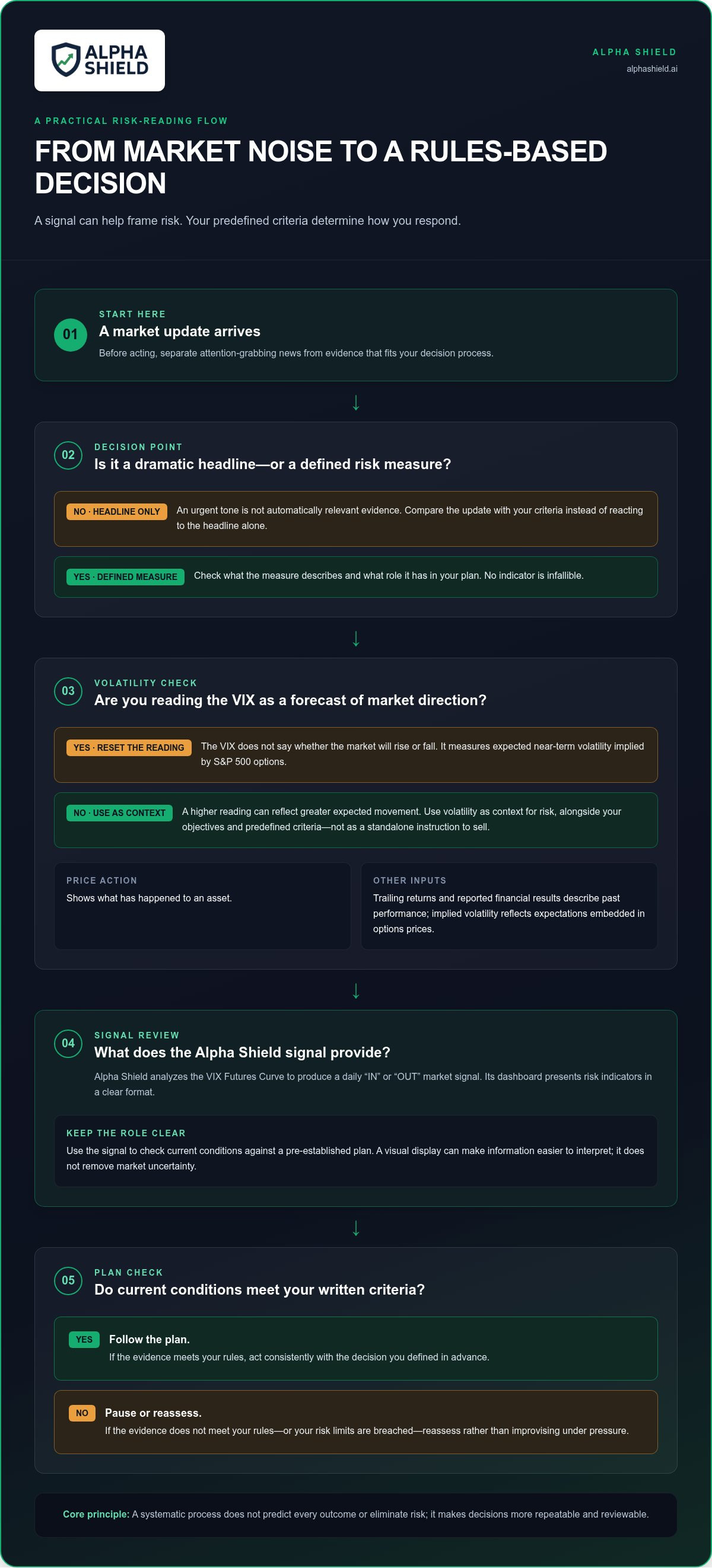
A 5-Step Framework for Building Investment Confidence
A repeatable framework turns risk management into a sequence of decisions you can prepare for before markets become stressful. Start by writing down your long-term capital goals and the level of loss you can tolerate without compromising them. That baseline helps determine what a signal should mean for your portfolio. The steps below connect market evidence to a planned response, rather than relying on instinct in the moment.
Step 1: Selecting Your Risk Indicators
Choose a primary indicator that reflects broad market risk, not a stream of opinions about individual holdings. Consider whether the measure aligns with your goals and whether you can explain what its readings mean. Market timing tries to identify exact turning points; systematic participation follows defined conditions without requiring a perfect call. Simpler signals can be easier to apply consistently than complex models whose outputs are difficult to interpret.
Step 2: Automating the Exit Strategy
“Automating” can mean automating your decision rules, not necessarily placing trades without review. Write an if-then plan: if your chosen indicator enters a defined high-risk state, take the response you selected in advance. Specify how you’ll reduce exposure and what evidence would support resuming participation. Alpha Shield’s systematic market signal guide explains how a rules-based signal can support a capital-preservation approach.
Step 3: Commit to Consistent Execution
Define how you’ll apply the plan across your portfolio and what circumstances justify reviewing it. Avoid changing thresholds simply because a signal is uncomfortable or a headline is persuasive. A plan can include a review process, but distinguish a genuine change in your goals from a temporary emotional reaction. Consistency doesn’t guarantee a favorable result; it makes your process easier to assess.
Step 4: Review Portfolio Risk on a Dashboard
Use a dedicated dashboard to check risk indicators in one place, rather than reconstructing the picture from scattered updates. The Alpha Shield Dashboard presents risk indicators to help strip away market noise. Make the review purposeful: compare the current signal with your plan, note whether portfolio risk remains within your limits, and act only as your rules direct. Frequent checking without a decision rule can increase stress rather than clarity.
Step 5: Audit Decisions Against the System
Keep a brief decision record: the signal observed, the action taken, and the reason. Review it regularly, including periods when no action was required. Ask whether you followed your process, whether the rules were clear, and whether a decision came from evidence or emotion. Evaluate the quality of the decision separately from its short-term outcome. This audit reveals where the framework needs refinement without turning every market move into a reason to abandon it.
Together, these steps create a practical structure for building confidence in investment decisions. The Alpha Shield Market Signal provides a daily “IN” or “OUT” reading based on the VIX Futures Curve, offering a defined reference point within a risk-management process. It does not remove market risk or guarantee a particular result.
Leveraging Alpha Shield for Disciplined Risk Management
A market signal is most useful when it has a defined place in an investor’s routine. Alpha Shield’s Market Signal analyzes the VIX Futures Curve and issues a daily “IN” or “OUT” indication. Rather than asking investors to interpret every market headline, it offers a consistent reference for assessing broad market risk. It doesn’t predict every turn or eliminate the possibility of losses. It helps make risk decisions more systematic.
The philosophy centers on capital preservation, not speculative gains. That focus matters because large drawdowns can impair long-term plans and increase the pressure to make reactive choices. Alpha Shield was founded by former investment bankers and global markets professionals with more than 50 years of combined experience. The aim is to apply a disciplined risk-management perspective in a format individual investors can use as part of their own decision process.
Stripping Away Market Noise
Financial coverage can present a constant stream of opinions, forecasts, and short-term price explanations. The Alpha Shield approach centers on a defined market-risk signal derived from the VIX Futures Curve. A single, clearly stated reading can simplify the question in front of an investor: does the current signal support participation, or does the system indicate a more defensive posture?
That simplicity is useful only when paired with a plan. Decide in advance how an “IN” or “OUT” signal relates to your portfolio, time horizon, and risk limits. Then use the signal as one input in a broader wealth-management routine, not as a promise that losses will be avoided or a substitute for personal judgment. Systematic risk management may help investors address drawdown exposure, but no tool can guarantee long-term growth.
Getting Started with Data-Driven Confidence
Integrate a market signal through a repeatable review rather than constant monitoring. At a regular time, check the signal and the Alpha Shield Dashboard’s risk indicators. Compare them with your written plan, record any action, and avoid changing the rules because of a single headline. If you already work with a wealth manager or follow an established allocation strategy, consider how a broad market-risk signal can complement that process without displacing your goals or other risk controls.
The dashboard presents risk indicators clearly, helping investors move from stressed observers of every fluctuation to more disciplined observers of data. This can reduce the burden of piecing together conflicting information. The value lies in clarity and consistency, not in claiming certainty. Building confidence in investment decisions comes from knowing what information you’re using and how it fits your process.
For a structured market-risk reference, the Alpha Shield Dashboard brings the signal and risk indicators into one place.
Make Your Next Investment Decision More Deliberate
Confidence doesn’t require certainty about the next market move. It comes from knowing what evidence you’ll rely on and how you’ll respond when conditions change. Before your next decision, write down the question that matters most to your long-term plan, the risk condition that would make you reconsider, and the action you’ll take if it occurs. Keep the answers accessible. A clear reference can help prevent a passing headline or sudden price move from rewriting your intentions.
That preparation is a practical starting point for building confidence in investment decisions. Review your approach periodically, but don’t confuse consistency with rigidity. If your goals or circumstances change, reassess the plan deliberately. If only market noise has changed, give your established criteria room to guide you.
Choose a process you can understand and follow through changing conditions. Explore the Alpha Shield Market Signal and Dashboard to add a structured market-risk reference to your decision process.
Frequently Asked Questions
What is the difference between market timing and systematic risk management?
Market timing often aims to identify the best moment to enter or exit, such as calling the exact market bottom. Systematic risk management uses predefined conditions to guide exposure without requiring a perfect forecast. For example, an investor might decide in advance how to respond when a broad market-risk indicator crosses a chosen threshold. The goal is consistent decision-making, not precision at every turning point.
Can a rules-based system really protect my portfolio from a market crash?
No rules-based system can guarantee protection from losses or identify every crash in advance. Signals can change after markets have already moved, and unusual conditions may not fit past patterns. A systematic approach can still help by setting a response to rising risk before stress makes decisions harder. Treat it as one part of portfolio risk management, alongside suitable allocation and an understanding of your own capacity for loss.
How do I stop making emotional investment decisions during high volatility?
Reduce the number of decisions you make under pressure. Set a regular time to review your portfolio, mute nonessential market alerts, and write down what would justify changing your plan. If you feel compelled to act after a sharp move, pause and compare the situation with those criteria first. A short decision journal can also reveal whether repeated changes are responding to evidence or to discomfort.
Why is capital preservation more important than high-risk stock picking?
Capital preservation prioritizes keeping losses from undermining the resources needed for long-term goals. It doesn’t mean avoiding all investment risk or assuming that every concentrated position will fail. It means considering downside as well as potential return before making a decision. A portfolio that suffers a deep decline needs a larger percentage gain to recover, so managing exposure can matter as much as pursuing growth.
What are macro market risk indicators and why should I track them?
Macro market risk indicators measure conditions affecting the broader market rather than one company. Examples include volatility measures such as the VIX and its futures curve, which can help assess market stress and expectations for volatility. They won’t explain every price move or predict direction with certainty. Tracking them can add context when individual holdings behave differently, helping investors assess whether a change is company-specific or part of broader market conditions.
How does a market signal dashboard improve investment confidence?
A dashboard can bring risk indicators together in a consistent format, reducing the effort of assembling information from separate sources. For example, an investor can review a signal, compare it with a written portfolio plan, and record whether action is warranted. The display itself doesn’t make a decision or remove uncertainty. Its value is in making the relevant information easier to review systematically rather than reacting to each new headline.
Do I need professional experience to use institutional-grade investment signals?
No professional market background is required to understand a clearly presented signal, but you should know what it measures and what it does not. Before using any signal, learn how its readings relate to your own goals, time horizon, and risk limits. Alpha Shield’s Market Signal is based on the VIX Futures Curve and indicates “IN” or “OUT.” That reading can inform a plan, but it isn’t a personalized portfolio recommendation.


