

What if the first step toward investing isn’t predicting the right moment, but deciding how much risk you can live with? Fear of a market decline, a poor entry point, or one costly mistake can make staying on the sidelines feel safer. That concern is understandable. But overcoming fear of investing in stocks doesn’t require certainty about what markets will do next.
If you’re wondering how to begin without letting fear make the decision for you, start by separating manageable uncertainty from financial unreadiness. Money needed soon, high-interest debt, or no emergency cushion may call for preparation before taking market risk. If your finances are ready, a clear plan can make uncertainty easier to manage.
This article explains what drives investing fear and how to assess risk in relation to your goals, time horizon, and ability to absorb losses. You’ll learn how to set practical decision rules, begin at a pace you can sustain, and use systematic market-health information as one input, not as a forecast or substitute for personal judgment. The aim isn’t to eliminate risk. It’s to define your boundaries before investing.
Key Takeaways
- Overcoming fear of investing in stocks starts with identifying whether your concern is about loss, complexity, mistakes, or timing.
- Separate emotional risk tolerance from financial risk capacity to judge whether market fluctuations fit your circumstances.
- Compare diversified funds, scheduled contributions, cash, and systematic signals by the uncertainty each may address and the risks that remain.
- Build a starting plan by checking financial readiness, defining goals, setting risk limits, choosing an approach, and reviewing it consistently.
- Use Alpha Shield Market Signal and its dashboard as risk-monitoring inputs, not as stock picks, forecasts, or substitutes for personal judgment.
Why does investing in stocks feel frightening, even when you have a long-term goal?
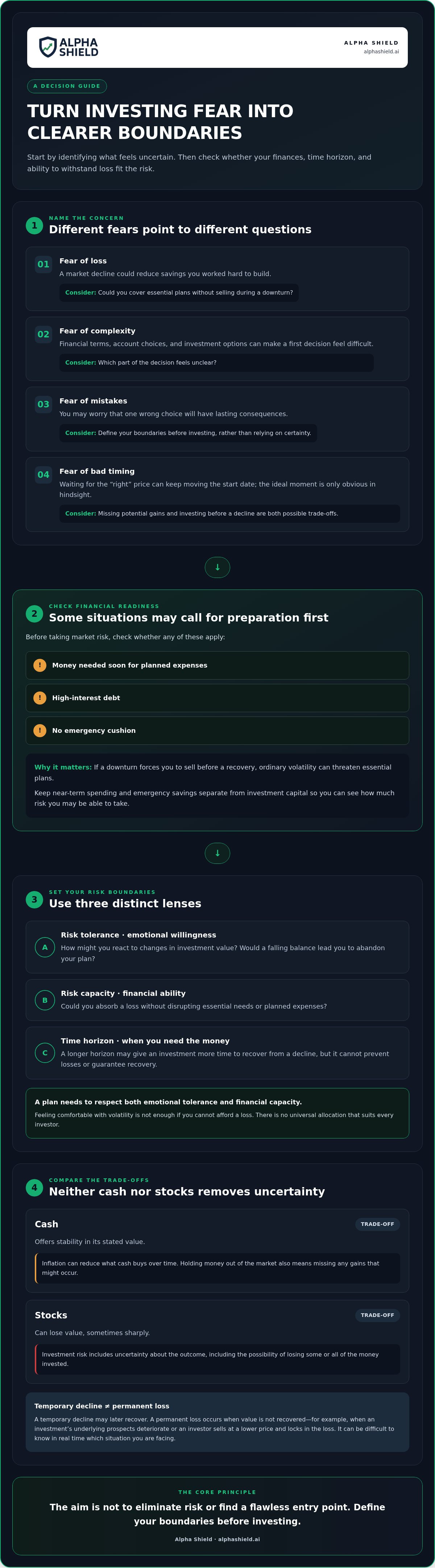
A long-term goal doesn’t automatically make market risk feel comfortable. Fear can be a useful signal to examine your finances and assumptions, not a command to invest immediately. Start by identifying what the fear is pointing to. Different concerns call for different responses.
Investment risk is uncertainty about an outcome, including the possibility of losing some or all of the money invested. That uncertainty can feel especially difficult when headlines amplify market emotions. The interaction between fear, greed, and investor behavior is explored in Greed and Fear in Financial Markets. Recognizing the emotion can help you make a deliberate decision, but it doesn’t predict what the market will do next.
- Fear of loss: You may worry that a decline will reduce savings you worked hard to build.
- Fear of complexity: Financial terms, account choices, and investment options can make a first decision feel harder than it needs to be.
- Fear of mistakes: You may believe one wrong choice will have lasting consequences.
- Fear of bad timing: You may wait for a clear signal that prices have reached the “right” level, even though that moment is only obvious in hindsight.
Cash and stocks each involve trade-offs. Cash offers stability in its stated value, but inflation can reduce what it buys over time. Holding money out of the market also means missing any gains that might occur. Stocks can lose value, sometimes sharply. Neither choice removes uncertainty. The practical question is which risks fit your needs and timeframe.
What are investors most afraid of losing?
A temporary market decline is a fall in an investment’s value that may later recover. A permanent loss occurs when value isn’t recovered, for example because an investment’s underlying prospects deteriorate or an investor sells at a lower price and locks in the loss. The two are different, but it can be difficult to know in real time which situation you’re facing. A long horizon may give an investment more time to recover, but it can’t make losses impossible.
Timing matters to your personal finances, too. If you invest money needed soon for rent, tuition, or another planned expense, a downturn may force you to sell before a recovery. That pressure can turn ordinary volatility into a threat to essential plans. Keep near-term spending and emergency savings separate from investment capital so you can see how much risk you may be able to take without putting those plans at risk.
Is waiting for the perfect moment a form of risk management?
Waiting can feel like protection because it avoids an immediate decision. But if your rule is “invest only when the market feels safe,” uncertainty can keep moving the start date. Markets may rise or fall while you wait. Missing potential gains is a trade-off, not a guaranteed result, just as investing before a decline may lead to losses.
Inflation creates another possible cost: cash may buy less over time if prices rise faster than its return. That doesn’t mean investing is always the right answer. It means your decision should reflect your goals, readiness, and ability to absorb loss, rather than a prediction about the next market move. A systematic risk-management framework can help turn uncertainty into defined rules. For overcoming fear of investing in stocks, the aim isn’t to remove risk or find a flawless entry point. It’s to understand the trade-offs before choosing whether, when, and how much to invest.
How do risk tolerance, time horizon, and potential loss shape stock investing?
Fear becomes easier to assess when it’s translated into boundaries. Three factors matter: how you might react to volatility, how much financial loss you could absorb, and when you’ll need the money. These factors are related, but they aren’t interchangeable. A long investment horizon can allow more time to recover from a decline, but it doesn’t prevent one or guarantee a recovery.
Risk tolerance is your emotional willingness to withstand changes in investment value without abandoning your plan. Risk capacity is your financial ability to absorb a loss without disrupting essential needs. A plan needs to respect both. If you can tolerate volatility emotionally but can’t afford a loss financially, comfort alone isn’t a sufficient basis for taking risk.
How is emotional comfort different from financial risk capacity?
Imagine a freelancer who feels calm during market drops but has irregular income and upcoming tax or household bills. That person may have high risk tolerance but limited risk capacity, because a decline could coincide with a need to withdraw invested money. Before deciding how much to invest, separate emergency savings and near-term obligations from capital intended for longer-term goals.
Then test a possible decline against your actual circumstances. Could you still cover planned expenses without selling? Would a falling balance lead you to abandon your approach? Your answers can help define a personal risk boundary. There’s no universal allocation that suits every investor, because income stability, obligations, goals, and emotional responses differ.
How do time horizon and liquidity needs affect potential loss?
Time horizon is the period before you expect to use the money. If the goal is far away, you may have more flexibility to remain invested through volatility. If you’ll need the funds soon, a decline can leave less time to recover before withdrawal. Liquidity needs matter too: money tied up in fluctuating investments may not be available at a value you’re comfortable accepting when an expense arrives.
Write down the purpose and expected timing of each goal. Then identify which funds must remain accessible and which could withstand fluctuations. This turns a vague concern about losses into a practical constraint on investment decisions.
What can diversification change, and what can it not change?
A fund tracking a broad market index can provide exposure to many companies, reducing dependence on any one holding compared with owning only a few individual stocks. The degree of diversification still depends on what the fund tracks: a narrow sector fund, for example, may remain concentrated. Diversification can spread exposure, but it cannot eliminate market risk or prevent a broadly diversified portfolio from falling when markets decline.
For a deeper look at how investors think about portfolio risk, market crash defense strategies can help frame the role of risk-management rules. The North American Securities Administrators Association also outlines practical considerations in Overcoming the Fear of Investing: Practical Steps. Both can inform your thinking, but neither replaces your assessment of personal capacity and goals.
For overcoming fear of investing in stocks, use tolerance to understand your likely response, capacity to set a financial limit, and time horizon to assess when a loss could matter. If objective market-health information would help you monitor portfolio risk within those boundaries, explore the Alpha Shield risk-monitoring tools. This information is an input, not a substitute for your own plan.
Which investing approaches can reduce uncertainty without promising safety?
No investing approach removes uncertainty. The useful question is narrower: which part of the decision does an approach help structure, and which risks remain? A broad fund can reduce reliance on one company. Scheduled contributions can reduce the pressure to choose one purchase date. Cash can preserve access to a set amount of money. A systematic market signal can add a consistent risk-monitoring input. Each has limits.
These approaches can be combined, but they solve different problems. A routine may help reduce impulsive decisions without making an investment suitable for your goals. A fund may spread company-specific exposure without shielding you from a market-wide decline. Assess the remaining risk before treating any method as reassurance.
Do diversified funds make stock investing safer?
A broad stock fund can hold shares in many companies, so its performance depends less on any one company than a concentrated position would. If one holding performs poorly, other holdings may offset some of its impact. But that doesn’t guarantee a positive return. If market conditions drive down many stocks at once, a diversified stock fund can also fall.
Diversification addresses concentration risk. It isn’t capital protection, and it can’t guarantee returns or prevent losses. The fund’s holdings matter, too: a fund focused on one industry or narrow segment may provide less breadth than a broad-market fund. Look at the exposure the fund actually provides, not just the fact that it holds multiple investments.
Can scheduled contributions and cash reduce uncertainty?
With scheduled contributions, an investor puts a set amount into an investment at regular intervals rather than investing the full intended amount on one chosen date. This approach, often called dollar-cost averaging, spreads purchases across different prices and can make the process more routine. It changes purchase timing, not the possibility of loss. The investment can still decline, and regular contributions don’t guarantee a better outcome.
Cash serves a different purpose. It can keep money available for planned spending or emergencies, reducing the risk of needing to sell an investment at an inconvenient time. But cash set aside for long periods may lose purchasing power if prices rise, and it doesn’t participate in potential stock-market gains. Decide what the money is for before choosing whether to invest or hold it in cash.
How can systematic market signals help investors manage uncertainty?
Market signals can offer structured information about changing market conditions. Used within a pre-defined plan, they may help investors respond according to rules rather than reacting to each headline or sudden feeling. They don’t predict every move, establish whether stocks suit your circumstances, or remove the possibility of loss.
Alpha Shield Market Signal and the Alpha Shield Dashboard are designed to help investors monitor market health and manage portfolio risk, with a systematic focus on long-term capital preservation. They’re risk-management inputs, not individual stock recommendations, a shorting strategy, or a day-trading tool. For investors overcoming fear of investing in stocks, the value of a method is in clarifying decisions, not promising safety. You can explore Alpha Shield’s market-risk monitoring tools as one input alongside your goals, time horizon, and risk limits.
What practical steps help you start investing without acting from fear?
A written process gives decisions structure before market movements test your resolve. It also makes room for a valid conclusion that you aren’t ready to invest yet. Use this sequence to assess readiness and define boundaries before committing money.
- Assess readiness. List essential savings, emergency reserves, debt payments, and near-term spending. Don’t commit money you may need for an upcoming bill or an unexpected expense. If investing would put those obligations at risk, pause and strengthen your financial position first.
- Define the goal. Identify what the money is for and when you expect to use it. A goal with a distant time horizon may allow more flexibility than a planned expense that’s approaching. The purpose helps determine how much fluctuation may be tolerable.
- Set risk limits. Decide in advance what level of decline you could withstand financially and emotionally. Consider what you would do if the investment fell, rather than assuming you’ll feel the same once it happens. A limit might be a boundary on the amount invested or a condition for reviewing your plan.
- Choose an approach. Select an investment method that matches your goal, knowledge, and capacity for risk. Keep the initial commitment consistent with your obligations and boundaries, not with a promised return or someone else’s portfolio.
- Review deliberately. Set a review schedule and define what evidence would justify a change. A change in your goal, finances, or investment fundamentals may warrant reassessment. A worrying headline or one market drop, by itself, may not.
How can you define a manageable first step?
A manageable first step is an amount you can commit without using essential savings or weakening your ability to meet near-term obligations. Consider how a decline in that amount would affect your plans and peace of mind. Starting with a modest commitment can help you learn how you respond to market movement, but a smaller investment is still exposed to loss. There’s no universal minimum that suits everyone.
What should a written investing plan include?
Record the goal, expected timeframe, liquidity needs, and acceptable level of fluctuation. Add the approach you’ve chosen, when you’ll review it, and what developments could justify a change. For example, a change in your financial circumstances may deserve attention; a daily price move may not. This distinction helps separate evidence-based decisions from fear-driven reactions.
Keep the plan somewhere you can consult before acting. If a decision exceeds your confidence or you’re unsure how it affects your broader finances, pause and seek qualified financial advice. There’s no requirement to move faster than your readiness allows. Overcoming fear of investing in stocks means replacing an impulsive decision with a process you understand and can follow.
Learn more about Alpha Shield’s market-risk monitoring tools.
How can Alpha Shield support a more disciplined approach to investing?
A market signal can add structure to an investing process by supplying information about market health and portfolio risk. It doesn’t decide whether investing is suitable for you. That depends on your goals, timeframe, financial capacity, and plan. Used carefully, a risk-management tool can help you consider market conditions without treating every headline as a reason to act.
Alpha Shield Market Signal and the Alpha Shield Dashboard are designed to support risk monitoring, with a systematic focus on long-term capital preservation. Their role is distinct from choosing individual stocks or pursuing short-term trades. A signal is not a stock pick, a shorting strategy, or a day-trading tool.
What role can a market signal play in a personal investing process?
Think of a signal as one input in a decision framework, not a standalone instruction. Your written plan should first establish the purpose of the investment, when you may need the money, and what level of fluctuation you can withstand. Market-health information can then contribute context as you evaluate risk against those boundaries.
For example, if your plan sets conditions for reviewing exposure, a systematic signal may provide an additional reference point when market conditions change. It can’t tell you whether that response fits your personal circumstances, and it shouldn’t override your goals or financial needs. The final judgment remains yours.
This distinction matters. A tool can organize information, but it cannot remove uncertainty. It can’t guarantee protection, prevent every drawdown, or ensure returns. Nor does a signal forecast every market move. Treating it as certainty can create a new risk: relying on a tool instead of understanding what you own and why.
How do you evaluate whether a risk tool fits your process?
Start with the need. If you want a structured input for monitoring market health and portfolio risk, a market signal may be relevant. If you need an investment selected for your circumstances, a risk-monitoring tool isn’t a substitute for individualized financial advice or your own research.
Next, define its scope and limits. Consider what information it is intended to provide, how that information fits your existing decision rules, and what it cannot determine. Use it alongside your knowledge of your finances and objectives, not as an automatic order to buy or sell. If you can’t explain how the tool connects to your plan, pause before relying on it.
Overcoming fear of investing in stocks doesn’t mean handing decisions to a signal. It means replacing vague reactions with clear boundaries and considered inputs. Alpha Shield can contribute market-health information for risk monitoring, but personal judgment remains essential.
Explore Alpha Shield Market Signal as a market-risk monitoring input.
Make your next investing decision deliberate
Overcoming fear of investing in stocks doesn’t mean forcing yourself to act. It means making the next decision from a clear process rather than pressure to predict the market. Start by revisiting your written boundaries. If your finances or goals have changed, pause and reassess. If you’re ready, move at a pace that lets you understand the risks you’re taking.
For additional market-health context, Alpha Shield’s systematic approach may be one input in your risk-management process. System development began in 2017, and Alpha Shield launched in 2019. Its founders are former investment bankers and global markets professionals with over 50 years of combined experience. The signal supports risk monitoring, but it can’t guarantee protection or replace your judgment.
You don’t need perfect certainty to make a thoughtful choice. Set your boundaries, keep learning, and let discipline guide your next step. To add systematic market-health information to your risk-management process, explore Alpha Shield Market Signal.
Frequently Asked Questions
Is it normal to feel afraid of investing in stocks?
Yes, concern about losing money or making a poor choice is understandable. Caution prompts useful checks, such as whether you understand an investment and can afford fluctuations. It becomes paralysis when you postpone every decision without defining what information or financial condition would make you ready. For overcoming fear of investing in stocks, identify the specific concern first, then decide whether it calls for more preparation, a smaller commitment, or waiting.
Can you lose all your money by investing in stocks?
Yes, an individual stock can lose nearly all its value, including if the company fails. A diversified fund spreads exposure across holdings, so one company’s collapse has less influence than it would in a single-stock position. But diversification doesn’t eliminate losses: a broad stock fund can fall substantially during a market decline. The amount at risk depends on what you own, so understand the investment before committing money.
How much should a beginner invest in stocks?
There isn’t one amount that fits every beginner. First account for essential bills, debt payments, emergency savings, and expenses you expect soon. Then consider what you could invest without needing to sell during a downturn or disrupting those obligations. The right starting amount also depends on your income stability and comfort with potential losses. If those figures are unclear, wait while you build a more complete picture of your finances.
Is it better to wait for a stock market crash before investing?
Not necessarily. A crash is difficult to predict, and waiting for one can leave you postponing a decision indefinitely or missing gains if prices rise instead. Investing before a decline also carries the possibility of losses. Rather than making a plan depend on a forecast, consider whether your finances are ready and whether a consistent approach fits your goals. Waiting can be reasonable if you need time to prepare, not because a crash is certain.
What should I do if my investments fall soon after I start?
Pause before changing course, then compare the situation with the rules you wrote before investing. Check whether your goal, need for the money, or financial circumstances have changed, and distinguish those changes from discomfort caused by a lower account value. Review what the investment holds and whether your original reasons still apply. If the decision feels beyond your confidence, avoid acting in haste and seek qualified financial advice.
Are ETFs less risky than individual stocks?
Some ETFs hold a wide range of investments, which can reduce dependence on any single company compared with owning one stock. But “ETF” describes a fund structure, not a risk level: an ETF may track a broad market or a narrow sector. Even diversified stock ETFs can lose value during market declines. Compare the fund’s underlying holdings and concentration, and don’t assume that an ETF is safe simply because it contains multiple securities.
Can I invest in stocks while keeping money for emergencies?
Yes, provided emergency funds remain accessible and separate from money exposed to market fluctuations. For example, if an unexpected car repair would otherwise force you to sell shares, that reserve may be too small for your current needs. Decide which savings must remain available before investing surplus capital. This separation can reduce pressure to sell at an unfavorable time, but it doesn’t prevent losses on the money you invest.


