

What if the right time to exit the stock market isn’t when prices start falling, but when your pre-set risk conditions are met? It’s natural to worry about selling too early or staying invested through a severe drawdown. The challenge is deciding whether a downturn signals a lasting change or short-term volatility, especially when headlines and indicators point in different directions. Deciding when to exit the stock market shouldn’t depend on guessing the exact market top.
A disciplined approach starts with your financial situation, risk tolerance, and long-term goals. It then defines, in advance, what evidence would justify reducing exposure and what conditions would prompt you to reconsider. No indicator can establish with certainty where markets will go next, and no signal can guarantee protection from losses.
This guide explains how to assess market risk, distinguish meaningful changes from headline noise, and build a repeatable decision process. You’ll learn what market-health indicators can and can’t tell you, how to set exit and re-entry conditions before stress rises, and how to use a market signal or dashboard as one input in your broader risk-management process, not as a stand-alone instruction.
Key Takeaways
- Define an exit as a planned reduction or closure of exposure, not a reaction to a forecast or a single alarming headline.
- Compare price trends, volatility, market breadth, and broader market-health context. Each can offer a different, sometimes conflicting, view of risk.
- When deciding when to exit the stock market, weigh staying invested, rebalancing, reducing exposure, and exiting against the same decision criteria.
- Build a repeatable plan: set goals, choose evidence, define responses and review intervals, then document exit and re-entry conditions in advance.
- Use a systematic market signal and dashboard as inputs to your risk process, not as guarantees or instructions to buy or sell individual stocks.
When should you exit the stock market? Start with the decision, not the forecast
Selling can reduce your exposure to a falling market. It can also lock in losses and leave you uncertain about when to reinvest. The question of when to exit the stock market is difficult because declines can be temporary, while waiting for certainty can mean accepting more risk than you intended.
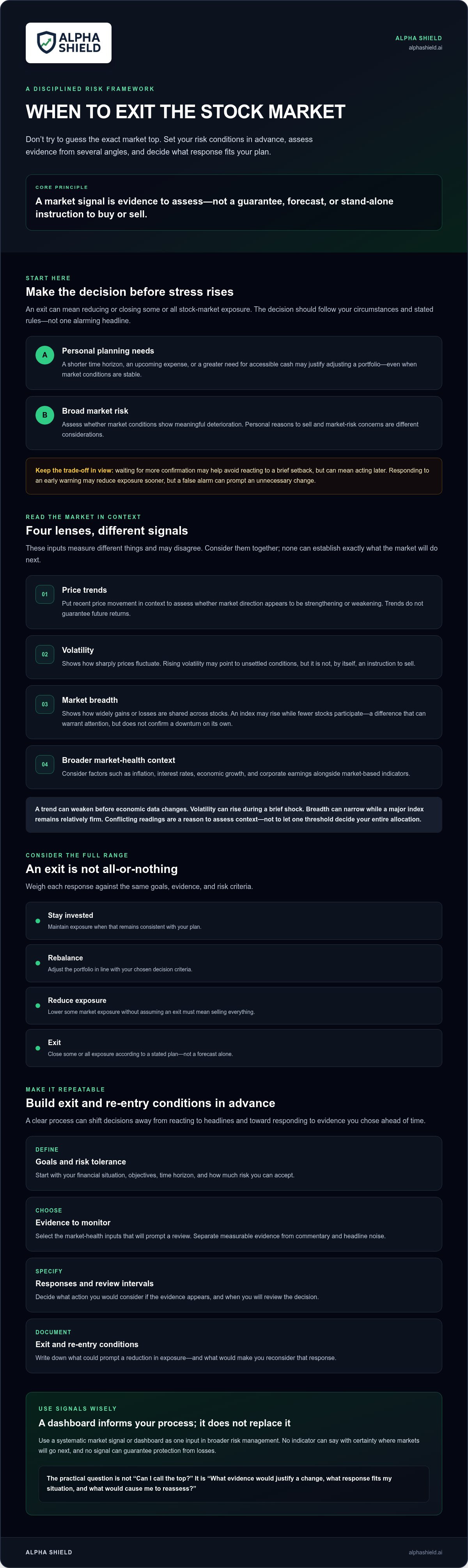
An exit doesn’t have to mean selling every investment. It can mean reducing or closing some or all stock-market exposure according to a stated plan. That plan should identify the evidence you’ll monitor and the action you’ll consider if it appears. An exit rule defines what to watch and what response to consider before market stress rises. This shifts the decision from reacting to a forecast to following a process.
Market risk versus personal reasons to sell
Start by identifying why you’re considering a change. Broad market deterioration is a risk-management concern. A shorter investment time horizon, an upcoming expense, or a greater need for accessible cash is a personal planning concern. Either may justify adjusting a portfolio, but a personal need to sell doesn’t mean the market has reached a top.
For example, if you expect to use part of your savings soon, reconsider how much market volatility that money can bear. That decision may make sense even if market conditions remain stable. The appropriate response depends on your objectives, circumstances, and risk tolerance. Don’t assume one framework suits every investor, and consider discussing major portfolio changes with a qualified financial or tax professional.
Why timing the exact market top is not a reliable plan
A turning point is easiest to identify after it has passed. Before then, a decline might deepen or recover, and an apparent recovery might continue or reverse. Market timing describes attempts to make investment decisions based on expected market movements. A rules-based exit, however, doesn’t require predicting the precise high or low.
There’s a trade-off. Waiting for more confirmation may reduce the chance of reacting to a brief setback, but it can also mean acting later if deterioration continues. Responding to an early warning may reduce exposure sooner, but a false alarm can prompt an unnecessary change. No signal removes that uncertainty.
Set your acceptable risk and decision rules before headlines intensify. Specify what evidence would prompt a review, what portfolio response you would consider, and what would make you reconsider that response. Next, assess different types of market evidence while remembering that no single indicator can settle the decision.
Which evidence can support a stock-market exit decision?
No single indicator answers every question. Price trends describe direction. Volatility shows how sharply market conditions are changing. Breadth indicates whether index performance is shared across many stocks or concentrated in fewer of them. Macroeconomic and other market-health measures add context about factors such as inflation, interest rates, economic growth, and corporate earnings. Together, these inputs can help you assess risk. They can’t establish exactly what the market will do next.
A market signal is evidence to assess, not a guarantee of what comes next. Indicators can disagree because they measure different things and respond at different speeds. A price trend may weaken before economic data changes. Volatility may rise during a brief shock. Breadth may show narrowing participation while a major index remains relatively firm. Don’t let one threshold, indicator, or alarming headline automatically dictate your entire allocation.
How to interpret trend, volatility, and market breadth
Trend measures put recent price movement in context. They can help show whether market direction is strengthening or weakening, but they don’t guarantee future returns. Volatility describes the degree of price fluctuation. A sharp increase may indicate more unsettled conditions, but it isn’t a stand-alone instruction to sell.
Market breadth means how widely gains or losses are shared across the stocks in an index or market. If an index rises while fewer stocks participate, that difference may warrant attention. Breadth adds context, but it doesn’t confirm on its own that a downturn is imminent.
How to assess signals without overreacting to headlines
Separate measurable inputs from commentary. You can track a defined signal, price behavior, or change in breadth against a rule. A headline is often an interpretation of events and may emphasize the most dramatic explanation. Before changing your plan, check whether the evidence has persisted over your chosen review period or reflects a single-day move.
Then ask what the evidence supports: closer monitoring, a review of risk exposure, or a change already specified in your plan? Don’t make a larger portfolio decision than the evidence and your circumstances justify. For a broader framework, see this guide to macro market risk indicators.
Evidence is useful when it connects to a predefined response. Fidelity’s overview of a disciplined exit and re-entry plan offers another reference for rules-based decisions. A market-health dashboard, such as Alpha Shield’s market-risk monitoring, can help organize indicators for consistent review. Treat any signal as one input, not a guarantee or stand-alone instruction.
Is it better to exit the stock market or stay invested through volatility?
There isn’t one response that fits every investor. Staying invested maintains market exposure, while rebalancing restores a chosen portfolio mix. Reducing exposure makes a partial change; exiting removes some or all stock-market exposure. The right choice depends on your time horizon, objectives, and ability to tolerate losses. An exit signal can’t guarantee a better outcome than remaining invested. It can only inform a decision within your broader plan.
Compare the trade-offs before acting:
| Approach | Risk exposure | Timing uncertainty | Transaction considerations | Recovery participation |
|---|---|---|---|---|
| Stay invested | Maintains current market exposure | Avoids a sell-and-re-enter decision | Typically no sale required for this choice | Remains exposed to a recovery |
| Rebalance | Returns the portfolio toward chosen targets | Doesn’t require calling a market top | Trades may involve costs or tax consequences | Retains exposure according to the target mix |
| Reduce exposure | Lowers, but doesn’t eliminate, exposure | Requires a rule for any later adjustment | Sales may have costs or tax consequences | Participates to the extent exposure remains |
| Exit | Removes the sold portion’s market exposure | Requires deciding when, or whether, to re-enter | Sales may have costs or tax consequences | May miss a recovery while out of the market |
What are the risks of selling during a downturn?
A sale doesn’t cause a market decline, but it can crystallize a loss on the investment sold. If prices later recover, an investor who has sold may miss some or all of that rebound, especially without clear re-entry conditions. Re-entering can be difficult if the decision depends on waiting until uncertainty disappears.
Before selling, check the potential tax treatment, account type, holding period, and transaction implications for your circumstances. These details vary. Verify them with a qualified tax or financial professional rather than assuming every sale has the same effect.
When might reducing exposure differ from leaving entirely?
Reducing exposure is a distinct option, not a default recommendation. It may let an investor respond to a defined change in risk while retaining some market participation. An all-or-nothing exit removes more exposure, but it also makes the re-entry decision more consequential. The appropriate choice depends on your plan, not on an assumption that one approach is always safer.
For broader risk-management context, see this guide to market crash defense strategies. Use it to consider how a planned response fits your objectives and tolerance for drawdowns, not as a promise that any strategy will prevent losses.
How to build a disciplined exit and re-entry plan
A plan is useful only if you can apply it under pressure. Build it while markets are relatively calm, then use it to guide reviews instead of letting each new headline rewrite your response. Deciding when to exit the stock market becomes more manageable when you’ve already defined your objectives, evidence, and possible actions.
Use this sequence:
- Define your goals. Clarify the portfolio’s purpose, time horizon, and the level of risk you can accept.
- Select evidence. Choose the market indicators you’ll monitor and note what each is intended to show.
- Specify responses. Decide whether a condition prompts a review, rebalance, partial reduction, or another action. Set any thresholds to fit your circumstances.
- Set review intervals. Choose in advance when you’ll assess the plan and how you’ll handle evidence that appears between reviews.
- Document the rules. Record the triggers, actions, and re-entry conditions so you can assess decisions against the same process.
Define your goals, select evidence, specify responses, review on a schedule, and document the rules. Every threshold is investor-specific. A rule that suits one portfolio may be inappropriate for another.
Set exit conditions before market stress rises
Write down the portfolio risk that would prompt a review, then identify what evidence would support that concern. Be precise about the next step: a review is not the same as a sale, and a partial reduction is not a full exit. For example, if a market-health measure you selected remains outside your personally defined range at a scheduled review, you might reassess your allocation rather than act automatically. This is an illustration, not a universal rule.
Include personal constraints, such as upcoming cash needs or a change in time horizon. If a decision could affect broader financial plans, consider discussing it with a qualified adviser.
Plan re-entry, monitoring, and review
An exit plan needs an entry plan. Define what evidence would prompt you to reassess exposure and what conditions would support returning toward your intended allocation. Re-entry criteria help prevent an open-ended wait for certainty. Set periodic reviews that suit your process, and avoid turning every market move into a new discretionary trade.
For related guidance on consistent decision-making, read this guide to rules-based investing systems. Alpha Shield’s market signal and dashboard can also be used as inputs to a broader risk-monitoring process, not as a guarantee or stand-alone instruction.
For an overview of the service, visit Alpha Shield’s Market Signal and Dashboard.
How a systematic market signal can support an exit decision
A market signal can help organize risk information and make your review process more consistent. It doesn’t decide how much risk is appropriate for you. That depends on your goals, time horizon, financial needs, and the rules you set in advance. If you’re assessing when to exit the stock market, treat a signal as one input alongside your portfolio plan, not as an automatic instruction.
Alpha Shield provides a market signal and dashboard for monitoring market health and risk. It doesn’t provide individual stock picks, day-trading software, or a shorting strategy. It also doesn’t guarantee protection from losses or identify every market top. The purpose is disciplined monitoring, not certainty.
What a market-risk dashboard can and cannot tell you
A dashboard can bring market-health information together so you can review it consistently against your chosen criteria. Before relying on a particular interface or display, confirm what the current dashboard shows. The value of a signal depends on understanding what it measures and how it fits your process, not on assuming it predicts the next market move.
Signals can draw attention to changing conditions and prompt a review. They can’t remove uncertainty, account for every personal circumstance, or replace your judgment. A risk signal may indicate that conditions deserve attention, but your plan determines whether the response is to monitor, rebalance, reduce exposure, or take another step.
How to evaluate a systematic signal for your process
Before incorporating a signal, ask practical questions:
- Purpose: What type of market risk is it designed to monitor?
- Inputs: Which indicators inform the signal, and what do they represent?
- Updates: How and when is the information refreshed? Verify the process rather than assuming it.
- Limitations: What can’t the signal establish, and what role should your own judgment play?
Then compare its role with your existing portfolio rules. A useful tool should support a decision framework, not replace personal financial advice or dictate an allocation without regard to your objectives. For broader context on evaluating systematic approaches, read this overview of institutional-grade investment signals.
Alpha Shield focuses on long-term capital preservation and monitoring market risk. Consider whether a dedicated signal and dashboard would help you apply your own decision rules more consistently. The tool is one input, not a promise of a better outcome.
Learn more about the Alpha Shield Market Signal.
Make your next market decision with a plan
Deciding when to exit the stock market isn’t about identifying the exact top. It’s about matching your response to your goals and risk tolerance, then applying clear rules instead of reacting to every headline. Price trends, volatility, breadth, and broader market conditions can inform a review, but none can guarantee what happens next.
Before stress rises, document what evidence would prompt action, what that action could be, and what would lead you to reassess or re-enter. Staying invested, rebalancing, reducing exposure, and exiting each involve trade-offs. The right choice depends on your circumstances, and a systematic signal should support your decision process rather than replace it.
Alpha Shield’s system development began in 2017, and the service launched in 2019. It was founded by former investment bankers and global markets professionals with over 50 years of combined experience. Its market signal and dashboard are designed to help investors monitor risk, not predict every market top or prevent all losses.
For more information, visit Alpha Shield.
You don’t need perfect foresight to make a more disciplined decision. Start with a clear plan, review it consistently, and adjust it as your goals and circumstances change.
Frequently Asked Questions
Is there a reliable signal for when to exit the stock market?
No signal can reliably identify every market top or guarantee protection from losses. A signal can help organize evidence, but first understand what it measures, how it responds to different conditions, and where its limitations lie. Use it as one input in a documented plan alongside your objectives, time horizon, and risk tolerance. A signal should inform your decision, not make it for you.
Can you exit the stock market before a crash?
Sometimes investors reduce their exposure before a major decline, but predicting a crash in advance is uncertain. A rule may respond only after measurable conditions change, while a false signal may lead to an unnecessary portfolio adjustment. Rather than rely on a prediction, decide ahead of time what evidence would prompt a review and what responses you would consider. That gives you a process without implying certainty.
Should I sell stocks when the market is volatile?
Volatility alone doesn’t establish that selling is appropriate. It describes changing market conditions, not a guaranteed direction or outcome. Review why you hold the investments, when you may need the money, and whether your portfolio still fits your objectives and risk tolerance. If volatility leads you to reconsider your plan, use criteria you set in advance. Avoid making a major decision based only on one headline or market session.
What happens if I exit the stock market and it rebounds?
You may avoid some later losses, but you could also miss part or all of a recovery before re-entering. The result depends on when you sell, when you return, and any transaction or tax effects that apply to your situation. A written re-entry process can make the decision to invest again more deliberate. Without one, an exit may become an indefinite move to the sidelines.
How do I decide when to re-enter the stock market?
Set re-entry conditions before you exit, using evidence that fits your investment process rather than waiting for certainty. Specify what you’ll monitor, how often you’ll review it, and what actions you might take if conditions change. No rule eliminates timing risk. Your time horizon, financial needs, and risk tolerance matter, so consider consulting a qualified financial professional about decisions affecting your portfolio.
Is market timing suitable for long-term investors?
Market timing can mean selling too early, returning too late, or trading more often than intended. Some long-term investors include systematic risk signals in a broader decision process; others prefer to stay invested and rebalance. Neither approach guarantees better results. Consider your objectives, personal circumstances, and ability to tolerate losses before choosing a process. Understand the trade-offs and follow rules that fit your plan.
Can a market-risk dashboard tell me exactly when to sell?
No. A dashboard can present market-health indicators and help you monitor conditions, but it can’t guarantee an exact exit point. Review what its indicators represent, what their limitations are, and how they relate to your decision rules. Alpha Shield provides a market signal and dashboard for risk monitoring, not individual stock recommendations or personalized financial advice. Treat the information as one input in your broader process.
Explore the Alpha Shield Market Signal and Dashboard to see whether it fits your risk-monitoring process.


