
What makes an investment signal institutional grade: an exclusive label, or a disciplined process you can examine? The phrase can sound reassuring, but it isn’t a formal quality standard. For individual investors assessing institutional grade investment signals, the real test is whether the method is transparent, systematic, and clear about its limits.
It’s reasonable to want a dependable way to interpret market risk. Yet polished marketing, conflicting indicators, and fast-moving commentary can make signal quality harder to judge and emotional reactions more likely. A risk signal can add information to your process, but it can’t guarantee protection from losses or replace a complete investment plan.
This article explains how to assess a signal’s rules, transparency, and intended role. You’ll compare systematic tools with news-led and discretionary approaches, then consider whether Alpha Shield’s market signal and dashboard fit your investment process. The focus is disciplined evaluation, not promises or stock picks.
Key Takeaways
- Judge “institutional grade” by a signal’s process and transparency, not by a prestige label.
- Understand how market data can provide risk context, and why an output still requires interpretation.
- Compare institutional grade investment signals with news-led reactions, discretionary judgment, and sentiment alerts.
- Use a practical diligence process to assess methodology, limitations, intended use, and fit with your plan.
- See how a focused market signal and dashboard can support risk monitoring without replacing your broader investment process.
What Are Institutional Grade Investment Signals, and What Should the Label Mean?
“Institutional grade” should describe the discipline behind a signal, not confer prestige on it. The phrase isn’t a formal quality designation, and institutional use alone says nothing about whether a signal is accurate or suitable for an individual investor. No signal can guarantee returns or prevent losses.
For individual investors, the useful questions are practical: What is the signal designed to assess? Are its rules defined and explainable? Can you understand its output and the limits of what it tells you? A polished dashboard or claim of professional use is not a substitute for clear answers.
A signal is useful only when its purpose and limits are clear. Assess institutional grade investment signals by their process rather than their label. This helps distinguish a measurable method from broad claims that sound authoritative but don’t explain how the signal is produced.
What makes an investment signal institutional grade?
Look for a consistent process, a defined purpose, and decision rules that can be explained. A systematic signal applies a method to information; quantitative analysis in finance describes the broader use of mathematical and statistical methods to examine financial questions. That doesn’t mean every institutional investor uses the same framework or that every quantitative method is sound. Ask what the provider can explain about its methodology and how it communicates limitations.
Signal, recommendation, and investment strategy: the distinctions
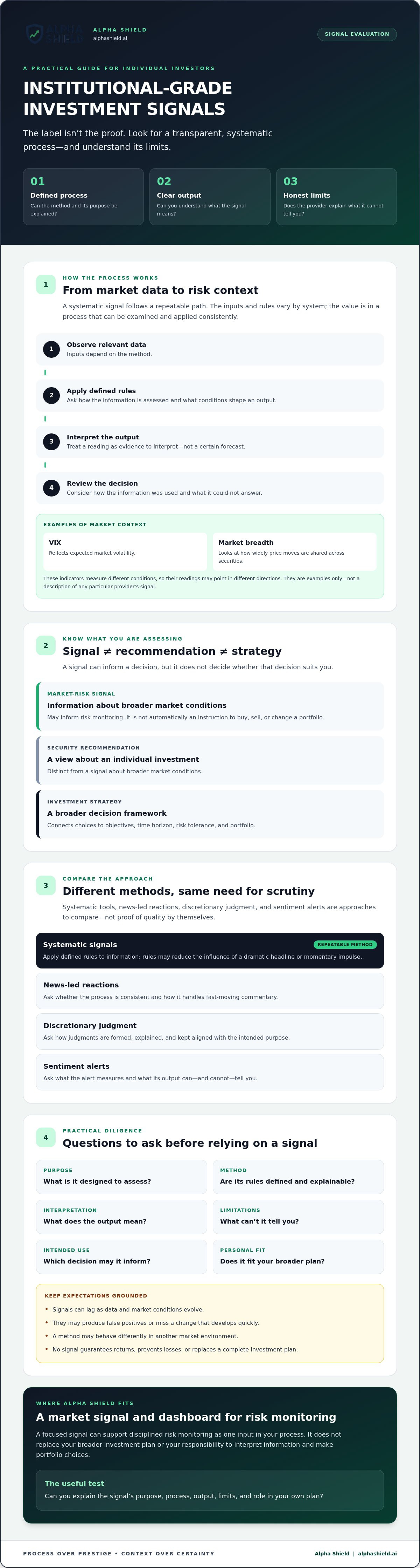
A signal is information that may inform a decision. It isn’t automatically an instruction to buy, sell, or change a portfolio. A market-risk signal concerns broader market conditions; an individual security recommendation points to a particular investment. A complete investment strategy goes further, setting out how decisions fit a person’s objectives, time horizon, risk tolerance, and portfolio.
Even a clearly defined signal can’t determine whether a decision is suitable for you. Investors remain responsible for how they interpret information and make portfolio choices. Treat the signal as one input in a decision process, not a substitute for that process.
How Systematic Investment Signals Turn Market Data into Risk Context
A systematic signal follows a repeatable path: observe relevant data, apply defined rules, interpret the output, then review how decisions were made. Inputs and rules vary by system. The point is to replace improvised reactions with a process that can be examined and applied consistently.
For example, the VIX, which reflects expected market volatility, and market breadth, which looks at how widely price moves are shared across securities, can each provide market context. These are examples only, not a description of any particular provider’s signal. Indicators may point in different directions because they measure different conditions. Their readings are evidence to interpret, not certain forecasts.
From indicators to a rule-based signal
A framework might define which inputs matter, how they’re assessed, and which conditions correspond to an output. Thresholds are one possible feature, but providers don’t all use the same approach. Some methods combine indicators; the institutional approach to weighting signals offers context on why combining signals requires deliberate choices. Ask what a provider actually discloses rather than inferring a complex process from the “institutional” label.
Rules can reduce the influence of a dramatic headline or momentary impulse, but they don’t remove the need for judgment. Consider what an output measures, which decision it may inform, and what it cannot tell you. Without a clear intended use, even a consistent signal can be misapplied.
Why a signal can be useful without predicting every turn
A risk signal describes conditions to monitor; it doesn’t predict the date or cause of a specific market event. Its value may lie in prompting a disciplined review of exposure or risk, not in identifying a market top in advance. A tool built for risk monitoring isn’t necessarily designed to time every move or select individual securities.
Signals can lag as data and market conditions evolve. They can produce false positives, flagging elevated risk before a sustained decline, or miss a change that develops quickly. A method that worked in one environment may behave differently in another. These are reasons to assess a process over time, not to expect perfect timing.
Investors looking for a defined reference point for market-risk monitoring can review Alpha Shield’s systematic market signal and dashboard. Explore the market-risk signal and dashboard as one possible input to a broader investment process, not a substitute for it.
How to Compare Institutional Investment Signals with Other Approaches
Different approaches answer different questions. A headline reports an event. A sentiment alert reflects a mood or measure of positioning. A systematic signal applies predefined rules, while discretionary judgment relies on an investor’s interpretation. None is automatically right for every portfolio. Compare the process, purpose, and limitations before deciding how an approach fits your routine.
| Approach | Consistency | Transparency | Decision cadence | Intended use and key limitations |
|---|---|---|---|---|
| Systematic signal | Applies defined rules repeatedly | Depends on how much methodology the provider explains | Set by the system’s design | Can provide a repeatable reference for risk review. Rules can lag, misfire, or fail to reflect changing conditions. |
| News-led reaction | Varies with the event and response | The event may be visible, but its portfolio meaning isn’t always clear | Often immediate | Useful for understanding developments. Reacting to each headline can encourage frequent, unplanned decisions. |
| Discretionary judgment | Depends on the decision-maker | Rationale may be explained, but can be difficult to reproduce consistently | Flexible | Can weigh context that a rule misses. Decisions may be affected by assumptions, experience, or emotion. |
| Sentiment-only alert | Depends on the measure and its rules | Varies by source and methodology | May shift as sentiment changes | Can flag crowd mood, but sentiment may turn quickly or conflict with other market evidence. |
Systematic signals versus headlines and sentiment
A headline can explain what happened, but it doesn’t prescribe a portfolio response. A systematic signal can offer a consistent framework for reviewing risk across different news cycles. Sentiment may add context, but a sudden shift in mood isn’t conclusive evidence about what markets will do next. News and sentiment still matter. The goal is to weigh them without letting each new alert dictate an immediate change.
Systematic signals versus discretionary market timing
Discretionary timing lets an investor interpret events and adjust decisions as circumstances change. A predefined signal can make its process more repeatable and easier to review: did the rule produce the output, and did the investor follow their plan? That doesn’t establish better performance. Rules still need context, and their relevance depends on an investor’s goals and risk tolerance.
Compare signals by rules, scope, and limitations, not by labels alone. Ask the same questions you’d ask of any decision aid: what does it measure, what decision can it inform, and where is your own judgment necessary?
How to Evaluate a Market Signal Before Using It
Due diligence starts with the job a signal is meant to do. Before considering whether institutional grade investment signals suit your process, check what the provider explains about its method, intended users, decision scope, and limitations. Product quality and portfolio suitability are separate questions: a clearly described tool may still not fit your goals or risk tolerance.
- Define its purpose. Is it designed to monitor broad market risk, inform a portfolio review, or serve another role? Ask who it is intended for and what decisions it can reasonably inform.
- Examine the methodology. Look for an understandable account of the inputs and rules. You may not need every technical detail, but you should be able to tell how the process works at a high level and what evidence supports the provider’s claims.
- Look for limitations. Does the provider discuss uncertainty, false signals, and conditions in which the tool may be less useful? Confirm what the signal does not do. It shouldn’t be mistaken for a guarantee, a full investment plan, or individual security advice.
- Assess portfolio fit. Consider your objective, time horizon, risk tolerance, existing holdings, and decision rules. Decide in advance how you’ll review a signal so each change doesn’t automatically trigger a trade.
- Plan ongoing review. Check how the provider presents examples and performance claims. Historical examples should include clear dates and methodology; past results don’t establish future outcomes. Reassess whether the tool’s purpose and process still fit your needs.
Questions to ask about methodology and transparency
Ask for a plain explanation of what the signal measures, how its rules produce an output, and what kind of user it is designed to serve. If examples are offered, check whether they cover difficult market periods and show the method used, rather than only selected outcomes. A frank discussion of uncertainty and known limitations is more useful than a broad claim of accuracy or institutional quality.
For additional context on the wider forces investors may monitor, see this guide to macro market risk indicators. That context can inform your questions, but it doesn’t establish whether a specific signal fits your portfolio.
Testing fit with your portfolio and decision process
Before relying on an output, decide when you’ll review it, what questions it should prompt, and how it relates to your existing plan. A signal can support a measured review without dictating an action. If you’re uncertain about suitability or portfolio changes, consider seeking guidance from a qualified financial professional.
To review the service’s stated scope, visit Alpha Shield’s Market Signal.
Where Alpha Shield Fits: A Market Signal and Dashboard for Risk Monitoring
Alpha Shield offers a systematic market signal with access to the Alpha Shield Dashboard through a subscription. Its intended role is focused: help users monitor market risk and manage portfolio drawdowns as part of a long-term capital-preservation process. The dashboard provides access to the service’s signal. Confirm specific indicators or display features with the provider rather than assuming they are included.
What the Alpha Shield Market Signal is designed to support
A market-risk signal can provide a reference point for reviewing exposure within an investor’s broader plan. It isn’t a complete investment plan, and its output doesn’t determine what is suitable for a particular portfolio. Alpha Shield is not a day-trading tool or shorting strategy, and it doesn’t provide individual stock picks. A signal also can’t guarantee that losses will be avoided or market risk eliminated.
For broader context, read about market crash defense strategies and the approach described in Alpha Shield’s systematic market signal. Use those materials to understand the service’s stated scope, then assess whether it addresses a need in your process. Institutional grade investment signals should be judged by clear purpose, explainable methodology, and candid limits, not by the label alone.
Deciding whether a systematic signal belongs in your process
Apply the same checks you’d use for any market-risk tool: Is its purpose relevant to your needs? Can you understand what it is designed to indicate? Are its limitations clear? Can you review its output without treating every change as a reason to trade? A good fit should complement your investment plan, not displace your objectives, time horizon, risk tolerance, or independent judgment.
Alpha Shield’s system development began in 2017, and the service launched in 2019. Its founders have more than 50 years of combined investment-banking and global-markets experience. These are background facts about the service’s development and team, not proof of investment results or a guarantee of future outcomes. Evaluate the signal using the information the provider makes available and its compatibility with your decision rules.
To learn more about the service, visit Alpha Shield Market Signal.
Make Your Next Signal Review More Disciplined
Institutional grade investment signals earn consideration through a transparent process, not an impressive label. Before relying on one, understand its purpose, methodology, and limitations, then decide whether it complements your goals and existing portfolio rules. A market-risk signal can inform a review, but it can’t guarantee protection or replace your investment plan.
Alpha Shield is a focused market signal and dashboard subscription for monitoring market risk and supporting long-term capital-preservation decisions. System development began in 2017, and Alpha Shield launched in 2019. Its founders bring more than 50 years of combined investment-banking and global-markets experience. That background provides context, not evidence of future investment results.
If a systematic risk-monitoring tool could complement your process, review its stated scope and limitations against the criteria you’ve established.
Keep decisions grounded in a clear plan. A disciplined process can help you respond to market risk with greater consistency and less reliance on noise.
Frequently Asked Questions
What are institutional-grade investment signals?
Institutional-grade investment signals are structured indicators designed to inform investment or risk decisions through a defined process. The label itself doesn’t establish quality. Assess what the signal is intended to indicate, how its methodology works, and what its limitations are. A signal can provide useful context, but it isn’t automatically a forecast, a personalized recommendation, or a guarantee against losses. Its value depends on how clearly its purpose and appropriate use are explained.
How can you tell whether an investment signal is reliable?
No single test can establish that a signal will remain reliable in future markets. Start by checking what it measures and whether its methodology and limitations are explained in understandable terms. Look for dated, reproducible evidence, including examples from challenging market periods, rather than promotional claims alone. Ask how the provider accounts for false signals and changing conditions. Historical examples can help you assess a process, but they don’t guarantee future results.
Are institutional-grade investment signals suitable for individual investors?
They may suit individual investors if the signal’s purpose and complexity fit their decision process. Institutional terminology doesn’t make a tool appropriate for every portfolio. Consider your time horizon, risk tolerance, objectives, and existing decision rules before using one. A signal should inform your own research and review process, not replace it. If you need help assessing suitability or making portfolio decisions, consider consulting a qualified financial professional.
Can a market signal prevent investment losses?
No. A market signal can’t guarantee that losses will be prevented or eliminate market risk. It may help you monitor risk or follow a more consistent decision process, but an output can be wrong, arrive late, or behave differently as market conditions change. Before relying on a signal, understand what it is designed to do and where it may fall short. Treat risk monitoring as information, not insurance or certainty.
What is the difference between an investment signal and a stock recommendation?
An investment signal provides information that may help frame a broader market or risk decision. A stock recommendation points to a particular security or action. They aren’t interchangeable. For example, a market-level risk signal doesn’t necessarily assess an individual company or tell you which security to buy or sell. Check the provider’s stated scope so you understand what decisions the signal may inform and what choices remain yours.
How should investors compare systematic signals with financial news?
Compare the role each plays in your process. Financial news reports events and context; a systematic signal applies a defined framework to selected information. News may explain a market development, while a signal may offer a consistent reference for reviewing risk. Either can be incomplete or mistaken. Assess their transparency, timing, consistency, and limitations. Neither approach is always superior; suitability depends on your needs and how you make decisions.
Does Alpha Shield provide stock picks or a day-trading strategy?
No. Alpha Shield offers a systematic market signal and dashboard subscription intended for market-risk monitoring and long-term capital-preservation decisions. It isn’t a day-trading tool or shorting strategy, and it doesn’t provide individual stock recommendations. The dashboard gives subscribers a way to view the service’s signal. Review current product information to understand its scope, and don’t treat the signal as personalized financial advice or a guarantee against losses.
Explore the Alpha Shield Market Signal to review its stated purpose and consider whether it fits your risk-monitoring process.


