

Diversification can reduce the damage caused by a single company’s problems, but it can’t remove the effects of a broad market decline. That’s the central challenge of systematic risk mitigation: managing exposure to forces that affect many investments at once, without assuming any tool can eliminate risk. When commentary changes by the day, a repeatable process matters more than a confident headline.
If you’re unsure what diversification can protect against, or worry that defensive moves may come too late or cost more than they help, that concern is reasonable. Risk controls have different purposes and limitations. The goal isn’t to predict every downturn. It’s to make decisions consistently and understand the trade-offs before market conditions become stressful.
This article explains the difference between market-wide risk, company-specific risk, and systemic risk. It compares practical controls, including diversification and disciplined market signals, and outlines how to monitor exposure through a repeatable process. You’ll also see where a tool such as the Alpha Shield Market Signal may fit as one input, not a guarantee or a substitute for your broader investment plan.
Key Takeaways
- Learn how interest rates, inflation, economic growth, and geopolitical shocks can affect broad asset prices.
- Compare diversification, allocation rules, hedging, and market signals by what each can do and where its limits lie.
- Build a repeatable systematic risk mitigation process with defined exposure limits, indicators, and review rules.
- Assess a market signal by checking its methodology, intended use, update process, and stated limitations.
- Use a dashboard to support consistent monitoring, not to replace judgment or promise protection from losses.
What Systematic Risk Mitigation Means for Long-Term Investors
Market-wide exposures can affect many assets at once. Company-specific risks are narrower, tied to the circumstances of an individual business. The distinction matters because diversification can spread exposure across companies, but it can’t remove an investor’s exposure to the broader market.
Systematic risk is shared exposure to broad forces that affect many investments. These forces can include changes in interest rates, inflation, or economic conditions. The Systematic risk overview describes this market-wide exposure in contrast with risks specific to individual assets. Systematic risk mitigation, then, is about managing how a portfolio responds to broad market forces, not eliminating them.
Systematic risk versus unsystematic and systemic risk
Three related terms describe different problems. A company’s unexpectedly weak earnings, for example, could hurt its shares, although the effect depends on the circumstances. A systemic event is different: it involves problems spreading through interconnected financial institutions or markets.
| Risk type | Source of risk | Assets affected | Typical response |
|---|---|---|---|
| Systematic | Broad economic or market forces | Many assets, though not necessarily to the same degree | Set portfolio exposure limits and review allocation |
| Unsystematic | Company- or sector-specific events | A narrower group of securities | Diversify holdings and assess concentration |
| Systemic | Interconnected institutional or market failures | Potentially multiple institutions and markets | Monitor financial-system resilience and sources of interconnectedness |
The distinction is practical. A company-specific earnings setback is not automatically a market-wide event. And a market downturn, even a severe one, is not automatically a systemic failure. Keeping these categories separate helps you choose controls that address the risk you actually face.
Why diversification helps but has limits
Holding securities across companies and sectors can reduce reliance on any one business or industry. If one company faces falling sales or operational trouble, other holdings may not share the same exposure. Diversification is therefore a useful control for concentration risk.
But a broad market decline can affect a diversified portfolio because many holdings remain exposed to shared forces. Their prices may not move identically, and some assets may respond differently, but diversification alone can’t neutralize market-wide exposure. No asset mix guarantees capital preservation. The practical aim is to understand and manage exposure within a plan, rather than mistake a wider spread of holdings for complete protection.
How Market-Wide Risks Reach a Portfolio
Broad forces reach investments through several channels. Higher interest rates can change borrowing costs and the value investors assign to future earnings. Inflation expectations can affect purchasing power, company expenses, and bond yields. Growth data can shift expectations for corporate revenue and credit quality. Geopolitical shocks may disrupt trade, energy supplies, or investor confidence. These are possible pathways, not fixed cause-and-effect rules.
Macroeconomic forces and shared market exposure
The same event can affect asset classes differently. A rate increase, for example, may pressure some bond prices while influencing equities through financing costs and earnings expectations. The result depends on why rates changed, what markets had already anticipated, and how exposed each asset is. Federal Reserve policy is one relevant input, but it doesn’t dictate a predictable market response.
Market relationships can also shift under stress. Assets that appeared to move independently in calmer conditions may become more closely linked during a sharp selloff, while others may respond differently. Correlations describe how returns have moved relative to one another over a selected period. They are not permanent portfolio features. Test assumptions across different conditions rather than treating past diversification patterns as guaranteed.
A risk factor is a force that can affect returns; an indicator is a measure that may reflect how that force is influencing markets. Keeping the two separate helps prevent a signal from being mistaken for the underlying cause.
What volatility measures and market indicators can show
Beta estimates a security’s historical sensitivity to movements in a reference market over a defined period. A higher beta has indicated greater past sensitivity, not a certain future loss. Beta isn’t a forecast, and it doesn’t protect a portfolio. The academic discussion in Understanding Systematic Risk examines the relationship between beta and firm financial performance, underscoring why beta should be interpreted as a measure rather than a complete risk decision.
The VIX reflects options-market expectations of near-term volatility for the S&P 500. It does not forecast whether the index will rise or fall. Treasury yields provide information about interest rates and bond markets; broad index trends show price behavior across a market segment. Neither source explains the whole picture on its own.
Indicators can be noisy, lagging, or contradictory. A disciplined systematic risk mitigation process defines in advance what each measure is intended to show, how often it will be reviewed, and what action, if any, might follow. Investors assessing structured market-health monitoring can review Alpha Shield’s monitoring approach as one possible input to a broader process, not as a guarantee against losses.
Comparing Systematic Risk Mitigation Approaches
No single control fits every portfolio or market condition. Strategic diversification, allocation rules, hedges, and market-risk signals serve different purposes. A practical systematic risk mitigation process compares each tool by its intended use, limitations, and monitoring needs, then uses only those that fit the investor’s objectives and capacity to act.
Diversification, allocation, and hedging
Long-term asset allocation sets the portfolio’s broad mix in line with an investor’s goals and risk tolerance. Allocation rules can define when to review or rebalance that mix. These are not the same as short-term responses to changing market conditions, which may call for separate criteria and review procedures.
Hedging may offset some exposures, but it isn’t a universal safeguard. Depending on the instrument and implementation, it can add cost and complexity, create basis risk when the hedge doesn’t track the portfolio closely, or provide only imperfect protection. Suitability depends on the portfolio and the investor’s circumstances.
Systematic signals versus discretionary reactions
Predefined rules can make decisions more consistent: if a specified condition is met, review exposure according to the plan. By contrast, decisions driven mainly by headlines or intuition may shift with the latest story or emotional pressure. Rules have limits too. A signal can be false, arrive after a market move, or fail to capture an unexpected shock. It informs a decision; it doesn’t eliminate drawdowns or predict every event.
| Approach | Use case | Key limitation | Monitoring requirement |
|---|---|---|---|
| Strategic diversification | Spread exposure across holdings and asset types | Doesn’t remove broad market risk; relationships can shift | Review concentration and whether holdings still serve their intended roles |
| Allocation rules | Set a consistent framework for portfolio mix and rebalancing | Rules may not suit every market condition or personal circumstance | Check thresholds, assumptions, and review schedule |
| Hedging | Offset a defined portfolio exposure | May involve cost, complexity, basis risk, or incomplete protection | Track hedge effectiveness, exposure, and implementation |
| Market-risk signals | Provide a structured input when assessing market conditions | Can be noisy, delayed, or wrong; cannot prevent every loss | Understand the signal’s method, update process, and intended use |
The useful comparison is not which approach is universally “best,” but which risk it addresses and what discipline it requires. A signal can support a broader review process, while allocation and diversification establish portfolio structure. For a deeper overview of possible approaches, see market crash defense strategies.
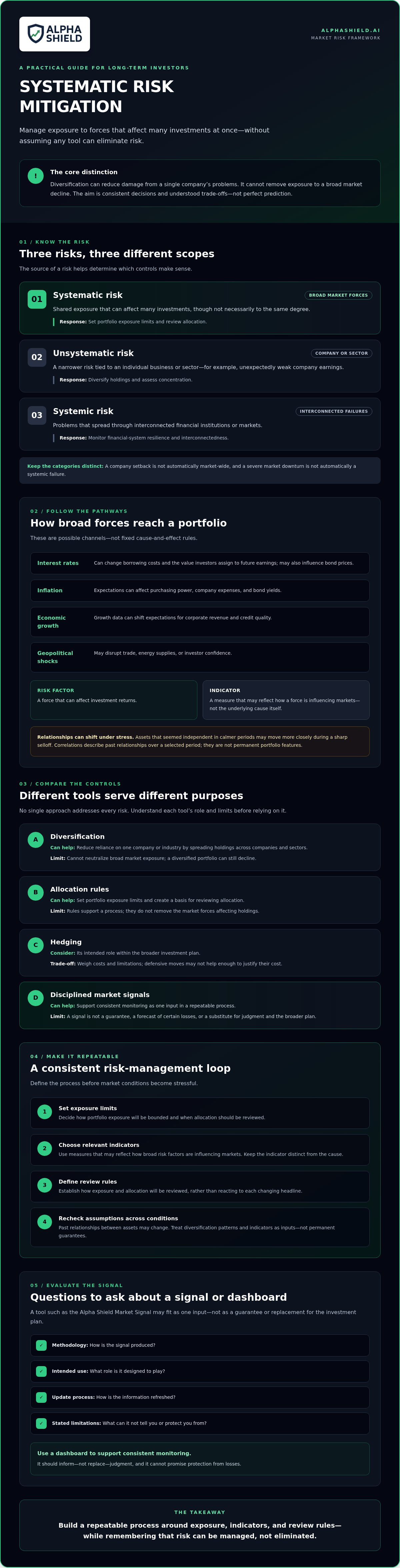
A Repeatable Process for Managing Systematic Risk
A process turns market monitoring into a defined review, rather than a running reaction to every headline. For systematic risk mitigation, decide in advance what you’ll monitor, how often you’ll review it, and what a signal can and cannot trigger. The steps below provide a framework, not a prescribed portfolio response for every investor.
- 1. Define risk limits. Identify the loss, volatility, or exposure conditions that matter to your goals. Clarify what would prompt a review.
- 2. Identify portfolio exposures. Map how holdings may respond to broad forces such as rates, inflation, or slower growth. Note concentrations and liquidity needs.
- 3. Select relevant indicators. Choose measures that relate to the risks you’ve identified. Understand what each one measures and where it may fall short.
- 4. Set review rules. Specify a review schedule and the conditions that call for reassessment. A threshold should start a review, not automatically instruct a trade.
- 5. Document decisions. Record the signal, context, decision, and rationale. This makes later reviews more consistent and helps distinguish a planned response from a reaction.
Set objectives, exposure boundaries, and review rules
Make the limits personal and practical. A long-term investor with near-term cash needs may have different liquidity priorities from someone investing for a distant goal. Consider time horizon, spending needs, and other personal circumstances before deciding what exposure is acceptable or what action might follow a review.
Write the rules while conditions are relatively calm. For example, state which portfolio measure you’ll review, how often you’ll check it, and whether a threshold leads to analysis, consultation, or another planned step. A monitoring threshold is a prompt to assess the situation, not a trade instruction on its own.
Review signals without mistaking them for certainty
Before relying on an indicator, check that its definition is clear, its application is consistent, and it is relevant to the risk you want to monitor. If a signal changes, compare it with your objectives and portfolio exposures rather than treating it as a standalone command. Scheduled reviews can keep short-term noise from displacing the rules you set in advance.
A risk signal is an input to a process, not a guarantee. It can be mistaken, delayed, or incomplete. For context on interpreting market measures, see this guide to macro market risk indicators.
Evaluating a Systematic Risk Mitigation Signal and Dashboard
A signal is useful only if you understand what it measures and how it fits your decisions. Before adding one to a systematic risk mitigation process, assess its methodology, intended use, update process, and limitations. A clear presentation matters, but clarity alone doesn’t establish reliability or make a signal right for every portfolio.
Questions to ask before relying on a market signal
Use these questions to evaluate whether a signal supports your monitoring process:
- What does it measure? Identify the market condition or risk it is designed to reflect. Check whether that aligns with the exposure you want to monitor.
- How should it be interpreted? Look for a clear explanation of what a change in the signal means, and what it does not mean.
- How often is it updated? Understand the update process and whether it matches your review schedule. Don’t assume a signal is real-time unless that is explicitly confirmed.
- Where can it fall short? Check whether the provider discusses false signals, lag, uncertainty, or conditions that may weaken the signal’s usefulness.
- Does it fit your existing process? Consider whether it adds relevant information to your portfolio reviews or risks becoming a standalone instruction detached from your objectives.
A provider should explain limitations as plainly as intended use. If those boundaries are unclear, treat that as a reason to investigate further. A signal can support a decision framework, but it cannot account for every personal circumstance or unexpected market event.
Where Alpha Shield fits in a disciplined process
The Alpha Shield Market Signal and Alpha Shield Dashboard are subscription tools for monitoring market health and portfolio risk. A dashboard can make defined indicators easier to review consistently, helping investors rely less on scattered headlines. Its role is to support structured monitoring, not to determine what every investor should do.
Alpha Shield does not provide individual stock picks, day-trading tools, or shorting strategies. The Market Signal is one input to a broader investment process, not personalized advice or a guarantee against losses. Investors can explore related considerations in this overview of institutional-grade investment signals.
If the approach fits your monitoring needs, Explore the Alpha Shield Market Signal and assess how it may complement your existing review process.
Make Your Risk Process More Consistent
Systematic risk mitigation starts with a clear distinction: diversification can reduce company-specific concentration, but it can’t remove broad market exposure. A repeatable process helps you identify what to monitor, set review rules, and assess portfolio decisions against your time horizon and needs instead of reacting to every headline.
Signals and dashboards can support that discipline, but they have limits. Treat a market signal as one input, not a forecast, guarantee, or substitute for your investment plan. Alpha Shield provides a market signal and dedicated dashboard for monitoring market health and risk. System development began in 2017, and Alpha Shield launched in 2019. Its founders bring over 50 years of combined experience as investment bankers and global markets professionals.
A steadier process won’t remove uncertainty, but it can help you respond with greater clarity and consistency. Build your rules, review them thoughtfully, and keep moving forward with discipline.
Frequently Asked Questions
Can systematic risk be eliminated through diversification?
No. Diversification can reduce concentration in a particular company or sector, but it can’t remove exposure to broad forces that affect multiple investments. A diversified portfolio may still decline during a market-wide selloff, even if its holdings don’t all respond equally. Systematic risk mitigation focuses on understanding and managing that shared exposure through a broader process. No combination of assets guarantees that a portfolio will avoid losses.
What is the difference between systematic risk and systemic risk?
Systematic risk is shared exposure to broad market forces, such as changing interest rates or economic conditions. Systemic risk concerns failures that spread through interconnected financial institutions or markets. A market decline can involve systematic risk without becoming a systemic failure. The distinction helps clarify the problem: investors manage portfolio exposure to market-wide forces, while systemic risk describes potential instability spreading through the financial system.
How can investors mitigate systematic risk?
Investors can manage, but not eliminate, systematic risk by setting an appropriate long-term allocation, diversifying holdings, and defining review rules for portfolio exposure. Some may also assess hedging or market-risk signals while accounting for their limitations. A practical process identifies relevant indicators, sets a review schedule, and documents decisions. Any action should fit the investor’s time horizon, liquidity needs, and personal circumstances rather than follow headlines alone.
Does beta measure all systematic risk?
No. Beta estimates how sensitively an investment has moved relative to a chosen market benchmark over a particular historical period. It can help describe past market exposure, but it doesn’t capture every risk factor, predict future returns, or protect against losses. Its usefulness depends on the benchmark and measurement period. Investors should treat beta as one input, alongside other exposure measures and an understanding of how portfolio holdings may respond to different conditions.
Are market timing signals reliable during a market crash?
No signal can be assumed to work reliably in every crash. A market timing signal may be delayed, produce false readings, or respond differently as market conditions change. Before relying on one, review its methodology, intended use, update process, and disclosed limitations. Alpha Shield’s Market Signal is designed to support long-term market-health and portfolio-risk monitoring. It isn’t a guarantee against losses or a substitute for a broader investment process.
What should a systematic risk dashboard include?
A useful dashboard should make its indicators clear: what each one measures, how often it is updated, and how it relates to the risk being monitored. It should also make limitations and interpretation rules easy to understand. The goal is a consistent view of defined measures, not a stream of alerts that encourages impulsive decisions. Alpha Shield provides a dedicated dashboard for market-health and risk monitoring; check its current materials for specific indicators and update details.
Is systematic risk mitigation the same as shorting or day trading?
No. Systematic risk mitigation is a broader process for monitoring and managing portfolio exposure to market-wide forces. It can involve allocation decisions, diversification, predefined review rules, or signals. Shorting and day trading are distinct trading approaches, not requirements of risk management. Alpha Shield focuses on long-term capital preservation through systematic market timing signals. It doesn’t provide individual stock picks, day-trading tools, or shorting strategies.
Explore the Alpha Shield Market Signal and dashboard to see whether they fit your market-risk monitoring process.


