

What if avoiding emotional investment decisions isn’t about feeling nothing, but about stopping a feeling from making the call? A sharp market drop can make selling feel urgent. A fast rally can make buying seem like the only way to avoid missing out. Conflicting headlines can add noise just when you need a clear next step.
Those reactions are understandable, but they don’t have to set your investment strategy. A written decision process can help you pause, check what has changed, and compare the evidence with your goals and risk limits. It won’t predict the market or remove uncertainty. It gives you a steadier way to respond.
This guide explains how fear and excitement can influence investment choices, challenges common myths about timing the market, and lays out a repeatable process for volatile periods. You’ll learn to identify personal triggers, set decision rules before pressure rises, and consider systematic risk signals as one input, not a substitute for personal judgment. The objective is clarity, not certainty.
Key Takeaways
- Learn why managing emotional reactions is more practical than expecting to eliminate them.
- See how recent market moves and attention-grabbing headlines can shape your perception of risk.
- Recognize common traps, including panic selling, FOMO buying, and holding too tightly to an earlier decision.
- Use a repeatable process for avoiding emotional investment decisions when markets become volatile.
- Understand how a market-risk signal can inform a portfolio review without replacing your plan or judgment.
Avoiding Emotional Investment Decisions Starts by Challenging These Myths
Market volatility can make a familiar investment plan harder to follow. A portfolio review that felt straightforward in calmer conditions may seem less clear when prices move sharply and the outlook is uncertain. The realistic goal isn’t to remove emotion. It’s to notice when a reaction may be influencing a choice, then use a consistent process to decide what deserves attention.
Emotional awareness can create space to check assumptions and revisit the plan. It can’t reveal what markets will do next. Recognizing fear, regret, or excitement is a useful prompt to review your reasoning, not a forecast.
Myth: Good investors make decisions without emotion
Fear, regret, and excitement are normal responses to uncertainty and financial risk. Feeling them doesn’t mean an investor lacks discipline. The decision that follows matters more: does it fit the investor’s goals and rules, or is it mainly a reaction to immediate pressure?
Stress can draw attention toward recent losses or dramatic headlines, making other relevant information harder to weigh. This response varies from person to person. The study of behavioral economics offers a foundation for understanding how psychological factors can shape economic choices. In practice, naming a feeling can prompt a useful check: “What information supports this action beyond how the market feels right now?”
Myth: A confident market forecast removes uncertainty
A forecast is an expectation about what may happen. A market signal is an indicator that can inform a review. Neither guarantees an outcome. Even careful analysis relies on available information and assumptions, while market conditions can change in ways no process can fully anticipate.
Separate what the evidence says from what you expect and what you plan to do if conditions change. This helps prevent a strong opinion from being mistaken for certainty. Disciplined investing means following considered rules while accepting that outcomes remain uncertain.
For investors focused on avoiding emotional investment decisions, the practical lesson is clear: don’t wait to become emotionless or certain. Build awareness, check the evidence, and keep decisions connected to a plan. That approach supports deliberate choices without pretending to control the market.
Why Fear, Excitement, and Headlines Can Distort Investment Choices
Behavioral finance examines how psychological influences shape financial decisions. It helps explain why investors may weigh information unevenly, especially when markets move quickly. Attention, memory, and recent experience can affect how risk feels, even when an investor’s long-term goals haven’t changed.
After a sharp decline, for example, recent losses may come to mind more readily than earlier market movements. A strong rally can have the opposite effect, making recent gains seem like evidence that prices will keep rising. These are possible patterns, not universal responses. They show why it can help to compare your current impression with a written plan and a broader range of evidence.
How loss aversion and confirmation bias affect judgment
Loss aversion describes the tendency to feel a loss more strongly than a comparable gain. An investor may focus on avoiding another decline and consider selling, even if the reasons for holding the investment haven’t changed. Confirmation bias is the tendency to favor information that supports an existing view. Someone convinced that a market recovery is underway, for instance, may give upbeat reports more weight than conflicting evidence.
Neither tendency determines what every investor will do, but either can narrow a review. To counter that, ask: “What evidence would challenge my current view?” Then consider whether the information changes your goals, time horizon, or agreed risk limits, rather than simply reinforcing a preference.
Why market headlines can intensify emotional reactions
Urgent or repeated coverage can keep a short-term event in focus, making it feel more consequential than it may be to a long-term plan. A headline can describe a real development, but it doesn’t automatically mean your time horizon or acceptable risk has changed. Separate the event from the decision: what happened, what reliable evidence supports its significance, and does it meet a condition you set in advance?
Market noise is information that attracts attention; a decision trigger is a condition you defined in advance. That distinction makes avoiding emotional investment decisions more practical: assess whether new evidence meets your criteria before acting on the urgency of the coverage.
For a structured view of market-health and risk indicators, investors can review the Alpha Shield Dashboard as one input to their process. Indicators can inform a portfolio review, but they don’t predict outcomes or replace personal judgment.
Common Emotional Investing Traps, and What They Actually Mean
An emotional reaction can signal that it’s time to review a decision. It isn’t, by itself, a reason to buy or sell. The useful distinction is between an impulse driven by immediate pressure and a response that fits your written goals, time horizon, and risk limits.
Use the table to identify a possible trigger, then pause and ask a question before acting. These patterns aren’t universal. They’re prompts for a more deliberate review.
| Trap | Possible trigger | Pause and ask |
|---|---|---|
| Panic selling | A sharp decline or fear of further losses | Does selling follow a written risk limit, or only my discomfort right now? |
| FOMO buying | A fast rally or talk of others’ gains | Does this purchase fit my goals and risk tolerance? |
| Recency bias | Recent market moves dominate expectations | Am I treating a short-term move as proof of what comes next? |
| Reluctance to revisit a decision | Admitting new information may challenge an earlier choice | Would I make the same decision today, based on current evidence? |
Panic selling and the urge to avoid further losses
A sharp decline may create an urge to sell simply to stop the immediate discomfort. Before acting, check whether the decision follows a risk limit you set in advance or responds only to the latest move. Neither holding nor selling is automatically right in every situation. The relevant test is whether the choice reflects your plan and current circumstances. For a rules-based framework, see this guide on when to exit the stock market.
FOMO buying and overconfidence after a market rally
A rally can make an investment seem urgent, especially when it appears others are benefiting. A recent rise doesn’t establish what prices will do next. Before increasing exposure, compare the proposed action with your stated goals, time horizon, and tolerance for risk. If the case depends mainly on not wanting to miss out, take time to reassess.
These checks are practical tools for avoiding emotional investment decisions. They don’t remove uncertainty. They help ensure that a reaction leads to a plan review, not an automatic trade.
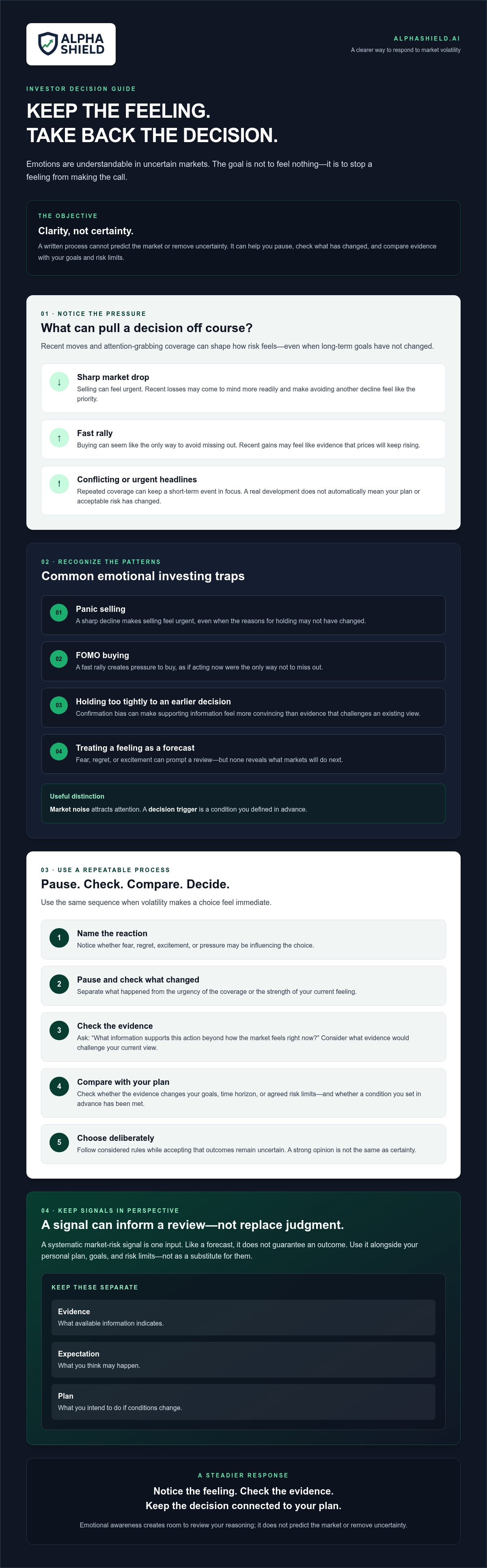
A Repeatable Process for Avoiding Emotional Investment Decisions
A simple sequence can create space between a market event and your response. Set it out before stress rises, when it’s easier to think clearly. Record your goals, time horizon, and acceptable level of risk in advance. Then use the same steps whenever you’re considering a meaningful portfolio change.
- Pause. Step back from the urge to act immediately. If the decision feels urgent, give yourself time to review it.
- Identify the trigger. Name what prompted the decision: new evidence, a market move, a headline, or a strong emotional response.
- Check the plan. Compare the proposed action with your goals, time horizon, diversification, and risk tolerance.
- Assess the evidence. Separate observable information from assumptions. Ask whether it changes your original reasoning or meets a condition you defined in advance.
- Document the decision. Note the reason, supporting evidence, and intended time horizon. If you decide to wait, record what would prompt another review.
This process for avoiding emotional investment decisions isn’t a formula for predicting markets. It makes your reasoning visible and gives you a consistent way to review a proposed action.
Write decision rules before volatility tests them
Document the conditions that would prompt a portfolio review without trying to guess a perfect threshold. For each possible action, record why you might take it, what evidence you’d want to see, and how long the decision is intended to serve your plan. For more context on systematic analysis, read about institutional-grade signals for individual investors.
Use a pause-and-review checklist before acting
Before changing your portfolio, ask: Did new evidence trigger this, or mainly a strong reaction? Does the action still fit my goals, diversification, and risk tolerance? A regular review schedule can help separate routine decisions from the pressure of constant updates. For background on monitoring market phases, see this guide to market cycle indicators for investors.
A checklist can support clear thinking, but it can’t account for every personal circumstance. If you need guidance tailored to your financial situation, consider speaking with a qualified financial professional.
How Systematic Market Signals Can Support More Disciplined Decisions
A market-risk signal can add structure to a portfolio review. Rather than treating each urgent headline as a prompt to act, consider a consistent indicator alongside your written plan and the evidence behind a proposed change. The signal can frame a question: does the current market-risk picture warrant reviewing my exposure? It doesn’t determine what any individual investor should do.
Headlines can highlight important developments, but their urgency and frequency may pull attention toward short-term events. A systematic signal offers a consistent reference point, though it has limits too. It may lag, change as conditions evolve, or fail to anticipate an unexpected event. Neither headlines nor signals remove uncertainty. For a broader discussion of monitoring approaches and their limits, see this guide to global market risk monitoring.
What a market-risk signal can, and cannot, do
A signal can provide structured information to consider during a portfolio review. It is not a prediction with a guaranteed result, a personal instruction, or a substitute for assessing your objectives and risk tolerance. It is also not an individual stock recommendation and can’t guarantee protection from losses. Use it as one input, then check what it measures, what it may miss, and whether it’s relevant to your own decision rules.
Where Alpha Shield fits in a decision process
Alpha Shield Market Signal and the Alpha Shield Dashboard are designed to help investors monitor market risk through market-health and risk indicators. They can provide a systematic input to a review, alongside personal goals, portfolio context, and other relevant evidence. Alpha Shield focuses on long-term risk awareness. It doesn’t provide day-trading tools, shorting strategies, or individual stock recommendations.
For investors avoiding emotional investment decisions, a signal is most useful when it supports a process rather than replaces one. If an indicator prompts a review, return to your written criteria and decide whether the evidence warrants a change. If it doesn’t meet your conditions, a headline or signal alone need not dictate an action.
Make Your Next Investment Decision More Deliberate
A practical approach to avoiding emotional investment decisions starts with recognizing a reaction, then checking it against your goals, time horizon, and risk limits. A pause-and-review process can help you separate new evidence from urgency. A market-risk signal may add structured context, but it can’t predict outcomes or replace your judgment.
Alpha Shield’s system development began in 2017, and the service launched in 2019. It was founded by former investment bankers and global markets professionals with over 50 years of combined experience. The Alpha Shield Market Signal and dashboard are designed to support market-risk awareness for long-term investors, not to provide individual stock recommendations or guarantee protection from losses.
If systematic risk monitoring could support your review process, explore the Alpha Shield Market Signal and dashboard.
You don’t need certainty to make a considered choice. Build a process you can return to when markets get noisy, and take the next step with greater clarity.
Frequently Asked Questions
How can I stop making emotional investment decisions?
You can’t control every reaction, but you can create a process that slows decisions down. Pause, identify what triggered the urge to act, check your written goals and risk limits, assess the evidence, and document your reasoning. For avoiding emotional investment decisions, define your time horizon and acceptable risk before markets become stressful. Review your portfolio on a consistent schedule instead of treating every headline as a reason to trade.
Is it possible to invest without emotion?
No. Fear, excitement, and regret are normal responses to uncertainty, and feeling them doesn’t mean you lack discipline. The practical aim is to notice when an emotion may be shaping your judgment and then check the decision against your plan. For example, a sudden urge to sell is a reason to review your criteria, not automatic proof that selling is right or wrong.
Why do investors make decisions based on fear or greed?
Uncertainty can make potential losses feel urgent, while a rising market can create pressure to join in before an opportunity seems to pass. Attention may also focus on recent price moves or headlines, leaving less room to consider longer-term goals. These influences don’t affect everyone in the same way. Recognizing them can help you pause and assess whether an action is supported by evidence and your investment plan.
What should I do before selling investments during a market downturn?
Before selling, check whether the decision follows a risk limit or other rule you set in advance. Ask what has changed in your circumstances, goals, or the evidence behind your original decision. Separate those factors from the immediate discomfort of seeing prices fall. Consider how a sale could affect your broader portfolio and time horizon. If your personal situation makes the choice unclear, seek guidance from a qualified financial professional.
Can a market signal prevent emotional investing?
No. A market signal can provide structured information for a portfolio review, but it can’t remove emotions, predict every market move, or guarantee protection from losses. Alpha Shield Market Signal and the Alpha Shield Dashboard are designed to help investors monitor market risk. Treat a signal as one input alongside your goals, risk tolerance, and other relevant evidence, not as an individual stock recommendation or an instruction to trade.
Do rules-based investment decisions guarantee better results?
No. Rules can make decisions more consistent and help limit impulsive reactions, but they don’t guarantee better returns or prevent losses. Markets remain uncertain, and a rule may need review if your goals, time horizon, or financial circumstances change. A sound process records the reason for an action, the evidence considered, and how the decision fits your plan. For personal advice, consult a qualified financial professional.


