

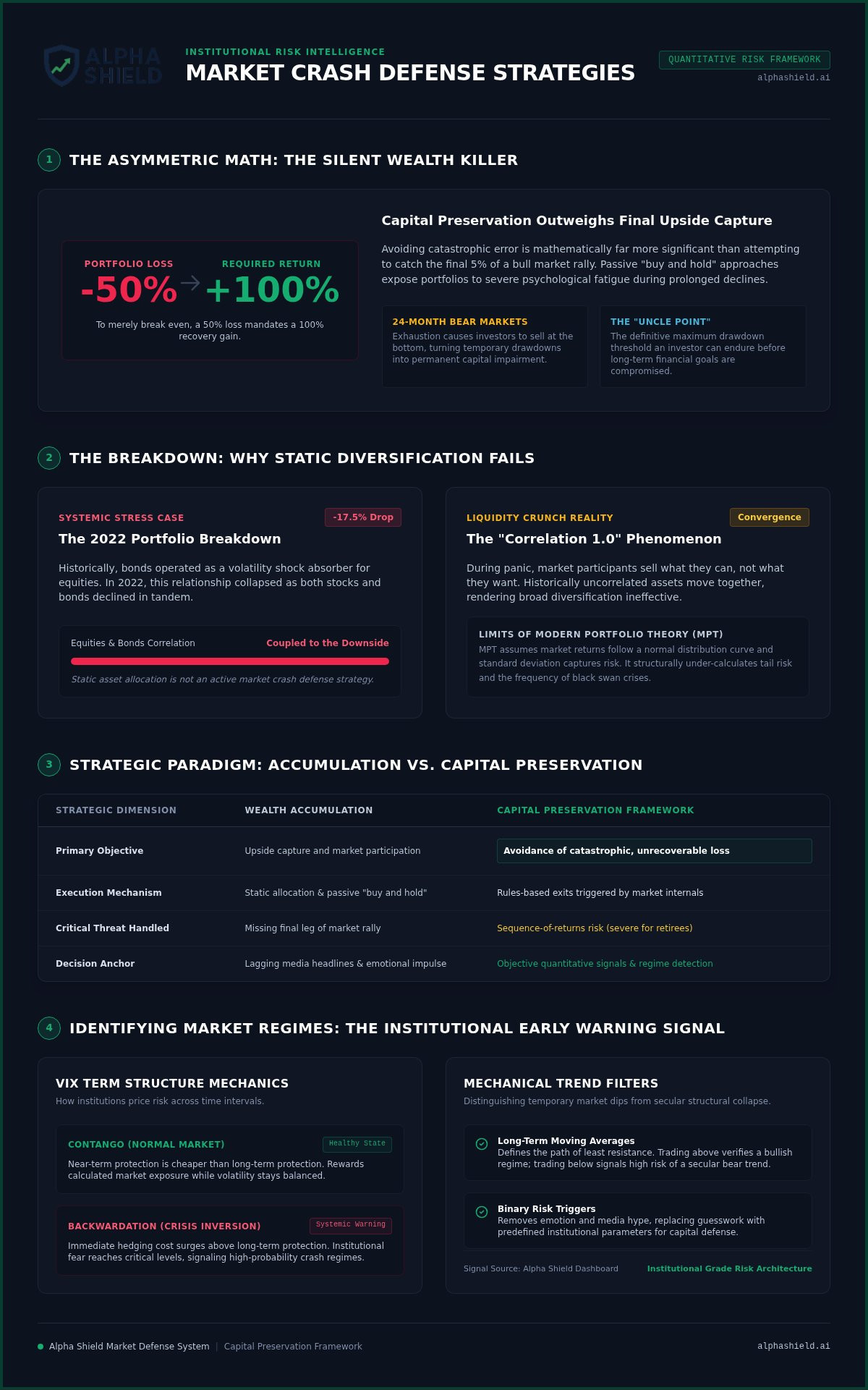
A 50% loss requires a 100% gain just to break even. This asymmetric math is the silent killer of long-term wealth. Most investors rely on traditional diversification as their primary market crash defense strategies, yet they often find that "safe" assets fail exactly when they are needed most. During the 2022 breakdown, a standard 60/40 portfolio dropped 17.5% because equities and bonds fell in tandem. If your protection depends on hope rather than data, you are exposed to catastrophic error.
You understand that contradictory media advice and portfolio volatility create a cycle of constant stress. It's time to replace emotional reactions with institutional discipline. You will learn why static diversification is a fair-weather friend and how to implement a data-driven, rules-based system to preserve your capital. This article examines how monitoring the VIX term structure provides a rational anchor in a volatile environment. We will outline the mechanics of a clear, emotion-free exit strategy and the use of institutional-grade risk signals to reduce drawdowns during bear markets.
Key Takeaways
- Understand why traditional diversification fails when asset correlations converge during systemic crises, rendering the 60/40 portfolio an unreliable hedge.
- Learn to identify high-risk market regimes by monitoring VIX term structure and volatility behavior rather than reacting to financial media noise.
- Discover how to implement data-driven market crash defense strategies that replace emotional intuition with objective, rules-based execution.
- Establish a systematic capital preservation framework by defining your maximum drawdown tolerance and setting precise, binary exit triggers.
- Explore how the Alpha Shield Market Signal and Dashboard provide the institutional-grade clarity needed to navigate complex market environments with discipline.
Why Traditional Diversification Fails During a Market Crash
Traditional diversification is often marketed as the only free lunch in finance. This premise holds during normal market cycles when asset classes move independently. However, during a systemic crisis, this protection frequently evaporates. We call this the "Correlation 1.0" phenomenon. In a liquidity crunch, investors sell what they can, not what they want. Assets that appeared uncorrelated during periods of growth suddenly move in lockstep to the downside. When panic peaks, the benefit of holding a broad basket of assets disappears.
The 60/40 portfolio is a primary victim of this shift. Historically, bonds acted as a shock absorber for equity volatility. In 2022, this relationship broke. A standard 60/40 allocation suffered a 17.5% decline as both stocks and bonds fell simultaneously. This failure proves that static asset allocation is not a substitute for active market crash defense strategies. Relying on historical correlations during a regime shift is a dangerous gamble with your principal.
The math of recovery is unforgiving. As established, a 50% drawdown requires a 100% gain just to return to break even. Passive "buy and hold" strategies ignore the psychological and financial toll of these events. Watching years of gains vanish over a 24-month bear market often leads to emotional exhaustion. This exhaustion frequently triggers a "sell at the bottom" response, locking in permanent capital impairment that takes a decade to repair.
The Limits of Modern Portfolio Theory
Modern Portfolio Theory (MPT) relies on standard deviation to measure risk. This model assumes market returns follow a normal distribution curve. It fails to account for tail risk or "black swan" events that occur more frequently than the models suggest. Historical averages are misleading during periods of structural change. Over-diversifying into "alternative" assets often creates a false sense of security; many of these products are simply highly correlated equity bets with higher fees and lower liquidity.
Capital Preservation vs. Wealth Accumulation
Wealth accumulation focuses on upside capture. Capital preservation focuses on the avoidance of catastrophic error. For those nearing or in retirement, sequence-of-returns risk is the primary threat. A major loss early in the withdrawal phase can permanently impair a portfolio's longevity. Effective market crash defense strategies prioritize the "uncle point," which is the maximum drawdown you can tolerate before your long-term goals are compromised. Avoiding the big loss is mathematically more significant than catching the final 5% of a bull market rally.
Identifying Market Regimes: The Mechanics of High-Risk Periods
Markets don't move in a vacuum. They operate within distinct regimes. A market regime is a persistent environment characterized by specific volatility and trend behaviors. Identifying these regimes is the foundation of institutional market crash defense strategies. Most retail investors follow news headlines. This approach is flawed. Headlines are lagging indicators. They describe the past. Market internal metrics describe the present. A quiet regime rewards participation. A turbulent regime demands protection. If volatility spikes and trends break, the system must pivot. Logic, not emotion, dictates this transition.
The VIX Term Structure as a Warning Signal
The CBOE Volatility Index (VIX) is more than a "fear gauge." Its futures curve reveals how institutions are hedging. In a healthy market, the curve is in contango; near-term protection is cheaper than long-term protection. When the curve shifts to backwardation, the cost of immediate protection surges. This inversion signals that institutional fear has reached a critical threshold. The VIX term structure acts as a high-fidelity predictive tool that captures systemic market stress before price action fully reflects the danger. By managing market volatility through curve analysis, you gain an information advantage over the general public.
Trend Following and Macro Momentum
Trend following provides the mechanical filter for price action. We use long-term moving averages to define the path of least resistance. If the market trades above these levels, the bullish regime remains intact. If it breaks below, the probability of a secular bear market increases. It's vital to distinguish a temporary dip from a structural collapse. Systematic market crash defense strategies ignore the daily noise of the financial press. They focus on the underlying momentum that drives capital flows. This objective framework ensures you aren't caught in a "buy the dip" trap during a liquidity crisis. You can observe these regime shifts through the Alpha Shield Dashboard, which translates complex data into actionable risk signals.
Quantitative Defense vs. Emotional Reactivity
Biological survival instincts are a liability in capital markets. Fear triggers a flight response that often results in selling at the nadir of a crisis. This behavioral gap is where years of compounding are permanently erased. Effective market crash defense strategies don't rely on human intuition. They rely on quantitative triggers that function without bias. Discretionary investing assumes a human can outthink a liquidity cascade. A systematic approach acknowledges that they can't. It replaces the "gut feeling" with a mathematical framework.
The financial media functions as an urgency engine. It thrives on sensationalism to capture attention. This creates a noise floor that obscures structural reality. A professional strategist ignores this urgency. By subtracting the hype, you clarify the objective path. We view simplicity as a luxury. Reducing complex macroeconomic data to a binary "In" or "Out" signal is the ultimate achievement in risk management. It removes the need for constant interpretation and prevents the paralysis caused by conflicting opinions.
Removing Human Bias from Risk Management
Loss aversion and recency bias are cognitive traps. Loss aversion causes investors to hold losing positions too long, hoping for a rebound that may not come. Recency bias makes them believe a current crash will continue indefinitely, preventing a timely re-entry. A rules-based system provides the discipline to exit when the signal dictates, regardless of how it feels. This objective validation acts as a circuit breaker for the ego. It ensures that market crash defense strategies are executed with clinical precision during periods of maximum stress.
Clarity Over Complexity
Most investors fail because they track too many conflicting indicators. When data points contradict each other, decision-making stalls. The institutional approach prioritizes one reliable signal over ten noisy ones. This focus allows for emotional detachment from portfolio fluctuations. While general asset allocation and rebalancing provide a baseline for risk, they often lack the agility to navigate a rapid regime shift. High-fidelity risk signals filter out the chaos. If the data indicates a regime flip, the system exits. There is no debate. This mechanical clarity reduces the mental load of complex decision-making and transforms a volatile environment into a series of logical steps.
Implementing a Systematic Capital Preservation Framework
A robust plan requires a mechanical sequence. You cannot build a defense during the storm. You must calibrate the engine before the regime shifts. Effective market crash defense strategies follow a four-step execution cycle that replaces hesitation with discipline.
Step 1 involves defining your "Uncle Point." This is the absolute maximum drawdown your portfolio can sustain before your long-term financial security is compromised. It's a hard number. It's not a suggestion. If your strategy allows for a 15% drawdown, you must have a plan to halt losses at that exact threshold.
Step 2 establishes objective entry and exit triggers. These are based on the volatility metrics and trend following discussed in previous sections. If the VIX curve inverts and prices break below the long-term moving average, the signal flips. There is no room for interpretation here. The data dictates the state.
Step 3 determines your safe haven asset. During high-risk regimes, capital must rotate into preservation assets. This might include cash, 1-3 Month T-Bill ETFs such as BIL, or short-term Treasuries. The goal is liquidity and principal stability, not yield.
Step 4 is execution. You must act without hesitation when the signal triggers. Delaying by even one session can significantly increase drawdown exposure. In a liquidity cascade, speed is a form of risk management.
The Exit Strategy: Moving to Safety
Moving to cash is a valid tactical decision. It's not "missing out"; it's a deliberate capital preservation maneuver. High-risk regimes often feature sharp "dead cat bounces." These short-term relief rallies trigger FOMO in undisciplined investors. A systematic framework ignores these bounces unless the underlying regime metrics normalize. Re-entry is governed by the same data-driven rules as the exit. When the trend resumes and volatility subsides, the system signals a return to risk assets. This prevents the "whipsaw" effect that destroys capital during choppy bear markets.
Protecting Retirement Accounts (401k/IRA)
Retirement accounts often have limited investment menus. You don't need complex shorting strategies to protect these assets. Most 401k plans offer money market funds or stable value funds. When a risk-off signal occurs, shifting equity allocations into these vehicles preserves years of contributions. This tactical shift is essential for long-term wealth preservation. You can learn more about this approach in our guide on Alpha Shield: The Systematic Market Signal for Capital Preservation.
Navigating Volatility with Alpha Shield Market Signals
Market forecasting is often a game of speculation. Most financial media outlets focus on "what might happen" in the next quarter. This approach is inherently flawed because it relies on predictions rather than reality. Alpha Shield rejects this model. Our system focuses exclusively on "what is happening" right now. The Alpha Shield Market Signal decodes global risk into actionable clarity by filtering out the noise of the news cycle. It transforms complex market mechanics into a disciplined, rules-based instruction. This is the core of professional market crash defense strategies. It replaces the uncertainty of the retail environment with the stability of institutional-grade data.
The system operates with the confidence of a seasoned professional. It prioritizes capital preservation over speculative excitement. If the data indicates a regime shift, the signal changes. There is no debate. There is no emotional hesitation. This structural simplicity strips away the complexity of the financial world. It provides you with a clear, unobstructed path to understanding market risk. By focusing on systematic calculation, you avoid the catastrophic errors that define retail trading. Clarity is the ultimate luxury in a volatile market.
The Power of the Systematic Signal
The signal identifies high-risk regimes before catastrophic drawdowns occur. It evaluates the VIX term structure and trend velocity to determine the current market state. The Alpha Shield Dashboard provides real-time risk calibration for the modern investor. This professional toolset allows you to monitor market health with the same precision used by institutional desks. It filters out the noise of the financial media and presents a single, actionable instruction. Alpha Shield removes the guesswork from market timing by providing a binary instruction based on verified quantitative metrics. If the signal is "OUT," the system prioritizes principal preservation. If it is "IN," the system captures broad equity momentum.
Your Rational Anchor in Market Chaos
Navigating a volatile market requires absolute emotional detachment. This is difficult to achieve when your capital is at risk. Joining a community of disciplined, long-term focused investors provides a collective focus on security. You benefit from a battle-tested system led by former investment bankers with 50 years of institutional experience. This expertise provides the peace of mind that comes from a rational anchor in a chaotic environment. You don't need to predict the future to protect your wealth. You only need to respond correctly to the present data. Systematic rigor is the only reliable defense against market uncertainty.
Securing Your Wealth Through Systematic Discipline
True capital preservation requires moving beyond the passive hope of traditional diversification. You now understand that high-risk regimes are identifiable through objective metrics like the VIX term structure and long-term trend analysis. By implementing a rules-based framework, you replace emotional reactivity with institutional precision. This ensures that your market crash defense strategies are executed with clinical detachment when the environment shifts from quiet to turbulent.
Alpha Shield provides the rational anchor needed to navigate these transitions. We don't offer hype, speculative stock picks, or day-trading tools. Instead, we provide a systematic, data-driven signal developed by former investment bankers with 50 years of institutional experience. Our focus remains solely on capital protection and the avoidance of catastrophic error. This methodical approach transforms market chaos into a series of logical, actionable steps. It provides the clarity required to maintain your long-term financial security.
Protecting your long-term wealth is a matter of professional discipline, not guesswork.
Frequently Asked Questions
Is market timing actually possible for individual investors?
Yes, but it's only effective when you use a systematic, data-driven approach rather than discretionary guessing. Institutional investors use volatility regimes to time exits with precision. Individual investors can replicate this by following objective signals like the VIX term structure. It's not about predicting the exact top. It's about identifying when the risk-to-reward ratio has structurally shifted against you.
What is the difference between hedging and capital preservation strategies?
Hedging typically involves using derivatives like put options to offset losses, which can be expensive and complex. Capital preservation strategies focus on reducing exposure to risk assets during high-volatility regimes. Instead of paying for insurance, you rotate into safe havens like cash or short-term Treasuries. This method avoids the cost of premium decay while protecting your principal during a liquidity crisis.
How do I know if a market dip is the start of a crash?
You must look at market internal metrics rather than price action alone. A normal dip occurs while the VIX term structure remains in contango and prices stay above long-term moving averages. A crash typically begins when these indicators flip. If the volatility curve moves into backwardation and trend momentum breaks, the regime has changed. These quantitative signals are the core of effective market crash defense strategies.
Why shouldn't I just buy and hold through a 50% drawdown?
The math of recovery is punitive. A 50% loss requires a 100% gain just to reach break-even, which can take a decade or more to achieve. For investors nearing retirement, this sequence of returns risk can be catastrophic. Systematic capital preservation avoids these deep drawdowns, allowing your portfolio to compound from a higher base. Protecting your principal is mathematically superior to enduring a multi-year recovery cycle.
Does Alpha Shield recommend specific stocks to buy during a crash?
No, Alpha Shield doesn't provide individual stock recommendations or day-trading tools. The service focuses on broad market risk signals and capital preservation. We provide a binary IN or OUT instruction based on the overall market regime. Our goal is to help you manage total portfolio risk by identifying when to move to safety, rather than speculating on which individual companies might outperform during a downturn.
Can I use these defense strategies for my 401k or retirement account?
Yes, systematic signals are highly effective for retirement accounts with limited investment menus. When the signal triggers an OUT instruction, you can move your equity allocations into the plan's money market fund or stable value fund. This tactical shift protects your contributions from systemic declines without requiring complex instruments. It's a professional way to manage 401k risk using institutional-grade market crash defense strategies.
What are the most reliable macro market risk indicators in 2026?
The VIX term structure remains the most reliable high-fidelity indicator of institutional fear. Specifically, the relationship between spot VIX and its futures months reveals structural stress. Additionally, long-term trend following and the Fed's benchmark interest rates, currently at 3.75% to 4.00%, provide essential context. Monitoring these metrics through the Alpha Shield Dashboard ensures you're responding to data rather than media noise or speculation.
What happens if I miss the market bottom while waiting for a signal?
Systematic strategies prioritize the avoidance of catastrophic error over catching the absolute bottom. Waiting for a re-entry signal ensures the market has returned to a stable, low-volatility regime. While you might miss the first few percentage points of a rally, you avoid the whipsaw of false bounces. Long-term wealth is built by participating in sustained uptrends and avoiding the heart of major bear markets.


