

Traditional diversification doesn't protect capital during structural regime shifts; it merely ensures an investor participates in simultaneous liquidations. When equities and fixed income decline together, passive allocation exposes its mathematical vulnerabilities. True portfolio defense requires systematic capital preservation, an objective, rules-based discipline that isolates capital protection from speculative market timing.
You've likely experienced the frustration of watching core wealth evaporate during sudden market shocks while conventional models failed to respond. Reacting to sensational financial headlines triggers emotional, discretionary allocation mistakes, disrupting the compounding mathematics essential to long-term wealth. You shouldn't have to choose between absorbing catastrophic drawdowns and parking your assets permanently in cash.
This guide demonstrates how institutional investors use quantifiable regime models to shield portfolios from severe market drawdowns without shorting, day trading, or speculative guesswork. We analyze the breakdown of traditional balanced portfolios, explain the mechanics of volatility filtering, and preview the rules-based architecture that secures capital across volatile market cycles.
Key Takeaways
- Understand the mathematical asymmetry of losses, where preventing steep portfolio drawdowns protects long-term compound capital far better than chasing speculative upside.
- Discover how institutional systematic capital preservation replaces subjective market forecasting with quantifiable indicators of systemic risk.
- Examine why static 60/40 asset allocation breaks down during liquidity contractions, requiring dynamic regime-filtering instead of passive correlation assumptions.
- Learn the five-step non-discretionary framework that eliminates human hesitation through predefined, objective portfolio allocation triggers.
- See how institutional risk monitoring translates into simple, visual signals via tools like the Alpha Shield Dashboard without resorting to shorting or day trading.
The Mathematics of Portfolio Survival: Why Capital Preservation Precedes Growth
Most investors focus entirely on upside returns. Institutional allocators recognize that avoiding severe drawdowns drives long-term compound wealth far more effectively. Systematic capital preservation is an objective, rules-based methodology designed to eliminate exposure during tail-risk events without discretionary guesswork. Modern discipline within financial risk management prioritizes geometric mean returns over volatile peak gains. Capital defense must precede capital expansion.
The Geometric Asymmetry of Compounding Losses
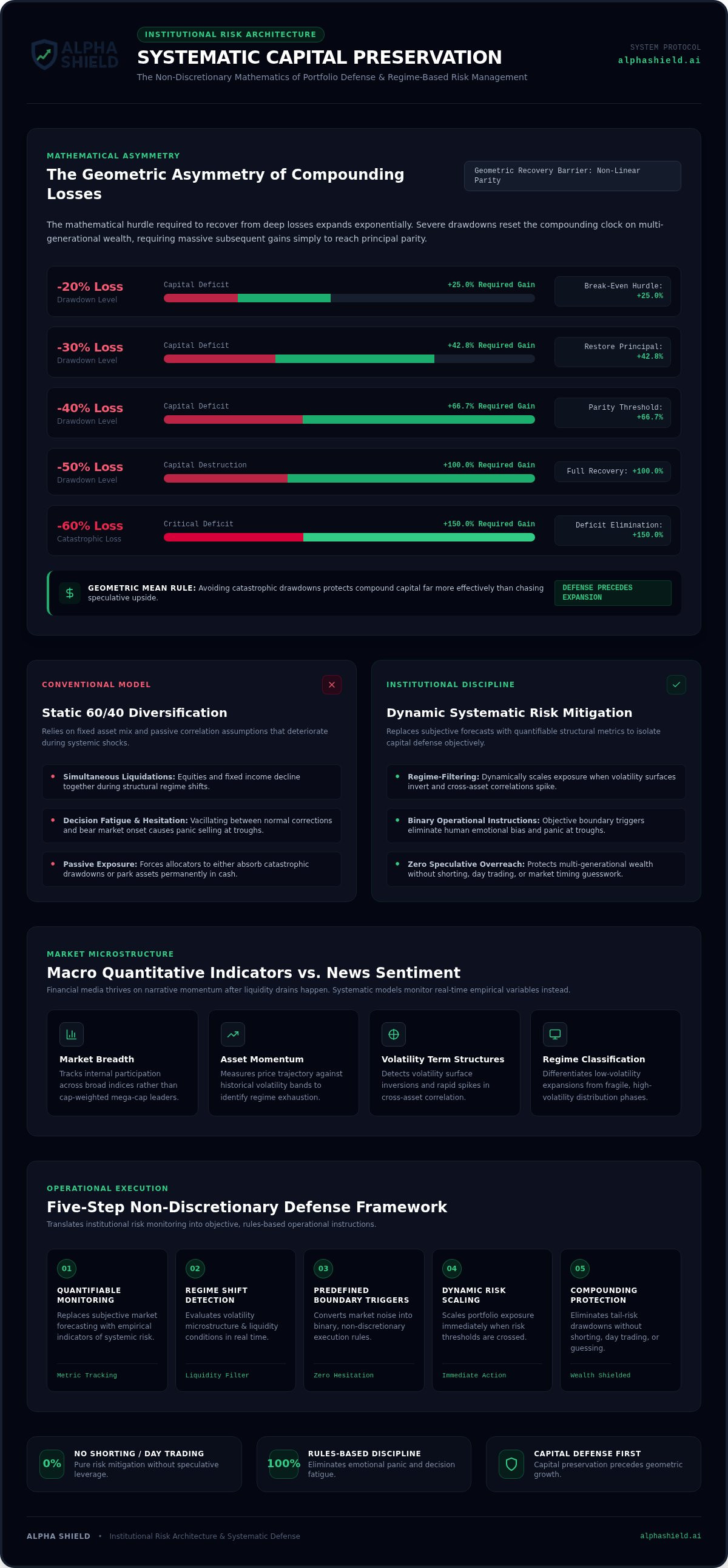
The mathematical hurdle required to recover from deep losses is non-linear. Minor drawdowns are manageable, but severe capital destruction introduces exponential recovery barriers:
- 20% loss: Requires a 25% gain simply to break even.
- 30% loss: Requires a 42.8% gain to restore principal.
- 40% loss: Requires a 66.7% gain to reach parity.
- 50% loss: Requires a 100% gain to fully recover.
- 60% loss: Requires a staggering 150% gain just to eliminate deficit.
A catastrophic year resets the clock on multi-generational wealth. When a portfolio absorbs a 50% hit, years of future compounding are consumed merely recovering lost principal. Eliminating these severe contractions removes the pressure to chase high-risk, speculative yields to get back on schedule.
The Cost of Emotional and Discretionary Hesitation
Discretionary management introduces cognitive friction during sudden market liquidations. When portfolio values plunge, human panic peaks, leading investors to sell near cycle troughs. Emotional bias transforms temporary volatility into permanent capital loss.
Discretion creates decision fatigue. Investors vacillate over whether a drop is a routine correction or the onset of a bear market. Rules-based systematic capital preservation resolves this uncertainty by converting complex, emotional market noise into binary, operational instructions. If risk metrics cross a predefined boundary, the framework scales defense immediately, removing hesitation from the portfolio equation entirely.
Core Mechanics of Systematic Capital Preservation Models
Conventional wealth management often treats risk defense as a passive retreat into cash or money market funds. True systematic capital preservation operates dynamically. It replaces subjective economic forecasts with quantifiable market structure metrics, moving capital out of harm's way only when structural conditions deteriorate.
Market Regime Classification and Volatility Signals
Markets operate in distinct regimes: persistent, low-volatility expansions and fragile, high-volatility distribution phases. Lagging macroeconomic reports like GDP or quarterly earnings don't capture real-time stress. Quantitative architectures evaluate market microstructure, volatility term structures, and liquidity conditions instead.
When volatility surfaces invert and cross-asset correlations spike, systemic fragility climbs rapidly. Macro regulatory frameworks, such as the Office of Financial Research's Bank Systemic Risk Monitor, demonstrate how institutions track structural vulnerabilities across financial systems. Dynamic models apply this exact discipline to portfolio exposure. If volatility metrics cross pre-calculated thresholds, the allocation protocol scales back exposure immediately.
Macro Quantitative Indicators vs. Financial News Sentiment
Financial media thrives on narrative momentum. Headlines follow price action rather than driving it, creating emotional whiplash for allocators who rely on commentary. By the time a headline reports a crisis, the institutional liquidity drain has already occurred.
Systematic architectures strip away sensationalism by monitoring empirical variables:
- Market breadth: Tracking internal participation across broad indices rather than cap-weighted mega-cap leaders.
- Asset momentum: Measuring price trajectory against historical volatility bands to identify regime exhaustion.
- Term structure shifts: Decoding pricing pressures in volatility futures to detect institutional hedging activity.
This process evaluates whether underlying market internals support index price levels. When divergence expands, systematic capital preservation models execute defensive measures automatically. Investors seeking to eliminate subjective bias can monitor these structural regime shifts through the Alpha Shield Dashboard, maintaining institutional discipline without falling prey to financial media sentiment.
Static Asset Diversification vs. Dynamic Systematic Risk Mitigation
The standard 60/40 portfolio relies on an unproven assumption: equities and fixed income remain negatively correlated during market crises. That assumption fails when liquidity dries up. When central banks tighten policy or inflation accelerates, stocks and bonds frequently decline together. Passive asset diversification doesn't eliminate systemic risk. It distributes your exposure across declining asset classes.
The Breakdown of Traditional Fixed-Income Buffers
During liquidity shocks, asset correlations converge toward one. Rising rate environments penalize long-duration sovereign debt, stripping Treasuries of their traditional role as a safe harbor while equity valuations contract. In these scenarios, static asset allocation offers false comfort.
Cash and ultra-short instruments serve as the ultimate defensive buffer during liquidations. With 3-month Treasury bills yielding 4.11% as of late September 2026, liquidity preserves purchasing power without duration risk. Holding cash isn't an admission of defeat. It's a calculated, temporary position that isolates capital from systemic contractions.
Static Exposure vs. Binary Regime-Based Allocation
Binary regime allocation replaces passive buy-and-hold strategies with rules-based precision. The portfolio holds risk assets during measurable market expansions and rotates into short-term liquidity when systemic risk surfaces. This structural shift eliminates catastrophic exposure while keeping capital positioned for broad market trends.
| Portfolio Dimension | Static 60/40 Model | Dynamic Systematic Capital Preservation |
|---|---|---|
| Core Philosophy | Passive buy-and-hold; relies on historical negative correlation. | Rules-based regime filtering; moves to liquidity during systemic stress. |
| Drawdown Management | Absorbs full market drawdowns; relies on eventual recovery. | Cuts market exposure dynamically when structural risk parameters trigger. |
| Decision Framework | Calendar rebalancing regardless of macro conditions. | Objective, quantitative triggers; eliminates discretionary emotional bias. |
| Recovery Requirements | Severe contractions force prolonged multi-year breakeven hurdles. | Preserves core principal, allowing compounding to resume immediately. |
Systematic capital preservation removes the drag of secular bear markets. Passive target-date funds spend years climbing out of multi-year deficits. Dynamic models step aside during prolonged distribution cycles, securing capital until quantitative indicators confirm market structure has stabilized.
Designing a Non-Discretionary Portfolio Defense Framework
Executing an institutional defense protocol requires operational certainty. When market conditions deteriorate, discretionary decision-making introduces emotional friction. A disciplined framework replaces instinct with a sequential five-step process: establish quantitative risk baselines, track structural indicators for regime decay, execute binary de-risking upon trigger confirmation, maintain defense during liquidity contractions, and re-allocate systematically when market health returns.
Establishing Objective Liquidity and Risk Triggers
Rules must govern execution. A systematic capital preservation model tracks empirical measures like volatility term-structure inversions and market breadth collapse. When these metrics breach predefined thresholds, capital shifts immediately into capital-preservation assets. Waiting for macroeconomic confirmation or trusting gut feelings exposes portfolios to cascading downside. Investors can review this rule-based discipline in detail through our guide on market crash defense strategies.
De-risking Mechanics Without Leverage or Shorting
Defending capital does not require complex derivatives, short sales, or active day trading. Shorting introduces severe structural friction, including borrow fees, margin calls, and uncapped tail risk during sudden bear market rallies. Speculative hedging mechanisms often generate more losses than the market declines they attempt to offset.
Sound systematic capital preservation relies on exposure reduction. When risk triggers flash, the model rotates capital into unencumbered cash equivalents and short-term Treasury bills. This eliminates downside exposure cleanly, avoiding leverage, counterparty risk, and unnecessary trading friction.
Disciplined Re-entry Criteria Following a Drawdown
Exiting before a crash is only half the equation; returning to equities requires equal discipline. Following severe drawdowns, human allocators remain paralyzed by fear, missing the initial stages of market recoveries. Discretionary investors often stay in cash too long, watching prime compounding opportunities vanish.
Objective re-entry rules resolve this hesitation. A non-discretionary model monitors quantifiable normalization signals, such as sustained positive asset momentum and contracting volatility regimes. If conditions stabilize, the model triggers mechanical re-entry. Capital returns to the market systematically, removing emotion and eliminating second-guessing.
Institutional Discipline in Practice: The Alpha Shield Systematic Edge
Institutional risk desks don't rely on gut feelings or passive diversification. They operate with strict mathematical boundaries. Translating institutional risk management techniques into an accessible operational framework is the core objective of systematic capital preservation. Instead of tracking hundreds of corporate balance sheets or absorbing conflicting media broadcasts, modern capital defense strips away peripheral noise. It distills complex macro market health into transparent, non-discretionary software directives.
From Institutional Trading Desks to Clear Market Signals
System development began in 2017 with an official platform launch in 2019. Developed by former global markets professionals with over 50 years of combined institutional experience, the platform applies battle-tested risk discipline to protect core wealth. The architecture embraces simplicity as the ultimate risk management luxury.
The model doesn't issue individual stock recommendations, implement day-trading tactics, or deploy speculative shorting strategies. Those methods introduce unnecessary leverage and structural friction. The platform concentrates exclusively on binary market timing signals for macro capital defense. When systemic liquidity evaporates, the system provides unequivocal guidance to rotate into safety. You can learn practical execution frameworks in our guide on identifying high-risk market periods.
Actionable Risk Visibility via the Alpha Shield Dashboard
Complex financial data often paralyzes allocators. The Alpha Shield Dashboard eliminates cognitive fatigue by translating multi-factor volatility metrics and market structure data into clear risk visibility. It serves as an institutional risk monitor designed for investors who demand peace of mind over speculative thrill.
By tracking structural market stress rather than short-term price fluctuations, the dashboard empowers wealth managers and allocators to safeguard capital before catastrophic liquidations take hold. It replaces ambiguity with objective clarity. Explore how this underlying methodology works in our breakdown of macro market risk indicators. For serious investors ready to establish an unshakeable defensive baseline, access institutional portfolio clarity with the Alpha Shield Market Signal.
Securing Your Capital for the Next Market Cycle
Compounding wealth doesn't depend on predicting market tops or chasing speculative high-beta assets. Long-term portfolio survival depends on eliminating catastrophic drawdowns. Adopting a framework of systematic capital preservation protects core capital through objective regime monitoring, replacing emotional hesitation with clear mathematical rules.
Static diversification fails when liquidity contracts and asset correlations spike. A dynamic defense model isolates your wealth from secular downturns, rotating into cash equivalents to protect principal without shorting or leverage. System development began in 2017, leading to our platform launch in 2019. Built by institutional investment professionals with over 50 years of combined global markets experience, this framework strips away media noise to deliver disciplined risk management.
You can protect multi-generational capital with clarity and confidence. Replace market uncertainty with institutional discipline, keeping your wealth secure through every phase of the economic cycle.
Frequently Asked Questions
What is systematic capital preservation and how does it differ from traditional investing?
Systematic capital preservation is an objective, rules-based methodology designed to eliminate catastrophic portfolio drawdowns by dynamically reallocating capital based on quantitative market indicators. Traditional investing relies on static buy-and-hold allocations or discretionary opinions that often fail during regime shifts. In contrast, a systematic model eliminates emotional hesitation. It monitors market structure continuously, moving into defensive cash equivalents during systemic hazard and re-engaging when healthy market conditions return.
Why is avoiding portfolio drawdowns mathematically superior to chasing market gains?
Avoiding major drawdowns is mathematically superior because recovery requirements compound non-linearly. A 50% loss demands a 100% gain just to restore starting capital, consuming years of compounding potential. By eliminating steep downside contractions, your portfolio protects its principal base. Compounding continues uninterrupted from a higher asset floor, consistently outperforming aggressive growth strategies that repeatedly surrender accumulated capital during severe market liquidations.
How does systematic capital preservation differ from day-trading or market timing?
Day trading involves frequent intraday transactions seeking short-term speculative profits, which creates high turnover and tax drag. Discretionary market timing tries to predict market tops using subjective opinions. Systematic capital preservation does neither. It focuses exclusively on non-discretionary macro defense across multi-week or multi-month market cycles. The model doesn't issue daily stock picks. It identifies structural risk thresholds to protect core wealth from severe drawdowns.
Does systematic wealth protection require shorting stocks or buying put options?
No, institutional wealth defense avoids shorting and options trading entirely. Short positions introduce uncapped risk, margin calls, and severe borrowing costs. Derivative hedges introduce continuous time decay, which steadily erodes portfolio returns. Capital defense focuses on exposure reduction instead. When risk parameters breach critical levels, capital rotates directly into unencumbered short-term Treasury bills or cash equivalents, preserving principal cleanly without speculative liabilities.
Why do traditional 60/40 diversified portfolios fail during systemic market crashes?
The standard 60/40 model assumes stocks and bonds maintain negative correlation during turbulence. In liquidity crunches and inflationary spikes, that correlation breaks down. Both asset classes sell off simultaneously as interest rates adjust or institutions liquidate holdings for cash. Static diversification merely spreads capital across declining assets. True defense requires dynamic, rules-based de-risking into cash instruments rather than relying on broken fixed-income buffers.
What market signals determine when an investor should move into defensive cash?
Dynamic models track structural market indicators rather than corporate news headlines or economic surveys. Critical inputs include volatility term structure inversions, internal market breadth deterioration, and cross-asset momentum breakdowns. When these quantifiable measures signal that distribution outweighs institutional accumulation, the model generates an objective risk-off directive. This binary instruction removes subjective speculation, guiding capital into safety before liquidations accelerate.
Can systematic risk mitigation strategies be applied to retirement accounts like 401(k)s?
Yes, investors can readily apply systematic risk principles across standard retirement accounts like 401(k)s, traditional IRAs, and Roth IRAs. Because these strategies rely on simple rotations between core equity funds and stable value or Treasury money market options, they don't require margin approval or complex trading permissions. This allows retirement allocators to protect accumulated wealth against catastrophic late-career market drawdowns without operational friction.


