
A conventional buy-and-hold portfolio will not protect your retirement when systemic shocks hit. Mathematical reality is unforgiving: a 50% drawdown requires a 100% gain just to break even. For anyone nearing retirement, sequence-of-returns risk can destroy decades of compounding in a matter of months. That makes protecting 401k from market crash events an urgent discipline rather than a speculative exercise. Diversification provides a passive cushion, but it cannot stop a structural collapse.
You're likely frustrated by the sensational noise of financial media and anxious about losing substantial ground right when timing matters most. You don't need another speculative prediction; you need an objective standard. In this guide, you'll discover a disciplined, institutional-grade framework to shield your savings from deep drawdowns using systematic market signals. We explore how to detect elevated market risk, preserve capital within your retirement plan, and strip destructive emotion out of your investment decisions completely.
Key Takeaways
- Understand why traditional buy-and-hold strategies leave retirement accounts exposed to severe sequence-of-returns risk during structural market shifts.
- Learn how institutional risk managers analyze volatility regimes to distinguish routine market pullbacks from catastrophic drawdowns.
- Examine why rules-based capital preservation differs fundamentally from emotional retail market timing.
- Discover a disciplined framework for protecting 401k from market crash scenarios using pre-set liquidity options and objective exit triggers.
- See how the Alpha Shield Market Signal and Alpha Shield Dashboard strip emotion out of portfolio defense with clear, binary market instructions.
The Vulnerability of Retirement Portfolios in 2026
Traditional retirement strategies rely on an outdated premise: time cures all portfolio damage. For workers decades away from retirement, absorbing a cyclical contraction is manageable. For anyone within five to ten years of retirement, a severe decline introduces devastating sequence-of-returns risk. Sustaining large losses immediately before or during distributions permanently reduces portfolio longevity. Waiting a decade for equities to recover isn't an option when living expenses demand steady capital withdrawals.
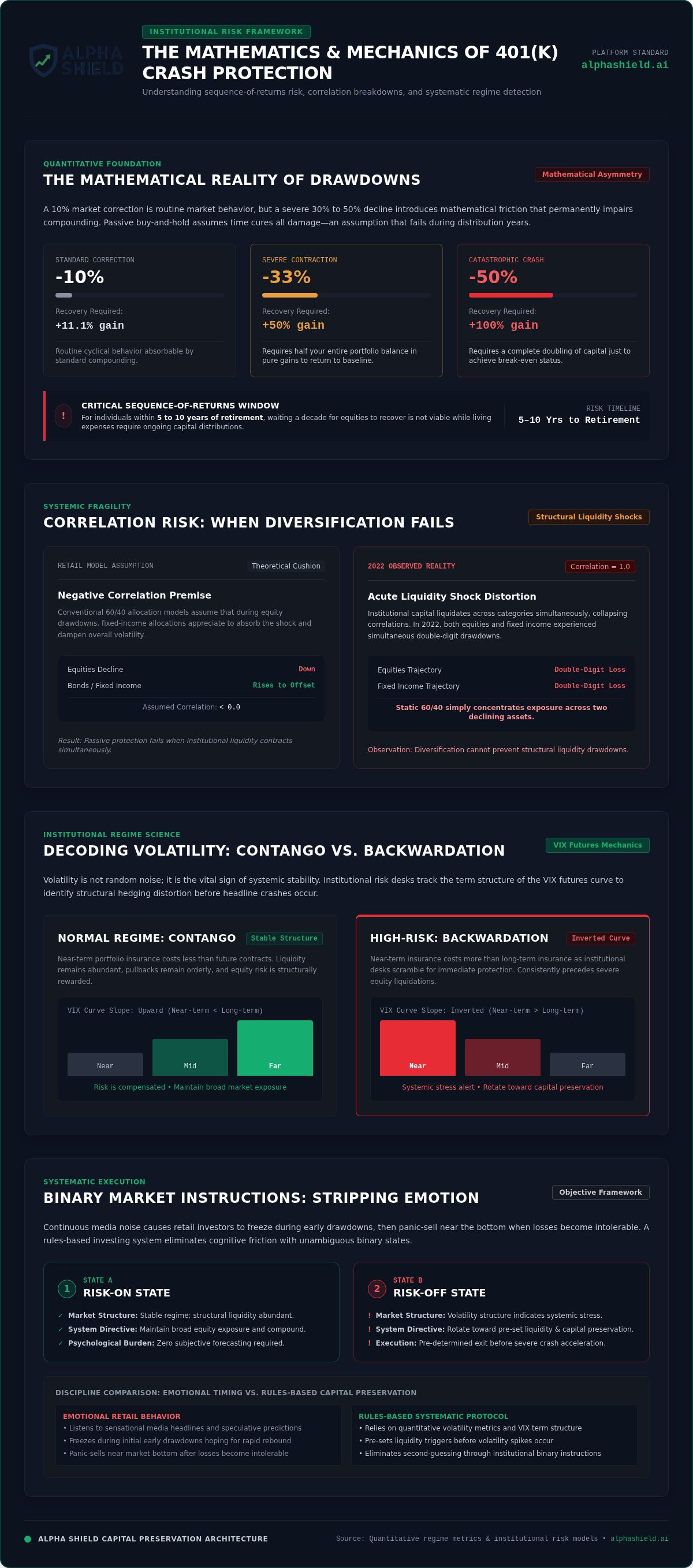
A standard 10% market correction is routine market behavior. A catastrophic 30% to 50% drawdown is a structural failure that crushes compounding. Mathematically, a 33% loss requires a 50% gain to recover; a 50% loss requires a 100% surge just to return to baseline. In fast-moving, algorithmic markets, passive buy-and-hold becomes an unmanaged liability. Successfully protecting 401k from market crash events requires recognizing that modern crash speed has outpaced passive recovery cycles.
Correlation Risk: When Diversification Fails
Conventional advice tells retirement savers that broad asset diversification provides sufficient protection. Retail models assume that when equities fall, fixed-income allocations rise to absorb the shock. In acute liquidity shocks, this assumption collapses. Institutional capital liquidates across categories, driving correlations toward one. Correlation risk occurs when assets meant to counterbalance each other decline together, as demonstrated in 2022 when both equities and fixed income suffered double-digit losses simultaneously. In high-volatility regimes, a static 60/40 allocation simply concentrates risk across two falling assets.
The Psychological Cost of Market Crashes
Market crashes generate severe cognitive friction. Continuous financial media bombards investors with conflicting noise, alarmist headlines, and speculative predictions. Without a mechanical process, retirement savers default to emotional reactions: freezing during early drawdowns, then panic-selling near the bottom after losses become intolerable. True discipline cannot rely on emotional willpower under stress. Removing fear and second-guessing requires implementing a rules based investing system. By establishing clear parameters before volatility spikes, protecting 401k from market crash cycles transforms from an emotional panic into a repeatable risk management protocol.
Identifying Market Regimes: The Science of 401k Protection
Financial markets operate in distinct environments known as regimes. In normal regimes, liquidity is abundant, pullbacks are orderly, and equity risk is rewarded. In high-risk regimes, structural liquidity evaporates, volatility spikes, and asset prices suffer swift, severe declines. Most investors rely on lagging economic data or television commentary to evaluate safety. Effectively protecting 401k from market crash events requires abandoning subjective predictions in favor of objective, mathematical regime detection.
Decoding Volatility Signals
Volatility is not a random byproduct of trading; it is the definitive vital sign of market stability. Institutional desks monitor the term structure of volatility via the VIX futures curve. In stable regimes, the curve remains in contango, meaning near-term protection costs less than future contracts. When institutional stress reaches critical thresholds, the curve inverts into backwardation. Near-term insurance suddenly costs more than long-term insurance as large institutions scramble for protection. This mechanical distortion consistently precedes severe equity liquidations. Utilizing an objective stock market drawdown indicator filters out subjective commentary, alerting you to institutional hedging pressures long before headline losses appear.
Institutional Grade Metrics for Individuals
Major investment institutions do not manage multi-billion-dollar portfolios on intuition. They track quantitative metrics daily to determine whether capital should remain deployed or moved to safety. Individual investors deserve the same systematic rigor. Transforming complex volatility mechanics into a clear binary signal removes paralysis:
- Risk-On State: Market structure is stable; maintain broad equity exposure.
- Risk-Off State: Volatility structure shows systemic stress; rotate toward capital preservation.
By establishing pre-determined parameters, you can identify an exit before a crash accelerates into catastrophic losses. Monitoring these regime shifts through Alpha Shield provides the institutional clarity needed to secure your retirement savings without speculative guesswork. Systematic discipline replaces emotional reaction, ensuring your capital steps out of harm's way before severe damage occurs.
Diversification vs. Systematic Signals for 401k Safety
Retail financial advice treats static asset allocation as the ultimate shield. Spread your capital across broad index funds, rebalance once a year, and endure the downturns. In stable macroeconomic conditions, this passive approach captures equity expansion effectively. When severe regime shocks hit, static diversification merely diversifies the source of your losses. Protecting 401k from market crash conditions requires an active, systematic shield rather than passive exposure.
Financial media labels any departure from full market exposure as dangerous "market timing." That stigma applies to retail guessing games, emotional day-trading, and trying to call absolute tops and bottoms. Institutional risk managers view exposure management differently. For sovereign wealth funds and multi-billion-dollar desks, dynamic risk-off rotation is basic operational governance. Incorporating objective signals into your retirement plan serves as an essential pillar of institutional market crash defense strategies, replacing subjective speculation with disciplined capital preservation.
The Math of Recovery
The mathematics governing drawdowns is asymmetric and unyielding. Portfolio recovery is never a linear one-to-one calculation:
- A 20% decline demands a 25% gain to break even.
- A 33% decline requires a 50% surge to return to even.
- A 50% loss forces a grueling 100% rally just to restore original principal.
Drawdown math dictates that capital lost to severe crashes compounds in reverse, requiring years of exceptional bull performance merely to reach zero. Protecting capital during major shocks defends the compounding engine. Avoiding a 30% catastrophic loss mathematically outpaces chasing a 10% incremental gain every single time.
Systematic Advantage in 401k Management
Target-date funds and generic 60/40 portfolios force savers into a hope-based mindset. You watch portfolio balances decline while hoping the market reverses before your retirement timeline arrives. Hope is not an actionable risk metric. A systematic signal framework strips anxiety away by answering the central question: should you have capital exposed to broad equities today, or should it sit in capital-preservation assets? Binary, data-driven outputs replace second-guessing with decisive structure. When indicators flash green, you capture broader equity trends. When the system shifts red, your capital rotates to safety, ensuring that protecting 401k from market crash damage happens systematically rather than through panic.
5 Steps to Protect Your 401k from Severe Market Drawdowns
Safeguarding your retirement savings requires an operational workflow rather than abstract theories. Standard retail advice tells you to sit idle through steep declines. A systematic protocol, by contrast, gives you concrete operational steps to insulate your balance before structural damage spreads. Here is how institutional capital preservation translates into an employer-sponsored retirement account.
Step 1: Knowing Your 401k 'Safe Havens'
Log in to your plan provider today and locate your capital preservation vehicles. Standard 401k plans provide two primary defensive shelters: Stable Value funds and government Money Market accounts. Unlike long-duration bond funds, which lose value when interest rates spike, Stable Value instruments protect principal while yielding interest backed by contractual guarantees. Locating this designated safe harbor in advance ensures you won't hesitate when volatility surges. Know where the safe shelter sits before you ever need to access it.
Once you verify your preservation options, implement a disciplined sequence:
- Step 2: Establish a non-emotional exit trigger. Eliminate personal bias. Commit to acting exclusively when quantitative data signals an authentic regime break.
- Step 3: Monitor market regimes daily. Track underlying volatility metrics through a professional stock market risk dashboard rather than scanning cable news commentary.
- Step 4: Execute the defensive reallocation. When your dashboard triggers a high-risk regime alert, shift equity balances into your designated Stable Value or Money Market fund.
- Step 5: Re-enter systematically. When volatility term structure normalizes and your risk metrics flip back to green, rotate capital back into broad equity indexes to capture recovery phases.
Step 4: The Mechanics of the Defensive Shift
Executing a defensive shift does not trigger a taxable event. Within a standard 401k, shifting funds between investment options is an internal reallocation, not an early withdrawal. You aren't distributing funds to your bank account; your capital remains inside the qualified tax shelter at all times. This eliminates taxable gains and early distribution penalties entirely. Treat this execution with clinical detachment: execute the transfer instruction cleanly, log out of the portal, and let systematic discipline handle protecting 401k from market crash disruptions.
Alpha Shield: The Institutional-Grade Signal for Capital Preservation
Navigating volatile market cycles requires removing human bias entirely. Alpha Shield provides that discipline. Built by professionals with over 50 years of combined institutional experience, our system is not a day-trading tool, nor does it issue speculative stock picks or shorting strategies. It is an objective capital preservation engine. We focus on sober, anti-hype risk management, replacing media noise with quantitative clarity so you can focus on protecting 401k from market crash events with complete confidence.
The Alpha Shield Market Signal Advantage
Modern institutional risk desks rely on systematic data, not intuition. The Alpha Shield Market Signal decodes underlying market mechanics, specifically volatility term structure, to produce absolute clarity. Instead of ambiguous forecasts, the system issues a definitive binary instruction: Risk-On (participate in broad equities) or Risk-Off (preserve capital in cash or safe havens). Through the Alpha Shield Dashboard, users see visual regime shifts unfolding in real time. You don't have to guess whether market turbulence is a minor ripple or the start of a structural liquidation. The dashboard identifies high-risk environments before they turn into severe drawdowns, giving you a proven market crash and drawdown tool designed specifically for capital preservation.
Moving Forward with Confidence
Retirement security in 2026 demands more than passive hope. With persistent macroeconomic shifts and shifting asset correlations, relying on static models leaves your wealth needlessly exposed. Genuine financial peace of mind comes from following a repeatable, rules-based process. When you adopt a systematic protocol, daily market anxiety disappears. You know precisely when market conditions warrant full participation, and you know exactly when to step aside into safety. Protecting 401k from market crash damage ceases to be a frantic reaction to crisis headlines. It becomes a calm, calculated execution that keeps your retirement goals intact. Join a community of disciplined investors who prioritize long-term capital preservation over speculation, and secure your financial future today.
Take Control of Your Retirement Security
Enduring catastrophic portfolio drawdowns isn't an unavoidable cost of investing. Traditional buy-and-hold advice assumes you have decades to recover, but sequence-of-returns risk makes that assumption dangerous for near-retirees. Protecting 401k from market crash damage requires moving beyond passive hope. By tracking institutional volatility signals rather than media noise, you replace guesswork with mathematical precision.
Alpha Shield transforms complex market mechanics into clear binary direction. Backed by professionals with over 50 years of combined institutional experience, our system filters out panic and tracks systemic stress in real time through the Alpha Shield Dashboard. You don't need speculative trades or daily predictions to defend your wealth. You only need the discipline to step aside when high-risk regimes emerge and re-enter when conditions stabilize.
Take the emotion out of your retirement strategy. A disciplined process gives you the control and clarity needed to protect your hard-earned capital across any market environment.
Frequently Asked Questions
Is it possible to protect my 401k from a market crash without a financial advisor?
Yes, you can independently manage your portfolio risk using objective, systematic market signals. Most advisors simply recommend static asset allocations that endure full drawdowns. By monitoring data-driven regime indicators yourself, you know exactly when to rotate between broad equities and capital-preservation options. This approach gives you complete control without paying recurring management fees for passive advice.
What is the safest place to move 401k money during a stock market crash?
Stable Value funds and government Money Market funds offer the safest shelter within standard employer plans. Stable Value options protect your initial principal while crediting steady interest through contractual insurance wraps. Money market funds hold short-term government debt with minimal duration risk. These vehicles provide capital preservation when protecting 401k from market crash events, unlike bond funds that can decline when interest rates rise.
How often should I check my market signals for 401k protection?
Checking your signals once per day after market close is sufficient. Institutional regime systems assess structural shifts across days and weeks, not minute-by-minute fluctuations. You don't need intraday monitoring or screen watching. A daily glance at your risk dashboard confirms whether the market regime remains Risk-On or shifts to Risk-Off, keeping operational maintenance under two minutes.
Does 'timing the market' actually work for retirement accounts?
Emotional retail market timing fails, but systematic risk management succeeds. Trying to predict market tops and bottoms based on news or intuition leads to selling late and buying high. Institutional risk mitigation relies on mathematical volatility metrics to step aside during elevated systemic risk. Avoiding catastrophic 30% to 50% drawdowns protects compounding without needing to predict exact turning points.
What is the difference between a market correction and a total market crash?
A correction is a routine decline of 10% to 20% within an orderly market structure. A market crash is a severe, rapid decline exceeding 20% to 50%, typically driven by liquidity shortages and forced institutional selling. Corrections are normal pullbacks within healthy trends, whereas crashes represent structural breakdowns that can take years of growth to recover.
Can I use Alpha Shield signals for my specific 401k provider like Fidelity or Vanguard?
Yes, Alpha Shield signals work across all major plan custodians, including Fidelity, Vanguard, Charles Schwab, and Empower. The signal provides a binary output indicating market health. You simply execute that instruction inside your existing provider portal by adjusting allocations between your core equity index funds and your plan's Stable Value or capital-preservation fund.
What are the tax implications of moving my 401k to cash during a crash?
There are zero tax consequences when reallocating assets inside an employer-sponsored 401k plan. Because the account is a tax-advantaged vehicle, shifting allocations from equity funds into money markets or cash equivalents is an internal rebalance, not a distribution. You trigger no capital gains taxes, no income taxes, and no early withdrawal penalties as long as the funds remain inside the account.
Why is diversification not enough to protect my 401k in 2026?
Diversification assumes that non-equity assets will rise or remain flat when equities tumble. During systemic liquidity events, historical correlations break down and diverse asset classes fall simultaneously. When equity and bond markets drop in tandem, static diversification fails. Successfully protecting 401k from market crash damage requires rotating to cash-equivalent shelters, not merely holding a basket of declining assets.


