

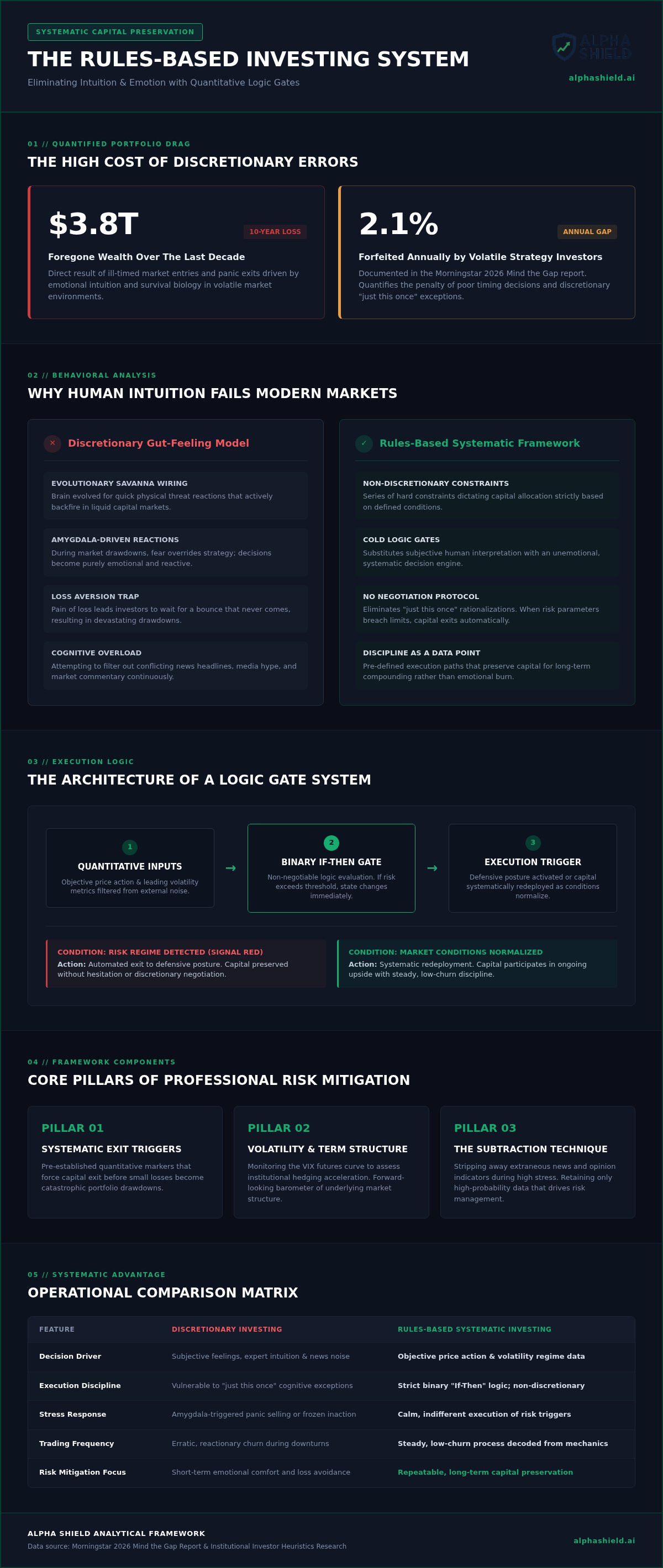
Did you know that ill-timed market entries and panic exits cost investors nearly $3.8 trillion in foregone wealth over the last decade? This staggering loss isn't usually the result of bad luck. It's the predictable outcome of relying on human intuition in an environment that actively punishes emotional responses. To navigate modern volatility without losing your shirt, you need a rules based investing system that replaces subjective gut feelings with a cold, data-driven logic gate.
It's exhausting to filter through constant financial news noise while worrying about when to exit the market. You probably already know that your most disciplined moments lead to the best results, yet maintaining that composure during a sudden crash feels nearly impossible. This article promises to show you how a systematic framework removes the burden of choice and provides a repeatable process for capital preservation. We'll examine the mechanics of risk management and explain how subtracting human emotion allows you to remain a rational anchor in a chaotic market environment. By the end, you'll understand why discipline is a data point, not a feeling.
Key Takeaways
- Learn why human biology is ill-equipped for 21st-century market volatility and how emotional intuition leads to avoidable capital loss.
- Understand the mechanics of a rules based investing system that uses binary "if-then" logic to replace subjective interpretation.
- Identify the objective inputs—including price action and volatility metrics—that professional frameworks use to calibrate risk exposure.
- Discover the two core pillars of risk mitigation: systematic exit triggers and the continuous monitoring of broader market health.
- See how institutional-grade signals provide a rational anchor, allowing you to ignore market noise and prioritize long-term capital preservation.
The Fallacy of Intuition: Why "Gut Feelings" Fail in Modern Markets
A rules based investing system is a non-discretionary framework for decision-making. It is not a set of suggestions. It is a series of hard constraints that dictate exactly how capital is managed under specific conditions. Most retail investors rely on discretionary intuition, which is often just a polite term for guessing based on current sentiment. This reliance on gut feeling is dangerous because human biology is fundamentally mismatched with 21st-century market volatility. Our brains evolved for survival on the savanna, where quick, emotional reactions saved lives. In global markets, those same reactions lead to catastrophic errors.
The primary cause of portfolio failure is rarely a lack of intelligence. It is the inability to stick to a plan during high-stress periods. When markets drop, the amygdala takes over. Decisions become reactive rather than proactive. By utilizing systematic trading, an investor can filter out the emotional noise of news headlines and focus on quantitative signals that reflect actual market health. Unlike human-led coaching or discretionary management, which can succumb to the same emotional contagion as the client, a systematic engine remains indifferent to the prevailing mood of the crowd.
The High Cost of Discretionary Errors
Discretionary errors often start with the phrase "just this once." An investor sees a sharp decline and decides to wait for a small bounce before exiting. That bounce never comes. This behavior is driven by loss aversion, a psychological phenomenon where the pain of a loss is felt much more intensely than the joy of a gain. According to the Morningstar 2026 Mind the Gap report, investors in volatile strategies forfeit approximately 2.1% annually due to poor timing decisions. A rules based investing system acts as a logic gate. It provides a binary outcome: if the signal is red, you exit. There is no room for negotiation or "just this once" exceptions that lead to deep drawdowns.
Transitioning from Sentiment to Systems
Moving from sentiment to systems requires a fundamental shift in perspective. You must stop asking "what do I feel about the economy?" and start asking "what does the data say about the trend?" This transition significantly reduces cognitive load. You no longer need to process every conflicting headline or expert opinion. Instead, you follow a pre-defined path. This discipline is essential for implementing effective market crash defense strategies. By automating the mechanics of risk management, you preserve capital for long-term growth rather than burning it on short-term emotional reactions. The goal is clarity through subtraction of the human element.
The Architecture of a Rules-Based Investing System
The architecture of a professional rules based investing system functions like a high-tech analytical engine. It operates on a foundation of binary "If-Then" logic. If the market environment displays specific risk characteristics, then the system triggers a defensive posture. If conditions normalize, then capital is redeployed. This mechanical approach eliminates the need for discretionary guesswork. It is not about day-trading or high-frequency scalping. Instead, it is a steady, low-churn process designed to decode the market's internal mechanics rather than its external noise.
A key component of this architecture is the "subtraction" technique. Most investors add more variables to their decision-making process during times of stress. They look at more news, more opinions, and more indicators. A systematic framework does the opposite. It removes variables that do not contribute to risk management. Research into institutional investor heuristics shows that even experienced fund managers underperform when they rely on cognitive shortcuts or emotional intuition. By stripping away everything except high-probability data, the system provides a clear path through market chaos.
The Role of Volatility Metrics
Volatility is a more reliable signal than price alone. While price tells you what happened, volatility metrics help you understand the current regime. Professional systems prioritize the VIX futures curve to identify when institutional hedging is accelerating. This allows the system to calibrate risk exposure based on the market's internal structure. VIX term structure is a leading indicator of market health that provides a forward-looking barometer of risk. When the curve inverts, it signals that the market's internal structure is fracturing and that a defensive shift is required.
Data vs. Narrative
Successful investing doesn't require following the 24-hour news cycle. In fact, headlines are often a distraction from market mechanics. Systematic systems ignore political events and social sentiment to focus exclusively on quantitative data. These frameworks are designed for capital preservation, not speculation. They don't attempt to predict the future. Instead, they respond to current data in real-time. By adopting a rules based investing system, you subtract the noise and focus on the signals that actually matter for long-term security. To see how these signals translate into actionable clarity, you can explore the Alpha Shield Market Signal.
Systematic vs. Discretionary: Busting the "Expert Intuition" Myth
The debate between discretionary and systematic approaches is often framed as a battle of intellects. In reality, it's a battle of discipline. Discretionary investing relies on the "expert intuition" of a human manager to navigate shifting conditions. A rules based investing system relies on a fixed logic gate to execute predefined actions. Institutional trading desks don't rely on a manager's mood to manage exposure. They use systematic triggers to eliminate "fat finger" errors and emotional overrides. Even the most seasoned professionals are subject to the same cognitive biases that plague retail investors. Understanding the foundational principles of investment risk reveals that volatility isn't something to be outsmarted. It's a variable to be managed through mechanical rigor.
There's a persistent myth that complex markets require complex human thinking. This assumption is incorrect. Complexity in a market environment often creates more "noise" which overwhelms human decision-making capacity. True professional achievement lies in the reduction of this complexity into a single, actionable instruction. Simplicity in execution is the ultimate luxury. It allows an investor to remain detached from the chaos while the system handles the filtration. By subtracting the need for constant interpretation, you reduce the mental load that leads to decision fatigue.
The Myth of the "Market Guru"
Individual stock picks are frequently a distraction from genuine risk management. A "guru" might find a winner, but they rarely have a systematic plan for the next market-wide liquidation. When a crash occurs, the discretionary manager is left "guessing" the bottom. A systematic framework doesn't guess. It observes. It waits for the data to confirm a regime shift before redeploying capital. The Alpha Shield Market Signal isn't a prediction of what might happen tomorrow. It's a technical decoding of what's happening right now. This distinction is vital for those who value stability over speculative excitement.
Why Non-Discretionary Systems Win Long-Term
The primary advantage of non-discretionary systems is the reduction of drawdown recovery time. Emotional portfolios often suffer from "revenge trading" or "paralysis" after a loss, extending the time it takes to return to break-even. Systematic models prioritize capital preservation above all else. The Alpha Shield philosophy is built on a simple premise: avoid the catastrophic mistake to allow the power of compounding to work. If you eliminate the deep drawdowns that derail most investors, the path to long-term wealth becomes a matter of mathematical certainty rather than emotional endurance.
Core Pillars of Professional Risk Mitigation
A professional rules based investing system rests on three non-negotiable pillars. These pillars aren't suggestions. They're the mechanical requirements for long-term survival. The first pillar is the use of systematic entry and exit triggers. These triggers remove the burden of choice during periods of extreme volatility. If the data signals a regime shift, the system executes. If the signal remains stable, the position is held. There's no negotiation. This binary approach ensures that you're never left wondering whether it's the right time to protect your capital.
The second pillar involves the continuous monitoring of market health rather than just portfolio value. Most investors focus on their account balance, which is a lagging indicator of past decisions. A systematic approach monitors the internal structure of the market, specifically volatility curves and liquidity metrics, to identify risks before they manifest as losses. The third pillar is the elevation of capital preservation as the primary objective. Speculation is secondary. Protection is the priority. Together, these pillars create a "shield" that prevents the catastrophic errors that typically occur during market liquidations.
Managing Drawdowns with Precision
Drawdown represents the peak-to-trough decline in your portfolio value. It's the silent killer of retirement wealth because it destroys the base upon which future growth depends. A systematic exit signal stops the bleeding before a correction accelerates into a full-scale crash. The math of loss is unforgiving. Avoiding a 50% loss requires a 100% gain just to break even. By exiting early, you preserve the principal required for future compounding. This precision is what separates a professional strategy from a hope-based one.
Identifying High-Risk Regimes
Clarity is a luxury in a noisy market. A professional risk dashboard provides this clarity by translating complex data into a simple visual interface. Think of it as a "Green, Yellow, Red" light system for your capital. Green indicates a low-risk regime where the trend is favorable. Red indicates a high-risk regime where the probability of a drawdown is elevated. This visual approach significantly reduces the mental load of daily market observation. You don't need to interpret the news. You only need to follow the signal provided by the Alpha Shield Dashboard.
Achieving Portfolio Clarity with Alpha Shield
Alpha Shield is the logical conclusion of a rules based investing system. It is not a speculative tool for excitement; it is a protective framework for capital preservation. Founded by former investment bankers with over 50 years of collective institutional experience, the platform provides the rigor that retail environments often lack. It avoids the "black box" complexity that plagues many algorithmic traders. Instead, it offers a transparent, non-custodial signaling engine. The focus is on clarity and the avoidance of catastrophic errors. This is institutional-grade logic made accessible for the long-term investor.
The system maintains a strict "anti-hype" stance. It doesn't provide day-trading tools, shorting strategies, or individual stock recommendations. These activities create the "noise" that a systematic framework is designed to eliminate. By subtracting these high-risk variables, the Alpha Shield Dashboard provides a rational anchor in a volatile environment. It reduces the mental load of investing into a single, actionable daily instruction. Simplicity is the ultimate luxury for the disciplined investor who values security over gambling.
The Alpha Shield Difference
The logic behind the signal is rooted in the VIX term structure. This is not a recent innovation. Development of the signaling engine began in 2017. A rigorous testing period followed through 2019 to ensure the logic held across diverse market regimes. Unlike competitors who offer over-customized desktop applications that often lead to "curve fitting" and system failure, Alpha Shield focuses on a single, battle-tested regime filter. It decodes the VIX Futures Curve to determine if institutional hedging is accelerating. Between 2019 and 2025, this systematic approach allowed for a maximum drawdown of only -12.16%, preserving capital while the S&P 500 experienced a -33.72% drop. If the curve indicates stress, the system signals a move to capital preservation instruments. If the curve is in contango, capital remains in broad equity indices.
Next Steps for Systematic Safety
The path to long-term security requires a shift from guessing to measuring. Human intuition is a variable that fails under stress. Data is a constant that provides clarity. By adopting a rules based investing system, you replace emotional anxiety with a mechanical routine. You no longer need to wonder if a market dip is a correction or a crash. The signal tells you when to stay and when to step aside. This removes the burden of discretionary choice from your financial future and allows compounding to work without the interruption of catastrophic losses.
Transitioning from Market Noise to Systematic Clarity
Market intuition is a myth that often leads to catastrophic capital loss. True wealth preservation requires the subtraction of human emotion and the addition of a rigorous rules based investing system. By shifting your focus from "what to buy" to "when to protect," you align yourself with the mechanical discipline used by institutional trading desks. This transition allows you to ignore the daily news cycle and focus exclusively on the quantitative signals that dictate market health.
Alpha Shield was built by former investment bankers with over 50 years of collective experience to provide this exact level of professional oversight. Since 2019, our objective, data-driven signals have prioritized drawdown protection and capital preservation over speculative excitement. Our framework decodes the VIX futures curve to provide a rational anchor during periods of high stress. You don't need to navigate market volatility alone or rely on gut feelings that fail under pressure.
Take the first step toward emotional detachment from market chaos. Professional clarity is a luxury that becomes possible once you replace guesswork with a battle-tested framework.
Frequently Asked Questions
What is a rules-based investing system?
A rules-based investing system is a non-discretionary framework that uses fixed logic to execute market decisions. It removes human emotion by defining exactly how capital responds to specific data inputs. If the system detects high-risk volatility regimes, it triggers a defensive posture. This structure prevents the discretionary errors that lead to deep drawdowns. It is an objective tool for maintaining discipline during periods of market chaos.
How does a systematic signal differ from a stock pick?
A systematic signal identifies broader market regimes rather than individual company performance. Stock picks focus on speculative narratives. In contrast, a rules based investing system focuses on "when to protect" by analyzing institutional hedging and liquidity. This approach removes the risk of picking a winner that still collapses during a market-wide liquidation. It prioritizes the health of the entire asset class over isolated speculation.
Can rules-based investing prevent all losses?
No system can eliminate all market risk, but systematic rules are designed to cap maximum drawdowns. The goal is to avoid catastrophic losses that require years of recovery. For example, Alpha Shield capped live trading drawdowns at -12.16% compared to the S&P 500's -33.72% drop. By exiting before institutional unwinds accelerate, you preserve the capital base needed for future compounding. It is about mitigation, not total elimination.
Do I need to be a professional trader to use a rules-based system?
You don't need professional trading experience because the system handles the complex calculations for you. The Alpha Shield Dashboard translates institutional-grade data into a single, actionable instruction. If the signal is green, you stay in. If it is red, you step aside. This reduces the mental load and allows long-term investors to benefit from sophisticated risk management without needing to monitor charts or news cycles 24/7.
Why is the VIX term structure important for market signals?
The VIX term structure acts as a forward-looking barometer of institutional hedging. It reveals the cost of protection in the futures market. When the curve is in contango, the market is typically in a bullish, low-risk regime. If the curve inverts into backwardation, it signals that professional traders are paying a premium for immediate protection. Decoding this slope allows a rules based investing system to identify structural market shifts before they appear in price.
How does Alpha Shield help with capital preservation?
Alpha Shield provides a daily binary signal that identifies when to shift from equity indices into capital preservation instruments like cash or treasuries. It was founded by former investment bankers with 50+ years of experience to solve the problem of emotional timing errors. By using the VIX futures curve as a regime filter, the platform helps you avoid the deep drawdown gaps that typically destroy wealth during sudden market crashes.
Is rules-based investing the same as algorithmic day-trading?
It is not the same. Alpha Shield explicitly avoids day-trading tools and high-frequency strategies. Rules-based systems for capital preservation typically have a low decision cadence, trading at most once per day. Day-trading focuses on short-term price fluctuations and high churn. Systematic risk management focuses on long-term trends and volatility regimes. The objective is to reduce decision fatigue and transaction costs while prioritizing the security of the principal.
What happens to a rules-based system during a "Black Swan" event?
Systematic frameworks respond to the immediate volatility spike that accompanies a "Black Swan" event. While no system predicts the specific event, the resulting move in the VIX futures curve triggers a mechanical exit signal. This prevents the paralysis that often strikes discretionary investors during rapid corrections. The system follows its logic to move capital to safety, ensuring that you don't hold positions while the broader market structure is fracturing.


