
A 50% loss requires a 100% gain just to return to zero. This mathematical asymmetry is the silent predator of long-term wealth. Most investors focus on potential returns while ignoring the catastrophic impact of deep drawdowns. It's exhausting to watch decades of progress vanish in a single year. You're likely tired of the conflicting news cycles and the emotional toll of market volatility. If you want to protect your portfolio, you must accept that capital preservation is the only path to long-term security.
Learning how to avoid large stock market losses isn't about guesswork. It's about systematic rigor. This guide provides the institutional-grade frameworks used to identify high-risk market regimes before the damage becomes irreversible. We'll show you how to implement a rules-based system that replaces emotional reactions with data-driven objectivity. You'll learn to treat volatility as a variable to be managed rather than an experience to be shared. We'll move from problem identification to mechanical solutions, providing you with a clear signal to navigate market chaos with absolute clarity and professional discipline.
Key Takeaways
- Distinguish between normal market volatility and catastrophic drawdowns to protect your portfolio from the mathematical penalty of asymmetry.
- Shift from subjective market predictions to the systematic identification of high-risk regimes using institutional-grade data filters.
- Learn how to avoid large stock market losses by establishing objective exit parameters based on volatility metrics and trend-following signals.
- Evaluate why passive diversification often fails during systemic crashes and how a rules-based approach serves as a rational anchor in volatile environments.
- Utilize the Alpha Shield Dashboard to transform complex market mechanics into a clear, non-emotional signal for disciplined risk management.
The Anatomy of a Stock Market Drawdown
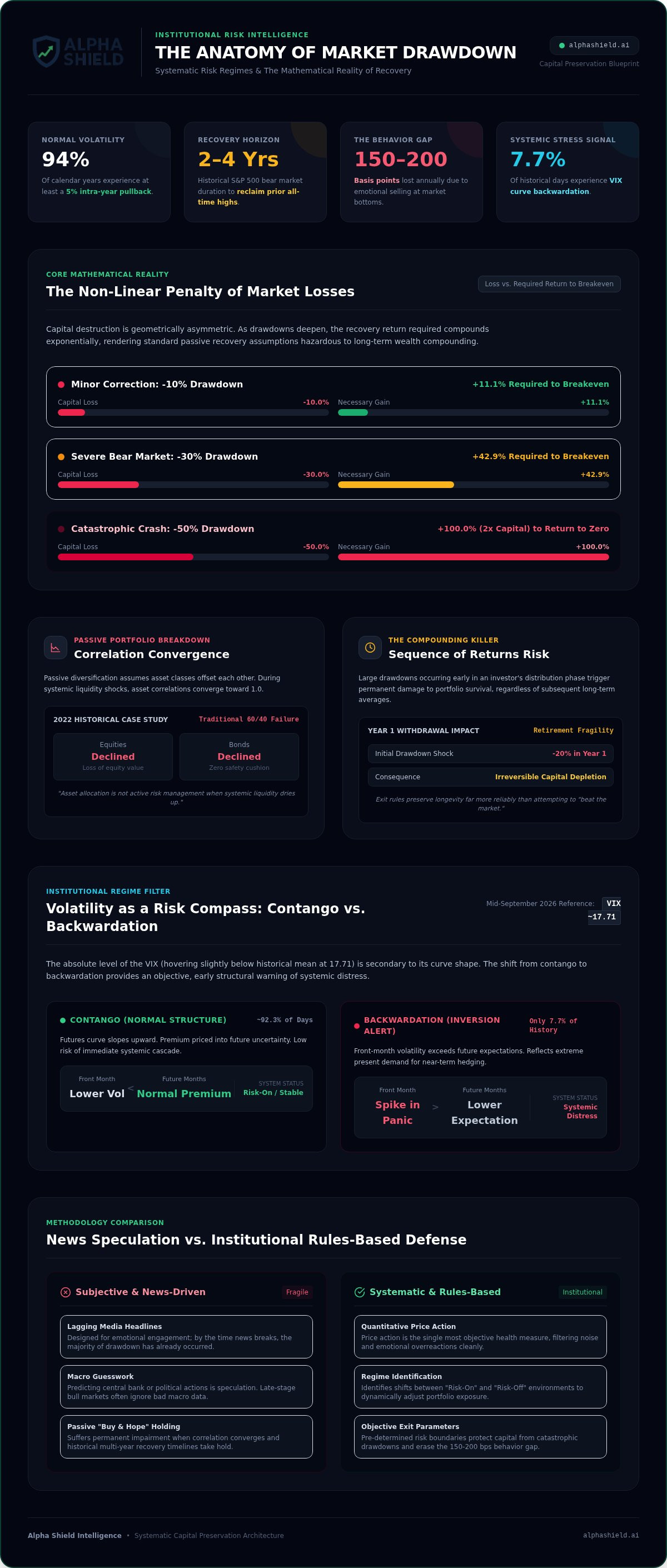
Market volatility is a standard feature of equity investing. A large loss, however, is a different variable entirely. While a 5% intra-year pullback occurs in roughly 94% of calendar years, a catastrophic drawdown can erase a decade of progress in months. Standard market drawdown measurement tracks the peak-to-trough decline before a new peak is achieved. Understanding this distinction is the first step in learning how to avoid large stock market losses. If an investor treats a 30% crash with the same passivity as a 3% dip, they risk permanent capital impairment.
The math of recovery is brutally asymmetrical. A 10% loss requires an 11.1% gain to break even. A 30% loss requires a 42.9% gain. If your portfolio drops 50%, you must generate a 100% return just to return to your starting point. Historical regimes like the 2000 dot-com bubble, the 2008 financial crisis, and the 2020 pandemic crash demonstrate that markets don't always recover quickly. Historical S&P 500 bear markets average 2 to 4 years to reclaim former all-time highs. For many, the psychological cost leads to reactive selling at the bottom. This behavior gap causes the average investor to underperform the market by 150 to 200 basis points annually.
Why Traditional Diversification Fails During Crises
Many investors rely on passive diversification as a safety net. This strategy assumes that different asset classes will move in opposite directions. During systemic liquidity shocks, this assumption often fails. This is known as correlation convergence. In 2022, both stocks and bonds declined simultaneously, leaving the traditional 60/40 portfolio with nowhere to hide. Asset allocation is not risk management. True protection requires a systematic filter that can identify when the environment has shifted from "risk-on" to "risk-off."
The Compounding Killer: Sequence of Returns Risk
Large losses are particularly dangerous when they occur at the beginning of a withdrawal phase. If a retiree experiences a 20% drawdown in their first year of retirement, the mathematical impact on their remaining capital is often irreversible. Sequence of returns risk is the primary threat to retirees. To maintain long-term security, the focus must shift from "beating the market" to capital preservation. Learning how to avoid large stock market losses through disciplined exits is the only way to ensure that a single bad year doesn't derail a lifetime of savings.
Evaluating Market Risk Regimes: Beyond the News Cycle
Market participants often mistake prediction for protection. Predicting the next move of the Federal Reserve or guessing the outcome of an election is a speculative gamble. Identifying the current market regime is a mathematical requirement. A market regime is the underlying environment that dictates asset behavior. In a "Risk-On" regime, volatility is suppressed and correlations are predictable. In a "Risk-Off" regime, liquidity thins and assets often decline in unison. Understanding these shifts is central to how to avoid large stock market losses. While the SEC guide on asset allocation and diversification provides a baseline for long-term stability, institutional-grade protection requires a more dynamic approach.
Financial headlines are designed for engagement, not risk management. They are lagging indicators. By the time a crisis is front-page news, the majority of the price drawdown has often already occurred. Quantitative signals act as a filter for this noise. They treat emotional sentiment as a variable to be measured rather than a narrative to be followed. This systematic approach allows an investor to remain objective when the broader market is driven by panic or irrational exuberance.
Volatility as a Risk Compass
The Cboe Volatility Index (VIX) serves as a primary metric for market health. In mid-September 2026, the VIX traded near 17.71, hovering slightly below its historical mean. The absolute level of the VIX is often less important than its term structure. In normal conditions, the VIX futures curve is in contango, reflecting a premium for future uncertainty. Backwardation, where front-month volatility exceeds future expectations, occurs in only 7.7% of historical trading days. This inversion is a reliable indicator of systemic distress. Monitoring these shifts allows investors to reduce exposure before a panic acceleration occurs.
Macro Indicators vs. Price Action
Markets frequently ignore negative macro data during the late stages of a bull cycle. This creates a false sense of security. Price action remains the most objective measure of market health. Trend-following models provide a binary framework for risk. If the price remains above established long-term moving averages, the environment is favorable. If the price breaks below these levels, the risk of a catastrophic drawdown increases. Systematic monitoring removes the need for subjective interpretation. For those seeking a rational anchor, the Alpha Shield Market Signal provides a clear, data-driven instruction to navigate these regime shifts without emotional bias.
Diversification vs. Systematic Market Timing
Passive diversification is often described as the "only free lunch" in finance. It acts as a seatbelt, holding the investor in place during a collision. Systematic market timing, however, functions as the brakes. It is designed to prevent the collision entirely. During systemic liquidity shocks, the historical benefit of spreading capital across different asset classes often vanishes. Correlations converge toward +1.0, meaning almost everything falls at the same time. Learning how to avoid large stock market losses requires a shift from static asset allocation to dynamic risk containment.
There is a critical distinction between discretionary market timing and systematic risk management. Discretionary timing is a form of gambling based on intuition, headlines, or "gut feel." Systematic management uses objective, mathematical triggers to identify high-risk regimes. One relies on luck; the other relies on disciplined execution. By removing the need for subjective interpretation, an investor can treat a market exit as a mechanical requirement rather than an emotional choice.
The Opportunity Cost of Large Drawdowns
The "stay the course" philosophy ignores the massive opportunity cost of recovery time. During the 2008 financial crisis, the S&P 500 took years to reclaim its previous highs. An investor who avoided the deepest part of that 50% drawdown didn't just protect their wealth; they maintained "dry powder." Being liquid when assets are undervalued is a significant structural advantage. Avoiding a 30% drop allows for a much faster recovery in the subsequent bull cycle. Capital preservation provides the flexibility to participate in new opportunities without the burden of digging out of a mathematical hole.
Rules-Based Systems vs. Discretionary Trading
Institutional investors use algorithmic signals to eliminate human hesitation. Human emotion is a liability during periods of high stress. When markets move rapidly, the "Sell" decision must be predetermined. A rules-based system provides a binary framework: if the risk signal is triggered, the exposure is reduced. This process requires an understanding of execution mechanics. Reviewing the FINRA guidance on stop and limit orders helps clarify how to implement these exits programmatically. A disciplined system ensures that a strategy remains a rational anchor even when the broader market environment becomes chaotic.
How to Build a Rules-Based Exit Strategy
Adopting a "buy and hold" mentality is often a passive surrender to market forces. To protect wealth, an investor needs a proactive framework for capital preservation. A rules-based exit strategy replaces subjective hesitation with mechanical precision. This is the most effective method for how to avoid large stock market losses. The process involves five distinct steps to ensure that capital is protected before a drawdown becomes catastrophic.
- Step 1: Define Drawdown Tolerance. Establish an objective percentage of loss that the portfolio will not exceed. This is your line in the sand.
- Step 2: Select Macro Signals. Use non-emotional data points such as long-term moving averages or volatility term structure curves to identify regime shifts.
- Step 3: Establish a Binary Framework. Create an "In or Out" rule. If the criteria are met, you stay. If they are breached, you exit.
- Step 4: Daily Monitoring. Check the status of your signals every day. Do not consult financial news or social media during this process.
- Step 5: Execute Without Exception. When a signal triggers an exit, follow the instruction immediately. Never allow "hope" or the expectation of a quick rebound to delay your discipline.
Identifying High-Risk Periods with Precision
Visualizing risk is essential for maintaining discipline during periods of market stress. Using a stock market risk dashboard allows an investor to see the transition from stability to danger in real time. This system utilizes a "Shield" concept. If the signal remains green, the environment is favorable for equity exposure. If the signal turns red, capital preservation becomes the only priority. The "Risk-Off" trigger is a mathematical threshold based on institutional data, not a guess. This clarity ensures that you aren't reacting to headlines, but rather to the internal mechanics of the market itself.
Removing the Anxiety of "When to Exit"
Decision fatigue is a primary cause of investment errors. When an investor has to decide whether to sell every time the market dips, they eventually succumb to emotional exhaustion. A pre-defined system eliminates this mental load. Automation or a strict checklist ensures that the "Sell" decision is made before the crisis begins. This shift in focus helps overcome the fear of missing out. By prioritizing "not losing out" over temporary gains, you preserve the capital necessary to participate in the next sustainable bull market. How to avoid large stock market losses is ultimately a test of systematic discipline over discretionary impulse.
Alpha Shield: Systematic Clarity in Market Chaos
The previous sections established that capital preservation is a mathematical requirement, not an optional strategy. Implementing a rules-based framework is the only reliable method for how to avoid large stock market losses. The Alpha Shield Market Signal provides this framework by bridging the gap between institutional risk management and the individual investor. It's a professional tool designed to identify the high-risk regimes where traditional diversification fails. This system doesn't rely on market predictions. It relies on the systematic decoding of market mechanics to provide a rational anchor in volatile environments.
The Alpha Shield Dashboard is built on the philosophy that simplicity is a luxury. In a world of information overload, the ultimate professional achievement is the reduction of complex data into a single, actionable instruction. The system filters out the noise of the financial news cycle, focusing instead on objective volatility metrics and price action. This approach effectively eliminates the emotional exhaustion caused by constant market swings. By providing a clear, non-emotional signal, the dashboard allows investors to maintain systematic discipline regardless of the surrounding chaos.
Institutional-Grade Signals for the Individual Investor
Alpha Shield was founded by professionals with over 50 years of collective institutional experience. The system brings the same level of rigor found in global banking to personal portfolio management. It focuses primarily on the S&P 500 and major market indices to provide broad protection against systemic crashes. This institutional perspective ensures that the signals are rooted in data-driven objectivity rather than speculative excitement. The goal is to provide a steady pulse of reliable information that reduces the mental load of complex decision-making.
Taking the First Step Toward Disciplined Investing
Integrating the Alpha Shield Market Signal into an existing routine is a straightforward process. The system is designed for long-term investors who value security over short-term gambles. A core tenet of this philosophy is the value of being "wrong small and right big." By exiting the market when risk thresholds are breached, an investor avoids the catastrophic drawdowns that derail compounding. This disciplined approach ensures that capital is preserved for future opportunities when the market regime stabilizes. Secure your portfolio. Explore the Alpha Shield Market Signal
Securing Your Financial Future Through Systematic Discipline
Capital preservation is not a passive outcome. It is the result of a deliberate, rules-based process that replaces emotional noise with institutional rigor. By identifying high-risk regimes and implementing objective exit triggers, you protect the wealth you've spent decades building. Avoiding catastrophic drawdowns is the most critical component of long-term compounding. If the risk environment shifts, your system must respond with absolute clarity. This approach transforms volatility from a source of anxiety into a manageable variable that no longer threatens your financial security.
Alpha Shield provides this clarity through a systematic, data-driven dashboard. Founded by former investment bankers with over 50 years of combined market experience, the platform serves as a rational anchor in volatile environments. It delivers simplicity as a luxury by reducing complex institutional data into a single, actionable instruction. Mastering how to avoid large stock market losses ensures your portfolio remains resilient regardless of external market chaos. You don't need to predict the future when you can accurately decode the present.
You can move forward with the confidence that your capital is shielded by a proven, professional framework. Secure your legacy through disciplined risk management today.
Frequently Asked Questions
Is it really possible to avoid a market crash without being a professional trader?
Yes, investors can manage systemic risk without professional trading backgrounds by utilizing a rules-based dashboard. The Alpha Shield Market Signal translates complex institutional data into a single instruction. This system allows individuals to identify high-risk regimes before they result in catastrophic drawdowns. By following a disciplined framework, you can learn how to avoid large stock market losses without the need for constant market monitoring or subjective interpretation.
What is the difference between market timing and systematic risk management?
Market timing is typically a discretionary attempt to predict price movements based on news or intuition. Systematic risk management is a mathematical process that identifies the current market regime. While timing relies on luck, risk management relies on predetermined rules and volatility metrics. This approach treats market exits as a technical requirement. It focuses on capital preservation rather than speculative gains, providing a rational anchor during volatility.
How much of a drawdown is considered 'normal' vs. a 'large loss'?
Market pullbacks of 5% to 10% are considered normal volatility and occur in approximately 94% of calendar years. A large loss is defined as a bear market drawdown of 20% or more from peak to trough. Historical data shows these major regimes require significantly longer recovery periods. Utilizing a rules-based system is the primary method for how to avoid large stock market losses during these destructive bear market regimes.
Can I use these signals for my 401k or IRA accounts?
The systematic signals provided by Alpha Shield are effective for managing risk in 401k and IRA accounts. Most retirement portfolios are heavily weighted in broad index funds or ETFs that track the S&P 500. Since our signals monitor the health of these major indices, they provide clear guidance on when to reduce equity exposure. This helps protect your long-term compounding progress from being derailed by a single year.
Does Alpha Shield tell me which individual stocks to buy?
Alpha Shield does not provide individual stock recommendations or day-trading setups. Our philosophy focuses on broad market regimes and systematic capital preservation. We provide a macro-level signal that indicates when systemic risk is unacceptably high. This approach is designed for long-term investors who prioritize the security of their entire portfolio over the speculative performance of single companies. We offer clarity in chaos, not stock picks.
What happens if the signal is wrong and I exit the market too early?
Exiting the market before a rebound is often referred to as being wrong small. While no signal is perfect, the cost of missing a short-term rally is significantly lower than the cost of sitting through a 50% drawdown. A rules-based system prioritizes the avoidance of catastrophic errors. If the signal triggers an exit and the market recovers quickly, the system will provide a re-entry signal once the risk has passed.
How does the VIX term structure help in avoiding large losses?
The VIX term structure tracks the difference between short-term and long-term volatility expectations. In healthy markets, the curve is in contango. When the front-month VIX exceeds future expectations, the curve enters backwardation. This inversion occurs in only 7.7% of historical trading days and is a reliable indicator of institutional panic. Monitoring this structure allows the Alpha Shield Dashboard to identify liquidity distress before it manifests as a major price collapse.
Why is capital preservation more important than chasing high returns?
Capital preservation is the foundation of long-term wealth because of the mathematical asymmetry of losses. If a portfolio loses 50% of its value, it requires a 100% gain just to return to the break-even point. Chasing high returns often involves taking on tail risk that can lead to permanent capital impairment. By focusing on protection first, you ensure that your capital remains available to compound during sustainable bull markets.


