
Volatility doesn’t demand a forecast. It demands a disciplined process. For investors focused on protecting wealth in volatile markets, the challenge is recognizing when changing conditions may signal meaningful portfolio risk without letting headlines dictate every move.
It’s reasonable to feel unsettled when markets swing. Acting under that pressure, though, can mean locking in losses or missing a recovery. The alternative isn’t to ignore risk or assume that any signal can predict what comes next. It’s to use clear, systematic information as one input to informed judgment.
This article explains how Alpha Shield’s Market Signal and Dashboard present market-risk indicators to support a more structured response to volatility. You’ll learn how to assess a signal, compare approaches to risk monitoring, and set realistic expectations. The focus is long-term capital preservation, not headline-driven trades or promises of perfect timing.
Key Takeaways
- Separate market volatility from portfolio risk, and use drawdown to understand how losses can affect long-term plans.
- Build a repeatable review process so market indicators inform decisions instead of headlines driving them.
- Compare approaches by consistency, clarity, time commitment, and how much judgment they require.
- Use a disciplined process for protecting wealth in volatile markets without treating any signal as a forecast.
- Alpha Shield Market Signal and its dashboard support risk monitoring while leaving portfolio decisions to the investor.
Protecting wealth in volatile markets starts with defining the risk
Market volatility describes how much and how quickly prices fluctuate. It can include sharp moves in either direction, but it doesn’t tell an investor whether prices will rise or fall next. A useful distinction is: Volatility describes the movement of prices; drawdown describes the decline in portfolio value from a previous peak to a later low. Neither, on its own, predicts future returns. For a foundational overview, see Understanding Market Volatility.
Portfolio risk is broader than a daily price swing. It includes the possibility that investment losses, changing needs, or the timing of withdrawals could interfere with financial goals. A portfolio can move up and down without changing the investor’s plan. A deep or extended decline may matter more, however, if funds are needed soon or the investor can’t tolerate the associated loss.
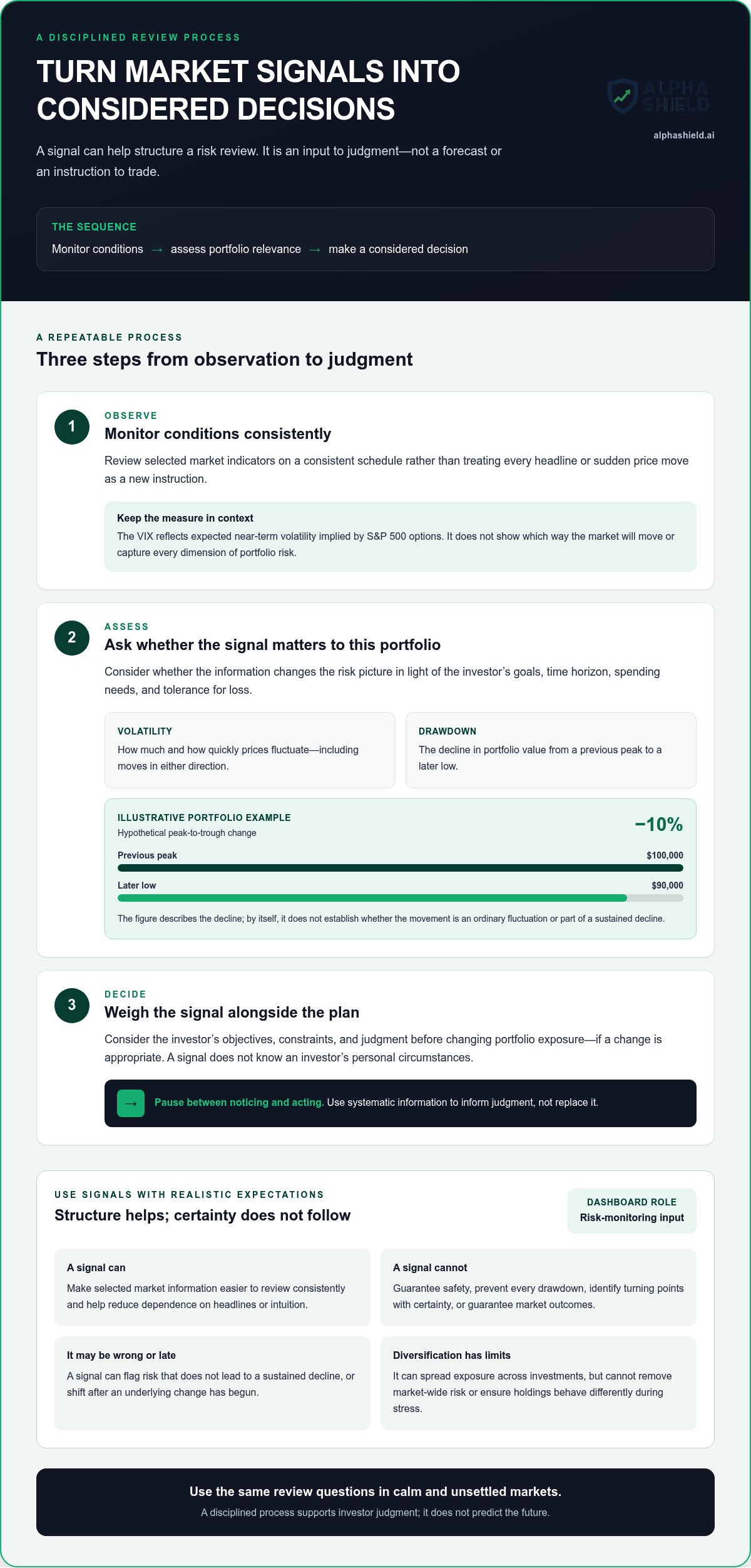
Consider a hypothetical portfolio that falls from a peak of $100,000 to $90,000. That’s a 10% peak-to-trough drawdown over the period. The figure alone doesn’t establish whether the movement is an ordinary fluctuation or part of a sustained decline. Protecting wealth in volatile markets means managing exposure to risk, not expecting every loss to be avoided.
The example in this article is illustrative. It describes a hypothetical long-term investor reviewing portfolio risk during uncertainty, not an actual Alpha Shield customer or a documented customer outcome.
Why volatility feels different from lasting capital loss
Price swings put pressure on an investor’s time horizon and decision discipline. A drop can feel like proof that a plan has failed, even before the investor has reassessed the portfolio, goals, or changing conditions. Selling after a decline realizes the loss and may leave the investor out of a later rebound. That doesn’t mean every decline will recover or that every fall will become a prolonged bear market. It means a rushed decision can narrow future choices.
A measured review starts with what changed: the portfolio’s exposure, the investor’s cash needs, or the conditions being monitored? Separating those questions from the intensity of the latest market move can help distinguish an uncomfortable fluctuation from a risk that may warrant a considered response.
What a wealth-protection process can and cannot do
Risk management provides structure for reviewing information and weighing decisions. It can’t guarantee safety, prevent every drawdown, or identify a market turning point with certainty. Diversification can spread exposure across investments, but it can’t remove market-wide risk or ensure that all holdings will behave differently during stress.
Outcomes depend on decisions, portfolio composition, time horizon, and changing conditions. A disciplined process makes these factors easier to review before acting. For the illustrative investor, that could mean defining which risks matter to the plan, reviewing relevant information consistently, and considering options rather than reacting to a headline. The process supports investor judgment; it doesn’t replace it.
How systematic market signals can add discipline to volatile-market decisions
A market signal turns selected information about market conditions into a repeatable input for decision-making. Its value isn’t that it removes uncertainty. It can help investors review risk using a consistent framework instead of treating every alarming headline or sudden price move as a new instruction. For people focused on protecting wealth in volatile markets, that structure can create a pause between noticing a change and deciding whether it matters to their portfolio.
A disciplined process separates three tasks: observe, assess, and decide. A signal belongs in the assessment stage. It can highlight conditions that merit attention, but it doesn’t know an investor’s time horizon, spending needs, tax situation, or tolerance for loss. A market signal can inform decisions, but it cannot guarantee market outcomes.
- Monitor conditions. Review selected market indicators on a consistent schedule instead of responding to every market update.
- Assess portfolio relevance. Ask whether the information changes the risk picture for the portfolio and the investor’s goals.
- Make a considered decision. Weigh the signal alongside the investor’s plan, constraints, and judgment before changing exposure, if a change is appropriate.
From market data to a repeatable decision input
Systematic analysis applies a consistent method to information, helping reduce dependence on intuition or the emotional force of a headline. The VIX is one familiar reference: it reflects expected near-term volatility implied by S&P 500 options. It isn’t a complete measure of portfolio risk, a forecast of market direction, or a guide to how every asset will behave. To assess a signal’s usefulness, understand what it measures and how it fits into a broader review.
Repeatability matters because it gives an investor a process to follow when attention is pulled in different directions. The same review questions can be applied when conditions appear calm and when they feel unsettled. That consistency doesn’t make judgment automatic; it makes the information easier to consider alongside the investor’s objectives.
Why signals can be wrong, delayed, or difficult to apply
Indicators describe conditions using available information. As markets evolve, an indicator may shift after an underlying change has begun, or flag risk that doesn’t lead to a sustained decline. These are common limitations of signal-based approaches. A false alarm can prompt unnecessary changes, while a delayed signal can arrive after losses have already affected a portfolio. No indicator resolves those trade-offs in advance.
Application matters, too. The same signal may have different implications for an investor with a long time horizon than for someone who expects to draw on their portfolio soon. Before acting, consider whether the signal is designed for the risk being reviewed, whether its role in the decision process is clear, and whether a potential response fits the investor’s plan. A signal should inform judgment, not automatically trigger trades or serve as a personalized portfolio recommendation.
For a practical example of structured market-risk information, review Alpha Shield’s market-risk approach and consider how a systematic input could fit into your decision process.
Compare wealth-protection approaches by process, limits, and fit
Different approaches manage uncertainty in different ways. A diversified portfolio spreads investment exposure. Discretionary management relies on an investor’s or adviser’s judgment about changing conditions. Systematic signal-supported monitoring adds a repeatable input to the review process. None guarantees protection or suits every investor. Compare how each approach handles consistency, clarity, time demands, and human judgment.
For an investor with a long horizon and a portfolio they can tolerate through market swings, diversified holding may be straightforward to maintain. Someone who wants a structured way to review market conditions may value systematic monitoring. Discretionary reactions allow flexibility, but decisions can vary with the information and emotions present at the time. The right fit depends on the investor’s goals, constraints, and ability to follow a process.
What diversification can address, and what it cannot
Spreading investments across different holdings or asset categories can reduce reliance on any single position. If one holding performs poorly, others may help offset its effect. But diversification doesn’t remove broad market risk: assets that differ in ordinary conditions may still decline together during periods of stress. It’s a way to manage concentration, not a guarantee against losses. A wider market crash defense strategies framework considers diversification alongside how portfolio risk is monitored and decisions are made.
Compare the process, not just the label
Consider these practical differences when deciding how an approach fits your plan:
- Diversified holding: Can be relatively repeatable once the portfolio is established, but still requires attention to concentration, changing goals, and whether the allocation remains suitable. It doesn’t automatically respond to changing market conditions.
- Discretionary reactions: Allow judgment to account for context, but can demand more time and lead to inconsistent decisions if the process isn’t clear. Frequent reactions to headlines may also make it harder to stick to a long-term plan.
- Signal-supported monitoring: Can organize market-risk information into a consistent input for review. Its clarity depends on whether the signal’s purpose and limits are understandable. The investor still decides how, or whether, it relates to their portfolio.
These methods aren’t necessarily mutually exclusive. A systematic review can sit alongside diversification and personal judgment. A systematic capital-preservation framework can clarify how monitoring fits into a wider long-term process without turning a signal into an automatic instruction.
How to evaluate a market-risk signal before relying on it
Start with the method and its intended role. Is the signal systematic, presented consistently, and clear about the information it provides? Are its limitations explained, without promises of guaranteed protection, returns, or precise market timing? Then compare its role with your existing plan. A useful signal supports a review; it doesn’t replace portfolio construction, personal judgment, or decisions tailored to your circumstances.
For protecting wealth in volatile markets, the strongest process isn’t necessarily the most complex. Look for a clear division of responsibilities: the approach organizes information, while the investor weighs it against their goals and constraints. That keeps risk monitoring useful without mistaking it for certainty.
An illustrative investor case: applying a disciplined process during volatility
This scenario is illustrative. It does not describe an actual Alpha Shield customer or a verified investment outcome.
Imagine a long-term investor reviewing a portfolio during a period of elevated uncertainty. Market commentary is growing more alarming, prices are moving sharply, and the investor feels pressure to make a quick change. Rather than treating urgency as evidence, they follow a defined review process. The objective isn’t to predict the next move. It’s to decide whether available information changes how portfolio risk relates to their long-term plan.
The decision point: volatility rises and headlines intensify
The investor first separates observable information from commentary. Headlines may describe possible risks, but they aren’t portfolio instructions. The investor reviews current exposure and asks what the portfolio is designed to do, when funds may be needed, and whether the original objectives or constraints have changed. Related market crash early-warning indicators can provide context for what investors might monitor, without establishing that a decline is certain or that a particular response is right.
Next, the investor considers whether portfolio exposure still fits their circumstances. They don’t assume every decline calls for a change, or that holding is automatically the right choice. They return to the existing investment plan and identify the question to answer: has the portfolio’s risk become inconsistent with the investor’s objectives, or is the pressure coming mainly from short-term uncertainty?
The response: use information without outsourcing judgment
A market signal may add a structured input to this review. The investor considers what the signal is intended to indicate and treats it as one part of the available information, not as an automatic order. No specific reading or portfolio action is assumed in this example. If the information raises a relevant concern, the investor weighs it against their time horizon, financial needs, and existing plan before deciding whether any change is appropriate.
They then document the reasoning. A concise record could note:
- What portfolio risk or objective prompted the review.
- Which information, including any relevant market indicators, was considered.
- Why the investor chose to maintain or reconsider their current exposure.
- What conditions would prompt another review under their plan.
This record creates a reference point for future decisions. It can help the investor assess whether choices followed a consistent rationale rather than being driven by the latest headline. It also makes clear where judgment entered the process and what uncertainties remained.
The example demonstrates a decision process, not a guaranteed protective outcome. Markets can keep falling, conditions can change, and a reasonable decision may still lead to losses. For protecting wealth in volatile markets, discipline means reviewing relevant information and objectives before acting, while remaining candid about what no signal or process can control.
How Alpha Shield supports a systematic approach to protecting wealth
Alpha Shield Market Signal and the Alpha Shield Dashboard give long-term investors structured information for monitoring market health and managing drawdown risk. In the illustrative process above, these tools provide market indicators for review alongside portfolio exposure, financial objectives, and personal circumstances. They add an organized input to the decision process, while the investor remains responsible for the decision.
What the Alpha Shield Market Signal is designed to support
Alpha Shield focuses on systematic market signals and long-term capital preservation. Its dashboard presents indicators for market health and risk management, helping bring relevant information into view rather than relying only on headlines. The purpose is risk monitoring, not certainty: no signal can guarantee that losses will be avoided, predict every market turn, or ensure a particular outcome.
That distinction matters. A signal can prompt a closer review of portfolio risk, but the investor still decides whether the information is relevant to their objectives and existing plan. Alpha Shield does not provide individual stock recommendations. Its Market Signal and Dashboard are focused on systematic market-risk information, not day trading or shorting strategies.
There is also useful context in the service’s development history. System development began in 2017, and Alpha Shield launched in 2019. Its founders are former investment bankers and global-markets professionals with over 50 years of combined experience. These facts describe the background behind the service. They are not evidence of investment performance, a promise of future results, or proof that any investor will avoid losses.
Decide whether a systematic dashboard fits your process
Consider whether structured market-risk information would fill a gap in your current approach. If you already have a defined review process, a dashboard can offer an additional reference point. If you tend to make decisions in response to market commentary, organized indicators can help create a more deliberate pause. Either way, consider the signal alongside your plan, not as a substitute for it.
Before relying on any market signal, be clear about what it is intended to support and what it cannot do. Market conditions change. Indicators may not align perfectly with an individual portfolio, and investors can still experience losses. A disciplined tool can inform judgment, but it cannot remove risk or guarantee the result of a decision. Protecting wealth in volatile markets depends on considering information in the context of each investor’s circumstances.
If a systematic market-risk reference fits your long-term process, explore Alpha Shield Market Signal with these limits in mind.
Make your next risk review more deliberate
The next step isn’t to predict what markets will do. It’s to decide how you’ll respond when uncertainty returns. Set a clear review routine, identify the portfolio risks that matter to your goals, and define what information would prompt you to reconsider your approach. A written process can help keep decisions consistent when market noise rises.
For investors focused on protecting wealth in volatile markets, systematic information can provide a useful reference point, but it can’t remove risk or replace personal judgment. The aim is to make decisions with greater clarity, grounded in your circumstances rather than urgency.
If a structured market signal could complement your approach, explore Alpha Shield and assess whether its role fits your long-term process.
Stay focused on the decisions you can control. A steady process is a practical foundation for moving forward through changing markets.
Frequently Asked Questions
Can any market signal guarantee protection from investment losses?
No. A market signal can organize information and support a risk review, but it can’t guarantee that losses will be avoided. Signals may be incorrect, delayed, or poorly matched to a particular portfolio. Before relying on one, understand what it measures, how it is intended to be used, and what its limitations are. For protecting wealth in volatile markets, treat a signal as one decision input, not insurance against loss.
Is market timing suitable for long-term investors?
It depends on what you mean by market timing. Trying to predict exact market highs and lows is difficult, and missing a recovery can affect long-term results. A systematic risk process is different: it may help an investor review exposure when conditions change without claiming to forecast turning points. If you consider such an approach, decide in advance how it fits your time horizon and what would lead you to reassess it.
What happens if a risk signal changes after I have adjusted my portfolio?
A changed signal is a prompt to review, not necessarily a command to reverse your last decision. Check whether the change is consistent with the tool’s stated purpose and your investment plan. Consider transaction costs, possible tax effects, and whether the portfolio still meets your needs before acting. A written review rule can help prevent repeated changes in response to every shift while leaving room to reconsider if your circumstances change.
How much of a portfolio should be protected during volatile markets?
There isn’t one appropriate percentage for every investor. The amount of risk to manage depends on your time horizon, need for cash, financial goals, and ability to withstand declines. For example, money needed for a near-term expense may call for a different risk assessment from funds intended for a distant goal. Review your overall allocation and circumstances, and seek individualized financial guidance if you need a portfolio-specific decision.
Can a market-risk dashboard replace a financial adviser?
No. A dashboard can present market indicators, but it doesn’t know your full financial picture or provide the individualized judgment an adviser may offer. It can’t account for every detail of your goals, income needs, taxes, and personal circumstances. Use market-risk information as a reference when reviewing your plan. If you work with an adviser, discuss how the indicators relate to your existing strategy rather than treating them as a substitute for that relationship.
Does Alpha Shield provide stock picks or execute trades?
Alpha Shield does not provide individual stock recommendations. Its Market Signal and Dashboard are tools for monitoring market health and risk, intended to support an investor’s review rather than select stocks or provide day-trading or shorting strategies. Investors remain responsible for deciding what action, if any, is appropriate for their portfolio. This keeps the service focused on systematic risk information rather than personalized investment instructions.


