

What if a timing signal’s job isn’t to call the next market top, but to help manage how much risk a portfolio carries? That distinction is central to evidence based market timing. A systematic rule can adjust exposure when defined conditions change. It can’t know exactly when a downturn will begin or end.
Conflicting forecasts make market decisions difficult to assess. Staying invested through a steep decline can feel costly, but moving to cash too early can mean missing a recovery. A backtest that looks compelling may also leave out real-world factors such as trading costs, taxes, or how the rules were selected.
This article explains how evidence-based timing differs from prediction, what to examine when evaluating a signal’s data and rules, and why historical results don’t guarantee future outcomes. It also shows how risk management can give a timing signal a defined role in a long-term investment plan, without treating it as a promise of protection or a substitute for disciplined investing.
Key Takeaways
- Distinguish rule-based exposure changes from attempts to predict market highs and lows.
- Use price trends, volatility, and market breadth as evidence inputs, not proof of what markets will do next.
- Compare evidence based market timing with buy-and-hold and discretionary reactions by weighing process, risks, and discipline.
- Assess a timing method’s rules, testing, and implementation assumptions before relying on its historical results.
- Learn how Alpha Shield’s Market Signal and dashboard support systematic risk monitoring without guaranteeing protection or returns.
Evidence-Based Market Timing: What It Means for Long-Term Investors
Long-term investors face a persistent trade-off. Staying invested preserves exposure to potential growth, but it also means accepting market declines. Reacting to every forecast creates a different risk: decisions can follow the latest headline even when the forecast offers no reliable basis for action.
Evidence-based market timing adjusts investment exposure according to predefined, testable rules that respond to observable market conditions. The definition is about process, not certainty. Evidence can inform a decision, but it can’t guarantee an accurate call about what markets will do next.
Market timing broadly refers to changing investment positions in an attempt to benefit from anticipated market moves. A systematic approach makes that idea more specific by setting explicit criteria and repeatable decisions. It isn’t stock selection, day trading, or a claim that an investor can identify the exact market top before it occurs.
How systematic timing differs from forecasting market tops
A forecast makes a claim about the future, such as prices falling next month. A rule responds to an observation defined in advance. In a hypothetical framework, exposure might be reduced if a broad market trend falls below a specified threshold. This illustrates a process, not Alpha Shield’s signal rule.
Rules can make decisions more consistent, but they can still be wrong, delayed, or reversed. A signal may change only after conditions have shifted. Markets may recover before it responds, or keep declining after it does. A systematic process can be examined and tested, but it doesn’t remove uncertainty.
Why long-term investors consider timing at all
Buy-and-hold investors accept downturns as part of remaining invested for long-term goals. Investors considering timing want to manage how much risk their portfolio carries as conditions change. Those aims can coexist: a timing signal may inform exposure without replacing a long-term plan or requiring constant trading.
Risk management shapes exposure; it doesn’t eliminate investment risk. Consider any approach alongside your time horizon, capacity for loss, and broader portfolio plan. For a wider look at portfolio protection, see market crash defense strategies.
What Evidence Can Support a Market-Timing Signal?
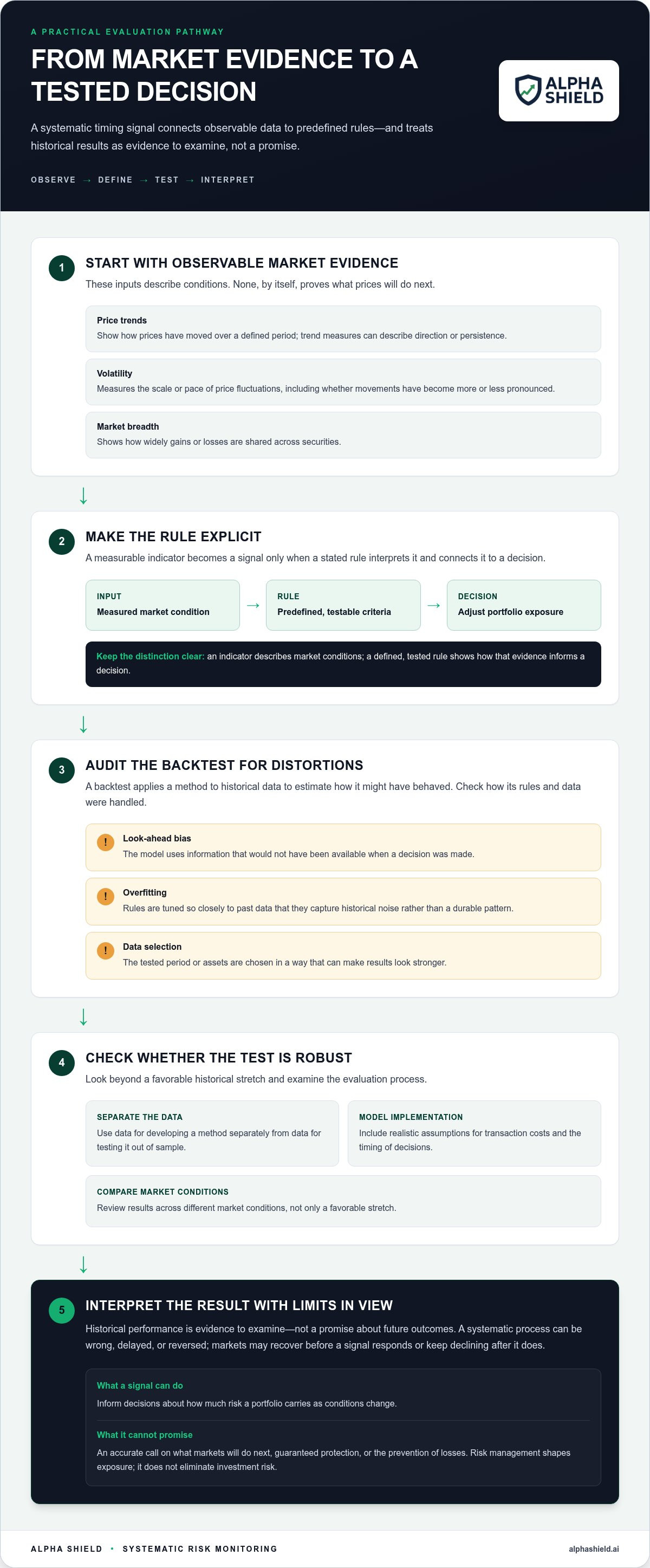
A timing method can draw on several kinds of observable market data. Price trends show how prices have moved over a defined period. Volatility measures describe the scale or pace of price fluctuations. Market breadth shows how widely gains or losses are shared across securities. These inputs can help characterize market conditions, but none independently proves what prices will do next.
An indicator is a measurable input. A signal is the interpretation of one or more inputs under stated rules. An indicator describes market conditions; only a defined, tested rule shows how that evidence informs a decision. The distinction matters. A measure may be calculated precisely and still have limited value if its thresholds, decision process, or intended use are unclear.
Market data, indicators, and the rule that connects them
Trend and volatility measures answer different questions. A trend measure may describe the direction or persistence of prices over a chosen period. A volatility measure may show whether price movements have become more or less pronounced. A rule could combine these inputs, but its design needs to specify how they’re measured and what action follows. No single indicator reliably identifies every crash or turning point. When reviewing macro market risk indicators, compare what each measures and how the method uses it.
That is the practical test for evidence based market timing: Can you identify the input, the rule that interprets it, and the resulting portfolio decision? Academic work can add context to this debate. Duke University offers a broader setting for exploring research and teaching on economic and market questions. An academic link or label alone, however, doesn’t validate a particular strategy.
How to read backtests without mistaking history for proof
A backtest applies a method to historical data to estimate how it might have behaved. Its usefulness depends on the integrity of the test. Look-ahead bias occurs when a model uses information that wouldn’t have been available when a decision was made. Overfitting happens when rules are tuned so closely to past data that they capture historical noise rather than a durable pattern. Data selection can also distort results if the tested period or assets are chosen to make performance look stronger.
A stronger evaluation separates the data used to develop a method from the data used to test it out of sample. It also uses realistic implementation assumptions, including transaction costs and the timing of decisions. Compare results across different market conditions, not just a favorable stretch.
Historical performance is evidence to examine, not a promise about future outcomes. Investors assessing systematic risk signals can review the Alpha Shield Market Signal and dashboard as tools for monitoring market risk. They support decision-making, but don’t guarantee that a signal will be right or prevent losses.
Evidence-Based Timing Versus Buy-and-Hold and Reactive Decisions
These approaches differ in how they make decisions, not just in how often they trade. Buy-and-hold maintains planned market exposure. Rule-based timing adjusts exposure according to predefined conditions. Reactive investing changes course in response to headlines, forecasts, or immediate emotion. None is automatically right for every investor.
| Approach | Decision process | Potential benefit | Key risk | Discipline required |
|---|---|---|---|---|
| Buy-and-hold | Maintain a long-term investment plan through changing markets. | Limits the need to make frequent market calls. | Investors remain exposed to declines and may abandon the plan under stress. | Stay aligned with the plan during downturns. |
| Rule-based timing | Adjust exposure when predefined market conditions meet stated criteria. | Provides a repeatable process for managing exposure as risk conditions change. | Signals can be delayed, trigger false alarms, or miss rebounds. | Follow the rules consistently and accept imperfect signals. |
| Reactive decisions | Change positions based on personal judgment, forecasts, or current news. | Allows a response to concerns the investor considers important. | Decisions can be inconsistent, mistimed, or driven by short-term noise. | Separate considered judgment from emotional impulse. |
What buy-and-hold prioritizes, and what it asks investors to tolerate
Buy-and-hold prioritizes continued participation in the market according to a long-term plan. Its relative simplicity can reduce the pressure to forecast every move, but it doesn’t remove volatility or ensure a positive outcome. Investors still need a plan they can maintain through declines. The appropriate level of exposure depends on personal objectives, time horizon, and tolerance for loss, not a universal allocation.
Where systematic timing can help, and where it can fail
Rule-based timing may offer a structured way to adjust exposure when defined risk conditions change. But a signal can reverse repeatedly in choppy markets, creating a whipsaw that prompts changes without a sustained shift. It can also respond after a decline has begun or reduce exposure shortly before a rebound. These are meaningful trade-offs, not exceptions to dismiss.
Evaluating evidence based market timing means comparing its process with alternatives against the same priorities: objectives, time horizon, risk tolerance, and implementation. Trading costs, taxes, and the ability to follow a method can affect its practical fit. No approach is universally superior, and results shouldn’t be compared without consistent assumptions. For a broader portfolio framework, consider systematic risk mitigation.
How to Evaluate a Market-Timing Method Before Relying on It
A timing method should be clear enough to inspect before it influences portfolio decisions. Use this checklist to assess whether its rules are defined, testable, and consistent across different market conditions. Evidence based market timing is only as useful as the process behind it and the investor’s ability to implement that process.
Five checks for assessing a timing strategy
- 1. Can you explain the rules? Identify the data inputs, how they’re interpreted, and what action follows. If the signal’s meaning or decision process is vague, its results are difficult to evaluate.
- 2. Is the test designed fairly? Check whether the method avoids look-ahead bias and whether it was evaluated on out-of-sample data that wasn’t used to build or tune the rules.
- 3. Are implementation assumptions realistic? Consider how often the method trades, whether turnover is disclosed, and how transaction costs, fees, and taxes could affect results. A backtest that ignores these factors may not reflect an investor’s experience.
- 4. Does it hold up across market conditions? Review performance in more than one type of market environment. A method can apply its rules consistently yet still produce false signals or periods of underperformance.
- 5. Are limitations stated plainly? Look for discussion of missed rebounds, delayed responses, false positives, and periods when the method didn’t work as intended. A balanced account helps distinguish a process from a promise.
Fit the method to a portfolio process
Before interpreting a signal, define what the portfolio is meant to do and what level of risk is acceptable. Then decide in advance how often signals will be reviewed, what response each signal can trigger, and who is responsible for acting. A written process helps keep short-term market noise from replacing the plan.
Consistency matters. Changing a method after one false signal or one market episode can turn a rules-based approach into discretionary timing. Review the method at planned intervals, and separate evidence about its design from frustration with a particular outcome.
This checklist is educational, not individualized investment advice. A method’s suitability depends on personal circumstances, objectives, and risk tolerance. Use it to structure questions and clarify trade-offs, not as a recommendation to buy, sell, or hold an investment.
Explore the Alpha Shield Market Signal
How Alpha Shield Frames Evidence-Based Market Timing
The evaluation framework above offers a practical way to assess any timing method: understand its purpose, inspect its process, and account for its limitations. Alpha Shield provides systematic market-risk monitoring for long-term investors. Its Market Signal and dashboard support decisions about portfolio risk, rather than predicting every market turn.
A market signal for monitoring risk, not picking individual stocks
Alpha Shield focuses on long-term capital preservation and managing portfolio drawdown risk. The Market Signal is a decision-support tool. It isn’t a guarantee against losses, a promise to identify crashes in advance, or an individual investment recommendation.
Alpha Shield isn’t a day-trading tool, shorting strategy, or stock-picking advice service. Its role is to help investors monitor market risk within a broader portfolio process. Consider the signal alongside your objectives, time horizon, risk tolerance, and existing investment plan.
Alpha Shield was founded by former investment bankers and global markets professionals with over 50 years of combined experience. That background provides context about the team’s experience, but credentials alone don’t establish that a signal will perform as intended or predict future market conditions. Assess the method and its limitations on their own merits.
What a dashboard can, and cannot, do for an investor
A dashboard can present market-health information in a clear, structured way, making it easier to monitor a systematic signal rather than rely on a stream of conflicting forecasts. It can help organize information for review. It can’t decide whether an action fits an individual’s circumstances, remove uncertainty, or ensure that portfolio losses are avoided.
Investors remain responsible for deciding how any signal relates to their own portfolio and risk limits. Consider how the tool fits the full investment process, rather than treating a reading as an instruction that applies universally. This is the practical boundary of evidence-based market timing: use information to support a defined process while recognizing that market outcomes remain uncertain.
For an overview of Alpha Shield’s approach to systematic market-risk monitoring, explore the Alpha Shield Market Signal.
Make Market Decisions With a Clearer Process
Evidence based market timing isn’t about calling the exact market top. It’s about using predefined, testable rules to guide exposure while recognizing that signals can be wrong, delayed, or reversed. Indicators provide inputs, not proof of future direction.
Before relying on a method, examine how its rules work, how they were tested, and whether the analysis accounts for costs, taxes, false signals, and periods of underperformance. Then consider how the method fits your objectives, risk limits, and long-term plan. Buy-and-hold, systematic timing, and discretionary decisions each involve trade-offs. No approach removes market risk or suits every investor.
Alpha Shield provides systematic risk monitoring through its Market Signal and dedicated dashboard. The service was developed beginning in 2017 and launched in 2019. The team includes former investment bankers and global markets professionals with over 50 years of combined experience. The dashboard helps monitor market health, but it’s a decision-support tool, not a forecast or guarantee.
A disciplined process can bring clarity to difficult decisions. Keep expectations grounded, evaluate evidence carefully, and build a plan you can follow through changing markets.
Frequently Asked Questions
What is evidence-based market timing?
Evidence-based market timing adjusts investment exposure according to predefined rules that respond to observable market data. An investor might use a stated trend measure and a clear threshold to guide a portfolio decision. The indicator itself doesn’t establish what markets will do next. A method is easier to assess when its inputs, rules, testing process, and limitations are explained clearly, without presenting historical results as a promise.
Can market timing work for long-term investors?
It can be considered as one part of a long-term risk-management process, but it isn’t guaranteed to improve results or suit every investor. A rules-based method may help structure exposure decisions as market conditions change. It can also respond late, generate false signals, or miss a rebound. Fit depends on the investor’s objectives, time horizon, risk tolerance, costs, taxes, and ability to follow the process consistently.
Is market timing the same as predicting a market crash?
No. Predicting a crash means making a claim about a future event or market direction. A systematic timing method responds to defined observations under stated rules. For example, a hypothetical process might adjust exposure after a trend measure crosses a predetermined threshold. That response doesn’t mean a crash has been predicted. Signals can be delayed or incorrect, and they can change as conditions evolve.
How do you evaluate whether a market-timing strategy is evidence-based?
Start by checking whether the strategy clearly explains its data inputs, decision rules, and resulting actions. Then examine how it was tested. Look for safeguards against look-ahead bias, out-of-sample evaluation, and realistic treatment of transaction costs, taxes, and trading frequency. Review its performance across different market conditions, including periods of underperformance. Claims are harder to assess if the method or its limitations remain unclear.
Can a market-timing signal prevent portfolio losses?
No signal can guarantee that portfolio losses will be prevented. A market signal may help investors monitor risk and inform decisions about exposure, but it can be wrong, delayed, or reversed. Alpha Shield’s Market Signal and dashboard support systematic market-risk monitoring, not guaranteed protection or individual stock recommendations. Investors remain responsible for decisions that fit their own circumstances and broader investment plan.
What is the difference between market timing and buy-and-hold investing?
Buy-and-hold generally maintains planned market exposure through changing conditions, while market timing changes exposure according to forecasts, judgment, or defined rules. Buy-and-hold asks investors to tolerate declines without abandoning their plan. Timing introduces the risk of acting too early, too late, or repeatedly in response to false signals. Neither approach is universally superior; objectives, time horizon, risk tolerance, and implementation all matter.
Do backtested market-timing results predict future performance?
No. Backtests show how a method would have behaved under selected historical data and assumptions, not how it will perform in future markets. Results may be distorted by look-ahead bias, overfitting, selective data, or omitted costs and taxes. Out-of-sample testing and realistic implementation assumptions can make a backtest more informative, but they don’t remove uncertainty. Treat historical results as material for evaluation, not a guarantee.


