

The most defensive portfolio isn’t necessarily the one with the most cash or the fewest stocks. Defensive investing strategies work best as a coordinated framework: each can reduce one type of exposure while creating another. More bonds may steady returns, for example, but inflation can erode their purchasing power.
If you’re looking to manage downside risk without stepping away from long-term growth, those trade-offs matter. Defensive approaches can help limit exposure to losses, but they can also lag when markets rise. No asset or market signal removes that uncertainty.
This guide compares six established strategies, including diversification, rebalancing, lower-volatility investments, and systematic market-risk signals. For each, consider the risk it targets, how it fits your timeframe, and what you may give up in growth or flexibility. The goal is not to react to every headline or promise protection from losses. It’s to make portfolio decisions more consistently, with a clear view of both risk and potential upside.
Key Takeaways
- Match each defensive approach to the portfolio risk it is designed to address, rather than treating any one holding as a complete solution.
- Compare defensive investing strategies by mechanism, timeframe, and opportunity cost before deciding how they fit together.
- Set goals, risk limits, allocation targets, and review rules in advance so decisions remain consistent when markets become volatile.
- Use systematic market signals as one input to broader risk oversight, not as a guarantee or a substitute for an investment plan.
- Recognize the limits of defensive choices: managing downside exposure can also mean participating less in strong market gains.
What Are Defensive Investing Strategies, and What Can They Realistically Do?
Seeking a steadier process through uncertain markets is reasonable. The challenge is to manage risk without letting short-term market moves replace long-term objectives. A defensive approach can make decisions more deliberate, but it can’t remove uncertainty or ensure investments behave predictably.
Defensive investing strategies are methods for managing portfolio exposure and potential downside while keeping long-term financial objectives in view. They can include diversifying holdings, adjusting asset allocation, or setting rules for reviewing risk. Each method works differently. Choose among them by identifying the risk you want to address and the role each investment or tool will play.
Risk management is not the same as predicting a market top. A process can define how much risk you’re willing to accept and how to respond when conditions change, but it can’t reliably identify every turning point or eliminate losses. Outcomes depend on portfolio design, market conditions, time horizon, and personal circumstances, including liquidity needs and capacity for loss.
How Is Defensive Investing Different from Avoiding All Risk?
Every investment choice carries trade-offs. Cash may be accessible, but its purchasing power can fall as prices rise. Bonds can provide income, yet their values may fluctuate and inflation can reduce the real value of returns. Managing exposure means calibrating risk, not necessarily leaving markets entirely.
Consider an investor with a mix of stocks and bonds who adjusts the allocation to better fit a shorter time horizon. That change may reduce exposure to stock-market declines, but it could also mean less participation if stocks rise. It’s a trade-off, not a forecast or a likely result.
Which Risks Can a Defensive Approach Address?
Different portfolio risks call for different responses. Diversification can address concentration risk, which arises when too much depends on a single company, sector, or asset type. Asset allocation and risk monitoring may help manage market risk, the possibility that broad price declines affect investments. Neither removes the chance of loss.
Inflation risk concerns the erosion of purchasing power over time. Liquidity risk is the possibility that you need funds when selling an investment would be difficult or unfavorable. Cash reserves may help meet near-term needs, while other defensive choices may target market exposure. One strategy rarely addresses every risk at once.
Capital preservation is an objective, not a guaranteed outcome. Identify which risks matter most, then evaluate each tool against that specific exposure. Also consider what it may cost in potential upside or flexibility.
Six Defensive Investing Strategies and the Risks Each One Addresses
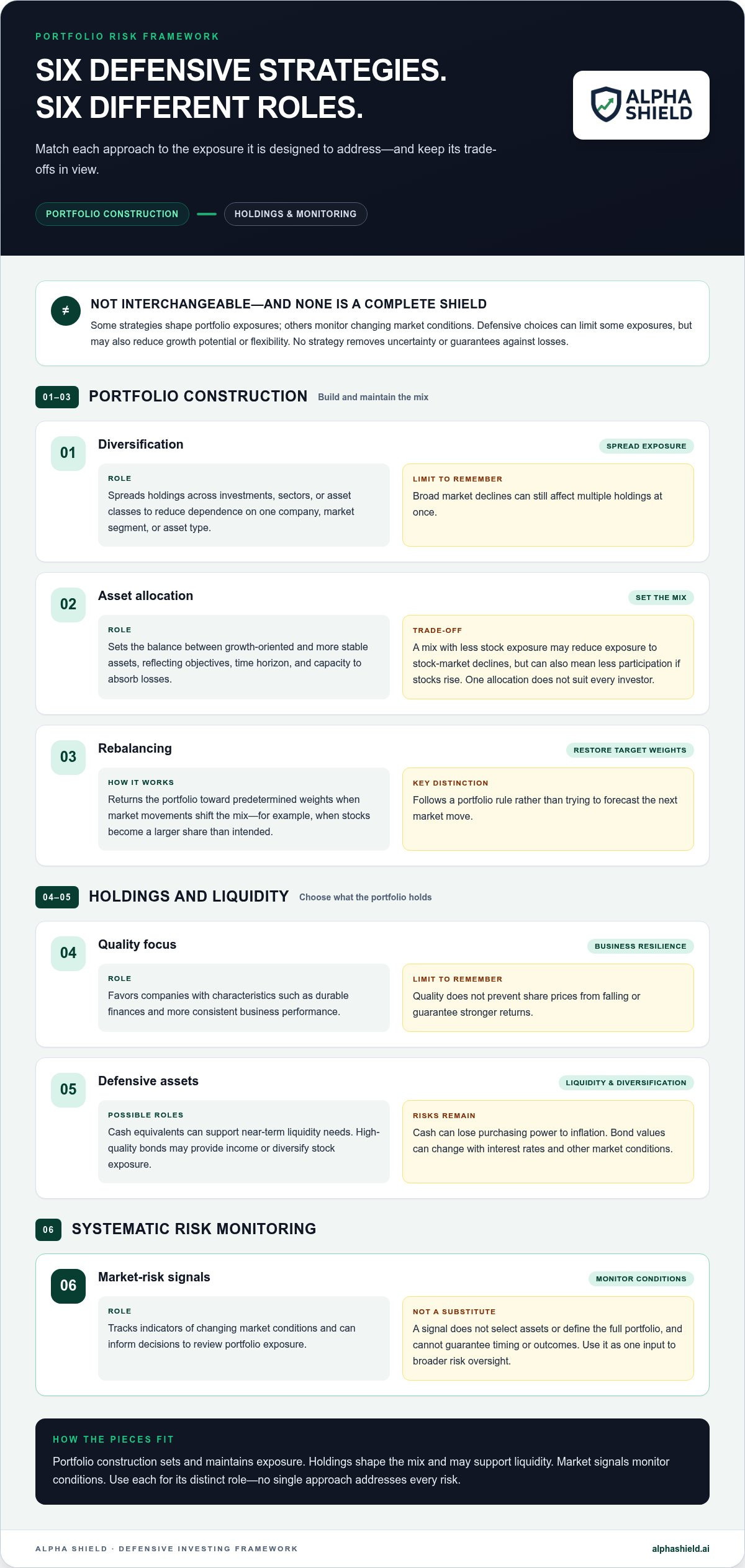
These six defensive investing strategies serve different roles. Some shape portfolio exposures; others monitor changing market conditions. None is a universal shield. For each one, weigh the risk it is meant to address against the trade-offs it may introduce.
Portfolio Construction: Diversification, Allocation, and Rebalancing
- Diversification: Spreads exposure across holdings, sectors, or asset classes. It can reduce dependence on any one investment or market segment, though broadly falling markets can still affect multiple holdings at once.
- Asset allocation: Sets the portfolio’s mix of growth-oriented and more stable assets. The balance should reflect objectives, time horizon, and capacity to absorb losses. An allocation that suits one investor may be unsuitable for another.
- Rebalancing: Restores predetermined portfolio weights when market movements shift them. If stocks grow to a larger share than intended, rebalancing can bring the mix back toward its plan. It follows a rule rather than trying to forecast the next market move.
These methods define portfolio structure. Fidelity’s overview of how to build a defensive portfolio also discusses approaches such as low-volatility stocks and bonds, illustrating how different components may contribute to a broader design.
Defensive Holdings and Systematic Risk Monitoring
- Quality focus: Favors companies with characteristics such as durable finances and more consistent business performance. This may help limit exposure to financially fragile businesses, but quality does not prevent share prices from falling or guarantee stronger returns.
- Defensive assets: Cash equivalents can support near-term liquidity needs, while high-quality bonds may provide income or diversify stock exposure. Both carry risks. Cash can lose purchasing power to inflation, and bond values can change with interest rates and other market conditions.
- Market-risk signals: Track indicators of changing market conditions. Unlike diversification or allocation, a signal monitors risk rather than selecting assets or defining the portfolio’s full construction. It can inform review decisions, but it can’t guarantee timing or outcomes.
Construction choices and monitoring tools are complementary, not interchangeable. A signal may prompt closer review of portfolio exposure, while allocation and rebalancing rules determine how the portfolio is structured and maintained. The Alpha Shield market-risk dashboard presents market-health indicators as a systematic input to risk oversight. It is one part of a broader process, not a replacement for an investment plan.
How to Compare Defensive Investing Strategies Without Chasing Safety
No single defensive strategy is best for everyone. Compare each option by the risk it targets, how it works, the period it is intended to serve, and what it may cost in growth, liquidity, or simplicity. A “defensive” label describes an intended role, not a promise that an investment can’t lose value.
| Approach | Risk addressed and mechanism | Trade-off to consider |
|---|---|---|
| Diversification | Reduces reliance on a single holding, sector, or asset class by spreading exposure. | Can’t eliminate market-wide losses; relationships between assets can change. |
| Defensive holdings | Cash equivalents may support liquidity; bonds or quality-focused investments may serve specific portfolio roles. | May carry inflation, interest-rate, credit, or business risks, and may participate less in rising markets. |
| Rebalancing | Returns portfolio weights toward preset targets after market movements shift them. | Requires consistent rules and may involve trading or tax considerations. |
| Risk signals | Monitor market conditions to inform risk review and decision-making. | Signals can be wrong, late, or change; interpreting them adds process complexity. |
What Trade-Offs Should Investors Weigh?
Start with the purpose. If near-term spending is the priority, liquidity may matter more than maximizing market exposure. If purchasing power over a long horizon is central, pay attention to inflation sensitivity. If a method requires frequent interpretation or complex execution, consider whether you can follow it consistently.
Defensive positioning can lag during rising markets if it reduces exposure to assets that are advancing. That opportunity cost is part of the design, not necessarily evidence that the approach has failed. Fidelity’s discussion of building a defensive portfolio provides further context on combining defensive components. Evaluate the role each component serves instead of treating its label as proof of safety.
Can Diversification or Bonds Prevent Portfolio Losses?
No. Diversification may reduce concentration exposure, but holdings can fall together during broad market stress. Relationships between investments and market behavior can change, so past patterns aren’t guarantees for the next downturn.
Bonds also carry risk. Interest-rate changes can affect market values, credit problems can impair repayment, and inflation can reduce the purchasing power of income and principal. These risks vary by bond and market conditions. No holding is a complete shield.
Use defensive investing strategies to manage specific exposures, not to chase an impossible risk-free portfolio. A systematic market-risk input can support broader oversight. The Alpha Shield market signal is one such input, not a prediction or guarantee.
How to Build a Defensive Investing Process Before Volatility Rises
A defensive process is most useful when its rules are set before market stress makes decisions harder. The aim isn’t to forecast every downturn. It’s to connect portfolio choices to your goals, risk boundaries, and review routine, so headlines alone don’t dictate your next move.
Set Objectives, Time Horizon, and Risk Boundaries
Time horizon, liquidity needs, and capacity for loss shape which defensive choices may fit. Money needed soon has a different role from assets invested toward a distant goal. Personal circumstances can also change, so define how and when you’ll revisit your assumptions.
Use these prompts to build a written framework. They’re general planning questions, not individualized financial advice.
- 1. Define goals: What is the portfolio meant to fund, and when might you need the money?
- 2. Assess risk: Which losses could you financially absorb, and which could disrupt your plans or cause you to abandon them?
- 3. Set allocation: Record an allocation target or range that reflects your objectives, time horizon, and risk capacity. Note what role each major asset group serves.
- 4. Establish rules: Decide in advance what warrants a review. For example, write down what you’ll do if an allocation moves outside its chosen range or a defined risk indicator changes.
- 5. Review: Choose a regular review schedule and identify life changes that should prompt an earlier reassessment.
Write down both the trigger and the next step. “Review the portfolio if a target allocation moves outside its range” is more actionable than “sell if the market looks dangerous.” It focuses on portfolio conditions rather than a short-term forecast.
Review Signals and Rules Without Overreacting
Scheduled reviews create a pause between a market event and a portfolio decision. If a predefined trigger occurs, assess it in context: does it affect your goals, liquidity needs, or chosen risk limits? If not, your rule may call for monitoring rather than an immediate change.
A systematic risk mitigation guide and an article on a market volatility warning system can help frame how signals fit into a review process. Treat indicators as inputs, not instructions. They can be wrong, delayed, or inconsistent, so consider them alongside your portfolio plan rather than in isolation. Alpha Shield’s market-health indicators offer a systematic input for monitoring market risk, not a replacement for a complete investment plan or a guarantee of an outcome.
To see how a dashboard can support this kind of monitoring, explore the Alpha Shield market-risk dashboard.
Where Market Signals Fit in a Defensive Investing Strategy
A market signal can add a structured observation to portfolio oversight. It gives investors another way to monitor market conditions and potential drawdown risk alongside their allocation, liquidity needs, and review rules. It doesn’t determine what every investor should do next. Its value depends on how it is interpreted and applied within a broader plan.
What Can a Market-Risk Signal Tell an Investor?
A signal reflects defined observations of market conditions. It is not a certain prediction of a downturn, a precise forecast of timing, or a promise that losses can be avoided. If an indicator changes, use it as a prompt to review exposure against existing portfolio rules, rather than reacting automatically.
A dashboard can make indicators easier to monitor consistently by bringing market-health information into one view. A repeatable review can help separate a measured risk check from a response to a single headline. For more context on defensive planning, see this guide to market crash defense strategies.
How Alpha Shield Fits a Broader Risk Framework
Alpha Shield Market Signal and the Alpha Shield Dashboard are designed to support market-risk monitoring. The dashboard presents market-health indicators as a systematic input for investors assessing potential drawdowns. The signal is not an individual stock recommendation or a shorting system. It doesn’t replace portfolio construction, personal risk assessment, or a complete investment plan, and it can’t guarantee protection or results.
Alpha Shield’s founders bring more than 50 years of combined investment banking and global markets experience. That background informs the company’s focus on systematic risk awareness, but it is not proof of future performance or a reason to disregard the limits of market signals. No indicator can account for every portfolio need or market outcome.
For a measured next step, consider how a market signal could fit into your existing review rules. Define what you would review if conditions change and what would not prompt an immediate portfolio adjustment. Then assess any signal in context with your time horizon, liquidity needs, and long-term objectives. Defensive investing strategies work through a coordinated process, not a single indicator.
Explore the Alpha Shield Market Signal to see how its market-health indicators can fit into a broader risk-monitoring process.
Build a More Measured Approach to Portfolio Risk
Defensive investing strategies are most useful as parts of a coordinated plan, not as a search for a risk-free holding. Diversification, allocation, and rebalancing shape portfolio exposure, while defensive assets and market signals can serve specific roles. Each choice has trade-offs, including the possibility of less participation during rising markets.
Set goals and risk boundaries before volatility rises, then document when you’ll review or adjust the plan. Treat market indicators as one input, not a forecast or guarantee. The Alpha Shield system began development in 2017 and launched in 2019. Its founders bring more than 50 years of combined investment banking and global markets experience, and its dashboard presents market-health indicators for risk monitoring.
A disciplined process won’t remove uncertainty, but it can make decisions clearer and more consistent. Start with the risks that matter to your goals, then build from there.
Explore the Alpha Shield Market Signal and its market-risk dashboard.
Frequently Asked Questions
What is a defensive investing strategy?
A defensive investing strategy manages portfolio exposure and potential downside while keeping long-term goals in view. It may use diversification, a suitable asset allocation, rebalancing rules, or market-risk monitoring. The purpose isn’t to predict every market decline or eliminate investment risk. Instead, a defensive process helps investors decide in advance how to manage exposures and review decisions as circumstances and market conditions change.
Which defensive investing strategy is best for beginners?
No single strategy is best for every beginner. A practical starting point is to understand your goals, time horizon, liquidity needs, and capacity for loss, then use those factors to guide a diversified allocation. Clear rebalancing and review rules can make the approach easier to follow. Avoid adding complicated tools before you understand their role, risks, and potential trade-offs within your broader plan.
Can defensive investing strategies prevent market losses?
No. Defensive investing strategies can help manage specific exposures, but they can’t prevent all losses or guarantee that a portfolio will be protected during a downturn. Diversification may reduce reliance on a single holding, for example, while broad market declines can still affect multiple investments. Outcomes depend on portfolio design and market conditions. Treat capital preservation as an objective, not a promised result.
Are bonds always a safe investment during market volatility?
No. Bond prices can change as interest rates and market conditions shift, and bonds also carry credit and inflation risks. A bond’s risk depends on factors such as its issuer, maturity, and the investor’s time horizon. Bonds may serve a stabilizing or income role in some portfolios, but they aren’t risk-free or a complete shield against losses. Consider their specific role alongside other holdings.
How often should investors review a defensive investing plan?
Set a regular review schedule that suits your plan, and define events that may warrant an earlier check. For example, review if your allocation moves outside a chosen range, your liquidity needs change, or a major life event affects your goals. The purpose is to assess the plan consistently, not respond to every headline or short-term market move. Revisit assumptions when your circumstances change.
Do market-risk signals guarantee protection from a crash?
No. A market-risk signal is a structured input for monitoring conditions, not a certain prediction or guarantee against losses. Indicators can be wrong, delayed, or inconsistent. Alpha Shield Market Signal and its dashboard present market-health indicators for risk monitoring, but they don’t replace portfolio planning or ensure an outcome. Use signals as one input alongside your goals, allocation, and predefined review rules.
Can defensive investing still participate in market growth?
Yes. A defensive portfolio can retain exposure to growth-oriented investments while using other methods to manage risk. The balance depends on an investor’s objectives, time horizon, and risk capacity. Reducing exposure to assets that are rising may also limit participation in strong markets. The aim is not to avoid growth, but to choose a measured level of risk that remains consistent with long-term goals.


