
What if the biggest self-directed investing risk isn’t a lack of information, but acting on the wrong information at the wrong time? Market commentary, social feeds, and account alerts compete for attention, making it harder to separate evidence from noise. This practical checklist of mistakes to avoid with self-directed investing can help you pause, assess a decision, and act with greater discipline.
Choosing your own investments gives you control, but control works best when it’s paired with clear rules. Use the steps below to test an investment thesis, check for concentration and portfolio risks, and set points for reassessment without drifting into day trading.
You’ll also learn to distinguish portfolio risk from account-specific rules and recognize when emotion is driving a decision. Market-health indicators, such as those shown in the Alpha Shield Dashboard, can provide context for a broader review. They are not stock recommendations or guaranteed crash predictions. The aim is clarity, not certainty: a steady process for monitoring conditions and managing exposure.
Key Takeaways
- Understand the difference between choosing investments in a brokerage account and following the specific rules that apply to a self-directed IRA.
- Use the mistakes to avoid with self-directed investing checklist to test your investment thesis, assess risk, review costs, and record your reasoning before acting.
- Diversification can help manage concentration, but it doesn’t eliminate risk or justify reacting to every headline.
- Keep investment decisions separate from account-specific tax and legal obligations, and seek authoritative guidance on IRA prohibited transactions and disqualified persons.
- Pause and reassess when evidence is unclear, liquidity is misunderstood, exposure is excessive, or your original assumptions have changed.
Self-Directed Investing Mistakes Begin with Confusing Control for a Strategy
Self-directed investing describes who makes the investment decisions: the investor, rather than an adviser acting on the investor’s behalf. It isn’t a single account type, asset class, or strategy. You might choose investments in a standard brokerage account, workplace plan, or another structure, each with its own features and obligations.
This distinction matters because access to choices can feel like a plan, even when it isn’t one. You might research an unfamiliar asset, place a trade, and monitor its price without clear criteria for why it belongs in your portfolio or what would change your view. That gap is where avoidable mistakes begin. The key mistakes to avoid with self-directed investing often stem not from having control, but from using it without a consistent decision process.
Self-directed investing versus a self-directed IRA
A self-directed IRA is a specific US retirement-account arrangement, not a synonym for all investor-led investing. Self-directed investing can apply across different account structures. A Self-Directed IRA overview can help explain that narrower category, but it isn’t a guide to every account or jurisdiction.
Account-specific tax treatment and transaction rules depend on the account and jurisdiction. A decision that is ordinary in one brokerage account may raise different considerations in a retirement account. If you invest through a US self-directed IRA, understand the rules that apply to it and seek authoritative guidance where needed. A general investing checklist doesn’t replace account-specific requirements.
Why autonomy needs a written decision process
Without criteria set in advance, attention can become the decision-maker. A dramatic headline may prompt a sale. A recent rise may make an investment seem safer than it is. Familiarity with a company or asset can feel like evidence, even when the underlying thesis hasn’t been tested. These reactions can lead to inconsistent choices: buying for one reason, then selling for another.
A decision rule is a criterion set in advance for evaluating or reviewing an investment. It might specify what evidence supports the thesis, which risks matter, how the investment fits the portfolio, and what changes would prompt a reassessment. The purpose isn’t to predict every market move. It’s to make your reasoning visible before emotion or new information shifts your perspective.
Investment control gives you the authority to decide; a complete investing plan gives each decision a reason, a risk boundary, and a review point. That distinction is practical. If you can’t explain why you’re acting, what could make your view wrong, and when you’ll reconsider, pause before placing the trade.
The sections ahead turn that discipline into a usable process. They cover how to test an investment thesis, assess concentration and market reactions, separate account obligations from portfolio choices, and review decisions as conditions change. A systematic market-risk indicator can inform that review, but it is only one input, not a stock recommendation or a guarantee against losses.
Avoid Self-Directed Investing Mistakes with a Repeatable Due-Diligence Checklist
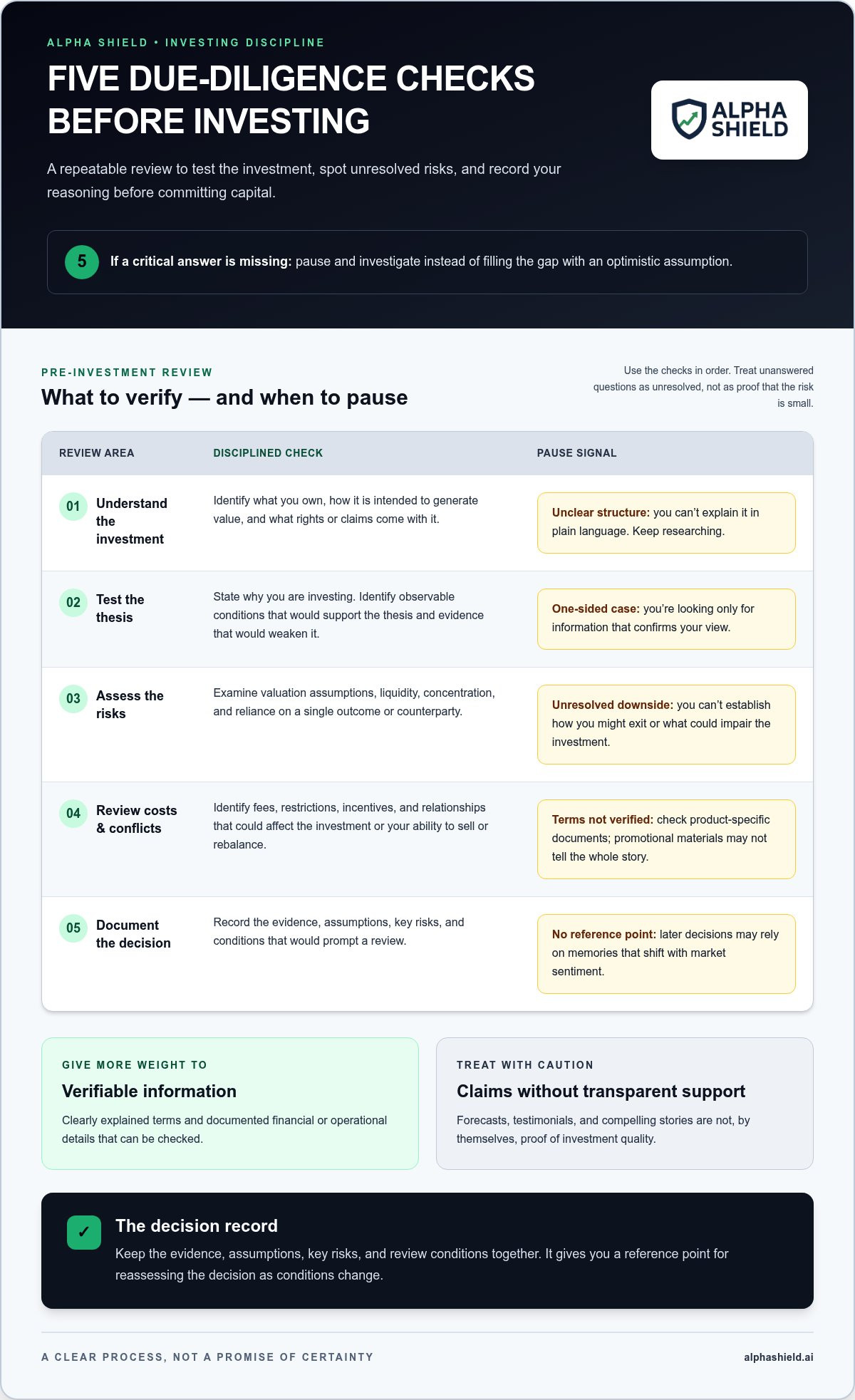
A consistent review process helps separate an investment’s merits from the confidence of its pitch. Use this checklist before committing capital. If a critical answer is missing, pause and investigate instead of filling the gap with an optimistic assumption.
- Understand the investment. Identify what you own, how it is intended to generate value, and what rights or claims come with it. If you can’t explain the structure in plain language, keep researching.
- Test the thesis. State your reason for investing, then ask what observable conditions would support it and what evidence would weaken it. Look for information that could disprove your view, not just material that confirms it.
- Assess the risks. Examine valuation assumptions, liquidity, concentration, and reliance on a single outcome or counterparty. If you can’t establish how you might exit or what could impair the investment, treat that as an unresolved risk.
- Review costs and conflicts. Identify fees, restrictions, incentives, and relationships that could affect the investment or your ability to sell or rebalance. Check product-specific terms in relevant documents; promotional materials may not tell the whole story.
- Document the decision. Record the evidence, assumptions, key risks, and conditions that would prompt a review. This gives you a reference point for later decisions, rather than relying on memories that may shift with market sentiment.
Check the thesis, evidence, and downside
Give greater weight to verifiable information, such as clearly explained terms and documented financial or operational details, than to forecasts, testimonials, or claims without transparent support. A compelling story isn’t proof of investment quality. Projected growth may depend on uncertain assumptions, favorable market conditions, and the ability to execute, none of which promotional material may establish.
Use this comparison to check whether the reasoning rests on evidence or expectation:
| A sound investment thesis | An unsupported assumption |
|---|---|
| Names evidence that can be checked and explains its limits. | Relies on confident claims, testimonials, or forecasts without clear support. |
| States what could weaken the case and identifies key dependencies. | Assumes the expected outcome will occur or treats one scenario as certain. |
| Explains valuation and how liquidity affects a potential exit. | Leaves pricing, exit options, or counterparty exposure unclear. |
Review fees, liquidity, and conflicts before committing
Check the relevant documents for costs, withdrawal or transfer limits, and conditions that could constrain a sale or rebalance. Liquidity isn’t just a label. Understand what process governs an exit and what could prevent it from happening when you want. If terms are vague, or a promoter’s incentives and material limitations are difficult to identify, don’t dismiss that uncertainty as a minor detail.
This routine addresses several mistakes to avoid with self-directed investing: treating a forecast as evidence, overlooking exit constraints, and committing before the downside is clear. For broader context on market conditions, Alpha Shield market-risk monitoring can be one input to your review, not a substitute for evaluating an individual investment.
Manage Concentration and Market Reactions Instead of Chasing Certainty
Diversification can reduce the impact of a problem tied to one holding, sector, or strategy. It can’t eliminate market risk. A portfolio spread across several investments may still depend on the same economic drivers, such as interest rates, credit conditions, or strong consumer demand. The practical task is to understand how holdings may behave together, not just count them.
A drawdown is a decline in portfolio value from a previous peak. It describes what happened; it doesn’t predict how far a decline will go or how quickly it may recover. No indicator or tool can prevent every loss. Risk monitoring can help you assess whether conditions have changed and whether your exposure still fits your plan.
Avoid letting one holding or idea dominate the portfolio
Look beyond the number of positions. Several investments may depend on the same sector, strategy, company, or market condition. Assess these overlaps together. For example, holdings in different companies can still create substantial shared exposure if their performance depends on the same industry trend. Review concentration by source of risk, then consider whether a setback in that area could affect several parts of your portfolio at once.
There’s no universal allocation that suits every investor. Instead, define what level of exposure would feel excessive for your circumstances and review it at planned intervals. Diversification is a risk-management tool, not a guarantee against losses.
Do not mistake volatility for a decision rule
A sharp price move can feel like new information, but volatility alone doesn’t prove that an investment thesis has changed. Compare the move with the conditions you set for reassessment. If the underlying facts remain consistent, a headline or short-term return may not justify an immediate trade. If important assumptions have changed, review the investment deliberately rather than waiting for certainty that may never arrive.
A planned review can help separate market movement from a meaningful change in risk. Set a schedule that suits your approach, and decide in advance what developments warrant an additional review. This creates a pause between a market event and an action. It doesn’t guarantee better returns, but it can reduce the chance of changing your portfolio solely in response to fear or excitement.
- Check whether holdings share a sector, strategy, or economic driver.
- Compare current exposure with the limits you set for yourself.
- Ask whether new evidence has changed the thesis, or whether the price has simply moved.
- Review broader market conditions on a planned schedule instead of reacting to every headline.
For a broader view of market conditions, macro market risk indicators can provide context for monitoring portfolio risk. They are one input, not individual stock recommendations or predictions that a crash will occur. For a more structured approach to managing exposure, explore this framework for systematic risk mitigation. Used alongside a planned review process, market signals can inform decisions without turning long-term investing into day trading.
Keep Account Rules, Records, and Review Habits from Becoming Avoidable Risks
Portfolio decisions and account obligations are connected, but they are not the same. An investment may fit your strategy and still raise account-specific tax, legal, or regulatory questions. These obligations depend on the account and jurisdiction. Treat them as a separate control layer: a sound investment thesis doesn’t settle every account-related issue.
Treat retirement-account rules as a separate checklist
Retirement-account guidance often focuses on accurate account titling and documentation, permitted transactions, and restrictions on certain investments. Those concerns don’t apply uniformly to every account or investor. For example, US self-directed IRA rules include prohibited-transaction and disqualified-person considerations. The details matter, so consult current official guidance, such as IRS materials, or a qualified tax or legal professional before acting on an account-specific question.
Don’t rely on a general investing article to determine whether a particular transaction is allowed. Keep a separate account checklist alongside your investment review. Confirm which account is involved, what rules govern it, and whether the planned transaction could create a compliance or tax issue. Requirements can change and vary by jurisdiction, so verify the current rules that apply to your circumstances.
Create a regular review routine without overtrading
A review routine should produce a record, not constant activity. Choose a cadence appropriate to your goals and account, then revisit the original thesis, key risk assumptions, and material changes in relevant market conditions. Also review statements and account documents for transactions or charges that need clarification. If nothing material has changed, a review doesn’t require a trade.
Organized records make the process more reliable. Keep decision notes with account statements, transaction confirmations, fee information, and relevant correspondence. For each material portfolio change, record what prompted it and which assumption or condition changed. Later, you can compare the decision with the evidence available at the time instead of reconstructing your reasoning from memory.
- Investment file: Note the original rationale, key assumptions, and review triggers.
- Account file: Retain statements, confirmations, fee details, and relevant account documents.
- Change log: Record the reason for significant buys, sales, or allocation changes.
Separate routine review from constant price-checking. A headline or daily fluctuation isn’t automatically a reason to act. If new information appears relevant, compare it with your review criteria, document what has changed, and decide whether further investigation is warranted. This helps address mistakes that arise when records are incomplete or reactions replace a repeatable process.
Systematic market-risk monitoring can add context to a review, but it doesn’t replace account-specific guidance or guarantee against losses. Use market-health indicators as one input while keeping your investment rationale and account records distinct.
Explore the Alpha Shield Dashboard to add systematic market-risk monitoring to your review process.
Use This Self-Directed Investing Checklist to Turn Lessons into a Process
A checklist turns good intentions into repeatable decisions. Use it before investing, during scheduled monitoring, and when a material change prompts a review. It won’t remove uncertainty, but it can help you catch mistakes to avoid with self-directed investing before an unclear assumption becomes an unexamined position.
Before investing: confirm the case and the fit
Before committing, pause and work through these checks. If an answer is missing, investigate before proceeding.
- Thesis: Can you explain why the investment may suit your plan and what evidence supports that view?
- Downside: What could weaken the case, and which assumptions matter most?
- Liquidity: Do you understand the terms and constraints that could affect your ability to exit?
- Portfolio fit: How does this exposure overlap with your other holdings, and could it make one risk too dominant?
- Account questions: Are there tax or legal issues that need authoritative, account-specific guidance rather than further market research?
- Record: Have you documented the rationale, evidence, risks, and conditions that would trigger reassessment?
A clear “yes” to each item doesn’t guarantee an outcome. It means you’ve examined the decision from more than one angle and can review your reasoning later.
Monitor conditions without turning the checklist into a trading system
Set a review cadence that fits your approach. At each review, compare current facts with your original thesis, risk assumptions, and portfolio exposure. Distinguish a change in evidence from ordinary price movement. If nothing material has changed, monitoring doesn’t require a trade. The purpose is disciplined awareness, not constant activity.
Stop and review if the evidence becomes unclear, you discover you misunderstood liquidity, exposure seems excessive, or an important assumption has changed. Record what triggered the pause. Then decide whether to gather information, reassess the investment, or consult a qualified professional about account-specific questions. Don’t treat a checklist as a command to buy or sell.
Market conditions can inform a broader review, but no signal can predict every decline or prevent every loss. Alpha Shield’s Market Signal and Dashboard are designed for systematic market-risk monitoring, not individual stock recommendations or guaranteed crash predictions. Treat market-health indicators as one input alongside your investment thesis, portfolio exposures, and review rules. For additional educational context, see this guide to evidence-based market timing.
Keep the process simple: assess before acting, monitor at planned intervals, and review when a defined trigger occurs. Consistent records help you see whether decisions followed your rules, even when markets are noisy.
Explore the Alpha Shield Market Signal for a systematic tool to monitor market risk and inform your portfolio review.
Make Your Next Investment Decision More Deliberate
A checklist is most useful when it becomes a habit, not a document you consult once. Revisit your decision rules as your goals, circumstances, or understanding of an investment change. That ongoing discipline can help keep mistakes to avoid with self-directed investing from returning in a new form.
For investors who want a structured view of market risk, Alpha Shield brings together experience from former investment bankers and global markets professionals with over 50 years of combined experience. Its dashboard presents market-health indicators for risk monitoring. Use them as context for your own review, not as a substitute for judgment or a promise about what markets will do.
Stay curious, keep your process clear, and let evidence guide your next step.
Frequently Asked Questions
Can self-directed investors beat the market?
Some investors may outperform a relevant market benchmark over a particular period, but consistent outperformance is difficult and can’t be assumed in advance. Compare performance with an appropriate benchmark over a meaningful time horizon, accounting for costs and the level of risk taken. A concentrated position might outperform during a favorable period while exposing the portfolio to sharper losses. Judge the decision process as well as the result.
Is market timing always a mistake for long-term investors?
No. Adjusting exposure in response to defined evidence isn’t automatically a mistake, but repeated attempts to predict short-term price moves can lead to rushed decisions. For example, selling after a sharp decline and waiting for a clear recovery may mean acting later than intended. If you use market signals, decide beforehand how they will inform your review. A signal is one input, not certainty about the market’s next move.
How much cash should a self-directed investor keep in a portfolio?
There isn’t a universal cash allocation that fits every investor. The appropriate amount depends on factors such as planned spending, investment horizon, income stability, and the liquidity of other holdings. Separate cash intended for near-term needs from cash held as part of an investment strategy. Before setting a target, consider what the cash is meant to do and how holding it affects your broader plan.
What happens if a self-directed IRA makes a prohibited transaction?
A prohibited transaction can create serious tax consequences for a US self-directed IRA, and the result depends on the facts and applicable rules. Don’t assume that correcting a transaction later will erase its effects. Preserve account records and transaction details, then consult current IRS guidance and a qualified tax or legal professional promptly. This is account-specific guidance, not a conclusion that applies to every retirement account or jurisdiction.
Can self-directed investing include private or alternative investments?
Yes, self-directed investing may include private or alternative assets, depending on the account structure, jurisdiction, and applicable restrictions. Eligibility alone doesn’t establish that an investment is suitable or well-supported. For example, private holdings may have limited information, less frequent valuations, or fewer exit options than publicly traded securities. Assess those features alongside portfolio exposure, and verify account-specific rules before making a transaction.
How can investors tell whether an investment claim is misleading?
Look for claims that can be checked against reliable documents or independent information. Be cautious if promotional material emphasizes projected gains but leaves out assumptions, downside scenarios, conflicts, or exit restrictions. A claim of guaranteed returns deserves particular scrutiny. Ask what evidence would disprove the claim, whether cited results apply to the investment being offered, and whether important limitations are explained clearly. These checks can help you avoid common self-directed investing mistakes.
Does a market-risk signal guarantee protection from investment losses?
No. A market-risk signal can help investors monitor market conditions, but it can’t guarantee protection from losses or identify every decline in advance. Signals may be one part of a broader review alongside investment research, portfolio exposure, and personal decision rules. Alpha Shield’s Market Signal and Dashboard are designed for systematic risk monitoring, not individual stock recommendations or guaranteed crash predictions. Treat indicators as context, not certainty.


