

What if protecting a portfolio didn’t depend on guessing when the next downturn will arrive? Effective downside risk protection strategies rely on layered rules, not a single forecast or hedge. That matters when you’re deciding which risks deserve attention and how much protection may limit gains in a rising market.
Those concerns are reasonable. Every approach involves trade-offs. A hedge can reduce some losses, but it may carry a cost or behave differently than expected. Diversification can spread exposure, but it can’t remove risk. The aim isn’t to predict every market move. It’s to create a repeatable process for deciding what to monitor and how to respond.
This guide compares the main approaches to downside protection, explains their limitations, and shows how to combine them without making a portfolio harder to manage. You’ll also learn how to review risk consistently and how systematic signals can support, but not replace, investment judgment. A market signal and dashboard can help organize that review as one layer in a broader risk-management process, not as a guarantee against losses.
Key Takeaways
- Separate the risk of potential losses from the task of predicting when markets will fall.
- Compare downside risk protection strategies by their purpose, effort, trade-offs, and limitations.
- Set portfolio review criteria before volatility rises so decisions follow a consistent process.
- Assess how allocation, liquidity, and hedging fit your goals and constraints rather than relying on a universal portfolio mix.
- Use systematic market signals to structure portfolio monitoring, not as a promise of an exact exit or a substitute for judgment.
What downside risk protection strategies can and cannot do
Downside risk is the possibility that a portfolio will lose value, including the potential severity of those losses. It depends on more than whether markets decline. The assets you hold, their weightings, and how readily they can be sold all affect how a downturn may affect your portfolio. Downside risk protection strategies aim to manage that exposure. They don’t need to predict the date or trigger of the next decline to be useful.
Risk mitigation changes an exposure or prepares for a loss; loss prevention promises that the loss won’t happen. That distinction matters. No allocation, hedge, or signal eliminates market risk or guarantees a specific outcome. A protection measure may reduce the impact of one kind of decline while leaving other risks in place.
Which portfolio risks are investors trying to manage?
Broad market risk affects many investments at once. Concentration risk arises when a portfolio depends heavily on a particular company, sector, asset class, or market driver. Liquidity risk concerns the ability to sell an investment when needed without an unfavorable delay or price. A portfolio concentrated in growth-oriented equities, for example, may respond differently to a sell-off than one spread across varied asset types. Diversification can address some concentration, but it can’t prevent broad market losses.
The relevant priority depends on the investor. Someone with near-term spending needs may focus on access to cash and the size of a potential drawdown. Someone investing over a longer horizon may weigh short-term declines differently, while still accounting for goals, capacity for loss, and personal tolerance for volatility. Risk management starts by identifying which exposure could interfere with the plan, not by assuming every investor needs the same defense.
Why protection always involves trade-offs
Defensive positioning can help in some conditions and lag in others. If a portfolio holds less exposure to falling assets, it may also participate less when those assets rebound. A hedge has its own mechanics and may not move in perfect opposition to the holdings it is intended to protect. For example, an investor who shifts part of an equity allocation into a defensive holding before a decline might experience a smaller loss if equities fall, but could also capture less of a subsequent equity recovery. This illustrates a trade-off, not a forecast or typical result.
Some approaches are designed to limit losses under defined conditions, but a stated buffer or hedge objective isn’t a universal floor beneath a portfolio. Outcomes depend on the strategy’s structure, timing, and the assets involved. Portfolio insurance, for instance, describes a hedging approach designed to limit losses from a declining stock index. It still doesn’t make an investor immune to every market risk. The practical test is whether a strategy’s potential benefit justifies its limitations within the broader plan.
How the main downside risk protection strategies work
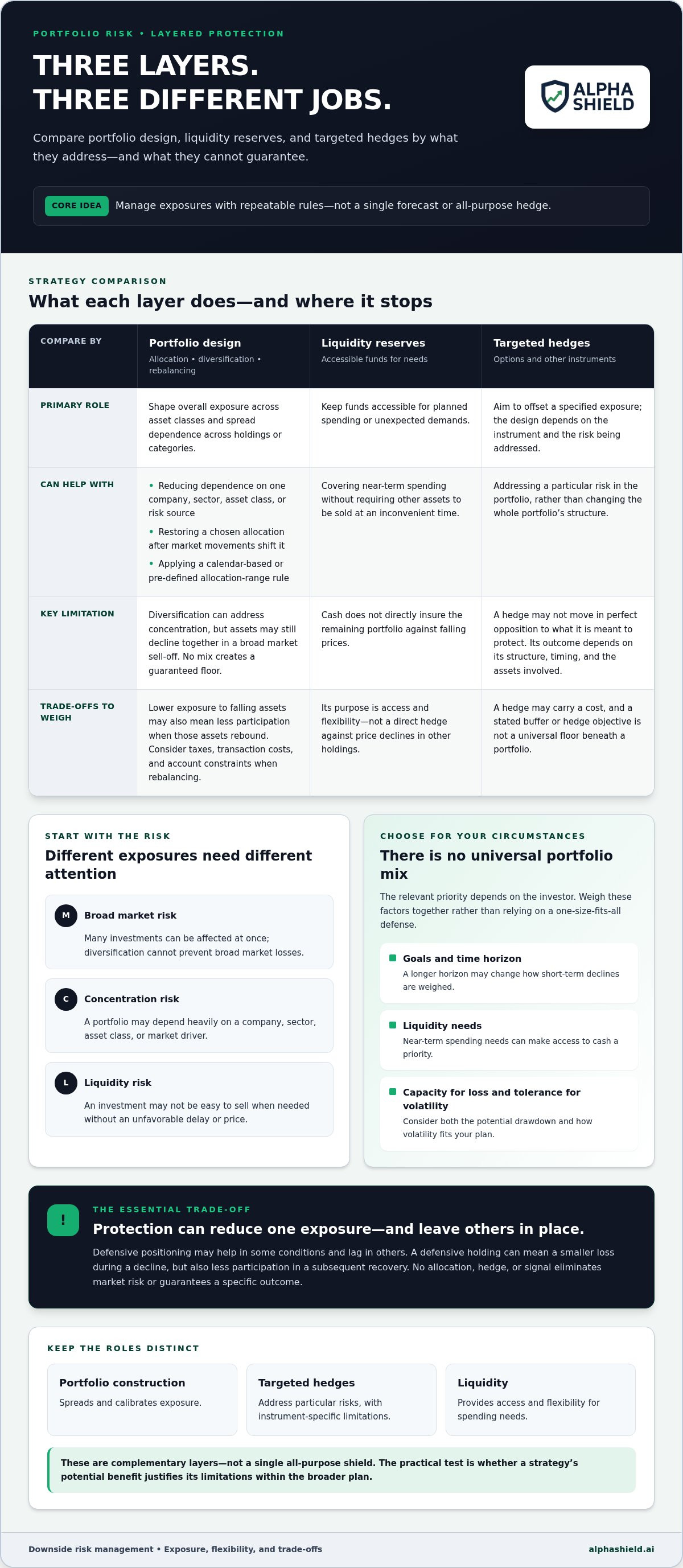
Protection can be built into portfolio design, applied through ongoing decisions, or added through instruments intended to offset a particular exposure. These methods address different problems. Asset allocation determines how a portfolio is distributed among asset classes and influences its overall sensitivity to market movements. There’s no universal mix: goals, time horizon, liquidity needs, and ability to tolerate losses all matter. The Corporate Finance Institute’s overview of downside risk management also distinguishes risk assessment from the tools used to manage it.
A useful framework separates portfolio-level controls from targeted hedges. Diversification, allocation, and rebalancing shape the portfolio itself. Options and other hedging instruments are designed to offset specified exposures, but their behavior depends on their structure and market conditions. Liquidity reserves serve another purpose: keeping funds accessible for planned needs or unexpected demands.
Portfolio construction and rebalancing as foundational controls
Diversification spreads investment exposure across holdings or categories, reducing dependence on any single company, sector, or other source of risk. It can address concentration, but assets may still decline together during a broad market sell-off. Rebalancing restores a chosen allocation when market movements shift the portfolio away from its targets. It applies a pre-set discipline, not a forecast of which asset will perform best next.
For example, if one part of a portfolio grows faster than others, its share of the total may become larger than intended. Rebalancing can bring exposure closer to the investor’s plan. The decision rule might be calendar-based or tied to a pre-defined allocation range. Either approach requires the investor to consider practical factors such as taxes, transaction costs, and account constraints before acting.
These controls work at the portfolio level. They influence how much risk the investor takes and where that risk sits, but they don’t create a guaranteed floor under the portfolio. As a concise rule: portfolio construction spreads and calibrates exposure; targeted hedges address particular risks; liquidity provides flexibility. Together, they offer different layers, not a single all-purpose shield.
Cash, options, and other hedges serve different purposes
Liquidity reserves can help cover near-term spending without requiring an investor to sell other assets at an inconvenient time. But holding cash doesn’t directly insure the remaining portfolio against falling prices. Options are contracts whose value may change with the underlying asset, market movement, and time remaining. They can be structured to offset a defined exposure, but may involve ongoing cost, complexity, and time sensitivity.
A hedge can also behave differently than expected if the portfolio and the hedging instrument don’t move in close alignment. Its protection may be partial, limited to certain conditions, or reduced as time passes. Compare each approach by the risk it targets, what it might cost in opportunity or upkeep, and what it leaves unaddressed. Don’t assume one instrument fits every portfolio or market scenario.
For investors who want a consistent view of market conditions alongside allocation and liquidity decisions, the Alpha Shield Market Signal and Dashboard provides a monitoring layer within a broader risk process. The signal helps organize attention; it isn’t a substitute for portfolio-level judgment or a promise of a particular outcome.
Compare downside protection strategies by trade-off, not headline promise
A useful comparison starts with function, not a claim of protection. Some methods change the portfolio’s exposures. Others provide liquidity, hedge a defined risk, or help investors monitor market conditions. These downside risk protection strategies aren’t interchangeable, and none is universally best. Compare the purpose, ongoing effort, trade-off, and limitation of each against your goals and constraints.
When a portfolio-level control may be more practical
If one sector, holding, or asset class dominates portfolio exposure, reviewing allocation may address the source of risk more directly than adding a hedge. Rebalancing can then help maintain the chosen structure. A rule-based review differs from reacting to every market headline: it defines in advance what conditions prompt attention. Simplicity can make a process easier to follow, but simple implementation alone doesn’t prove it will be effective.
When hedges or market signals may add another layer
A hedge may be relevant when an investor wants to address a specific exposure, but it introduces its own terms, costs, and limitations. A systematic signal serves another role: it helps structure monitoring, not predict markets with certainty. Both should sit within a broader plan. For a deeper look at combining rules into a repeatable process, see this systematic risk mitigation framework.
How to build a repeatable downside risk review process
A review process turns downside risk protection strategies into decisions you can examine and repeat. Set it up before markets become volatile. The objective isn’t to react to every headline or predict the next decline. It’s to know what information warrants a review, what questions to ask, and how a decision connects to your investment plan.
- Document your goals. Record your investment horizon, expected cash needs, and the role each part of the portfolio plays. Note how much fluctuation you can tolerate without abandoning the plan. These priorities help distinguish a temporary market decline from a change that could affect your ability to meet an important goal.
- Map your exposures. Review holdings by asset type, sector, and other meaningful concentrations. Consider which assets may respond to similar market conditions and whether you could access funds needed in the near term. A clear exposure map gives your review a starting point beyond the latest market narrative.
- Set review rules. Choose a regular review schedule and define what material changes in portfolio composition or market conditions should prompt an additional check. A prompt to review is not an automatic instruction to trade. Specify what you’ll examine before deciding whether any action is appropriate.
- Reassess and record. At each review, compare current exposures with your goals and rules. Log the information considered, the decision made, and any portfolio change. If circumstances have changed, document why the plan needs attention rather than adjusting it solely in response to market noise.
Set review rules before market stress tests them
Make the process easy to follow under pressure. State your review cadence, the conditions that trigger an extra assessment, and the portfolio questions you’ll revisit. For example, a change in near-term cash needs may deserve review even if markets are calm. A market signal can also be an input, but it should lead to a structured assessment, not an automatic trade.
Keep scheduled reviews distinct from event-driven checks. The first maintains routine oversight; the second addresses a meaningful change in risk conditions. This separation helps prevent every price movement or headline from resetting your investment plan. A related market crash defense strategies guide explores a systematic approach to preparedness.
Review outcomes without mistaking them for proof
A review log should capture the assumption behind a decision, the rule applied, and what changed afterward. Later, assess whether you followed the process and whether its assumptions still fit your goals. Don’t judge a decision only by whether markets rose or fell next. One memorable episode can raise a question worth investigating, but it isn’t enough by itself to validate or redesign a strategy.
Look for patterns across reviews. Were triggers clear? Did the information lead to a decision that matched the stated plan? If a rule proved difficult to apply, clarify it before the next review rather than improvising during market stress. This keeps the process accountable without treating any single signal as a certain forecast.
Where a systematic market signal fits in a layered protection plan
A systematic market signal can help investors monitor market health as part of a broader review. It belongs alongside portfolio allocation, liquidity needs, and personal constraints, not above them. The signal adds information about market conditions; it doesn’t determine how much risk an investor should take or whether a specific holding suits their goals.
Think of it as a structured prompt. If the signal indicates a change in market conditions, an investor can review the portfolio against pre-set criteria. That review might consider exposure, time horizon, and upcoming cash needs. The signal doesn’t promise an exact exit point, and it shouldn’t trigger a trade without considering the rest of the plan.
This distinction is central to disciplined downside risk protection strategies. Monitoring can make attention more consistent, but it cannot remove uncertainty. The investor remains responsible for interpreting information in light of their portfolio and objectives.
What a market signal can contribute to the process
Systematic indicators can help investors return to the same market-risk questions over time instead of responding only to prominent headlines. Alpha Shield Market Signal and the Alpha Shield Dashboard are designed to support monitoring of market health and portfolio drawdown risk. They don’t provide individual stock recommendations. For more product context, see the Alpha Shield Market Signal overview.
What the dashboard cannot replace
A dashboard can organize information, but it can’t remove market uncertainty or guarantee portfolio outcomes. It doesn’t know an investor’s full circumstances simply by displaying market conditions. A signal should therefore sit within a review process that accounts for investment objectives, liquidity requirements, time horizon, and other constraints.
For example, two investors may observe the same change in market conditions but reach different conclusions because one needs funds sooner or has a different allocation target. The signal can focus their attention on a review; it cannot make that decision for them. Keep decisions tied to the investor’s plan, and treat the indicator as one input rather than a forecast that must be followed.
A measured approach is straightforward: monitor consistently, review relevant exposures when conditions warrant attention, and make any portfolio decision in context. Explore the dashboard as one layer in that process.
Make your next risk review deliberate
Your next step doesn’t need to be a major portfolio change. Choose a review date, write down the questions you want to answer, and record what would prompt a closer look. A modest process you can follow consistently is more useful than a complicated plan you abandon under pressure. Over time, your notes can help you see whether decisions still reflect your objectives and constraints.
Good downside risk protection strategies support informed judgment; they don’t remove uncertainty or guarantee results. Alpha Shield’s market-monitoring system began development in 2017 and launched in 2019. Its founders bring more than 50 years of combined investment banking and global markets experience. These foundations inform a systematic approach, while portfolio decisions remain connected to each investor’s circumstances.
Build your review process one decision at a time. A clearer view of market conditions can help you approach that work with greater consistency.
Stay disciplined, keep your plan aligned with your goals, and explore the Alpha Shield Market Signal and Dashboard as a monitoring layer in your risk-review process.
Frequently Asked Questions
Can downside risk protection strategies prevent investment losses?
No. Downside risk protection strategies can reduce exposure to certain risks, but they can’t prevent every loss. A broad market decline, unexpected event, or mismatch between a hedge and the assets it’s meant to offset can still affect portfolio value. Evaluate a protection approach by the specific risk it addresses and what it leaves exposed. The goal is informed risk management, not certainty.
What is the difference between hedging and diversification?
Diversification spreads a portfolio across investments or risk sources, while hedging uses an instrument intended to offset a particular exposure. For example, holding investments across multiple sectors may reduce dependence on one industry. A hedge, by contrast, might be structured around a defined market exposure. Diversification changes the portfolio’s overall composition; a hedge adds a targeted position with its own conditions, potential costs, and limitations.
How can an investor protect a portfolio without selling everything?
An investor can review concentration, restore a chosen allocation through rebalancing, maintain liquidity for near-term expenses, or assess whether a targeted hedge fits the plan. These actions don’t require liquidating every holding. For example, if one part of a portfolio has grown to dominate its risk, reviewing that exposure may be more focused than making a broad, fear-driven sale. Any adjustment should account for goals, taxes, and timing.
Are options a reliable way to protect against a market downturn?
Options can be designed to offset a defined exposure, but they aren’t reliable protection in every situation. Their behavior depends on the contract’s terms, the underlying asset, market movements, and time remaining. An investor considering options should understand how the position could perform in different scenarios, including a flat market or a rapid rebound. Complexity and cost matter too. A hedge that’s difficult to monitor may not fit every investor’s process.
When should investors review their downside protection strategy?
Set regular review dates, then add a review when something material changes, such as investment goals, planned withdrawals, portfolio composition, or tolerance for volatility. A review doesn’t automatically call for a trade. It’s a chance to check whether assumptions still hold and whether a strategy remains aligned with the investor’s needs. A brief record of the reason for each review can help distinguish planned oversight from reactions to short-term headlines.
Can market signals predict when a crash will happen?
No market signal can establish the exact timing of a crash with certainty. Signals can help investors monitor market conditions and decide when to examine portfolio risk more closely, but they shouldn’t be treated as a countdown or guaranteed exit instruction. If a signal changes, compare it with the investor’s written review criteria and current circumstances. That keeps information useful without turning an indicator into a prediction.
How does a systematic market signal fit into a long-term investment plan?
A systematic market signal can provide a consistent reference point for monitoring market health within a long-term plan. Alpha Shield’s Market Signal and Dashboard are designed to help investors assess market conditions and drawdown risk. They don’t provide individual stock recommendations or remove the need to consider personal objectives, liquidity needs, and allocation. Use the signal to inform a portfolio review, not as a substitute for investment judgment.


