

What if a market signal’s value isn’t in predicting the next move, but in defining a response when conditions change? Market commentary can be noisy and contradictory, and terms such as indicator, alert, and signal are often used interchangeably. That makes it easy to mistake systematic investing signals for forecasts, when their purpose is to connect market evidence to a consistent decision rule.
If you’ve wondered how data becomes an investment action, the distinction matters. A signal can organize information and support a repeatable process, but it can’t guarantee what markets will do or prevent every loss. Its usefulness depends on the relevance of its inputs, the clarity of its rules, and how thoughtfully you manage risk.
This guide explains how signals differ from indicators and alerts, how data becomes a rule-based reading, and what to examine when judging a signal’s quality and limitations. You’ll also find a practical checklist for reviewing signals alongside your investment policy. The aim isn’t to predict with certainty. It’s to make decisions with more structure and less noise.
Key Takeaways
- Separate raw market data, indicators, alerts, signals, and investment decisions to understand what each one actually tells you.
- Trace how systematic investing signals move from selected inputs through defined rules to an interpretation of market conditions.
- Evaluate a signal’s purpose, input logic, consistency, and limitations before relying on its output.
- Use a practical checklist to assess timeframe and rule changes, then compare the signal with your investment policy rather than reacting to headlines.
- Alpha Shield’s market signal and dashboard support systematic risk monitoring with a long-term capital-preservation focus.
What Are Systematic Investing Signals, and What Problem Do They Solve?
A systematic investing signal is a rule-generated interpretation of market data. It takes selected information, applies predefined criteria, and communicates what those conditions may mean for a particular risk question. Its value isn’t simply in producing an output. It’s in making the reasoning repeatable, so the same rules are applied when markets are calm and when they’re volatile.
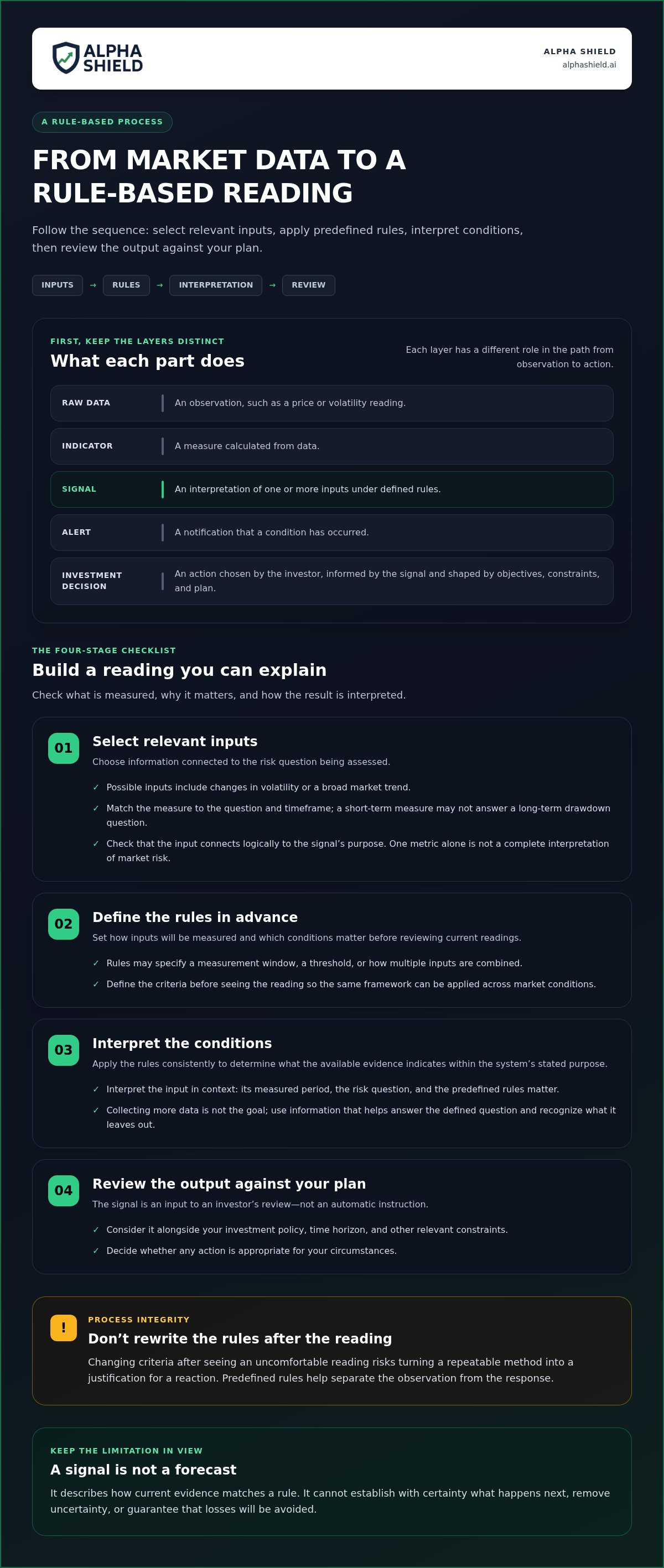
Several related terms describe different parts of this process. Raw data is an observation, such as a price or volatility reading. An indicator is a measure calculated from data. A signal interprets one or more inputs under defined rules. An alert notifies someone that a condition has occurred. An investment decision is the action an investor chooses, informed by the signal but also shaped by their objectives, constraints, and plan.
This distinction matters because a signal isn’t a forecast. It describes how current evidence matches a rule; it can’t establish with certainty what will happen next. A systematic process can organize risk information, but it can’t remove uncertainty or guarantee that losses will be avoided. The overview of systematic trading on Wikipedia provides additional context on rule-based approaches and their role in markets.
How Is a Signal Different from a Market Indicator?
An indicator is a measured input; a signal is an interpreted output. Imagine an investor monitoring a hypothetical volatility indicator. They might set a threshold and timeframe, then treat a reading above that threshold as a prompt to review risk exposure. The number is the indicator. The rule-based interpretation is the signal. This is an illustration, not a description of any specific system’s rules.
Thresholds and context determine whether an input becomes meaningful. A reading may have different implications depending on the period measured, the risk question, and the rules established in advance. Without those definitions, an indicator is information to interpret, not a complete conclusion.
Why Long-Term Investors Use Systematic Signals
For long-term investors, the challenge isn’t a shortage of market commentary. It’s assessing changing conditions without letting each headline trigger a different judgment. Rules provide a consistent reference point: if specified conditions are met, review risk; if they aren’t, continue monitoring under the same framework.
Systematic investing signals can reduce dependence on spontaneous reactions by applying an established process across market environments. They don’t make judgment unnecessary. A signal should support an investment plan, not replace it or dictate an action without regard to an investor’s circumstances.
- Check the role: Is the output measuring, interpreting, notifying, or directing a decision?
- Identify the rule: What input and conditions produce the signal?
- Respect uncertainty: Treat the output as evidence for risk assessment, not certainty about future returns.
How Systematic Investing Signals Turn Market Data into a Rule-Based Reading
A systematic process turns observations into a defined reading through a sequence. The sequence should be clear enough that you can explain what is measured, why it matters, and how the output is interpreted. Without those connections, a signal may look precise while offering little useful context.
A signal-to-decision process selects relevant inputs, applies predefined rules, interprets the resulting conditions, and gives the investor an output to review against their plan. Each stage has a distinct job:
- Select inputs. Choose information related to the risk question, such as changes in volatility or a broad market trend.
- Define rules. Establish how the inputs will be measured and which conditions matter before reviewing current readings.
- Interpret conditions. Apply the rules consistently to determine what the available evidence indicates within the system’s stated purpose.
- Review the output. Consider the signal alongside your investment policy, time horizon, and other relevant constraints before deciding whether any action is appropriate.
This order matters. If rules are changed after seeing an uncomfortable reading, the process risks becoming a justification for a reaction rather than a repeatable method. Predefined criteria help separate the observation from the response.
From Market Inputs to a Defined Signal
Potential inputs include price trends, volatility measures, and broader market conditions. Selection depends on the question being assessed and the timeframe involved. A measure suited to short-term fluctuations may not answer a long-term drawdown question. And one metric, viewed alone, does not provide a complete interpretation of market risk. The input must connect logically to the signal’s purpose.
For example, a system designed to monitor broad market stress might consider inputs that reflect market movement or changing volatility. The goal isn’t to collect the most data. It’s to use information that helps answer the defined question, while recognizing what that information leaves out.
Rules, Thresholds, and Signal Interpretation
Rules specify how inputs map to a signal state. They may define a measurement window, a threshold, or how multiple conditions are combined. Once set, the same criteria can be applied as readings change, reducing the influence of whichever headline happens to dominate attention that day.
Illustrative example only: If a hypothetical volatility measure rises above a predefined threshold for a specified observation period, the system could flag conditions for a risk review. If it remains below that threshold, the system could produce a different reading. The threshold is a decision convention, not proof that a market decline will follow or that risk has passed.
Systematic investing signals are most useful when their inputs, rules, and intended interpretation are understandable together. You can then review the output as structured evidence, not as an instruction detached from your objectives. For an example of a signal and dashboard focused on market-risk monitoring, explore Alpha Shield’s risk-monitoring approach.
How to Assess Systematic Investing Signals Without Confusing Them with Forecasts
A signal can bring structure to market evidence, but the label alone doesn’t establish its quality. Assess what it measures, how its rules work, and what conclusions it can reasonably support. Headline-driven commentary often emphasizes the latest event. Discretionary opinion may draw on experience, but different observers can interpret the same conditions differently. A systematic method offers predefined criteria, though its output still depends on the relevance of its inputs and the limits of its design.
Start by separating three things: evidence is what the system observes, interpretation is how its rules classify that evidence, and uncertainty is what remains unresolved.
Signal, Forecast, or Alert: What Is the Difference?
A signal is a structured reading of available information under defined rules. An alert is a notification that a condition has occurred; it may simply report an event without interpreting its significance. A forecast goes further by making a claim about a future outcome. These terms aren’t interchangeable. A risk signal may flag a condition for review without asserting that a decline will happen.
| Category | What it provides | What remains uncertain |
|---|---|---|
| Evidence | Observed data or a measured input | Whether it captures all relevant conditions |
| Signal | A rule-based interpretation of evidence | How conditions may develop next |
| Alert | A notice that a specified event occurred | What the event means for an investor |
| Forecast | A claim about a possible future outcome | Whether that outcome will occur |
What Makes a Signal Transparent and Testable?
Look for a clearly stated purpose, inputs that relate to that purpose, and rules that can be applied consistently. The method should also explain its timeframe and acknowledge false signals, gaps in its data, or conditions it may not capture. If the rationale is opaque, it’s difficult to judge whether the output answers the risk question that matters to you.
Historical or backtested results can show how rules behaved against past data, but they can’t establish how the same approach will perform in different conditions. Markets change, and past observations don’t contain every future scenario. Historical performance describes what a method did under past conditions; it cannot guarantee what it will do next.
To assess systematic investing signals, separate the observed input from the rule-based conclusion, then identify what the conclusion does not tell you. Ask whether the purpose is specific, whether the input logic is understandable, and whether the rules are applied consistently. Treat strong claims about certainty with care. A transparent signal supports risk assessment; it doesn’t remove uncertainty or replace an investment plan.
A Practical Checklist for Reading Systematic Investing Signals
A signal is one input to a disciplined review, not a complete portfolio plan. Before responding, test the reading against a consistent checklist. This pause helps separate useful risk information from the pressure of a dramatic headline or an unfamiliar market move.
Questions to Ask Before Acting on a Signal
Start with the signal’s stated purpose. Then check whether its timeframe fits your investment horizon and whether its inputs relate to the condition it claims to monitor. A reading designed to flag short-term market stress may not, by itself, answer a question about a long-term portfolio. Identify what the signal leaves out before deciding how much weight to give it.
- Purpose: What market condition is this signal designed to identify? Is that relevant to the risk you’re assessing?
- Timeframe: What period does it measure, and does that match your investment horizon?
- Inputs: What data informs the reading? Do those inputs relate clearly to its stated purpose?
- Rule changes: Have the criteria changed? If so, what changed and why? A methodology shift can affect how you interpret readings over time.
- Limitations: What does the signal not measure or claim to predict? Does it acknowledge uncertainty and the possibility of misleading readings?
Keeping Signal Readings in Portfolio Context
Monitoring is an observation. A portfolio change is a decision. One signal reading shouldn’t automatically determine that decision because it may not account for your asset allocation, cash needs, time horizon, or investment policy. Compare the signal with the principles you set before market conditions became stressful, rather than letting headlines redefine your plan.
Keep a brief decision record: note the signal, the relevant policy rule, your reasoning, and any action taken or deliberately avoided. Reviewing that record later can show whether decisions followed a consistent process or were driven by pressure in the moment. It also helps distinguish a change in market evidence from a change in your own criteria.
For additional context, an article on market crash early warning indicators can help explain what different risk measures may reveal, while an evidence-based market timing guide can broaden the discussion of how timing decisions fit into an investment approach. Treat either as context, not a substitute for assessing a signal’s purpose, rules, and limits. A sound checklist keeps the focus on the decision process, not the urgency of the latest commentary.
Use systematic investing signals as structured information to review against your policy. A reading may prompt closer attention, but it doesn’t settle what your portfolio should do. The decision remains yours, guided by your objectives and the rules you’ve chosen to follow.
How Alpha Shield Applies Systematic Investing Signals to Risk Monitoring
Alpha Shield’s market signal and dedicated dashboard support systematic risk monitoring. The service helps investors monitor market risk and manage potential drawdowns, with a focus on long-term capital preservation. Its purpose is to support disciplined awareness. A signal can help organize a response to changing conditions, but it can’t predict every downturn, prevent every loss, or guarantee an investment outcome.
This distinction shapes how to use the information. A market-risk reading can prompt you to review conditions against an established investment policy. It isn’t, by itself, a command to trade or a personalized assessment of what a particular portfolio should do. Alpha Shield focuses on long-term risk monitoring, not day trading, shorting, or individual stock selection.
What a Market Signal Dashboard Can Make Easier to Monitor
A dedicated dashboard brings a signal into view in a clear format. Instead of relying only on scattered market commentary, you can consult a defined risk-monitoring reference as part of a regular review. The benefit is a consistent point of attention, not a guarantee that every relevant risk is captured or that a particular response is right for every investor.
Monitoring and trading are different activities. A signal can inform awareness and support a deliberate review; it doesn’t automatically determine a transaction. Consider the reading alongside your objectives, time horizon, and policy. The article on protecting wealth in volatile markets offers a related case-study perspective on keeping risk awareness connected to longer-term discipline.
Where Systematic Risk Monitoring Ends
No signal removes market risk or ensures a particular result. Conditions can change in ways a method does not capture, and a reading may not align neatly with the needs of an individual portfolio. Systematic monitoring provides general market-risk information. It isn’t individualized financial advice, and it can’t account for every investor’s circumstances or constraints.
That boundary is useful. It keeps the signal in its proper role: a structured reference for monitoring conditions and reviewing risk, rather than a promise or a substitute for an investment plan. Ask what the reading indicates, what it leaves uncertain, and whether any response fits the policy already in place.
Alpha Shield’s market signal and dashboard are designed for this risk-monitoring approach. They offer a way to follow market conditions with a long-term capital-preservation focus, while leaving investment decisions in the context of each investor’s own plan.
Make Your Next Market Review More Deliberate
Your next step can be simple: decide in advance how you’ll respond when market conditions change. Write down what deserves a closer review, which parts of your investment policy guide that review, and what information you’ll need before considering a portfolio adjustment. This creates a process you can return to when headlines are urgent and emotions are elevated.
Use systematic investing signals as one source of structured information, not as a substitute for your objectives or judgment. The goal isn’t to react to every reading. It’s to approach risk with a steadier framework and make deliberate choices that fit your long-term priorities.
Explore Alpha Shield’s approach to systematic market-risk monitoring and long-term capital preservation.
Stay patient, keep your process clear, and let discipline guide the next decision.
Frequently Asked Questions
Can systematic investing signals predict a market crash?
No. They can identify market conditions that a defined method treats as elevated risk, but that isn’t the same as knowing a crash will happen. A signal may change before, during, or after a decline, and markets can fall for reasons the method doesn’t capture. Use a risk reading to inform preparedness and review your portfolio plan, not to assume a specific event or date is certain.
Are systematic investing signals the same as buy and sell alerts?
No. A buy or sell alert typically points toward a transaction, while a systematic signal may report a market condition for broader risk review. The distinction depends on what the output is designed to communicate. For instance, a risk-monitoring reading might prompt you to revisit your allocation rules without telling you which security to trade. Check whether an output provides market context, an alert, or an explicit transaction instruction.
Do systematic investing signals work in every market environment?
No method should be assumed to behave equally well under all conditions. A system built around one set of market relationships may be less informative if those relationships shift or an unusual event affects markets in an unexpected way. Consider whether the method’s stated scope fits the conditions you’re evaluating. Keep a separate plan for liquidity needs and portfolio constraints rather than relying on one reading to cover every scenario.
How often do systematic investing signals change?
There’s no universal schedule. A signal may update on a set interval or change when its defined conditions are met, depending on the system. These are different design choices: frequent updates can reflect short-term movement, while less frequent readings may filter some day-to-day fluctuations. Review the signal’s stated update cadence and the period its inputs cover, so you don’t mistake a new reading for a long-term trend.
Can investors combine systematic signals with fundamental analysis?
Yes. The two approaches can address different questions. A systematic signal may help monitor broad market risk, while fundamental analysis examines factors such as a company’s financial condition, competitive position, or valuation. Keep their roles distinct. For example, a market-risk reading might prompt a portfolio-level review, while company research informs a separate decision about an individual holding. Neither input should be treated as a substitute for your investment criteria.
Do systematic investing signals guarantee protection from losses?
No. No signal can remove market risk, ensure a particular result, or prevent every drawdown. A systematic process can help investors monitor specified conditions and apply a consistent review framework, but the output may be incomplete or arrive after markets have moved. Treat it as one risk-management input. Maintain a portfolio plan that reflects your own time horizon, liquidity requirements, and ability to tolerate losses.


