

What if the biggest risk in a volatile market isn’t the price swing, but the decision it provokes? Market declines and conflicting headlines can change how investors assess risk, especially when fear of loss is high. That’s why investor psychology in volatile markets matters: a short-term reaction can quickly become a portfolio decision.
When prices move sharply, it’s natural to seek certainty or act quickly. But a decision made to ease anxiety may look different once conditions change. A defined process helps separate an emotional response from a deliberate investment choice. For example, writing down what changed and checking it against your plan can make it easier to distinguish new information from a strong reaction to a market move.
This guide explains common behavioral biases that can surface during volatile periods and offers a practical way to separate market information from noise. You’ll also learn how systematic market information can complement, rather than replace, a long-term investment process. Alpha Shield’s Market Signal and Dashboard provide market-risk and market-health indicators that investors can use as reference points, without promising certainty or guaranteed protection.
Key Takeaways
- Recognize how rapid price changes can make uncertainty feel urgent and pull attention away from a long-term plan.
- Understand how investor psychology in volatile markets can amplify loss aversion and other biases without determining how you’ll act.
- Use a deliberate review process to assess new information while staying aligned with your considered framework.
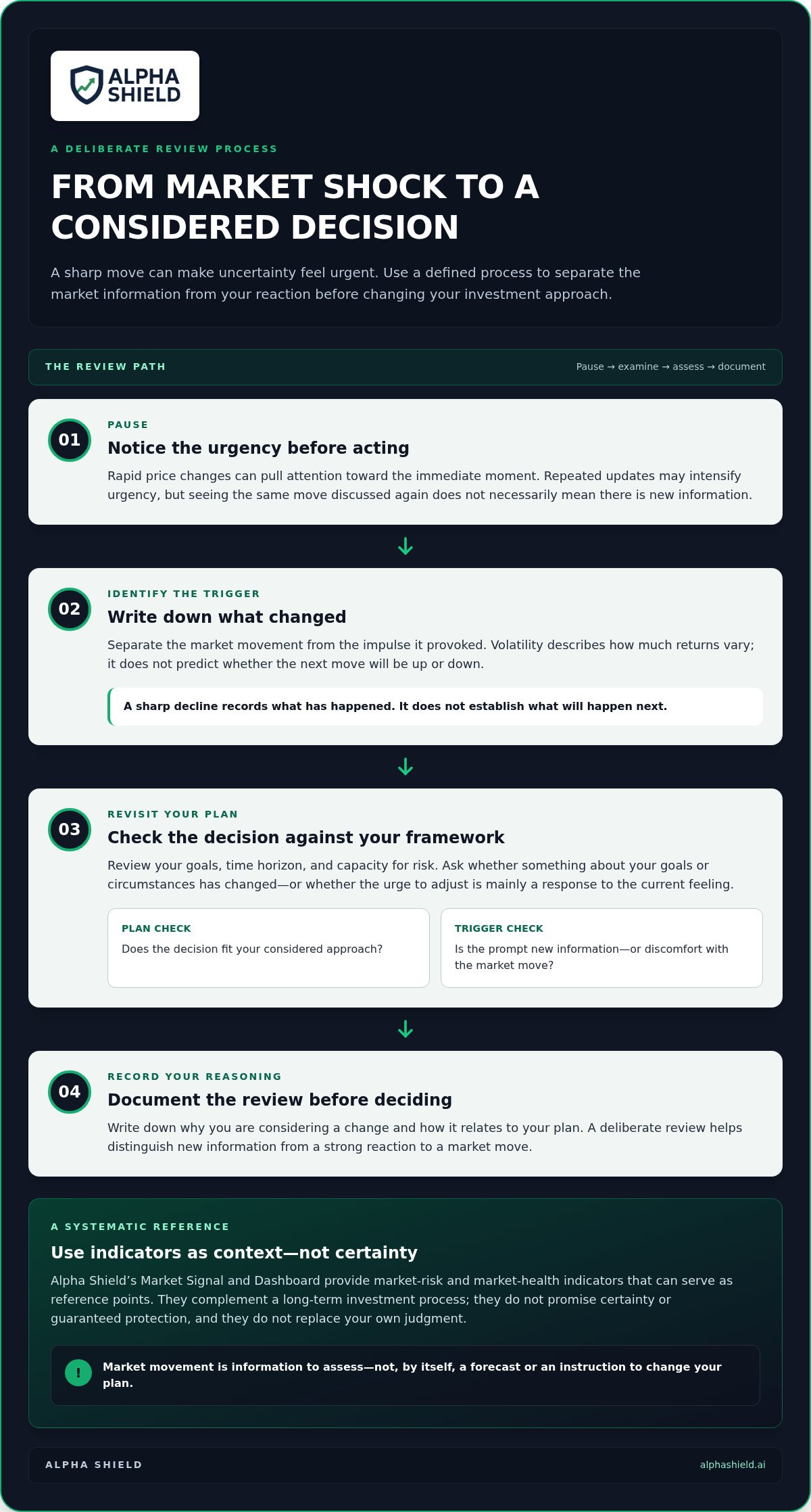
- Build a simple routine: pause, identify the trigger, revisit your plan, and record your reasoning before making a decision.
- Use Alpha Shield’s market-risk signal and dashboard indicators as a systematic reference, not a guarantee against losses or a substitute for your own judgment.
Why investor psychology becomes harder to manage in volatile markets
Investor psychology describes the emotions, beliefs, and biases that influence investment decisions. It helps explain why two investors can see the same market decline and respond differently. One may review their plan and continue to follow it. Another may feel compelled to change course immediately, even if their goals and circumstances haven’t changed.
Volatility can make uncertainty feel urgent. A long-term plan asks you to consider goals, time horizon, and capacity for risk. A sharp price move directs attention to what’s happening now. The immediate movement can feel more concrete than a distant objective, especially when portfolio values are changing quickly. This is one reason investor psychology in volatile markets deserves attention: discomfort is a feeling, but a change to portfolio risk is a decision.
Feeling uneasy doesn’t automatically mean you’re acting irrationally. The key question is whether that discomfort is prompting a change to your plan without a considered review. Behavioral finance examines how psychological influences can shape decisions, including when people don’t act as the fully rational decision-makers assumed by some models. Behavioral finance and investor psychology offers a broader overview of this field.
What happens psychologically when markets move sharply?
When prices fall quickly, potential losses can take up more mental space than other information. You may check account balances more often, focus on near-term movements, or search for explanations that promise certainty. Repeated updates can intensify that sense of urgency. Seeing the same price change discussed in several headlines, however, doesn’t necessarily provide new information that should change your decision.
Consider an investor with a long-term plan who sees a sudden decline in their portfolio’s value. They may begin reconsidering the plan, even though their goals and time horizon are unchanged. The market movement is real; the impulse to make an immediate adjustment is a separate response. Pausing to identify that difference can help prevent a feeling from becoming an unexamined portfolio decision.
Why volatility is not the same as a forecast
Volatility describes how much returns vary over a period. It doesn’t, by itself, say whether the next move will be up or down. A sharp decline records what has happened; it doesn’t establish what will happen next. Nor does pronounced price movement guarantee a particular outcome for an investor. Future results depend on what markets do next and on an investor’s circumstances and decisions.
Volatility measures variation in returns; it does not predict their direction. Keeping that distinction clear can prevent an observed market move from being mistaken for a reliable forecast. It doesn’t mean ignoring new information. It means assessing information on its merits instead of treating urgency, repetition, or dramatic wording as proof of what comes next.
How behavioral biases can shape investor decisions during volatility
Behavioral biases are tendencies that can influence judgment. They aren’t diagnoses, and they don’t determine how any one person will respond. Recognizing a bias can help you notice when a decision may be shaped by a mental shortcut rather than by your stated goals or decision process. In investor psychology in volatile markets, that distinction matters because the same market movement can prompt different actions for different people.
Loss aversion and the urge to avoid further losses
Loss aversion describes a tendency for potential losses to feel more significant than comparable gains. A possible loss may carry more psychological weight than an equivalent gain, though investors don’t all respond to it in the same way. Under pressure, one investor may sell quickly to stop further discomfort. Another may avoid making any decision, even when reviewing the portfolio would be reasonable. Neither response follows automatically from a decline. The bias can influence how a choice feels, but it doesn’t dictate what an investor does.
For example, an investor sees a holding fall in value and focuses on how much more could be lost if prices keep dropping. The question can shift from “Does my plan still fit my circumstances?” to “How can I avoid feeling this loss grow?” That shift can narrow attention to immediate relief. Pause to name the decision you’re considering, then ask whether it follows from a change in your goals or capacity for risk, or mainly from a desire to escape the current feeling.
Recency bias, herd behavior, and headline-driven decisions
Recency bias gives recent events more influence than a broader record may justify. After several sharp market moves, you may start treating the latest pattern as a guide to what is likely next. That can lead to changing a long-term approach based on a short stretch of performance. Recent information can matter, but its recency alone doesn’t establish that it should override an existing plan.
Herd behavior adds social pressure. If a reaction appears popular, following it can feel safer than making an independent assessment. Headlines and crowd commentary may reinforce that impulse, especially when they present one interpretation as obvious. Yet a widely repeated response isn’t necessarily aligned with your goals, time horizon, or risk tolerance.
A process-based review gives you a useful alternative. Instead of asking only what the market or crowd is doing, ask: What has changed in my circumstances? Which part of my stated plan applies here? Is this information new and relevant, or simply recent and attention-grabbing? These questions don’t dictate a trade. They help separate evidence from influence before you decide whether a portfolio review is warranted.
For a consistent market-risk reference alongside your own review, explore the Alpha Shield Market Signal. It provides a systematic reference, not a guarantee against losses or a substitute for individual judgment.
Emotion-driven reactions versus a disciplined investment process
A disciplined process doesn’t require you to ignore new information or suppress every emotional response. It gives you a consistent way to assess what has changed, whether it matters to your plan, and whether a review is warranted. In investor psychology in volatile markets, that structure helps separate a strong reaction from a considered decision.
It can help to look at the same event in three stages: the trigger, the review, and the process used to reach a decision.
| Emotional trigger | Deliberate review | Decision process |
|---|---|---|
| A headline predicts a sharp market downturn, prompting an urge to act immediately. | Identify what the headline reports, what is interpretation, and whether it introduces information relevant to your circumstances. | Apply the criteria in your investment plan. If the information meets a pre-defined review condition, reassess deliberately. If not, avoid changing the plan solely to relieve urgency. |
| A portfolio moves outside an investor’s comfort zone, creating pressure to make a quick adjustment. | Review the original assumptions, goals, time horizon, and capacity for risk. Note whether any of these have actually changed. | Document the reason for reviewing and the considerations behind any decision. This makes the process easier to evaluate later, regardless of the market’s next move. |
How to distinguish a market signal from market noise
Market noise attracts attention but doesn’t necessarily change the framework for a decision. A useful signal has a stated method and a defined role in your review. For example, it may prompt you to examine risk, but it shouldn’t be mistaken for certainty about what markets will do next. No single indicator can predict every turn.
A disciplined process needs more than a compelling headline or a striking number. Ask: What does this information measure? How does it fit into my review criteria? What decision, if any, is it meant to inform? The answers help keep commentary separate from evidence relevant to your plan. This systematic risk mitigation framework also offers context for thinking about risk as a process rather than a one-off reaction.
Why long-term plans still need deliberate review
A long-term horizon isn’t a reason to disregard changed circumstances. Goals, cash needs, time horizon, or tolerance for risk may shift. Assess those changes deliberately instead of treating every market headline as a reason to reconsider your portfolio.
Scheduled reviews create a predictable opportunity to check whether your plan still fits. Between reviews, a pre-set criterion can flag when new information deserves attention. This preserves room to respond without making every price movement a decision point. If you’re considering a systematic approach to market timing, assess how its rules differ from reacting to short-term sentiment, without assuming that any method removes uncertainty.
A practical routine for managing investor psychology in volatile markets
A repeatable pause can turn a moment of pressure into a structured review. The purpose isn’t to suppress emotion or decide what to buy or sell. It’s to slow the path from market event to portfolio decision, then check whether the decision fits your objectives and rules.
Pause, name the trigger, review your plan, and record why a decision may or may not be warranted.
A four-step pause before changing an investment decision
- Name the event. Write down what happened in observable terms, such as a reported market decline or a change in personal circumstances. Separate that fact from interpretations about what might happen next. This reduces the chance that a dramatic prediction is mistaken for an established outcome.
- Identify your response. Note the emotion or bias that may be influencing your immediate thinking. Is the pressure coming from fear, urgency, or a desire to follow what others are doing? Naming the influence doesn’t invalidate your concern. It makes the source of the pressure easier to assess.
- Compare the idea with your plan. Review the objectives and decision rules you set before this event. Ask whether the proposed change fits those criteria, or whether it is mainly an attempt to relieve discomfort. Consider your own circumstances rather than treating a general routine as a substitute for personal judgment.
- Record and revisit. Briefly document the information considered, the reason for review, and the conclusion reached. Revisit it according to your established process rather than repeatedly reopening the decision in response to each new headline.
What to review when market conditions change
A long-term plan still needs review when its underlying assumptions may no longer fit. Reconsider the time horizon for the money, the purpose of the investment, and whether your goals or capacity to accept risk have changed. A personal event, such as a changed income need or a revised timeline, may be more relevant than a headline alone.
Check whether the plan’s risk assumptions remain understandable and workable for you. Diversification may spread exposure across different investments, but it doesn’t eliminate volatility or prevent losses. Treat it as one part of a broader risk approach, not a guarantee of a particular outcome.
If a decision depends on your specific financial situation, tax considerations, or future needs, qualified financial advice can help you assess those factors. A general educational routine cannot determine the right choice for an individual investor.
How Alpha Shield can add a systematic reference to volatile-market decisions
Investor psychology in volatile markets can make each headline feel like a new instruction. A systematic reference offers another input: a structured view of market risk to consider alongside your objectives and established review process. Alpha Shield Market Signal is designed to help investors identify higher-risk periods. It doesn’t guarantee protection from losses, predict every decline, or determine the right decision for an individual investor.
What a systematic market signal can and cannot do
A market signal can serve as an additional reference for assessing conditions. Its value is in providing a consistent point of information to consider, not certainty about what happens next. Market conditions can change, and no signal can eliminate uncertainty or guarantee capital preservation. The signal also isn’t individualized financial advice. You still need to assess your circumstances, goals, and the role any information should play in a decision.
This distinction matters. A risk-monitoring reference can inform a review; it shouldn’t be treated as a command to buy or sell. Alpha Shield focuses on systematic market-risk monitoring and long-term capital preservation, not day-trading tools, shorting strategies, or individual stock recommendations.
Using a dashboard without replacing an investment plan
The Alpha Shield Dashboard displays market-health indicators for monitoring higher-risk periods. You can consider those indicators during a regular review, alongside your plan, rather than relying on whichever headline feels most urgent. The dashboard is one reference point, not a replacement for an investment plan or a source of personalized instructions.
Keep the roles clear by asking:
- What market-health information does the dashboard present?
- How does this information fit with the objectives and assumptions in my plan?
- Does it warrant a deliberate review under my decision process, or am I reacting to short-term pressure?
- What uncertainty remains, even after considering the signal?
These questions don’t prescribe a portfolio action. They help keep market-risk information separate from your personal decision, while making room to review relevant new evidence. A dashboard cannot determine whether your circumstances have changed, and it can’t ensure a particular investment outcome. Its role is to provide market-health indicators that can support a more systematic review.
For a structured reference to consider as part of your own process, explore Alpha Shield Market Signal.
Make your next market decision more deliberate
Turn awareness into a repeatable habit. Decide in advance what deserves a review, what information you’ll consider, and how you’ll record your reasoning. This structure won’t remove uncertainty, but it can help keep uncertainty from setting the decision process for you.
Investor psychology in volatile markets is easier to manage when reflection has a place in your routine, rather than being left to the most stressful moments. Review your process after the pressure has passed. Notice what helped you stay aligned with your objectives and where headlines or urgency pulled your attention off course. Then refine your framework for the next review.
Alpha Shield was founded by former investment bankers and global-markets professionals with over 50 years of combined experience. System development began in 2017, and Alpha Shield launched in 2019. Its market-health indicators can serve as one systematic reference within your broader decision process, without replacing personal judgment or guaranteeing an outcome.
Build your process one considered decision at a time. Explore Alpha Shield Market Signal and Dashboard as a systematic reference for monitoring market risk.
Frequently Asked Questions
Is market volatility normal, or does it always signal a market crash?
Market volatility is a normal feature of investing, and it doesn’t always mean a crash is coming. Prices can fluctuate as investors respond to changing expectations, economic information, and other market conditions. A period of movement is an observation, not proof of a future decline. A sudden drop may be a reason to review relevant information, but it can’t by itself establish that a crash will follow.
Why do investors make emotional decisions during volatile markets?
Uncertainty can make financial choices feel more consequential and immediate. Investors may focus on protecting what they have, seek reassurance from others, or struggle to assess conflicting information. Personal circumstances matter too: someone who expects to need funds soon may experience a market decline differently from someone investing toward a distant goal. Recognizing the pressure behind a decision can help clarify whether it reflects a considered need or a momentary reaction.
What is loss aversion in investing?
Loss aversion is a tendency to give a potential loss greater psychological weight than a comparable potential gain. An investor who bought an asset at a particular price, for instance, may treat that purchase price as a reference point and find a decline especially difficult to accept. That feeling can affect judgment, but it doesn’t dictate a specific action. People vary, and the importance of a decision depends on how it fits their circumstances and objectives.
Should I sell investments when the market becomes volatile?
Volatility alone isn’t enough to determine whether selling is suitable for you. Consider why you’re thinking about selling, whether your financial needs or goals have changed, and what your existing decision framework says. The implications may also depend on the investment and your personal tax situation. If you’re uncertain how those factors apply to you, a qualified financial professional can help assess your individual circumstances.
Can investor psychology be managed with a rules-based process?
A rules-based process can help manage investor psychology by setting out how decisions will be reviewed before pressure rises. For example, you might define which personal changes warrant a plan review and keep a written record of the reasons for reassessment. Rules shouldn’t be treated as unchangeable: if an assumption no longer fits, review it deliberately. The aim is consistency, not following a framework that no longer reflects reality.
Does a market signal guarantee protection from a market crash?
No market signal can guarantee protection from a crash or prevent investment losses. Alpha Shield Market Signal is designed as a systematic reference to help investors identify higher-risk periods, while the Alpha Shield Dashboard presents market-health indicators for risk monitoring. These tools don’t remove uncertainty or provide individualized financial advice. Treat signal information as one input for your own review, not as a promise about future market conditions or investment outcomes.


